How to Price Snow Removal: Per-Push, Seasonal and Per-Inch Pricing (Plus a Free Estimate Form)
How to price snow removal: per-push vs seasonal contract vs per-inch pricing, driveway size tiers, sidewalks and salting add-ons, commercial lots, minimums and deposits, with a worked quote example and a free printable snow removal form.
Why snow removal pricing is tricky
Snow removal is the only service business where you do not know how much work you sold until the season is over. A mild winter and a brutal one can differ by many storms, and your price has to make sense in both. Price too low on a seasonal contract and a heavy winter turns your route into unpaid labor. Price per visit without a clear trigger and customers argue about every half inch. The fix is to pick a pricing model on purpose, measure every property the same way, and put the trigger depth, the clearing standard and the add-ons in writing before the first storm.
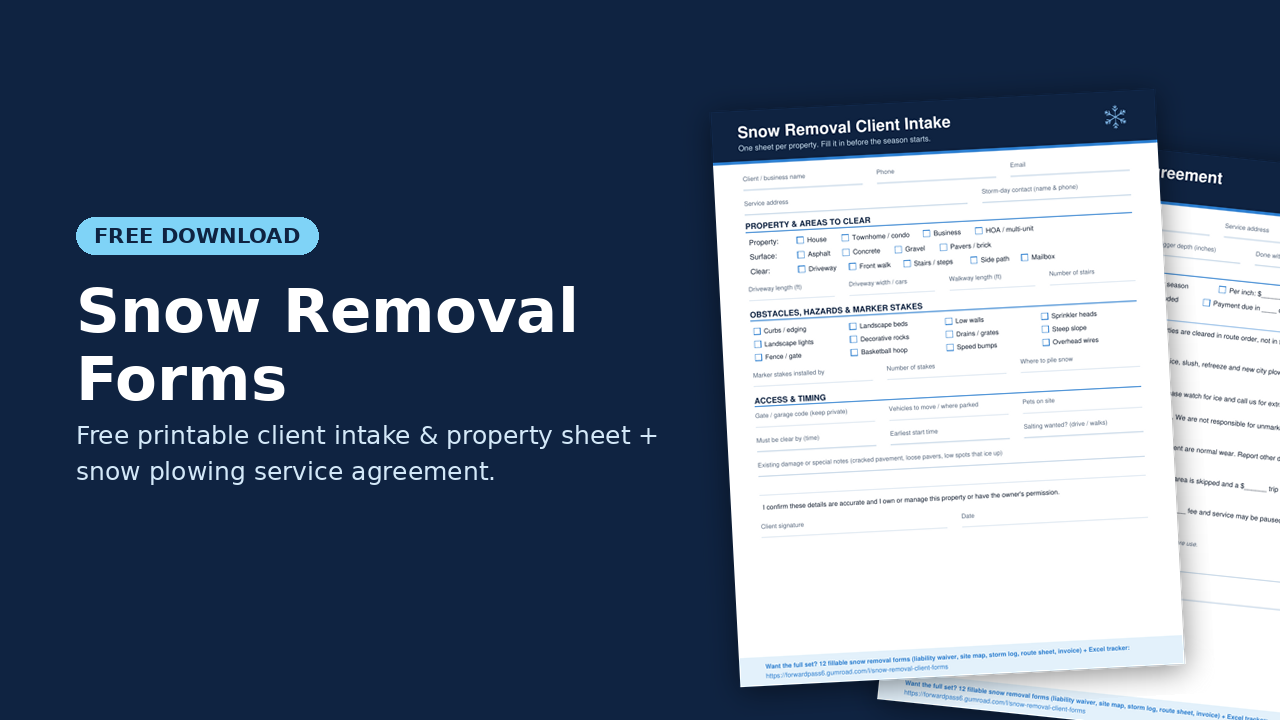
Free Snow Removal Forms
A printable client intake & property sheet plus a simple snow plowing service agreement for plowing and shoveling businesses.
Download free →1. Choose a pricing model: per push, seasonal or per inch
Most snow removal operators use one of three models, and many offer two so customers can choose:
- Per push (per visit): the customer pays a set price each time you clear the property after snowfall reaches the trigger depth. Simple and fair to both sides, and it pays you more in heavy winters. The downside is uneven cash flow and customers who skip light storms.
- Seasonal contract (flat rate): the customer pays one price for the whole season, often in installments, no matter how many storms there are. You get predictable income and easy route planning; the customer gets a known budget. Protect yourself with a push cap (for example, a set number of visits included, with extra visits billed per push) or a clause for storms above a set depth.
- Per inch (depth tiers): the price rises with snowfall, for example one price for the trigger depth up to a middle tier, a higher price for the next tier, and so on. This matches price to effort, since deep, heavy snow takes longer, but it requires you to record snowfall for every visit.
Whatever you pick, define the trigger depth (the snowfall at which you come out) and how depth is measured, because that single line prevents most billing disputes.
2. Price driveways by size tiers
Residential driveways are easiest to price in tiers instead of measuring square feet for every quote. A common approach:
- Small: single-car width, short length
- Medium: two-car width or a longer single lane
- Large: three-car width, long or circular driveways, or ones with turnarounds
- Extra large or difficult: steep slopes, gravel surfaces, tight spots where snow has nowhere to go, or long rural drives
Write down the tier, the approximate size and anything that slows you down (cars parked in the drive, narrow gates, no place to pile snow, landscaping or stakes to avoid). Adjust the tier price up for difficulty instead of inventing a new rate every time. A property sheet recorded on the first visit becomes the basis for every quote that follows.
3. Sidewalks, steps and salting as add-ons
Keep the driveway price clean and itemize everything else so customers can choose:
- Front walks and sidewalks: by length or as a flat add-on per visit; note whether the city requires public sidewalks cleared by a deadline
- Steps, porches and decks: usually shoveled by hand, so they take time; price per visit
- Salting or ice melt: per application, with the product cost built in; say whether you apply it automatically or only on request
- Roof raking, hydrant or mailbox clearing, or snow relocation: priced separately or by the hour
Itemizing also helps you upsell: many customers decline salting on the quote and then call for it after the first freeze.
4. Commercial lots are a different job
Parking lots, storefronts and apartment complexes are usually priced by the hour per piece of equipment, per push by lot size, or on a seasonal contract, with salting priced per application or per ton of material. Commercial customers expect tighter clear-by times (before opening), detailed service logs, proof of insurance and clear rules for snow stacking and haul-away. Before quoting, walk the lot, map the islands, drains, curbs and pile areas, and estimate the time per push with the equipment you actually own. Liability is higher on commercial sites, so many operators require a written agreement that limits their responsibility for ice that forms after service.
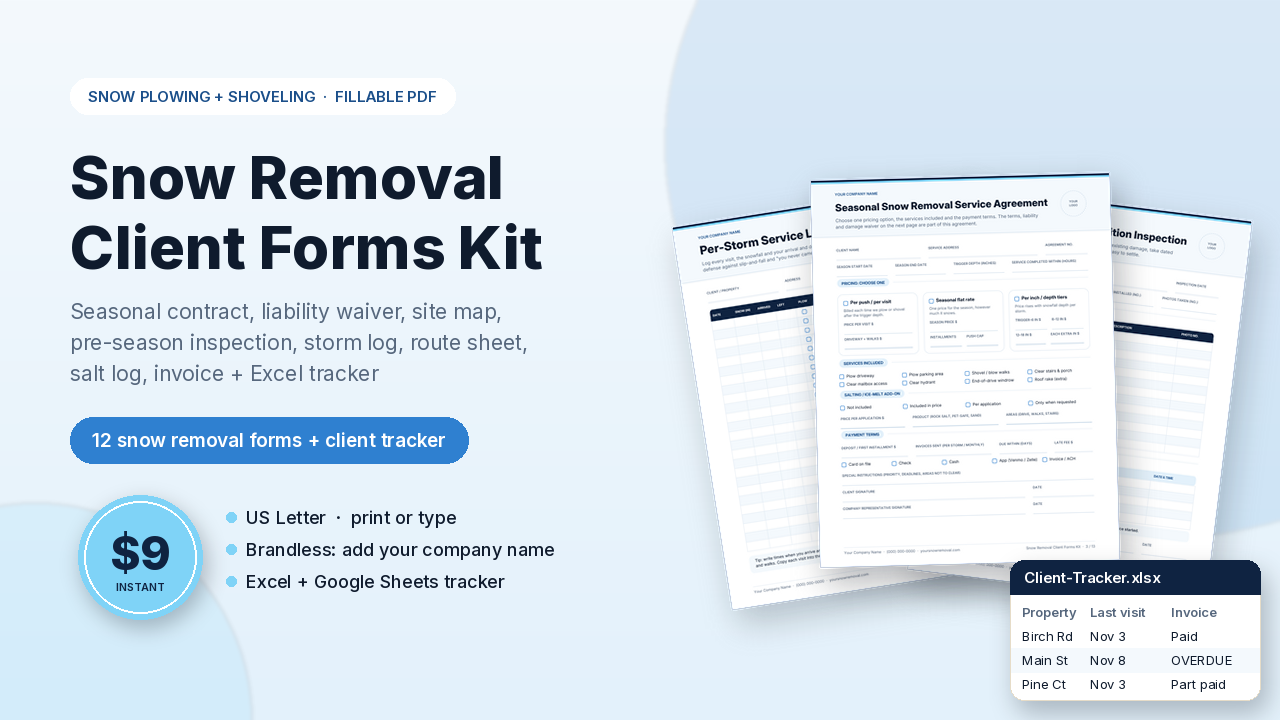
Snow Removal Client Forms Kit
12 fillable forms (intake & property info, seasonal service agreement with per-push, seasonal and per-inch pricing, liability & damage waiver, site map, pre-season inspection, quote, per-storm service log, route sheet, salt & ice-melt log, invoice, damage report, renewal) plus an Excel client tracker.
Get it →5. Minimums, deposits and payment terms
Every visit costs travel and setup time, so set a minimum charge per visit for small properties. For seasonal contracts, many operators collect a deposit or first installment when the customer signs, which reserves a spot on the route before the first storm, and schedule the rest in monthly installments during the season. For per-push customers, decide whether you bill after each storm, weekly or monthly, and whether you keep a card on file. Write the deposit, the installment dates, the late fee and what happens to the deposit if the season is light, so nobody is surprised.
A worked quote example
Here is how an itemized snow removal estimate fits together. The rates below are example numbers only to show the math, not real market prices or statistics; use your own costs and local market.
- Medium driveway, per push: example rate $50 per visit
- Front walk and steps add-on: example rate $15 per visit
- Salting add-on: example rate $20 per application
- Per-push total per visit (driveway + walk): $65, plus $20 when salting is applied
Now compare a seasonal offer for the same property. Say you expect around 10 visits in an example season and want a seasonal price that includes up to 12 pushes: 10 × $65 = $650, so you might offer an example seasonal price of $700 paid in 4 installments of $175, with pushes above 12 billed at the $65 per-push rate and salting billed per application. The customer sees both options on one estimate and picks the one that fits their budget. With a per-inch model you would instead list tiers, for example $50 for 2–6 inches and $75 for 6–12 inches, with deeper storms quoted separately.
6. Track every storm so you can defend every invoice
The best protection against billing arguments and slip-and-fall claims is a record. For each storm, log the date, snowfall, arrival and departure time, what you did (plow, shovel, salt) and how much salt you used. A per-storm log and a route sheet make invoices quick, show you which properties take longer than you priced, and give you the numbers to set next season's rates. At the end of the season, send a renewal form while the customer still remembers you showed up at 5 a.m.
A note on insurance, liability and local rules
This guide is educational, not legal or insurance advice. Snow and ice work carries real liability risk. Check what business licenses, liability and commercial auto insurance your state and city require, learn your local sidewalk clearing rules, and have a professional review your service agreement and liability waiver.
FAQ
How do you price snow removal?
Pick a pricing model (per push, seasonal flat rate or per inch), sort driveways into size tiers, adjust for difficulty, and itemize walks, steps and salting as add-ons. Set a trigger depth, a minimum charge per visit and clear payment terms, and put all of it on a written estimate.
Is per-push or seasonal snow removal pricing better?
Per-push pricing pays you for every visit and suits areas with unpredictable winters, but cash flow is uneven. Seasonal contracts give you predictable income and the customer a known budget; protect yourself with a push cap or a clause for very deep storms. Many operators offer both and let the customer choose.
What is a trigger depth in snow removal?
The trigger depth is the amount of snowfall at which you come out to clear the property. State it in the agreement along with how depth is measured and how soon after the snow stops you will finish, because it prevents most billing disputes.
Should salting be included in the snow removal price?
Most operators price salting or ice melt separately, per application, so the material cost is covered and customers can choose. State whether you apply it automatically after each storm or only on request.
Should I charge a deposit for a seasonal snow removal contract?
Many operators collect a deposit or first installment when the customer signs to reserve a spot on the route, with the balance in scheduled installments. Write the deposit amount, installment dates, late fees and refund rules into the agreement.
What should a snow removal estimate include?
Customer and property details, the areas to clear and their size, the pricing model and rates, trigger depth, add-ons such as walks, steps and salting, estimated visits or the seasonal total, minimum charge, deposit and payment terms, and a signature line.
This page is general guidance, not legal, tax or insurance advice. Licensing, insurance, sidewalk clearing and contract rules vary by state and city and change over time, so check yours before you take jobs.
Related templates
Free Snow Removal Forms
A printable client intake & property sheet plus a simple snow plowing service agreement for plowing and shoveling businesses.
Download free →Snow Removal Client Forms Kit
Fillable snow removal forms plus an Excel client tracker with storm visits, salt used, invoices and OVERDUE flags.
Get it →