How to Price Christmas Light Installation: Per-Foot Pricing, Quotes and a Free Estimate Form
How to price Christmas light installation: per-linear-foot rates, lease vs purchase, minimum charges, trees, wreaths and takedown, plus a worked quote example and a free printable estimate form for holiday lighting installers.
Why pricing is the hardest part of a holiday lighting business
Christmas light installation is a short, busy season. Most of your income arrives between early November and mid-December, and every quote you get wrong eats into it. Price too low and you fill your calendar with jobs that barely cover the lights, the ladder time and the takedown trip in January. Price too high, or quote vaguely, and homeowners pick the installer whose number they understood. A simple, repeatable pricing method fixes both problems: measure the same way every time, apply the same rates, and put the result on a written estimate the customer can approve on the spot.
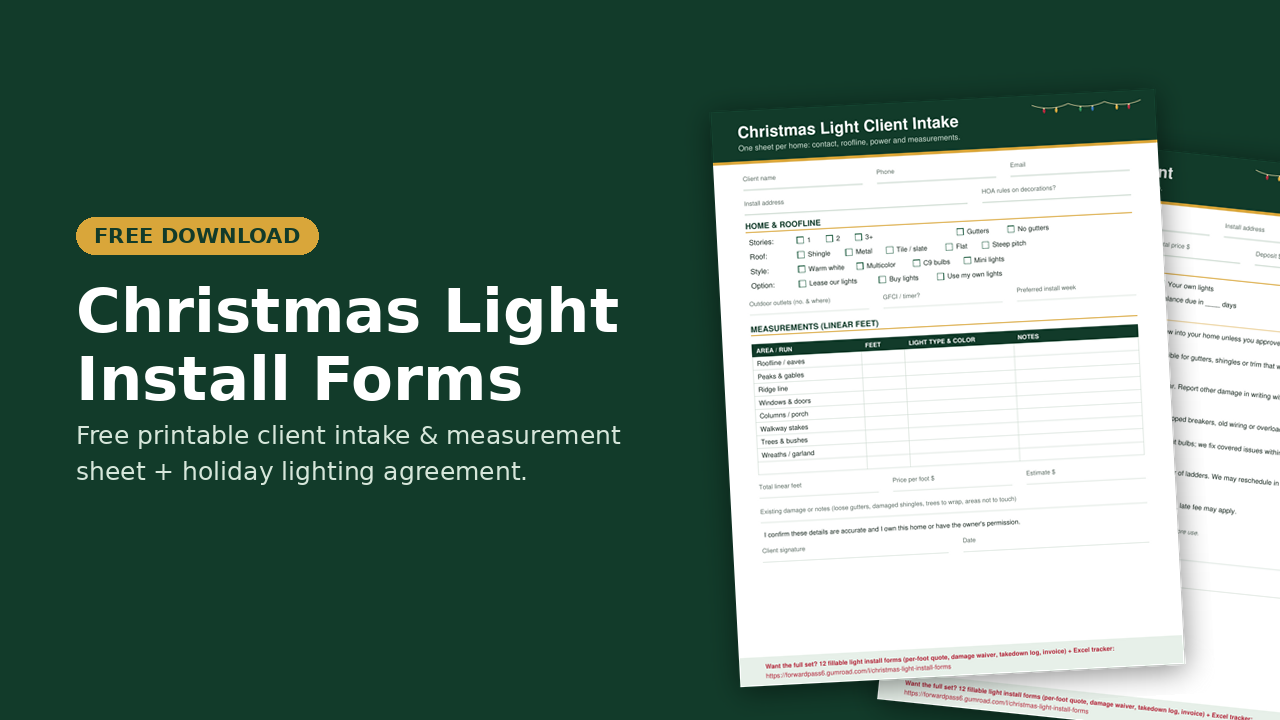
Free Christmas Light Installation Forms
A printable client intake & measurement sheet plus a simple holiday lighting agreement for Christmas light installers.
Download free →1. Measure before you quote
Almost every installer prices the main roofline by the linear foot, so accurate measurements come first. On a site visit (or from a measuring wheel and photos), record:
- Rooflines and gutters: each run in feet, with the story height (single story, two story, steep or high peaks)
- Ridges and peaks: these usually take more time and safety gear than gutter lines
- Walkways and driveways: feet of path lights or stakes
- Trees and shrubs: number, height and whether you wrap the trunk only or the trunk and branches
- Extras: wreaths, garland, window outlines, columns, railings, ground decor
- Power: location of outdoor outlets, timers, and whether you need extension runs
A measurement worksheet with a simple house sketch keeps this consistent from job to job and becomes the record you reuse next year.
2. Set a per-foot rate for the roofline
Your per-foot rate has to cover more than the lights. Build it from:
- Materials: lights, clips, extension cords, timers, and the share of reusable gear that wears out each season
- Labor: install time, the takedown visit, and travel for both
- Risk and difficulty: second stories, steep roofs and tile or metal roofs take longer and need more care
- Overhead: insurance, vehicle, storage, marketing and the off-season months
- Profit: what is left after all of the above
Many installers set a base rate for easy single-story gutter lines and add a surcharge per foot for second-story and steep sections, rather than one flat rate for every house. Research what established installers in your own area charge, then set your rates from your real costs, not from a number someone quoted in another city.
3. Lease vs purchase
Decide how the customer pays for the lights themselves, and say it on every quote:
- Lease (installer owns the lights): the price includes the lights, installation, service during the season, takedown and storage. The customer pays again next year. This is the most common model for professional installers because it creates repeat revenue and you control the quality of the gear.
- Purchase (customer owns the lights): the customer pays for the lights once, at a higher first-year price, and keeps them. Later years cost less because you only charge for labor. Spell out who stores the lights and who replaces failed bulbs.
- Customer-supplied lights: labor-only pricing for lights the homeowner already owns, usually with no guarantee on the lights themselves.
4. Price trees, wreaths and add-ons separately
Itemize everything that is not roofline. Trees are often priced by height and wrap style (trunk only or trunk plus canopy), shrubs by size or per bush, wreaths and bows per piece, garland by the foot, and walkway lights per stake or per foot. Itemizing helps in two ways: the customer can drop or add items without a new site visit, and you can upsell easily ("add the two front trees for this much").
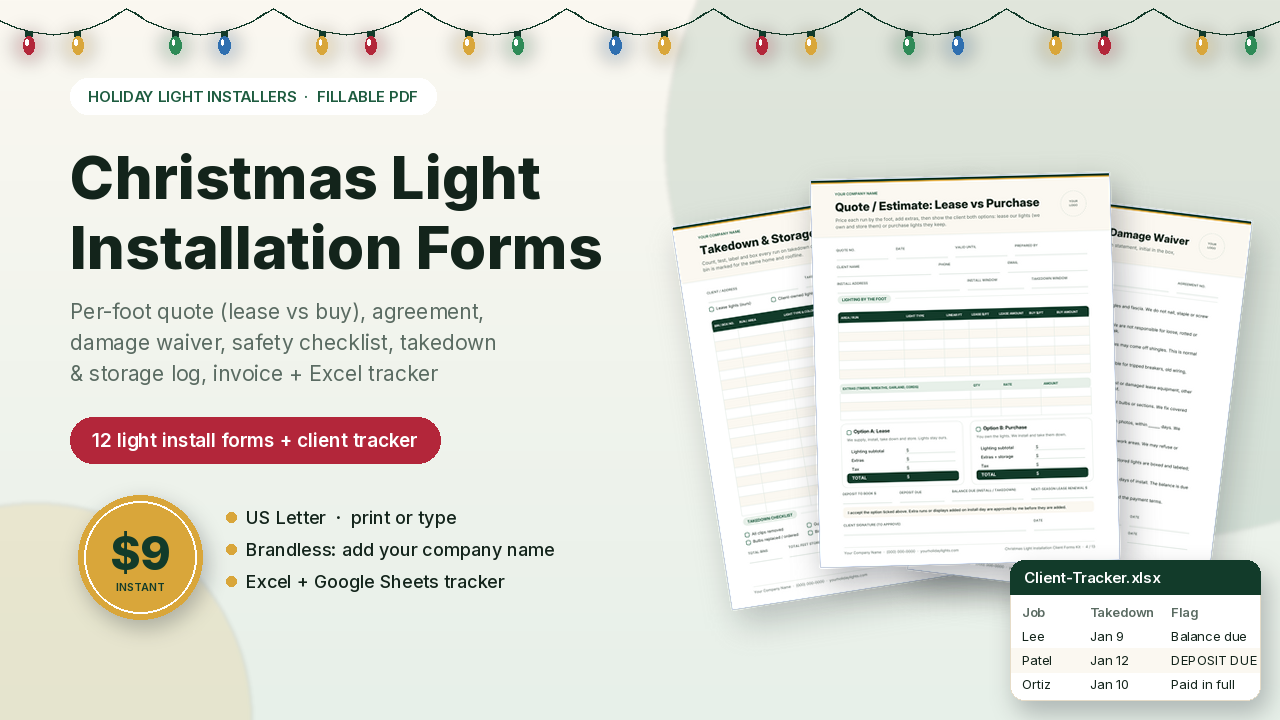
Christmas Light Installation Client Forms Kit
12 fillable forms (intake & roofline info, measurement & design worksheet, per-foot quote with lease vs purchase, service agreement, liability & property damage waiver, ladder / roof safety checklist, takedown & storage inventory, invoice, renewal form and more) plus an Excel client tracker.
Get it →5. Minimums, deposits and payment terms
Small jobs cost almost as much time as medium ones because of travel, setup and the return trip for takedown. A minimum job charge protects you from tiny orders. Many installers also take a deposit when the customer signs, to reserve an install date in a season where dates run out, with the balance due at install. Put the deposit amount, when the balance is due, accepted payment methods and any late fee on the estimate and the agreement.
6. Include service calls and takedown in the price
Customers will call when a strand goes out or a storm knocks a line down. Decide up front whether service calls during the season are included, how fast you respond, and what is extra (damage from the customer, pets, landscapers or severe weather). Do the same for takedown: list the takedown window (for example, after New Year), whether takedown is included, and how leased lights are labeled and stored for next year.
A worked quote example
Here is how an itemized estimate fits together. The rates below are example numbers only to show the math; use your own costs and local market.
- Single-story gutter line: 120 ft × example rate $4.00/ft = $480
- Second-story peak: 60 ft × example rate $5.50/ft = $330
- Two front trees, trunk and canopy wrap: 2 × example $90 = $180
- Front door wreath with lights: 1 × example $60 = $60
- Lease, install, in-season service, takedown and storage: included
Example total: $1,050. Deposit and balance due dates, the takedown window and the renewal offer for next season go underneath. A per-foot quote form that does this math the same way every time saves you from pricing on the fly while the homeowner is standing next to you.
7. Renewals: the real profit is year two
Your first season with a customer carries the measuring, design and sales cost. Repeat customers do not. At takedown, offer an early renewal for next season (for example, a small discount for booking before a set date) and keep each house record: measurements, design notes, photos, light inventory and what the customer paid. Next year the quote takes minutes.
A note on safety, insurance and local rules
This guide is educational, not legal or insurance advice. Roof and ladder work is dangerous. Check what business licenses, permits, liability insurance and workers compensation your state and city require, follow ladder and fall-protection safety practices, and have a professional review your service agreement and liability waiver.
FAQ
How do you price Christmas light installation?
Most installers measure the roofline in linear feet and charge a per-foot rate, with a higher rate for second-story or steep sections, then add itemized prices for trees, shrubs, wreaths, garland and walkway lights. Set a minimum job charge and state whether the price includes leased lights, in-season service calls and takedown.
Should I lease or sell the Christmas lights to customers?
Leasing, where you own the lights and the price covers install, service, takedown and storage, creates repeat revenue each year and keeps the gear quality under your control. Selling the lights gives the customer ownership at a higher first-year price, with lower labor-only pricing in later years. Many installers offer both and show both options on the quote.
Does the installation price include takedown?
It should say so either way. Many professional installers include takedown and storage in a lease price, with a stated takedown window after the holidays. If takedown is extra, list the price on the estimate so there are no surprises in January.
Should I charge a deposit for Christmas light installation?
Many installers take a deposit when the customer signs to reserve an install date during the busy season, with the balance due at installation. Write the deposit amount, refund rules and balance due date on the estimate and service agreement.
What should a Christmas light estimate include?
Customer and property details, measurements of each roofline and section, rates and line totals, trees and add-ons, lease or purchase, what is included (service calls, takedown, storage), the minimum charge, deposit and balance terms, the install and takedown windows, and a signature line.
When should a holiday lighting business start booking?
Many installers start taking bookings in early fall and install from early November, because December dates fill quickly. Put your booking deadline and any rush fee on your quote and website.
This page is general guidance, not legal, tax or insurance advice. Licensing, permit, insurance, safety and contract rules vary by state and city and change over time, so check yours before you take jobs.
Related templates
Free Christmas Light Installation Forms
A printable client intake & measurement sheet plus a simple holiday lighting agreement for Christmas light installers.
Download free →Christmas Light Installation Client Forms Kit
Fillable Christmas light installation forms plus an Excel client tracker with deposits, takedown dates and OVERDUE flags.
Get it →