Snow Removal Invoice Template: How to Bill Per Push, Seasonal and Salting Jobs (and Get Paid Faster)
How snow plowing and shoveling businesses can invoice clearly all winter: what a snow removal invoice should include, how to bill per push, per inch, seasonal installments and salting, when to send invoices after a storm, payment terms and late fees, with an example invoice and free snow removal forms.
Why snow removal invoices cause so many disputes
Snow removal is billed after the fact, often at 5 a.m., for work the customer may never see happen. By the time an invoice arrives, the driveway is clear, the snow has melted and the customer remembers one storm while you billed for three. Vague invoices make this worse: "Snow removal, January: $240" invites questions, slow payment and arguments about whether the trigger depth was really reached. A clear invoice that lists every visit, the snowfall, what was done and the rate from the signed agreement answers those questions before they are asked. It also makes your business look established, which matters when customers are deciding whether to renew next season.
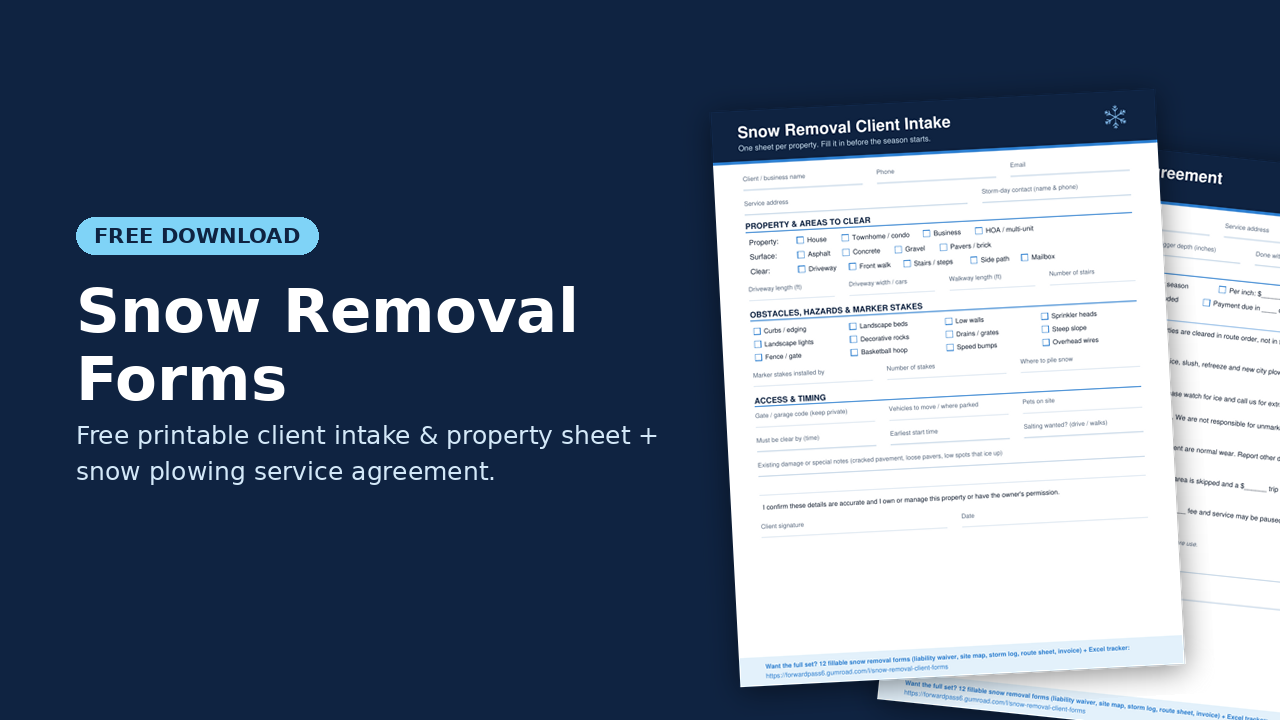
Free Snow Removal Forms
A printable client intake & property sheet plus a simple snow plowing service agreement for plowing and shoveling businesses.
Download free →What every snow removal invoice should include
Use the same layout for every customer so nothing gets missed:
- Your business details: name, phone, email and, if you have one, a logo and business or tax number.
- Customer and service address: the billing contact and the property you cleared, especially if they differ.
- Invoice number, invoice date and due date: a simple numbering system (for example SR-2026-014) makes payments easy to match.
- Billing period: the storm dates or month covered, or the installment number for seasonal contracts.
- One line per service visit: date, snowfall depth, what was done (plow, shovel walks, steps, salt) and the charge.
- Extras: salting or ice-melt applications, return trips for drifting or the city plow ridge, roof raking or hauling.
- Subtotal, tax (if it applies in your area), amount paid and balance due.
- Payment methods and terms: how to pay, when payment is due and any late fee from your agreement.
Copy the pricing wording from your signed service agreement so the invoice matches what the customer agreed to.
How to bill each pricing model
Per push (per visit): list every visit as its own line with the date, the snowfall and the rate. If you charge more for deeper storms, show the depth tier on the line, such as "Jan 6, 9 in., 6 to 12 in. tier". Per inch or depth tiers: record the depth you measured at arrival, not the forecast, and note where it came from (your log, a photo with a ruler or a local weather report). Seasonal flat rate: invoice the installment on the dates in the contract, for example in November, December and January, and still list the visits made in that period so the customer sees the value. If your contract caps the number of pushes, show the running total, such as "Visits this season: 9 of 15 included". Hourly (common for commercial lots): show arrival and departure times, equipment and the hourly rate for each visit.
Salting, ice-melt and other add-ons
Salting is where many snow businesses lose money, because applications are done quickly and never written down. Bill each application as its own line with the date, the areas treated and the price per application or per bag, as your agreement says. Do the same for return trips (drifting, refreeze or the city plow leaving a ridge at the end of the driveway), clearing cars, roof raking and hauling snow off site. Keep a salt and ice-melt log during the route so the invoice can be filled in from real records instead of memory. If an add-on was requested by text or phone, note who asked and when on the invoice line.
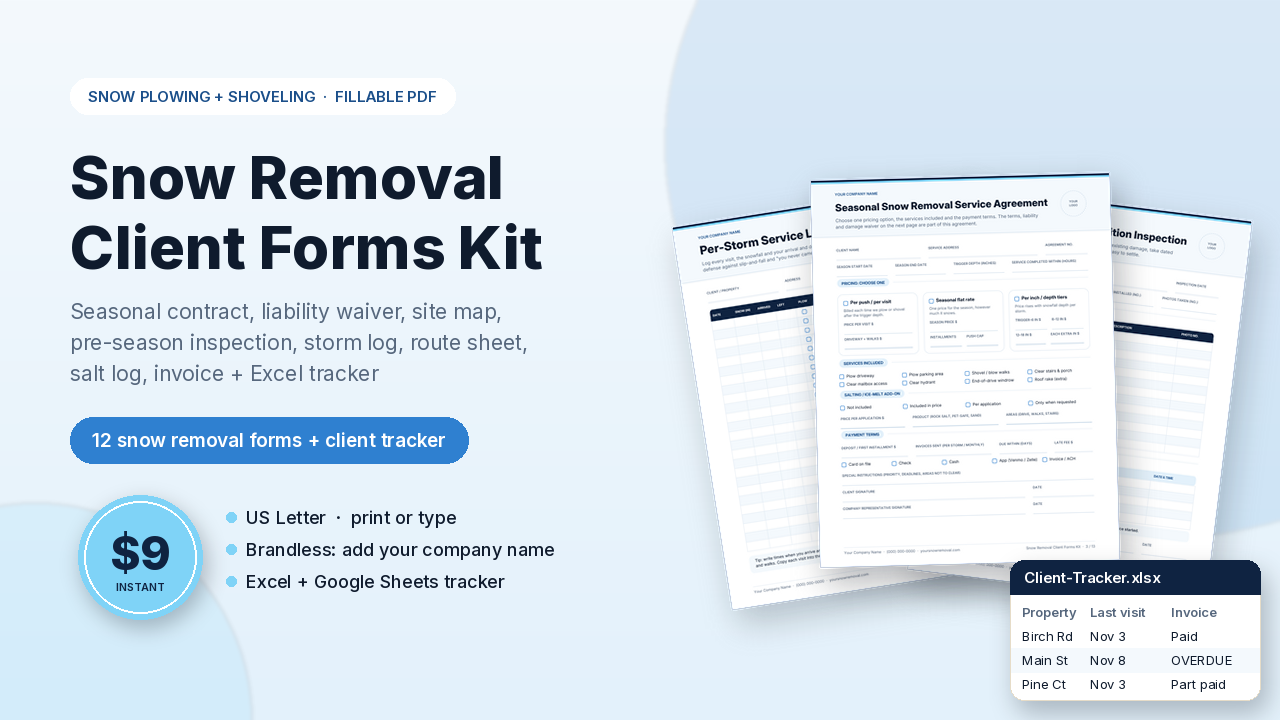
Snow Removal Client Forms Kit
12 fillable forms including a storm-by-storm invoice / receipt, per-storm service log, salt & ice-melt log, route sheet, quote, seasonal service agreement and liability waiver, plus an Excel client tracker with storm visits, invoices, balances and OVERDUE flags.
Get it →When to send snow removal invoices
Pick one schedule, write it in the agreement and stick to it. After each storm works well for per-push residential customers: the work is fresh in their mind and amounts stay small. Weekly or twice a month suits busy stretches with many storms and keeps your admin time down. Monthly is common for commercial accounts and seasonal contracts. Whatever you choose, send invoices within a day or two of the billing period ending. Late invoices get paid late, and a February bill for a December storm is far more likely to be questioned. Many operators also ask for a card on file or a deposit at signing, so each invoice can be charged and sent as a receipt.
Payment terms, late fees and overdue accounts
Set terms such as "due on receipt" or "due within 7 or 14 days" and print the due date on every invoice, not just the terms. If your agreement includes a late fee, state the amount and when it applies. For overdue accounts, send a friendly reminder a few days after the due date, a firmer one with the late fee at a week or two, and then pause service after written notice if your agreement allows it. Do not stop service in the middle of a storm without warning: tell the customer in writing first. Track every invoice with its due date, amount paid and balance so you always know who is behind before the next storm, not at the end of the season.
Example invoice (example numbers)
These are example numbers to show the format, not recommended prices. A residential customer is on a per-push agreement: $55 per push for 2 to 6 inches, $75 for 6 to 12 inches, walks and steps included, salting $20 per application. The invoice for January 1 to 15 lists: Jan 3, 4 in., plow and walks, $55. Jan 6, 9 in., plow and walks, $75. Jan 7, return trip for city plow ridge, $25. Jan 7, salt driveway and walks, $20. Jan 12, 3 in., plow and walks, $55. Jan 13, salt walks, $20. Subtotal $250, no tax in this example, paid $0, balance due $250, due January 29. Payment by card, check or app, with a note that a $15 late fee applies after the due date as stated in the service agreement. Every line matches an entry in the per-storm service log, so if the customer asks about January 7, you can show the time and photo.
Keep a storm log behind every invoice
Your invoice is only as strong as your records. During each storm, write down the arrival and departure time, snowfall depth, what was cleared, salt used and any problems, such as blocked driveways or parked cars. A dated photo of the finished drive helps too. Copy those entries into one tracker, and invoices nearly write themselves: total the visits for the period, add salting and extras, and send. At the end of the season the same records tell you which customers were profitable, which needed more pushes than expected and how to price renewals.
FAQ
What should a snow removal invoice include?
Your business details, the customer and service address, invoice number and date, due date, billing period, one line per visit with the date, snowfall and service, salting and extras, subtotal, tax if it applies, amount paid, balance due and payment terms.
How do I invoice seasonal snow removal contracts?
Bill the installments on the dates in the contract and list the visits made during that period, so the customer sees the work done. If the contract caps the number of pushes, show the running total and bill extra visits at the agreed rate.
Should I send a snow removal invoice after every storm?
Per-storm invoices work well for per-push residential customers because amounts stay small and the work is fresh. Weekly, twice-monthly or monthly billing is common for busy periods, commercial lots and seasonal contracts. Write your schedule in the agreement.
How do I charge for salting on an invoice?
List each salting or ice-melt application as its own line with the date, areas treated and the price per application or per bag from your agreement. A salt log kept during the route makes this accurate.
What payment terms should snow removal invoices use?
Many operators use due on receipt or due within 7 to 14 days, print the due date on every invoice, and state any late fee from the agreement. A card on file or a deposit at signing reduces late payments.
Can I use a free invoice template for snow removal?
Yes, as long as it lets you list each visit with the date, snowfall, service and charge, plus salting, extras and payment terms. A general invoice without visit lines tends to cause more questions from customers.
This page is general guidance, not legal, tax or accounting advice. Sales tax on snow removal, late fee limits and service suspension rules vary by state and city, so check your local rules and have your agreement and invoice wording reviewed by an attorney or accountant.
Related templates
Free Snow Removal Forms
A printable client intake & property sheet plus a simple snow plowing service agreement for plowing and shoveling businesses.
Download free →Snow Removal Client Forms Kit
Storm-by-storm invoice, service log, salt log and an Excel tracker that flags overdue invoices.
Get it →