Snow Removal Client Questionnaire: What to Ask Before You Quote or Sign a Seasonal Contract
A practical guide for plowing and shoveling businesses: the questions to ask a new client before you give a price or send a seasonal agreement, how each answer changes the quote, and what to confirm on the pre-season walk-through.
Why you need a questionnaire before you quote
"How much to plow my driveway this winter?" is the message every snow removal business gets once the first cold snap hits. The honest answer is "it depends." A short, flat, single-car driveway with nothing in the way is a very different job from a long gravel drive on a slope with a basketball hoop, a low stone wall, parked cars that never move and an owner who leaves for work at 5:30 in the morning. Both owners may describe their property in one word: "normal."
A short pre-quote questionnaire closes that gap. It is the set of questions you ask a prospective client before you give a price or send a seasonal agreement, so you can decide whether the property fits your route, which pricing model makes sense, how long each visit will take and what needs to be written into the contract. It also shows the client that you plan ahead, which matters when they are trusting you to show up in the middle of the night during a storm.
This guide covers what to ask and why. For the pricing method itself, see how to price snow removal. For the signed terms that come after the quote, see the snow removal contract template, and for billing each visit, the snow removal invoice template. The questionnaire sits in front of all three: it collects the facts that the quote, the contract and the invoices are built on.
You can send it as a form link, read it out on a phone call, or fill it in yourself on a pre-season walk-through. Many operators do a mix: a few key questions by text or form to decide whether to visit, then the rest on site.
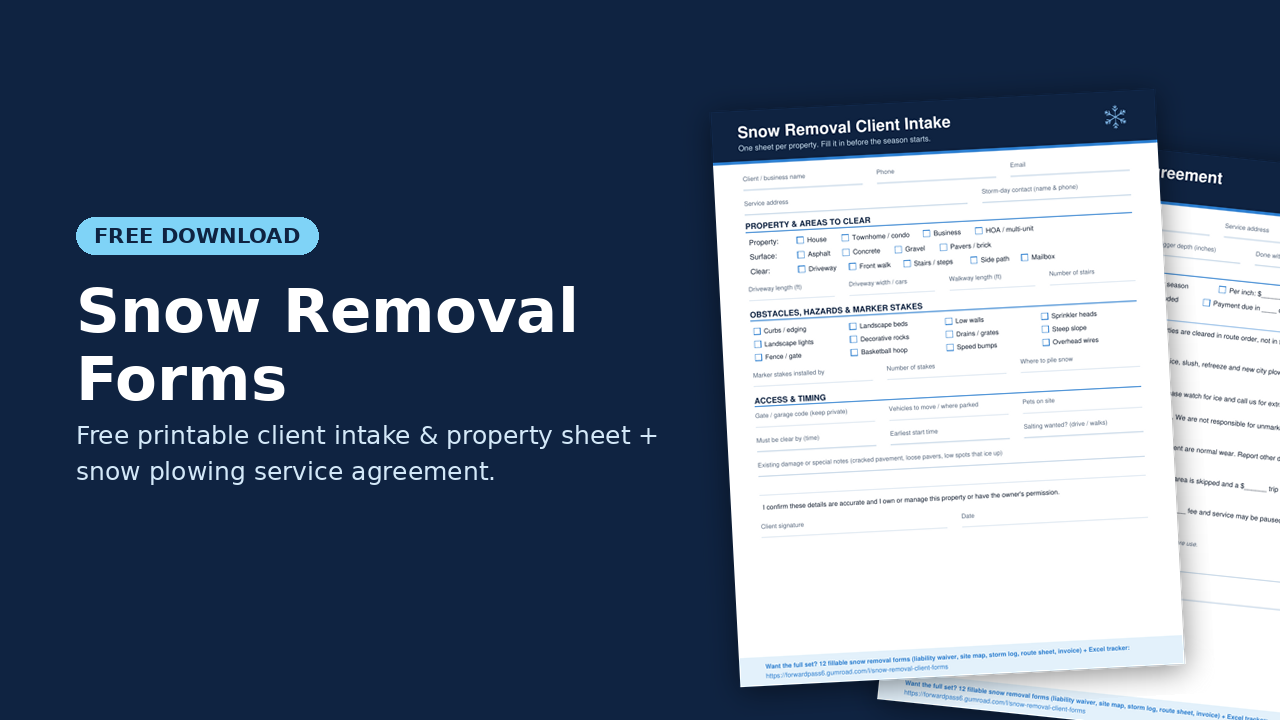
Free Snow Removal Forms
A printable client intake & property sheet plus a simple snow plowing service agreement for plowing and shoveling businesses.
Download free →Section 1: Contact details and the property
Start with the basics, and get enough detail to place the property on your route before you spend time on a site visit.
- Client name, phone number, email and preferred contact method during a storm (text, call or email)
- Property address, and whether it is a house, a rental they own, a small business or a multi-unit building
- Are they the owner, a tenant or a property manager? Who has authority to approve the work and pay the invoices?
- Is there a second contact if they are away or unreachable during a storm?
- How did they hear about you, and did they use a snow removal service last season? If they changed providers, what went wrong?
- Rough size of the areas to clear: driveway length and width (or number of car widths), walkways, steps, patio or parking area
- Is the driveway shared with a neighbor, or does it cross a shared lane?
- Do they have an HOA, building or landlord rule about snow service, contractors or where snow can be piled?
Ask for photos or a quick video of the driveway and walks, ideally taken from the street and from the house. Satellite views help with length and shape, but they do not show slope, cracks or what is parked there in winter.
Section 2: Driveway, walkway and surface details
The surface decides which equipment you can use, how close you can scrape, and what can go wrong. Ask about every area they want cleared, not just the driveway:
- Driveway surface: asphalt, concrete, pavers, gravel, dirt or a mix?
- Walkways, steps and porches: concrete, brick, stone, wood or composite?
- Is anything new, freshly sealed, cracked, heaving or uneven? Are there known soft edges or drop-offs?
- Is the driveway steep, curved or on a slope toward the street, a garage or the house?
- Are there decorative borders, drains, heated sections or sealed surfaces they are worried about?
- Which areas are in the job: driveway only, driveway plus front walk, side door path, steps, mailbox, fire hydrant, a path to the trash cans?
| Surface or feature | What to ask or note (example only) |
|---|---|
| Asphalt or concrete | Age and condition; any cracks or edges to avoid; [standard plow or blower] |
| Pavers or stamped concrete | Raised edges and joints; whether they want a shoe or rubber edge used; [method and any limits] |
| Gravel or dirt | Expect some gravel to move; agree what "cleared" means; [plow height or blower only] |
| Steep or sloped drive | Direction of slope, where melt water runs; salting likely needed; [extra time or add-on] |
| Steps, porches and decks | Material and number of steps; hand shoveling only?; [walk and step add-on] |
| Unknown or mixed | Ask for photos of each section; [confirm on the pre-season walk-through] |
Write down anything the client is worried about. A note like "new pavers by the garage, blower only" protects both of you when it is dark and the snow hides the edges.
Section 3: Obstacles, markers and where the snow goes
Most damage claims in snow removal come from things that were hidden under snow: a curb, a sprinkler head, a landscape light, a low wall or the edge of the lawn. The questionnaire is where you find them before the first storm.
- Are there curbs, landscape edging, garden beds, rocks, low walls or fences close to the paved areas?
- Any sprinkler heads, landscape lights, drains, utility boxes, cable pedestals or septic covers near the edges?
- Basketball hoops, mailboxes, trash cans, planters or decorations that sit near the driveway in winter?
- Do they already have marker stakes, or do they want you to install them? Who supplies them, and before what date?
- Where is snow allowed to be piled, and where is it not (on the lawn, against a fence, by the neighbor's property, blocking a hydrant or a sight line at the street)?
- Are there areas where melt water could refreeze, such as low spots, downspouts or shaded corners?
Ask them to mark the main obstacles on a photo or a simple sketch. Then confirm it in person and keep a copy with the job file. The contract is where you state how marker stakes and hidden objects are handled; the questionnaire just makes sure you know what is there.
Section 4: Trigger depth and service scope
The trigger depth is the amount of snow that starts a visit. It is one of the most common sources of disagreement, because clients often picture a cleared driveway after every flurry, while your pricing assumes visits only above a certain depth. Ask directly:
- At what depth would they like service to start: any accumulation, or only above a set depth such as [trigger depth]?
- During long storms, do they want you to come during the storm, only once it stops, or both?
- Do they want the end of the driveway cleared again after the town or city plow leaves a ridge at the street?
- What counts as done: driveway open for cars, walks and steps cleared, a path to the mailbox, the car cleaned off?
- Do they want snow cleared from in front of the garage doors, around parked cars, or only where cars can drive?
- Do they also want roof raking, snow hauling or ice dam help (only if you offer it)?
Write their answer as a number, not a feeling. "Plow when it snows" is not a trigger depth. A clear trigger in the quote and the contract makes the per-storm invoices much easier to explain later.
Section 5: Pricing preference: per push, seasonal or per inch
Ask how they would prefer to pay before you quote. Some clients want a fixed winter budget, others only want to pay when it actually snows. You still decide which options to offer; their answer helps you choose which ones to put in front of them. The table below shows the trade-offs in plain terms.
| Pricing model | What the client should understand (example only) |
|---|---|
| Per push (per visit) | You pay each time we clear above the trigger depth; a snowy winter costs more; [price per visit at size tier] |
| Seasonal (flat rate) | One price for the season, often in installments; covers visits up to [cap or limit, if any]; [season dates] |
| Per inch or by depth band | Price rises with the depth of each storm, such as [band 1], [band 2], [band 3]; [how depth is measured] |
| Hourly (some commercial lots) | Billed by time on site with equipment; [minimum charge] and [rate] |
Ask follow-up questions that affect each option: Do they want to cap their winter cost? Are they away for part of the winter? Would they rather pay monthly? If they choose seasonal, ask whether they understand what happens in a very light or very heavy winter, and point them to the terms in your contract. For the method behind each price, see how to price snow removal.
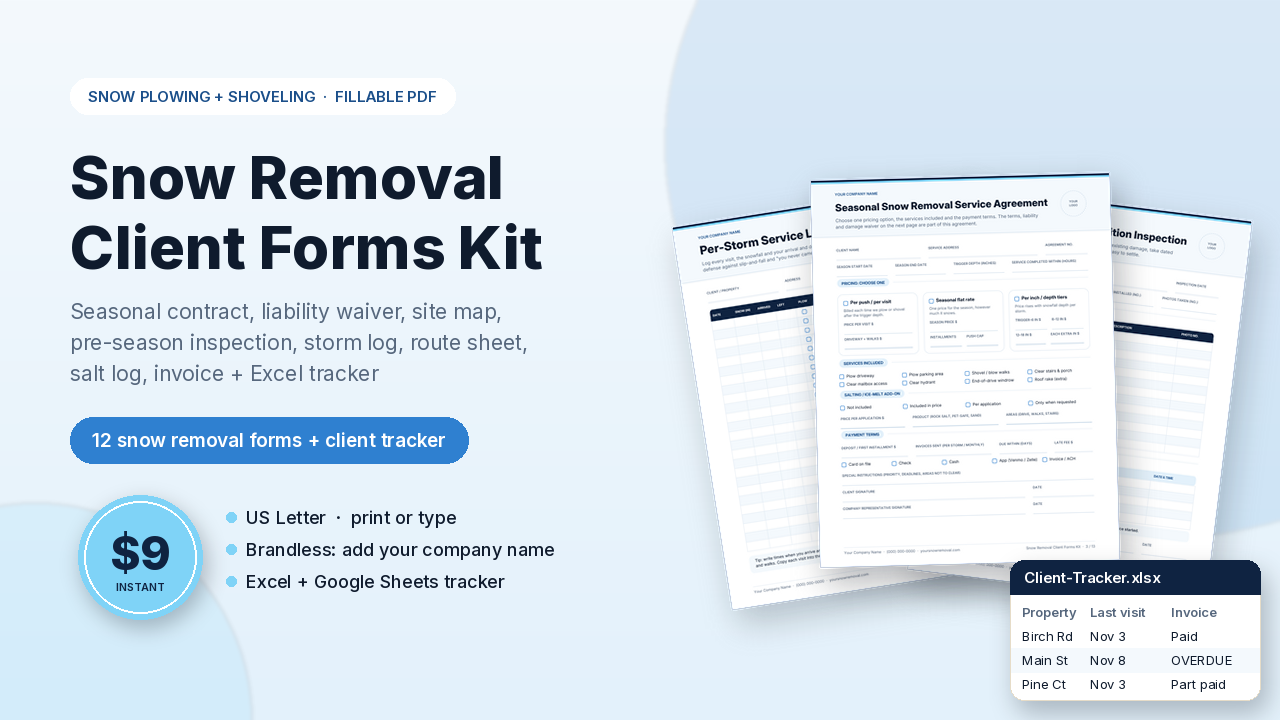
Snow Removal Client Forms Kit
12 fillable forms (intake & property info, seasonal service agreement with per-push, seasonal and per-inch pricing, liability & damage waiver, site map, pre-season inspection, quote, per-storm service log, route sheet, salt & ice-melt log, invoice, damage report, renewal) plus an Excel client tracker.
Get it →Section 6: Salting, ice and ice melt
Ice control is often treated as an afterthought, then becomes the biggest complaint of the season. Ask before you quote whether it is part of the job and how they want it done:
- Do they want salt or ice melt applied after each visit, only on request, or never?
- Which areas: driveway, walkways, steps, entrances, the slope by the street?
- Any surfaces or plants they want to protect, such as new concrete, pavers, a lawn edge or garden beds? Do they prefer a specific product type?
- Do they have pets and want a product labeled pet-friendly (follow the manufacturer's instructions; you are not making a safety promise)?
- Will they supply the product, or should it be included or billed per application?
- Do they want return visits just for icing after a freeze, even if no new snow falls?
Be clear that ice can form after you leave, especially when melt water refreezes overnight. Say what you will do, how often, and that you cannot guarantee ice-free surfaces. Exactly how responsibility is shared belongs in the signed contract, not in the questionnaire.
Section 7: Access, gates and parking
- Is there a gate, a gate code, a lock box or a shared entrance you need to get through?
- Where do cars usually park in winter? Can they be moved before you arrive, or will you work around them?
- Is there room for your truck to turn or stack snow without blocking the street or a neighbor's drive?
- Any dogs or other pets in the yard, or a gate that must stay closed?
- Any overhead hazards: low branches, power lines, garage door tracks, icicles near the door?
- For businesses and multi-unit buildings: opening hours, deliveries, accessible parking spaces and entrances that must be cleared first?
- Do they want a text when you arrive and when you finish, or photos after each visit?
Access problems cost time on every visit, and in a big storm a few minutes per stop adds up across a whole route. Ask now rather than finding a locked gate at 4 a.m.
Section 8: Timing and priority
Every client would like to be first after a storm. You cannot promise that to everyone, so ask what really matters to them and be honest about what your route can deliver.
- What time do they need the driveway open on a weekday? Who leaves first, and when?
- Do they work night shifts, care for someone with medical needs, or have another reason they need earlier service?
- Are weekends and holidays different?
- For businesses: when do staff and customers arrive, and is there a time when the lot must be clear?
- Is it acceptable if service comes later in very heavy storms, when every client on the route needs a visit?
- Will they be away for part of the season, and should service continue while they are gone?
Use the answers to place the property on your route and decide whether you can take it on. If you cannot meet a hard deadline, it is better to say so before the contract than after the first missed morning. Avoid promising a specific completion time unless you are confident you can meet it in a large storm.
Section 9: Budget and terms preview
Ask whether they have a budget for the winter or a price per visit in mind. It helps you suggest the right option, such as per push for a client who travels, or a seasonal plan with installments for someone who wants predictable costs. Then preview your main terms so nothing in the agreement comes as a surprise. The table below uses bracketed placeholders only; it is not recommended wording.
| Term | What to show (placeholders) |
|---|---|
| Season dates | Service runs from [start date] to [end date]; visits outside these dates are [policy]. |
| Trigger depth | We clear when accumulation reaches [trigger depth], measured [how and where]. |
| Pricing basis | Price is [per push / seasonal / per inch] based on [property size and scope]; confirmed after [the walk-through]. |
| Salting and ice | Ice melt is [included / billed per application at amount / not included]. |
| Markers and hidden objects | Marker stakes are [supplied by] and installed by [date]; unmarked objects [policy]. |
| Payment and deposits | A deposit of [amount] or [number] installments; per-storm invoices due within [days]. |
| Cancellation and renewal | Either party may cancel with [notice]; the agreement [renews / ends] on [date]. |
The terms themselves belong in your signed snow removal contract. The questionnaire only previews them so the client knows how you work before they agree to a price.
Turning the answers into a quote
With a completed questionnaire, a few photos and ideally a quick walk-through, you can choose the right pricing model, estimate time per visit and spot anything that needs special terms. The example below is for illustration only. The prices and times are placeholders; set your own based on your costs, equipment, route and market, and see how to price snow removal for the method.
| Questionnaire answer | How it affects the quote or contract (example only) |
|---|---|
| Two-car driveway, flat, asphalt | Base size tier at $[amount] per push or $[amount] seasonal |
| Long gravel drive on a slope | Plow height set for gravel; extra [minutes] per visit; salting likely; $[amount] per push |
| Front walk, side path and five steps | Walk and step add-on at $[amount] per visit |
| Low wall and landscape lights along the edge | Marker stakes before [date]; obstacles noted on the site map |
| Wants service at any accumulation | Explain your trigger of [trigger depth]; offer a lower trigger at $[amount] if you can |
| Needs the drive open by 6 a.m. on weekdays | Early route position only if your route allows; otherwise say so before signing |
| Prefers a fixed winter cost | Seasonal price of $[amount] in [number] installments; terms for very heavy winters stated |
Send the client a short written quote that lists the areas included, the trigger depth, the pricing model, what is extra (such as salting or clearing the street ridge) and what could change the price, such as damage you find on the walk-through. When they accept, send the agreement to sign, and after each visit bill using your snow removal invoice, referencing the same scope.
Common mistakes to avoid
- Quoting from an address alone. Ask for photos, the surfaces, the slope and what is parked there in winter.
- Leaving the trigger depth vague. Agree on a number and write it in the quote and the contract.
- Not asking about obstacles before the snow falls. Once it is buried, you cannot see the curb, the lights or the sprinkler heads.
- Assuming salting is included (or not). Ask, price it separately if needed, and say you cannot guarantee ice-free surfaces.
- Promising everyone the first slot. Ask about timing, then be honest about what your route can do in a large storm.
- Ignoring who has authority. With tenants and property managers, confirm who approves the work and who pays.
- Skipping the walk-through. The questionnaire tells you what to look for; it does not replace seeing the site before the season.
- Treating the questionnaire as the contract. Answers inform the quote. The signed agreement sets the terms.
One-page snow removal client questionnaire checklist
- Client contact details, a backup contact and preferred contact method during storms
- Property address and type; owner, tenant or manager; who approves and pays
- HOA, landlord or building rules about service and snow piles
- Driveway length, width and shape; walks, steps, patio or parking areas included
- Surfaces for each area, condition, slope and anything new or fragile
- Obstacles near the edges, marker stakes and who installs them
- Where snow can and cannot be piled; refreeze spots
- Trigger depth, service during or after storms, street ridge clearing, what counts as done
- Pricing preference: per push, seasonal, per inch or hourly
- Salting and ice melt: when, where, product preferences, who supplies it
- Access: gates, codes, parked cars, pets, turnaround space, overhead hazards
- Timing: when the driveway must be open, weekends, time away during the season
- Budget and a preview of season dates, payment, deposits and cancellation
- Photos or a sketch, plus a date for the pre-season walk-through
FAQ
What should a snow removal company ask a new client before quoting?
Ask for the client's contact details and who approves the work, the property address and type, the size and surface of the driveway, walks and steps, any slope, obstacles and marker stakes, where snow can be piled, the trigger depth they expect, their pricing preference, whether they want salting, access details such as gates and parked cars, when the driveway must be open, and a rough budget. Photos help a lot.
How is a client questionnaire different from a snow removal contract?
The questionnaire is used before you quote to collect facts about the property and the client's expectations, so you can decide whether to take the job and how to price it. The contract is the signed agreement that sets the terms: season dates, trigger depth, pricing, salting, liability for hidden objects, payment and cancellation. The questionnaire answers feed into the quote and the contract, but they do not replace either one.
Can I quote snow removal without seeing the property?
You can often give a price range from the questionnaire, photos and a satellite view, as long as you say the final price is confirmed after a walk-through. Slope, surface condition and obstacles are easy to miss in photos, so many operators visit before the season starts.
What trigger depth should I use?
There is no single right answer. It depends on your equipment, your route and what the client expects. Ask the client what they want, explain what your pricing assumes, and write the agreed depth into the quote and the contract as a number.
Should the questionnaire ask about salting even if I do not offer it?
Yes. If the client expects ice control and you do not provide it, it is better to say so before they sign. You can refer them elsewhere or note that ice control is not included.
When should I send the questionnaire?
Before the season, ideally early enough to do a walk-through and install marker stakes before the ground freezes or the first storm arrives. Late sign-ups can still use it; just keep the questions short and confirm the key answers on site.
This page is general information for snow removal businesses, not legal or insurance advice. Rules on business licensing, contracts, liability, deposits and where snow may be placed vary by location. Check the current requirements that apply to you and have your own forms and agreements reviewed.
Related templates
Free Snow Removal Forms
A printable client intake & property sheet plus a simple snow plowing service agreement for plowing and shoveling businesses.
Download free →Snow Removal Client Forms Kit
Fillable snow removal forms plus an Excel client tracker with storm visits, salt used, invoices and OVERDUE flags.
Get it →