Personal Trainer Contract Template: What to Include (Free Template + Example)
A plain-English walkthrough of the clauses personal trainers put in their client agreements: parties, services and session types, packages and pricing, scheduling, 24-hour cancellation and late arrivals, package expiration, health screening and medical clearance, assumption of risk, scope limits on medical and nutrition advice, online training, payment and refunds, termination and progress-photo consent, with a worked example and a free intake form.
Why personal trainers need a written client agreement
Most disagreements between trainers and clients have nothing to do with the workouts. They come from money and time. A client cancels two hours before a session and expects it back. A ten-session package bought in January is still half unused in October. Someone stops coming after three weeks and asks for a refund. Or a before-and-after photo appears on social media without clear permission.
A short personal trainer contract, often called a personal training client agreement, settles these questions on day one. It names both parties, describes the services and session types, sets the price and package rules, explains cancellations and expiration, records health screening and the client's acknowledgment of risk, limits your role to training, and covers online coaching, payment, refunds, ending the agreement and photo consent.
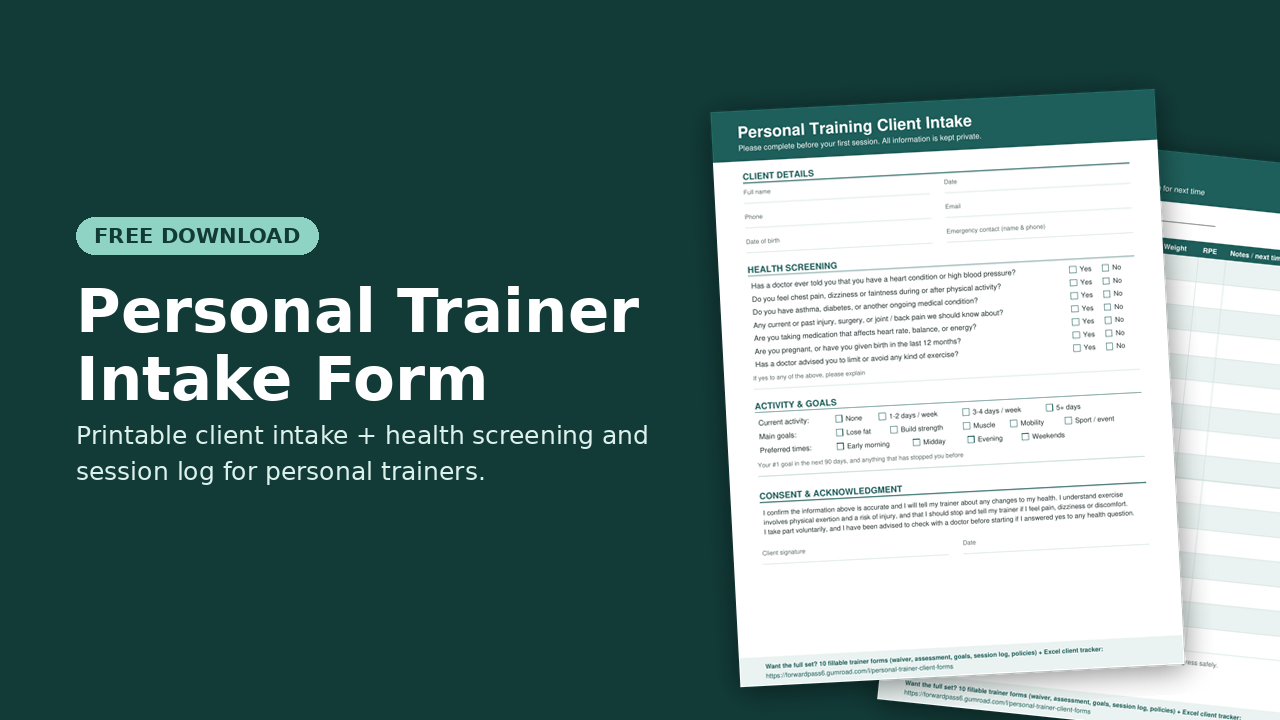
Free Personal Trainer Intake Form
A printable client intake and 7-question health screening plus a training session log for trainers and coaches.
Download free →1. Parties and contact details
Start with your business name or trading name, phone, email and any certification you want to list, such as your training credential and CPR/AED status with the expiry date. Add the client's full name, date of birth, phone, email and an emergency contact with a phone number.
If the client is under 18, a parent or guardian should sign the agreement and the health questionnaire, and you should note whether a parent will be present.
2. Services and session types
Describe what the client is buying in plain words. List each service you offer and what it includes:
- One-on-one sessions. Length (for example 30, 45 or 60 minutes), location (your studio, the client's home, a gym or a park) and whether a warm-up and cool-down are included in that time.
- Partner and small-group sessions. How many people, how the price is split, and what happens if one partner cancels.
- Assessments. An initial fitness assessment and any reassessments, such as every 8 or 12 weeks.
- Programming. Whether a written plan for workouts on the client's own is included or sold separately.
For in-home or outdoor training, note who provides equipment, that the client is responsible for a safe, clear space, and that you may move or cancel an outdoor session for weather, heat or air quality.
3. Packages and pricing
Write the price of each option into the agreement, or attach your current price list and refer to it. Trainers usually sell single sessions, session packages and monthly plans. For each one, state the number of sessions, the session length, the total price and the price per session so the client can see the value. Say how much notice you give before raising prices, for example 30 days.
Example price list only; set your own prices for your market: single 60-minute session $80; 10-session package $720 ($72 per session); 20-session package $1,320 ($66 per session); monthly plan of 8 sessions $560 billed every four weeks; partner session $110 for two people; online coaching $150 per month.
4. Scheduling, 24-hour cancellation and late arrivals
Your cancellation policy protects the time you hold for each client. State how sessions are booked (an app, text or a fixed weekly slot), and how much notice the client must give to cancel or move a session without losing it. A 24-hour notice period is common.
Then spell out what happens with late cancellations and no-shows. Many trainers count a session cancelled with less than 24 hours' notice, or a no-show, as used, and charge the full session rate to clients who pay per session.
Add a late arrival rule: the session ends at the scheduled time so the next client is not delayed, and if the client is more than, for example, 15 minutes late, you may treat it as a no-show. Also say what happens if you cancel or run late, such as making up the time or adding a free session.
5. Package expiration and freezing
Unused sessions are one of the most common sources of conflict. Give each package a clear expiration period, for example 10 sessions valid for 90 days from purchase and 20 sessions valid for 180 days. State the date on the agreement or the receipt.
Include a freeze option for medical reasons, pregnancy, extended travel or similar, such as a pause of up to 60 days with a doctor's note or written request. Rules on how long prepaid services must remain valid, and on gift certificates, vary by location, so check your local rules before setting expiration terms.
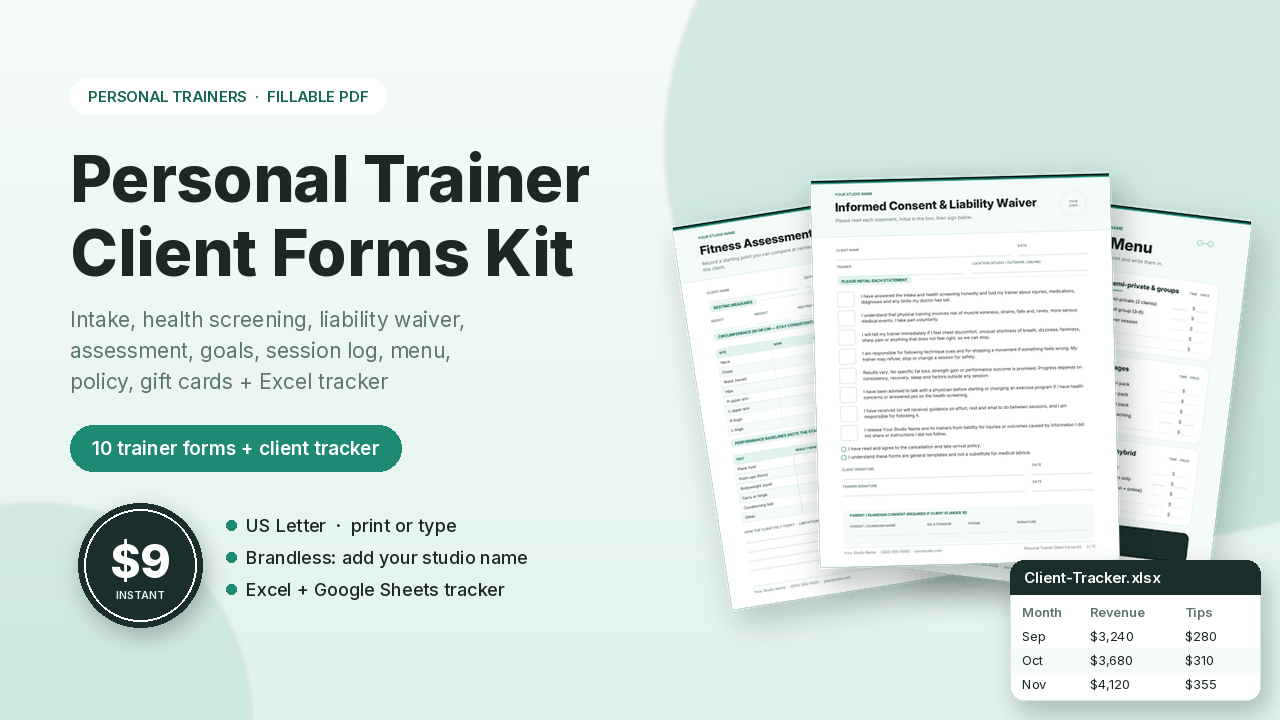
Personal Trainer Client Forms Kit
10 fillable forms (intake and lifestyle questionnaire, health screening, informed consent and liability waiver, fitness assessment, goal setting and training plan, session log, training menu, cancellation policy, photo release, gift certificates) plus an Excel client tracker.
Get it →6. Health screening, PAR-Q and medical clearance
Before the first session, the client should complete a health questionnaire. Many trainers use the PAR-Q (Physical Activity Readiness Questionnaire) or a similar screening that asks about heart conditions, chest pain, dizziness, joint or bone problems, medications, pregnancy and recent surgery.
Your agreement should say that the client has answered the screening truthfully and will tell you about any change in their health, new injury, pregnancy or medication before the next session. If the screening raises a concern, state that you require written medical clearance from the client's doctor before training begins or continues, and that you may pause sessions until it is provided.
7. Assumption of risk and liability waiver wording
Exercise carries a real risk of injury. Most trainers include an informed consent and assumption of risk section in which the client acknowledges these risks, confirms they take part voluntarily, agrees to follow instructions, and agrees to stop and tell you if they feel pain, dizziness or shortness of breath.
Many agreements also include a release or liability waiver. How far a waiver can limit your liability, and what wording a court will accept, depends heavily on local law. In many places a waiver cannot excuse negligence or gross negligence at all. Treat any waiver as one layer of protection, not a guarantee. Check your local rules, have a qualified professional review the wording, and carry professional liability insurance that covers the places you train.
8. Not medical or nutrition advice; results not guaranteed
Make the limits of your role clear. A personal trainer designs and coaches exercise. Unless you hold the right license, you should not diagnose injuries, treat medical conditions or prescribe diets. Add a clause stating that you do not provide medical advice, physical therapy or individual nutrition plans, that any general healthy-eating information is for education only, and that the client should see a doctor, physical therapist or registered dietitian for medical or nutrition needs. Rules on who can give nutrition advice vary by location.
Add a results clause too. State that you will work toward the client's goals but cannot guarantee a specific amount of weight loss, strength gain or other result.
9. Online and virtual training terms
If you coach online, add a short section for it. Describe what the monthly fee includes, such as a written program, a set number of check-ins or video calls, and message support with your usual reply time. State that the client exercises without you in the room, is responsible for a safe space and working equipment, and should stop if anything hurts.
Say which apps or platforms you use, that video calls are not recorded without consent, and how program files may be used: for the client's own training, not for resale or sharing.
10. Payment terms and refunds
State when payment is due: packages paid in full before the first session, monthly plans billed on a set date, single sessions paid at booking.
Write your refund policy in plain words. A common approach is that packages are non-refundable but can be frozen for medical reasons, or that unused sessions can be refunded at the single-session rate minus sessions used. Some places have consumer rules on fitness contracts, cancellation periods and refunds, so check your local rules before you write a no-refund policy.
11. Ending the agreement
Say how either side can end the agreement. For monthly plans, a common term is written notice before the next billing date, for example 14 or 30 days. For packages, the agreement usually ends when the sessions are used or expire. Also give yourself the right to end training if a client repeatedly misses sessions, behaves unsafely or abusively, or does not provide requested medical clearance, and say what happens to any unused paid sessions in that case.
12. Photos, video and progress-tracking consent
Progress photos, body measurements and form videos are useful, but they are personal. Ask for separate consent with a checkbox for each use: progress photos for the client's file only; videos for form review; and, separately, permission to share images or results on your website or social media, with or without the client's face or name.
Common mistakes in personal training agreements
- No written 24-hour cancellation and no-show rule
- Packages with no expiration date or freeze policy
- Skipping the health questionnaire or not asking for medical clearance when it raises a concern
- Relying on a waiver alone instead of insurance and careful practice
- Giving diet plans or injury advice outside your qualifications
- Promising specific results such as “lose 20 pounds in 8 weeks”
- Posting progress photos without written consent
Worked example: a new client buys a 10-session package
Example numbers only; set your own prices for your market. A new client wants to train twice a week for strength and general fitness. She completes the intake form and PAR-Q and mentions a past lower-back strain, so the trainer asks for medical clearance, which her doctor provides before the first session. She buys the 10-session package at $720 ($72 per session), valid for 90 days, and signs the agreement with the 24-hour cancellation rule. In week three she cancels with 6 hours' notice; the session is counted as used. In week five she travels for work and freezes the package for 14 days with a written request, which moves her expiration date back by 14 days. She ticks the box for progress photos in her file but not for social media. She uses all 10 sessions by day 80 and renews for 20 sessions at $1,320.
How to send and store your agreement
Send the agreement, intake form and health questionnaire together before the first session, and have the client sign everything before training starts. Keep signed forms, medical clearance notes, package dates and session logs in one secure file for each client.
FAQ
Do personal trainers need a contract with clients?
It is strongly recommended. A short client agreement records the services, price, cancellation rules, package expiration, health screening and assumption of risk, which prevents most disputes before they start.
What is a normal cancellation policy for personal training?
A 24-hour notice period is common. Sessions cancelled with less notice, or missed without notice, are usually counted as used or charged at the session rate. Some trainers allow an occasional emergency exception.
Should personal training packages expire?
Most trainers set an expiration period, such as 90 days for 10 sessions, with a freeze option for illness or travel. Rules on prepaid services vary by location, so check your local rules.
Is a liability waiver enough to protect a personal trainer?
No. How much a waiver protects you depends on local law, and many places do not allow waivers to excuse negligence. Use it together with health screening, safe practice and professional liability insurance.
When should a trainer ask for medical clearance?
When the health questionnaire raises a concern, such as heart symptoms, recent surgery, pregnancy or an ongoing condition. Ask for written clearance from the client's doctor before training begins.
Can a personal trainer give nutrition advice?
General healthy-eating information is usually fine, but individual meal plans or diet therapy may require a license in some places. State in your agreement that you do not provide medical or individual nutrition advice.
This page is general guidance, not legal, medical or nutrition advice. Waiver enforceability, consumer and fitness contract rules, prepaid package and refund rules, nutrition advice rules and insurance requirements vary by location. Check your local rules and have a qualified professional review your personal trainer contract before you use it.
Related templates
Free Personal Trainer Intake Form
A printable client intake and 7-question health screening plus a training session log for trainers and coaches.
Download free →Personal Trainer Client Forms Kit
10 fillable personal trainer forms plus an Excel client tracker for sessions, packages and payments.
Get it →More free guides
- Appointment Reminder Templates
- Cancellation Policy Templates
- Fitness Assessment Form for Personal Trainers
- Personal Training Liability Waiver
- Personal Trainer Pricing
- Personal Trainer Intake Form and Liability Waiver
- New Year Personal Trainer Pricing
- Tutoring Agreement Template + Student Intake Form
- Massage Pricing