Fitness Assessment Form for Personal Trainers: What to Test and Record (+ Free Forms)
A practical guide for independent personal trainers, online coaches and small studios: how to run a first fitness assessment after the health screening, which simple tests to choose, how to record results so retests are fair, and how to turn the numbers into goals a client actually cares about.
Why a written fitness assessment matters
A new client arrives in January and says they want to “get fitter.” Eight weeks later they feel stuck and wonder whether the sessions are working. If you never recorded where they started, you have nothing to show them except your memory and their mirror.
A short, written fitness assessment fixes that. It gives you a starting point to program from, shows you which movements need work before you load them, and gives the client clear proof of progress at every reassessment. That proof is one of the strongest reasons clients renew a package.
This guide is about the assessment itself: what to test and how to write it down. The paperwork that comes first is covered in the personal trainer intake form guide and the personal training liability waiver guide. For terms and packages, see the personal trainer contract template and personal trainer pricing guides.
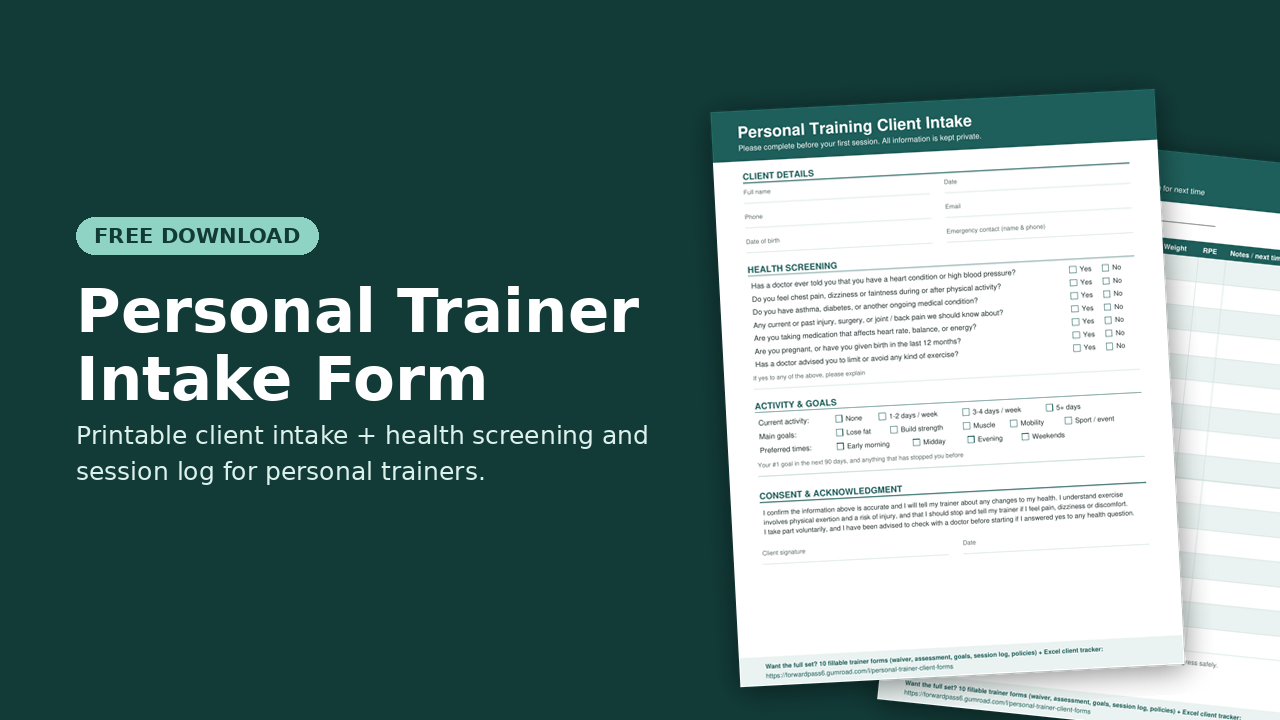
Free Personal Trainer Intake Form
A printable client intake and 7-question health screening plus a training session log for trainers and coaches.
Download free →Assessment vs intake form vs health screening
These three are often lumped together, but each has a different job:
| Form | When | What it records | Who fills it in |
|---|---|---|---|
| Intake questionnaire | Before the first session | Contact details, goals, schedule, training history, lifestyle, preferences | Client |
| Health screening | Before any exercise | Health questions, symptoms, medications, whether medical clearance is needed | Client (you review it) |
| Fitness assessment | First session, then every few weeks | Measurements, movement observations, test results, notes on how the client felt | Trainer |
The order matters. Screening comes first, and if the screening suggests the client should check with a doctor or other health professional, the assessment waits until they have. The assessment is not a medical test and should never be presented as one.
Before you start
- Paperwork signed. Intake, health screening and waiver completed and reviewed.
- Client feels well today. Ask about sleep, illness, recent injury, food and caffeine. If anything is off, reschedule the tests rather than push through.
- Explain the purpose. Tell the client this is a starting point, not a grade, and that they can skip any test or measurement.
- Set up the space. A clear floor, a box or bench of known height, a timer, a tape measure and the form. Note the equipment you used so you can repeat it.
- Warm up. A few minutes of easy movement before any strength or cardio test.
Agree on stop signals before you begin. Many trainers end a test immediately if the client reports chest discomfort, dizziness, unusual shortness of breath, sharp pain or anything that worries them, and follow their emergency plan if needed.
The basics at the top of the form
Keep the header short so it gets filled in every time:
- Client name, date and time of day
- Assessment number (initial, reassessment 1, 2 and so on)
- Location and equipment used (gym, home, park, online)
- How the client feels today (a simple 1–5 scale and a note)
- Health screening reviewed (yes/no) and any clearance on file
- Trainer name or initials
Time of day and location matter more than they look. A test done at 7 a.m. at home and retested at 6 p.m. in a gym is not a fair comparison.
Resting measures and body measurements (optional)
Some clients want numbers about their body; others find them stressful. Ask first, record only what the client agrees to, and offer alternatives that track progress without a scale.
| Measure | How many trainers record it | Note |
|---|---|---|
| Resting heart rate | Seated, after a few quiet minutes, by watch or manual count | Record the method so retests match |
| Body weight | Only if the client wants it; same scale, similar time of day | Never required to train |
| Girth measurements | Waist, hips, chest, upper arm, thigh; same landmarks each time | Write down where you measured |
| Progress photos | Only with written photo consent; same pose, light and clothing | Store privately; client can withdraw consent |
| How clothes fit / energy / sleep | Client rating on a simple scale | Useful for clients who prefer no body numbers |
Example only. Choose tests that suit your clients, your qualifications and your space.
Do not interpret blood pressure, body composition or any measurement as a health judgment. If a reading or symptom concerns you, suggest the client speak with a health professional and note that you did.
Posture and movement screen
Before you test how much a client can do, look at how they move. A simple screen might include a bodyweight squat, a hip hinge, a split squat or lunge, a push-up or incline push-up, an overhead reach and a single-leg balance. Watch from the front and side and record what you see in plain, neutral words.
| Instead of | Write |
|---|---|
| “Bad knees” | Knees move inward at the bottom of the squat, both sides |
| “Weak core” | Lower back arches during overhead reach; ribs flare |
| “Tight hamstrings” | Hinge stops above knee height; client reports stretch in back of thighs |
| “Has scoliosis” | Shoulders appear uneven when standing; no diagnosis made |
Example only. Choose tests that suit your clients, your qualifications and your space.
Observations are not diagnoses. If a movement causes pain, stop, note where and when it happened, and suggest the client check with an appropriate professional before you load it.
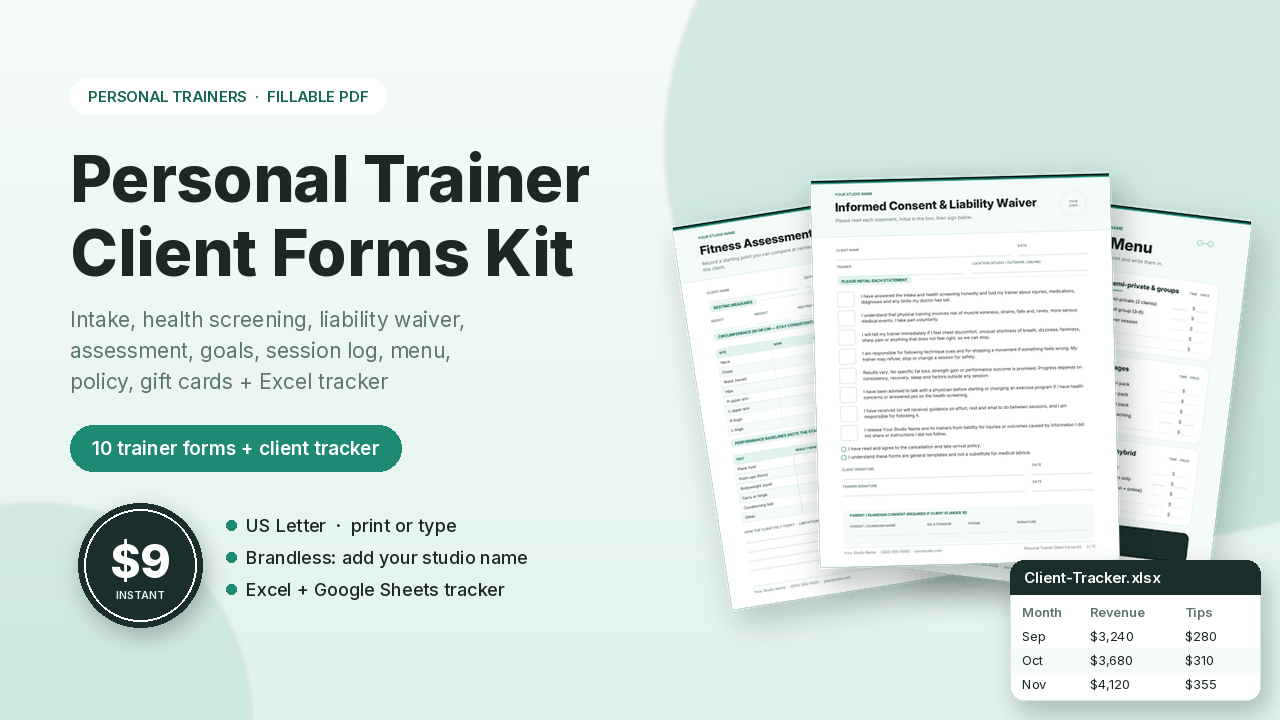
Personal Trainer Client Forms Kit
10 fillable forms (intake and lifestyle questionnaire, health screening, informed consent and liability waiver, fitness assessment, goal setting and training plan, session log, training menu, cancellation policy, photo release, gift certificates) plus an Excel client tracker.
Get it →Strength and muscular endurance tests
Pick two to four tests that match the client's level and goals. The best test is one you can repeat exactly in eight weeks.
| Test | Good for | Record |
|---|---|---|
| Push-ups (full, knee or incline) | Upper body endurance | Version and surface height, reps with good form |
| Chair or box sit-to-stand | Leg strength, older or deconditioned clients | Box height, reps in a set time |
| Plank or side plank hold | Trunk endurance | Seconds held with good position |
| Goblet squat or other loaded lift | Experienced clients | Load, reps, depth and any form notes |
| Wall sit | Leg endurance without equipment | Seconds held, knee angle |
Example only. Choose tests that suit your clients, your qualifications and your space.
Avoid maximal lifts at a first assessment for most clients. Record what was done and how it looked; a rating of perceived effort (for example on a 0–10 scale) next to each result helps you compare later.
Cardio tests
Keep cardio testing simple and submaximal for most clients. Common options include a timed walk or run over a set distance, a step test at a set height and pace, or a set time on a bike or rower at a steady effort. Record:
- The test and exact setup (distance, step height, cadence, machine settings)
- Time or distance completed
- Heart rate at the end and after a short recovery, if you use it
- Effort rating and whether the client could talk in full sentences
Stop the test straight away if the client reports chest discomfort, dizziness, nausea or breathing that feels wrong to them. Write what happened and what you did.
Mobility and flexibility
A few quick checks are enough: sit-and-reach or toe touch, shoulder reach behind the back, ankle mobility against a wall, and hip rotation lying down. Record which side, how far (in centimetres or inches, or a landmark such as “fingertips to mid-shin”) and whether anything felt uncomfortable. Use the same landmarks at every retest.
A complete example assessment record
| Section | Example entry |
|---|---|
| Header | [Client name], initial assessment, [date], 7:30 a.m., home, mat + 45 cm box |
| Feeling today | 4/5, slept well, no new pain |
| Measures | Resting HR by watch; waist and hip girth (client agreed); no weight by choice |
| Movement screen | Squat: knees move in at bottom. Hinge: good. Overhead reach: low back arches |
| Strength | Incline push-up on box: [reps]. Sit-to-stand 30 s: [reps]. Plank: [seconds] |
| Cardio | Step test at set pace: completed; effort 6/10; talking in short sentences |
| Mobility | Toe touch: fingertips to ankles. Ankle wall test: [cm] left, [cm] right |
| Client goals | Play with kids without back ache; hike in spring |
| Trainer notes | Start with squat pattern and trunk work; retest in 8 weeks |
Example only. Choose tests that suit your clients, your qualifications and your space.
Turning results into goals and a plan
Numbers only matter if they connect to what the client wants. Link each result to a goal the client can feel:
| Result | Possible goal (example only) |
|---|---|
| Incline push-ups on a box | Move to a lower box, then to the floor |
| Sit-to-stand reps | More reps in the same time; stand from low chairs easily |
| Step test effort 6/10 | Same test at a lower effort, or a longer hike without stopping |
| Low back arches overhead | Overhead reach with ribs down before adding overhead pressing |
Write two or three goals on a separate goal-setting sheet, agree a date to review them, and plan the first block of sessions around them. Avoid promising specific weight loss or health results; describe what you will work on together.
When to reassess
Many trainers retest every 6 to 12 weeks, at the end of a package, or before a new training block. Put the date on the calendar when you write the plan. Repeat the same tests in the same order, at a similar time of day, with the same equipment and warm-up, and record any differences honestly. Show the client the two records side by side; even small changes are motivating when they are written down.
In-person, in-home, online and group differences
| Setting | What changes |
|---|---|
| Gym or studio | Full equipment; note machine models and settings for retests |
| In-home | Measure box or chair heights; clear the space; note flooring |
| Online | Client sets up camera to show full body; use bodyweight tests; someone nearby is a good idea for cardio tests |
| Small group | Simple tests everyone can do; one record per person; keep results private |
Example only. Choose tests that suit your clients, your qualifications and your space.
Privacy, photos and tone
Assessment records include personal health and body information. Store paper forms securely and digital files in a private, password-protected place, and share them only with the client. Photos and video need written consent, and the client should know how to withdraw it. Rules on health data and record keeping vary by location, so check what applies to you.
Tone matters as much as storage. Use neutral language on the form, avoid labels about the client's body, and let them decline any measurement without needing a reason.
Common mistakes
- Testing before the health screening is reviewed.
- Too many tests at once, leaving the client exhausted and the trainer with data they never use.
- Not writing down test versions, heights, times or equipment, so retests are not comparable.
- Turning observations into diagnoses.
- Making body weight or photos mandatory.
- Never scheduling the reassessment.
One-page fitness assessment checklist
- Intake, health screening and waiver reviewed; clearance on file if needed
- Header: name, date, time, location, equipment, assessment number
- How the client feels today
- Optional measures the client agreed to
- Movement screen in neutral words
- Two to four strength or endurance tests with exact versions
- One cardio test with setup, effort and stop notes
- Mobility checks with landmarks and sides
- Client goals and trainer notes
- Reassessment date booked
FAQ
What should be on a fitness assessment form?
A header with the date, time, location and equipment; how the client feels that day; any optional measurements they agree to; a movement screen; a few strength, cardio and mobility tests with exact setups; client goals; trainer notes; and the reassessment date.
What is the difference between a fitness assessment and an intake form?
The intake form is filled in by the client and records contact details, goals, history and preferences. The fitness assessment is filled in by the trainer during the first session and records how the client moves and performs on simple tests, so you have a starting point to compare against.
Do I need a health screening before a fitness assessment?
Yes. Review a health screening first. If it suggests the client should speak with a doctor or other health professional, wait until they have before running any tests.
How often should personal trainers reassess clients?
Many trainers reassess every 6 to 12 weeks, at the end of a package or before a new training block. Use the same tests, order, equipment and time of day so the results are comparable.
Do I have to weigh clients?
No. Body weight, girth measurements and photos should be optional. Many clients prefer to track performance, energy, sleep or how clothes fit instead.
Can I run a fitness assessment online?
Yes, with bodyweight tests that the client can do safely at home. Ask them to set up the camera to show their whole body, measure any box or chair heights, and consider having someone nearby for cardio tests.
This page is general information for personal trainers and coaches, not medical, legal or insurance advice. A fitness assessment is not a medical test. Requirements for health screening, medical clearance, waivers, photos and the handling of client health information vary by location and certification, so check what applies to you or talk to a professional if you are unsure. Tests, schedules and example entries shown are examples only.
Related templates
Free Personal Trainer Intake Form
A printable client intake and 7-question health screening plus a training session log for trainers and coaches.
Download free →Personal Trainer Client Forms Kit
Fillable intake, health screening, waiver, fitness assessment, goal setting and training plan and more, plus an Excel client tracker.
Get it →