New Year Personal Trainer Pricing: How to Price January Starter Packages, Intro Offers and Challenges (Plus Free Forms)
How personal trainers can price the New Year rush: keep core rates, build a January starter package, use intro offers that protect your rate, sell December gift certificates, price group challenges, set capacity and cancellation rules, and turn January clients into regulars, with a worked example and free forms.
Why January needs its own pricing plan
For most personal trainers, January is the busiest month for new inquiries. People set New Year goals, gyms run promotions and gift certificates from the holidays get redeemed. The rush is short, though. Many new clients drop off by February, and a trainer who filled the calendar with heavily discounted sessions can end up working the hardest month of the year for the lowest pay.
A better plan is to decide in November or December what you will sell in January, how many new clients you can take, and how each new client moves onto a regular plan. The sections below cover starter packages, intro offers, gift certificates, group challenges, capacity and retention, with a worked example at the end.
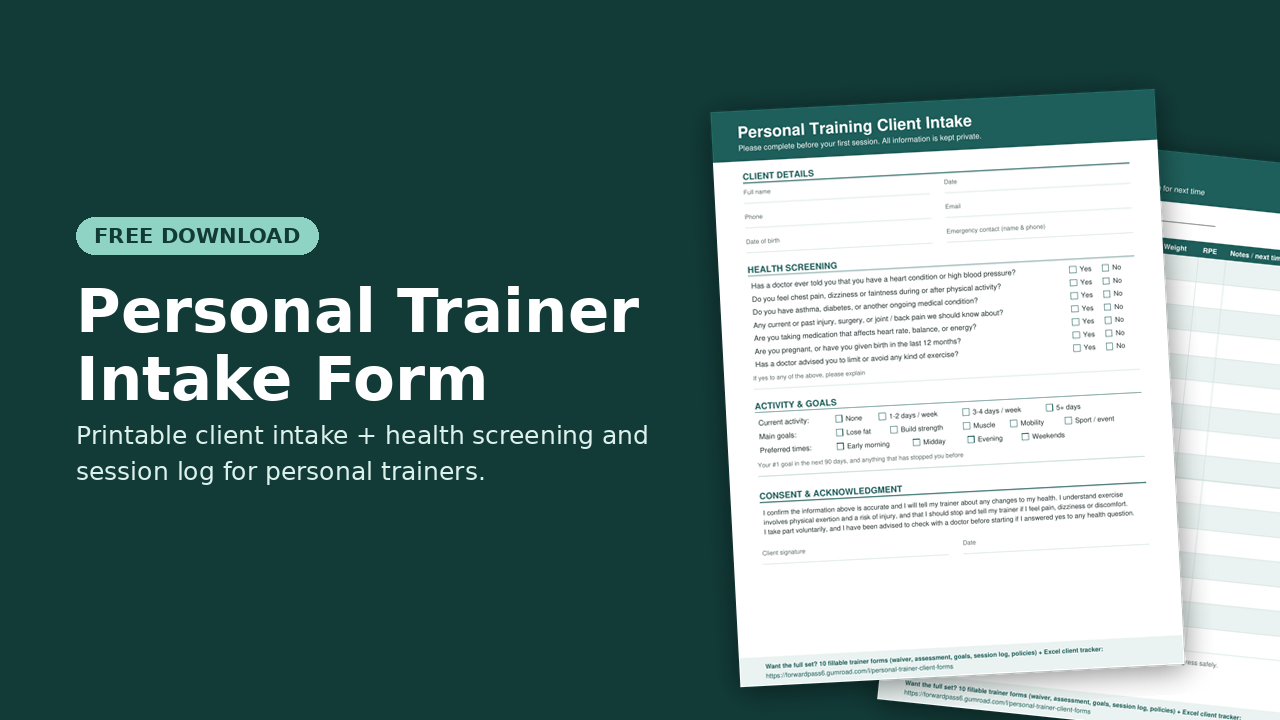
Free Personal Trainer Intake Form
A printable client intake and 7-question health screening plus a training session log for trainers and coaches.
Download free →1. Keep your core rates and package the start
Clients compare prices, and regulars notice when new clients pay less. Keep your standard session, package and monthly prices as they are, and create one clear New Year starter package for new clients. A starter package might include:
- An intake and assessment session. Health screening, goals, movement and fitness tests, so the program starts from the right place.
- A fixed number of sessions. For example, eight sessions over four weeks, booked at set times.
- A written plan. A simple program for the sessions and any workouts done on their own.
- A progress check. A re-test or review near the end, which is also when you offer the next step.
Price the package at your normal rate per session, then decide whether to include the assessment at no extra charge as the incentive. As an example only, a trainer charging $70 per session might price an eight-session starter package at $560 and include a $70 assessment for free. These are example numbers, not market rates. Check what trainers near you charge and build your own prices from your target hourly rate.
2. Price intro offers without cutting your rate
Intro offers work best when they lower the risk of starting, not the value of your time. Options that keep your per-session rate intact:
- A free or low-cost assessment that leads into the starter package.
- A bonus session or a nutrition and habit guide included with the package.
- A paid trial session that is credited toward the package if the client signs up within a set number of days.
- A limited number of spots at the New Year price, with a clear end date, such as January 31.
If you do offer a discount, make it modest, attach it to a commitment such as a prepaid package, and write the regular price next to it so clients know what they will pay afterward. Avoid open-ended deals that you will have to remove later.
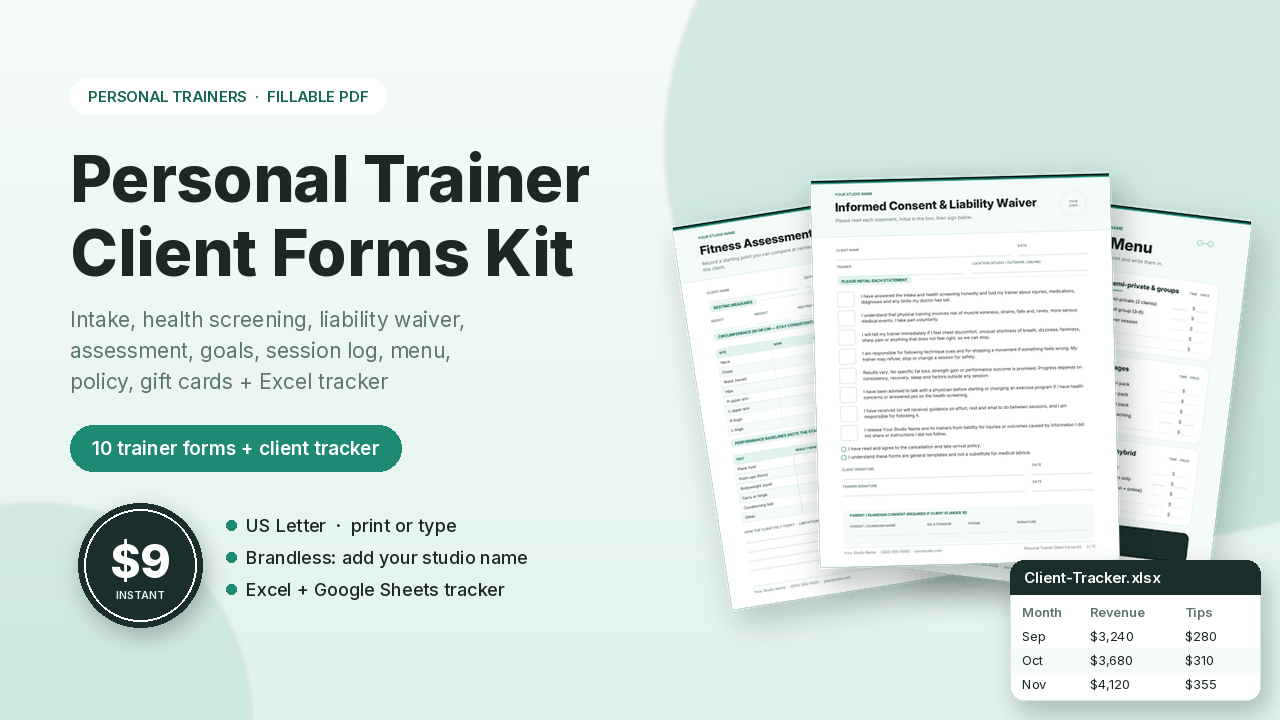
Personal Trainer Client Forms Kit
10 fillable forms (intake and lifestyle questionnaire, health screening, informed consent and liability waiver, fitness assessment, goal setting and training plan, session log, training menu, cancellation policy, photo release, gift certificates) plus an Excel client tracker. Want every kit? See the bundle.
Get it →3. Sell gift certificates and pre-sales in December
December is often quieter for trainers than January, and it is when family members shop for gifts. Gift certificates for your starter package bring in cash early and new clients in January. Sell them for a named package rather than a vague dollar amount, so the value is clear, and give each one a number, a value and an expiry date that follows your state's gift card rules.
Pre-sales work the same way for your own audience. Open booking for New Year starter packages in mid-December, take payment up front, and assign start dates and session times before January begins. You start the year with a full schedule instead of answering inquiries during your busiest weeks.
4. Price group challenges and small-group training
A four to eight week group challenge or small-group program lets you serve more January clients without adding hours one to one. To price it, add up your coaching time, programming, check-ins and any space rental, set a target total for the program, then divide by a realistic number of participants.
Set a minimum number of participants so the program only runs if it covers your costs, and a maximum so you can still coach everyone properly. Include an intake form, health screening and waiver for every participant, the same as for private clients. Group clients who enjoy the program are good candidates for private sessions or a monthly plan afterward.
5. Plan for February before January starts
Most New Year clients decide in the first few weeks whether to keep going. Build the next step into the starter package: a progress check in week three or four, a short review of what changed, and one or two clear options, such as a monthly plan with a set number of sessions or a larger prepaid package.
Price the ongoing options so they are slightly better value per session than the starter package, which rewards commitment without discounting your time. Autopay, a minimum term and a fixed weekly slot make it easier for clients to stay. Track who finishes the starter package and who renews, so you know whether your January offer actually builds your business.
6. Set capacity, cancellation and payment rules for the rush
Work out how many new clients you can take on without burning out or squeezing your regulars. Decide on a number, protect your existing clients' time slots first, and offer a waitlist once you are full. A waitlist is also a reason to keep your prices where they are.
January is when no-shows and last-minute cancellations climb. State your cancellation window, late cancellation fee and what happens to unused sessions in your policy, and have every new client sign it with their intake paperwork. Ask for payment before the first session, and set an expiry date on packages so sessions are used while the client is still motivated.
A worked example (example numbers)
Say a trainer's standard rate is $70 per session, the regular ten-session package is $650, and the monthly plan is eight sessions for $520. For January they sell a New Year starter package: a free assessment plus eight sessions over four weeks for $560, limited to 10 new clients, with 4 sold in December as gift certificates.
- Assessment: included (normally $70)
- Eight sessions at $70: $560, paid before the first session
- 10 starter packages: $5,600 in starter revenue
- Progress check in week four, with the monthly plan offered at $520 for eight sessions
- If 6 of the 10 clients move to the monthly plan: $3,120 per month in recurring revenue
- Package expiry: 6 weeks from the first session; late cancellation inside 24 hours counts as a used session
These numbers are examples only. Use your own rates, schedule and costs, and decide on a renewal goal before you launch, so you can tell whether the January offer worked.
Before you launch your New Year offer
Get your paperwork ready before the inquiries arrive: a client intake form, a health screening such as a PAR-Q style questionnaire, an informed consent and liability waiver, a cancellation policy, and a simple session log. Ask new clients to complete them before the first session, and refer anyone with health concerns to their doctor before training. Write your starter package, price, end date and spot limit on one page, share it in December, and you can spend January coaching instead of quoting.
FAQ
Should personal trainers raise prices in January?
Many trainers keep their standard rates and change what they sell instead. January brings more inquiries, so it is a good time to apply a planned annual rate increase to new clients, but a sudden jump just for the season can feel like price gouging to people who are only starting out. If you do raise rates, announce the new price list in December and give current clients notice.
Should I offer a New Year discount?
A small, limited offer can help people take the first step, but deep discounts tend to attract clients who leave in February. Many trainers prefer a value-added offer, such as a free assessment or an extra session in a starter package, so the per-session rate stays the same. If you discount, set a clear end date and a cap on the number of spots.
How many sessions should a New Year starter package include?
There is no standard number. Common starter packages run four to eight weeks, often with an assessment and one or two sessions a week, which is long enough for a client to build a habit and see early progress. Make the package short enough to feel low risk and long enough to lead into a regular plan.
How do I price a group fitness challenge?
Work backward from what you want to earn for the whole program. Add up your coaching hours, programming, check-ins and any space rental, set a target total, and divide by a realistic number of participants. Set a minimum enrollment so the challenge only runs if it covers your costs, and a maximum so each person still gets attention.
Can I sell training gift certificates for the holidays?
Yes. Gift certificates for a named package, such as a New Year starter package, are easy for family members to buy in December and bring new clients in January. Put the package, value, expiry date and any terms allowed in your state on the certificate, and track each one. The recipient still needs to complete your intake form and health screening before the first session.
How do I keep January clients after the first month?
Plan the next step before the starter package ends. Schedule a progress check near the end, show the client what they have achieved, and offer a clear next option such as a monthly plan or a larger session package. Autopay or prepaid packages and a set weekly time slot make it easier for clients to keep going after the New Year energy fades.
This page is general guidance, not legal, tax or insurance advice. Business, gift card and consumer rules vary by state and city, and clients with health concerns should get medical clearance before training, so check your local rules and have your waiver and policies reviewed by an attorney or insurer.
Related templates
Free Personal Trainer Intake Form
A printable client intake and 7-question health screening plus a training session log for trainers and coaches.
Download free →Personal Trainer Client Forms Kit
10 fillable trainer forms (intake, health screening, waiver, assessment, session log) plus an Excel client tracker.
Get it →