How Much to Charge for Personal Training: Session Rates, Packages, Online Coaching and Cancellations (Plus Free Forms)
How to set personal training rates: find your target hourly rate, count programming and admin time, compare per-session, package, membership and online coaching pricing, and set cancellation rules, with a worked example and a free printable intake form.
Why personal training rates are hard to set
An hour on the gym floor is only part of the job. Each client also needs program design, check-in messages, progress tracking, travel or gym rental and the odd no-show. Trainers who price only the hour in front of the client often discover their real pay is far lower than the number on their rate card. A simple method fixes that: know what every working hour must earn, count all the time a client really takes, and pick a pricing model that keeps clients committed.
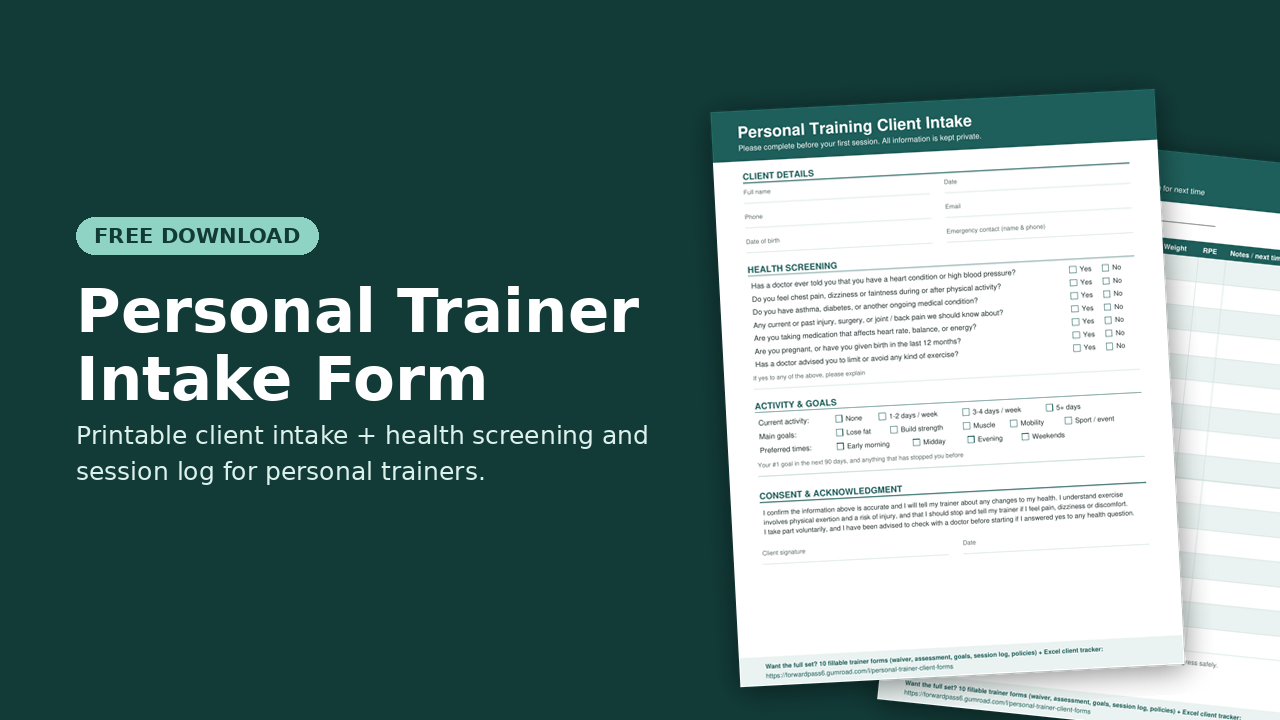
Free Personal Trainer Intake Form
A printable client intake and 7-question health screening plus a training session log for trainers and coaches.
Download free →1. Work out your target hourly rate
List what training costs you each year: the pay you want, gym rental or floor fees, insurance, certification renewals and continuing education, equipment, apps and software, mileage, marketing, card fees and money set aside for taxes. Then estimate how many paid sessions you can realistically coach per week, allowing for holidays, early-morning gaps and slower seasons. Divide yearly costs by paid sessions and you know what each session has to clear.
2. Count the hidden time per client
- Programming: writing and adjusting workouts week to week
- Assessment: the first consultation, health screening and periodic re-tests
- Check-ins: messages, form videos, nutrition or habit questions
- Travel and set-up: driving to in-home or outdoor sessions, preparing equipment
- Admin: booking, payments, waivers and progress notes
If each session carries 15 to 30 minutes of hidden work, your session rate needs to cover it.
3. Choose a pricing model
- Per session: simple for new or occasional clients, but income is less predictable
- Session packs: 10 or 20 sessions paid up front, often at a small discount, with an expiry date
- Monthly membership: a set number of sessions per month billed automatically, the steadiest income
- Small group or semi-private: a lower price per person while you earn more per hour
- Online coaching: a monthly fee for programming and check-ins without live sessions, which scales beyond your calendar
4. Adjust for location, format and specialty
In-home and mobile sessions usually cost more because of travel time; many trainers add a travel fee beyond a set radius. Specialist work such as pre and postnatal training, sports performance, rehab-adjacent strength work or nutrition coaching can command higher rates when you hold the right qualifications. Early-morning or peak-hour slots are also fair to price higher than off-peak times.
5. Set cancellation and payment rules
Missed sessions are the biggest leak in a trainer's income. Put the rules in writing before the first session: how much notice is needed to cancel (24 hours is common), whether a late cancel counts as a used session, when packs expire, and how payment is taken. A signed intake, health screening and waiver also protect you and show clients you run a professional business.
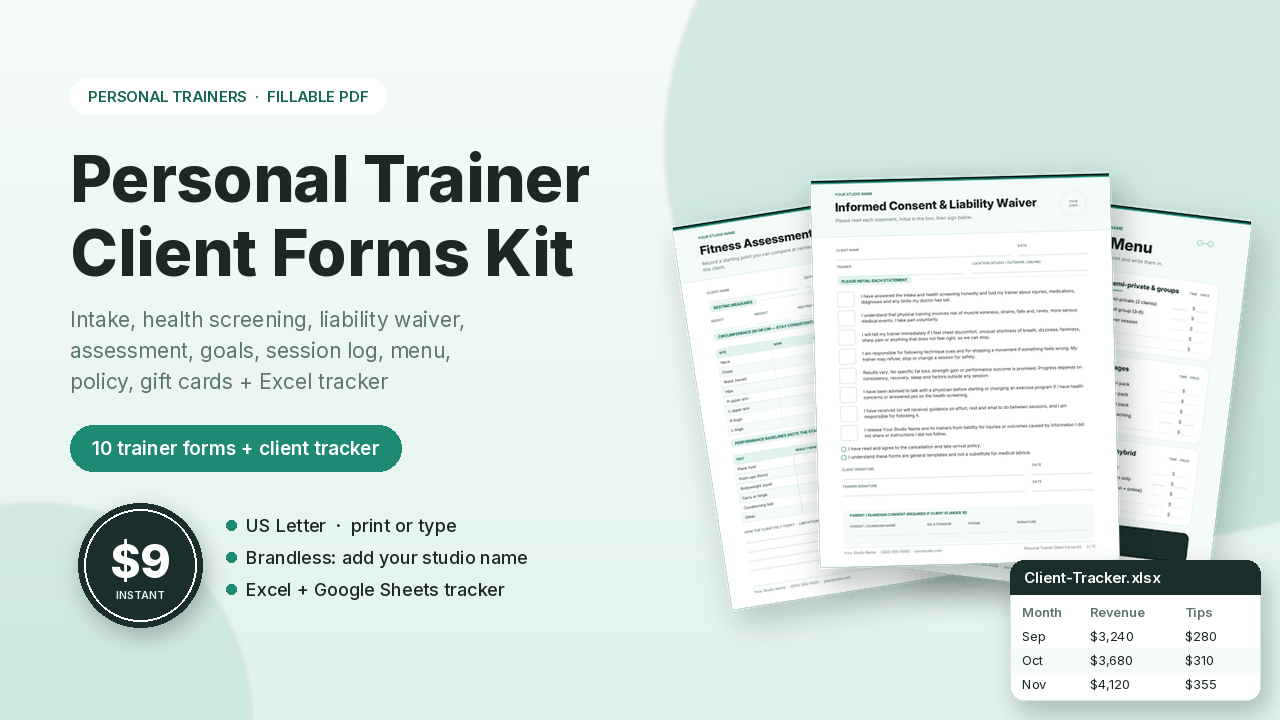
Personal Trainer Client Forms Kit
10 fillable forms (intake and lifestyle questionnaire, health screening, informed consent and liability waiver, fitness assessment, goal setting and training plan, session log, training menu, cancellation policy, photo release, gift certificates) plus an Excel client tracker.
Get it →Worked example (example numbers only)
Say a trainer wants yearly costs, pay and taxes covered at a level that works out to 1,200 paid sessions a year. If the total needed is $72,000, each session must clear $60. With about 20 minutes of programming and admin per session, a $60 rate keeps real pay on target only if clients rarely cancel. The trainer might offer single sessions at $70, a 10-pack at $620 that expires in 12 weeks, a 2-sessions-per-week membership at $480 per month, semi-private sessions at $40 per person and online coaching at $150 per month, plus a travel fee for in-home visits over 15 minutes away. Plug in your own numbers and local market rates.
Common pricing mistakes
- Pricing only the hour on the floor and ignoring programming and messages
- No cancellation policy, so no-shows cost you money
- Session packs that never expire
- Discounting so deeply that a full week still does not pay the bills
- Giving unlimited free check-ins to online clients
- Skipping the intake, health screening and waiver to save time
FAQ
How much should a personal trainer charge per session?
Work out what you need to cover your pay, gym or rental fees, insurance, education, equipment and taxes, then divide by the paid sessions you can realistically coach. Check local trainers with similar experience so your rate fits your market.
Are training packages better than paying per session?
Packages and monthly memberships give steadier income and better attendance, while per-session pricing suits occasional clients. Many trainers offer both, with a small discount for paying up front and an expiry date on packs.
How much should online personal training cost?
Online coaching is usually a monthly fee covering programming and check-ins. Price it by how much time each client takes per month, and set clear limits on check-ins and response times.
What is a fair cancellation policy for personal trainers?
A common policy is 24 hours notice, with late cancellations or no-shows counted as a used session. Put it in writing and have clients sign it before their first session.
Should in-home personal training cost more?
Usually yes, because travel time and equipment set-up are part of the job. Many trainers charge a higher rate or a travel fee beyond a set distance.
How often should personal trainers raise their rates?
Many review rates once a year or after gaining a new certification, and give current clients clear notice before a new rate starts.
This page is general guidance, not legal, tax, medical or business advice. Rules on waivers, insurance, health screening and taxes vary by location, so check the rules where you work.
Related templates
Free Personal Trainer Intake Form
A printable client intake and 7-question health screening plus a training session log for trainers and coaches.
Download free →Personal Trainer Client Forms Kit
10 fillable trainer forms (intake, health screening, waiver, assessment, session log) plus an Excel client tracker.
Get it →