Price Increase Letter to Clients: 5 Templates for Service Businesses (+ Free Invoice Template)
A practical guide for cleaners, lawn and snow crews, groomers, stylists, tutors and other service businesses raising their rates for the new year: work out the new price from your real costs, decide who it applies to and when, give fair notice, copy a letter, email or text template, answer pushback calmly, and update invoices, agreements and client records.
Why January is a natural time to raise your prices
If you run a cleaning company, a lawn or snow business, a salon chair, a grooming van, a tutoring service or any other recurring service, there comes a point where your rates no longer cover what the work costs you. Supplies, fuel, insurance, software and your own time all go up, and a price you set two or three years ago quietly turns into a pay cut.
The start of a new year is one of the easiest moments to fix that. Clients expect prices to change in January, your books for the year are fresh, and a rate change on the first invoice of the year is simple to track. The hard part is usually not the decision but the price increase letter itself: how much notice to give, what to say, how to explain it without apologizing, and what to do when a client pushes back.
This guide walks through all of it, with copy-ready templates for email, text and a printed note. Change the wording to sound like you.

Free 1-Page Invoice Template
A free 1-page invoice for Excel, Google Sheets and LibreOffice plus a printable PDF, with automatic line totals, discount, tax and due date, ready for your first invoice at the new rate.
Download free →Step 1: Work out what your new price needs to be
Before you write a word, check the numbers. A price increase that is based on your real costs is easier to explain and easier to stand behind. Pull last year's income and expenses (a free monthly expense log or the Small Business Expense Tracker makes this quick) and look at three things for one typical job:
- Direct costs per job: supplies, fuel or mileage, disposal fees, parking, card processing.
- Time per job: including travel, setup, cleanup and the messages and admin around it.
- Overhead per job: insurance, phone, software, equipment, marketing and other fixed costs, divided by the number of jobs you did.
| Line | Last year | This year |
|---|---|---|
| Direct costs per visit | $14 | $16 |
| Time per visit (incl. travel) | 2.5 hours | 2.5 hours |
| Overhead per visit | $9 | $11 |
| Target hourly pay for your time | $32 | $34 |
| Cost-based price per visit | $14 + $9 + (2.5 x $32) = $103 | $16 + $11 + (2.5 x $34) = $112 |
| Current price per visit | $100 | $100 |
Example only. Prices, costs, names and dates are made up to show the method. Use your own numbers, your own client agreements and the rules that apply where you work.
In this example the current $100 price is already below last year's cost-based price of $103 and well below this year's $112. A new price of $112 to $115 is simply catching up, not a luxury. Run the same math for each service you offer, then round to a clean number.
Step 2: Decide how much, for whom and from when
There is no single right percentage. What matters is that the new price covers your costs and your time, fits the market you serve and is something you are comfortable saying out loud. A few decisions to make before you write the letter:
| Decision | Options | Things to weigh |
|---|---|---|
| Who it applies to | All clients at once, new clients first, or everyone but a few long-time clients | A change for new clients only is easy, but it can leave your best regular clients underpaying for years |
| How big | One clean increase now, or a smaller increase now with a planned review every year | Smaller, regular increases are often easier for clients to accept than a big jump after years of no change |
| Start date | A clear date such as the first visit on or after a set date in January or February | Give enough notice for clients to plan; your agreement may set a minimum notice period |
| Grandfathering | Keep a long-time client at the old rate for a set period, then move them up | Always give grandfathering an end date so it does not become permanent by accident |
| Prepaid work | Honor the old price for anything already booked and paid | Gift certificates, packages and prepaid visits should be honored at the price they were sold |
Check your client agreements before you set the date. Some agreements say how much notice you must give before a price change, or fix a price for a season or a contract term. If you promised a fixed seasonal rate (for example a snow removal season or a school-year tutoring package), the new rate normally applies at the next renewal, not mid-term.
Step 3: Give enough notice
Notice is what makes a price increase feel fair rather than sudden. Common practice for recurring services is to tell clients a few weeks before the change takes effect, and longer for commercial accounts, contracts or clients who budget ahead. If your agreement names a notice period, follow it at a minimum.
A simple timeline for a January change:
- Late November to early December: finish your numbers and write the letter.
- Early to mid December: send the letter or email to every affected client, and update your price list and booking page for new clients.
- A week or two before the start date: a short reminder on the last invoice or a quick text.
- Start date: the first invoice at the new rate, with the new price clearly shown.
If you are reading this later in December, a February or March start date with the same steps works just as well. Rushing the change onto an invoice with little warning is what tends to cause friction.
What every price increase letter should include
- The new price, written plainly, for each service the client uses (for example "bi-weekly cleaning: $112 per visit, up from $100").
- The start date, written as a real date, and which visits or invoices it applies to.
- A short, honest reason in one or two sentences: rising costs for supplies, fuel, insurance or wages, or a change in how you work. No long justification and no apology.
- What stays the same or what is getting better: the same person, the same schedule, a new checklist, better products, longer appointments.
- Thanks for their business, said once and meant.
- How to reach you with questions, and a simple next step if they want to change their schedule or package.
Leave out long stories about inflation, comparisons with competitors, and phrases like "we hate to do this". Clear and friendly reads as confident; over-explaining reads as unsure.
Price increase letter templates you can copy
Replace everything in [brackets]. Keep the one that fits your business and delete the rest.
1. Email to recurring residential clients
Subject: Your [service] rate for [year]
Hi [Client name],
Thank you for choosing [Business name] this year. It has been a pleasure looking after [your home / your lawn / Buddy / your appointments].
I am writing to let you know that from [start date], the price for your [service and frequency] will be [new price] per [visit / session / month], up from [old price]. This is the first change to my rates since [year], and it reflects higher costs for [supplies, fuel and insurance].
Nothing else about your service changes: the same [schedule / team / checklist], and the same care you are used to.
If you have any questions, or would like to talk about a different schedule or package, just reply to this email or call me at [phone].
Thank you again for your support. I look forward to working with you in [year].
[Your name]
[Business name]
2. Letter to commercial or contract clients
Subject: Updated service pricing effective [start date]
Dear [Contact name],
Thank you for your business with [Business name]. We value our work with [Client company].
We are writing to give you [notice period] notice of an update to our pricing. From [start date], the rate for [service, scope and frequency] will be [new price] per [visit / month], replacing the current rate of [old price]. The update reflects increased costs for [labor, materials, insurance and equipment] since our current pricing was set in [month and year].
The scope of work in our agreement dated [date] stays the same. [If your agreement requires a signed amendment or renewal: We will send an updated agreement for signature by [date].]
Please let us know by [date] if you have questions or would like to review the scope or schedule to fit your budget.
Sincerely,
[Your name], [Title]
[Business name] · [phone] · [email]
3. Long-time client with a grandfathered rate
Hi [Client name],
You have been with me since [year], and I am truly grateful. Because of that, I want to give you plenty of notice and a softer start.
My rates for new clients are changing to [new price] per [visit / session] from [start date]. For you, your current rate of [old price] stays in place until [grandfathering end date]. From then on, your rate will be [new price or step price].
If you would like to talk about it, I am always happy to hear from you.
Thank you for being one of my first and best clients.
[Your name]
4. Short text message reminder
Hi [Client name], it's [Your name] from [Business name]. Quick reminder that your [service] rate changes to [new price] from your [date] visit, as mentioned in my [month] email. Thank you so much for your business! Any questions, just reply here.
5. A line for your new-client price list
Prices effective [start date]. Quotes and bookings confirmed before [date] keep the price shown on the quote. Prepaid packages and gift certificates are honored at the price they were sold.
How to reply when a client pushes back
Most clients will simply say thanks, or say nothing at all. A few will ask questions. Have short, calm replies ready so you are not tempted to back down on the spot.
| Client says | You can say | Options to offer |
|---|---|---|
| "That is a lot more." | "I understand, and I appreciate you telling me. The new rate reflects what the work now costs me to do properly." | A less frequent schedule, a smaller scope or a basic package at a lower price |
| "Can you keep my old rate?" | "I can keep it until [date] while you plan for the change. From then on it will be [new price]." | A short grandfathering period with a clear end date |
| "Someone else charges less." | "That may well be true. I set my prices to cover insured, reliable service and the time each job takes." | Point to what is included rather than matching a price |
| "I need to cancel." | "I understand. Thank you for the time we have worked together. If anything changes, I would be glad to have you back." | Leave the door open and confirm the final visit and invoice in writing |
Losing a client or two after a price increase is normal and often expected. If the new price is based on your real costs, the work you keep is usually more profitable than the work you lose, and the freed-up time can go to new clients at the new rate.
Update your invoices, agreements and records
The letter is only half of the change. Make sure the new rate shows up everywhere a client or a future you will look:
- Invoices: the first invoice at the new rate should show the new price clearly. A free 1-page invoice template lets you add a one-line note such as "New rate from [date], as announced on [date of letter]".
- Client agreements: if your agreement lists prices, send an updated version or a short written amendment, and keep the signed copy.
- Price list, website and booking page: update them on the day you send the letter, so new clients see the same price your existing clients were told.
- Client records: note each client's old rate, new rate, start date, the date you told them and any grandfathering end date. This is what stops a client from staying on an old rate by mistake.
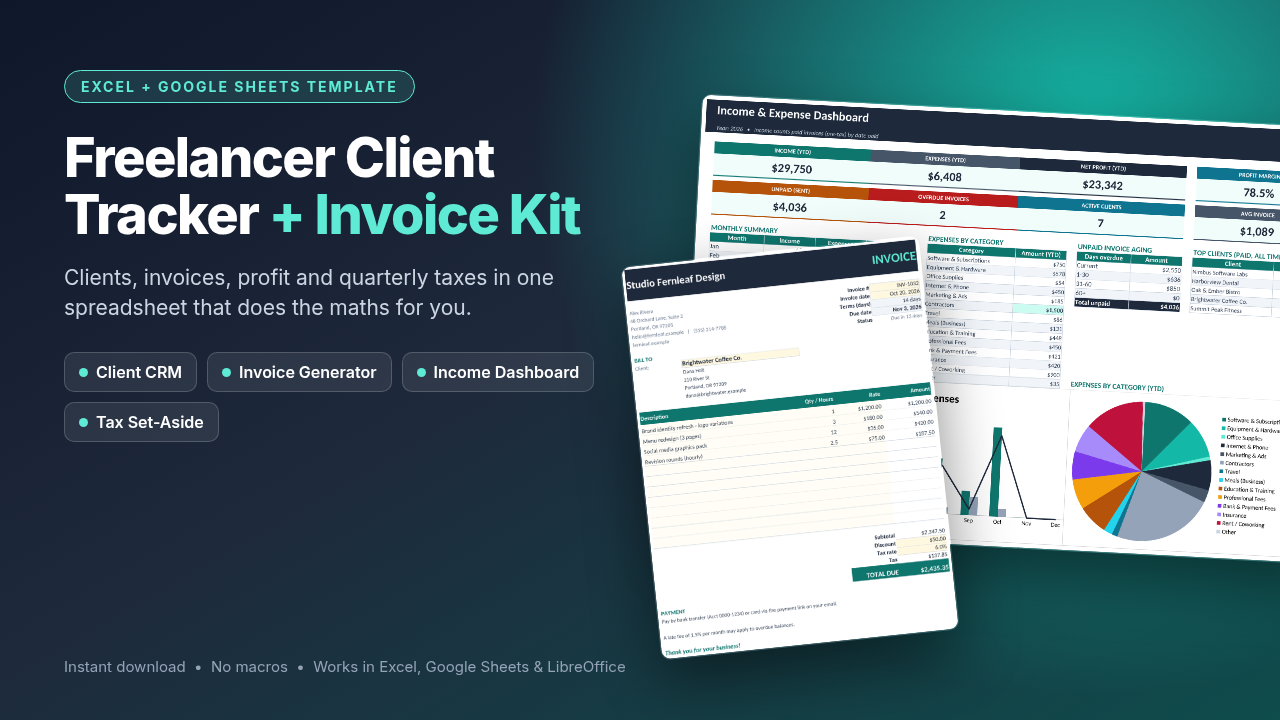
Freelancer Client Tracker + Invoice Kit
One Excel and Google Sheets file with a client list that stores each client's rate and payment terms, an invoice generator with client dropdowns, an invoice log with overdue alerts, an expense tracker, an income dashboard and a quarterly tax set-aside calculator. It does not include letter templates; copy the letters on this page.
Get it →Track every client's rate change in one place
Even with ten or twenty clients it is easy to lose track of who was told what. A simple table is enough:
| Client | Service | Old rate | New rate | Notified | Starts | Grandfathered until | Reply |
|---|---|---|---|---|---|---|---|
| A. Lopez | Bi-weekly clean | $100 | $112 | Dec 4, 2026 | Jan 4, 2027 | - | Thanked |
| Greenway Dental | Weekly office clean | $180 | $198 | Dec 1, 2026 | Feb 1, 2027 | - | Asked for updated agreement |
| M. Chen | Monthly deep clean | $160 | $175 | Dec 4, 2026 | Mar 1, 2027 | Feb 28, 2027 | Long-time client |
| R. Patel | Weekly clean | $95 | $112 | Dec 4, 2026 | Jan 4, 2027 | - | Moved to bi-weekly |
Example only. Prices, costs, names and dates are made up to show the method. Use your own numbers, your own client agreements and the rules that apply where you work.
The Freelancer Client Tracker + Invoice Kit has a client list with each client's rate and payment terms, an invoice generator that pulls client details from a dropdown, and an invoice log, so the rate change, the first invoice at the new price and the payment all live in one spreadsheet.
Common price increase mistakes
- Raising prices on an invoice with no warning.
- Leaving out the actual new price or the start date.
- Apologizing at length or giving a long list of reasons.
- Changing a price that your agreement fixes for a season or term.
- Grandfathering long-time clients with no end date.
- Forgetting to honor prepaid visits, packages and gift certificates.
- Updating the letter but not the website, price list and agreements.
- Waiting years between increases, so the jump feels bigger than it needs to be.
Price increase checklist
- Costs per job checked against last year's numbers
- New price for each service, rounded to a clean number
- Start date and notice period checked against client agreements
- Decision on grandfathering, with an end date
- Prepaid work, packages and gift certificates honored at the old price
- Letter or email written and sent to every affected client
- Price list, website and booking page updated the same day
- Reminder scheduled before the start date
- First invoice at the new rate shows the price clearly
- Client records updated with old rate, new rate, dates and replies
FAQ
How much notice should I give before raising my prices?
Follow any notice period in your client agreement first. Beyond that, a few weeks is common for recurring residential services, and longer for commercial accounts, contracts and clients who budget ahead. For a January change, sending the letter in early or mid December gives clients time to plan.
What should a price increase letter say?
The new price for each service, the date it starts, a short honest reason such as higher costs for supplies, fuel or insurance, what stays the same, a thank-you, and how to reach you with questions. Keep it short and do not apologize at length.
Should I explain why I am raising my prices?
A one or two sentence reason helps, such as higher costs for supplies, fuel, insurance or wages. You do not need to share your numbers or justify every dollar. Long explanations tend to invite negotiation.
Should I raise prices for existing clients or only new clients?
Raising prices for new clients first is the easiest step, but if existing clients never move up they can end up well below your cost-based price. Many service businesses move everyone to the new rate with notice, and give a few long-time clients a short grandfathering period with a clear end date.
Can I raise prices in the middle of a contract?
Check your agreement. If it fixes a price for a season or a term, the new rate normally applies at the next renewal. If it allows price changes with notice, follow the notice it requires. When in doubt, ask a local attorney.
What if a client cancels after a price increase?
Thank them, confirm the final visit and invoice in writing and leave the door open. If your new price is based on your real costs, the time freed up can be filled by new clients at the new rate.
This page is general information for small service businesses, not legal, tax, accounting or financial advice. Rules on price changes, notice periods, contracts, consumer protection and prepaid services vary by country, state and city and can change; check your own agreements and ask a qualified accountant or attorney if you are unsure. All prices, costs, names and dates shown are examples only.
Related templates
Free 1-Page Invoice Template
A free 1-page invoice for Excel, Google Sheets and LibreOffice plus a printable PDF, with automatic line totals, discount, tax and due date, ready for your first invoice at the new rate.
Download free →Freelancer Client Tracker + Invoice Kit
Client list with rates and payment terms, invoice generator, invoice log with overdue alerts, expense tracker and profit dashboard.
Get it →More free guides
- How to Ask Clients for Reviews
- Year-End Client Thank-You Notes
- January Slow Season Promo Ideas
- How to Calculate Your Freelance Hourly Rate (Simple Formula)
- Year-End Checklist for Freelancers
- How to Track Freelance Clients, Projects and Payments in One Spreadsheet
- Free Freelance Invoice Template (and What to Put on It)
- Late Payment Email Templates for Freelancers (Polite to Firm)
- House Cleaning Pricing
- Lawn Care Pricing
- Dog Grooming Pricing