Personal Training Gift Certificate: What to Include, Package Ideas and How to Redeem (+ Free Forms)
A practical guide for trainers selling training as a holiday gift: what to put on the certificate, packages that sell, wording that lands well, fine print to check, onboarding the recipient, and how many certificates you can actually serve in January.
Why personal training gift certificates work in December
December is usually a quieter month on a trainer's calendar, and it is also when partners, parents and adult children are looking for a gift that feels more personal than another sweater. A personal training gift certificate connects the two: someone pays you in December, and a new client walks in during January, when motivation is high and many people are already looking for help with a New Year goal.
Done well, a certificate is not just a pretty card. It names exactly what the recipient gets, has a number you can look up, explains how to book, and leads the new client straight into your normal intake, health screening and waiver process. Done badly, it creates confusion months later: a recipient who does not know what is included, a session count nobody tracked, or an expiry date that may not even be allowed where you work.
This guide covers what to put on a training gift certificate, how to choose between dollar-value and named-package certificates, how to word it so it lands well, the fine print to check, how to plan January capacity, and how to track and redeem every certificate. For what to charge per session, see how much to charge for personal training. For the January packages many gift certificates feed into, see New Year personal trainer pricing. For onboarding the recipient once they book, see the personal trainer intake form and the personal training liability waiver guides.
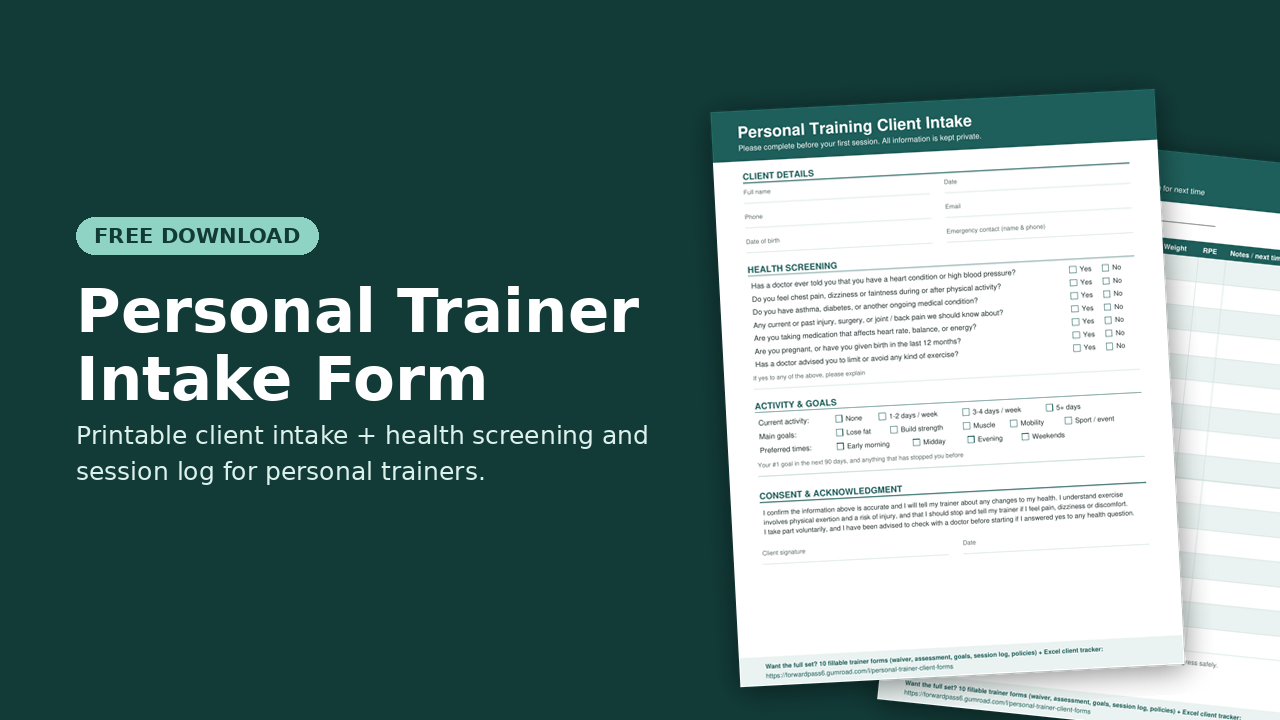
Free Personal Trainer Intake Form
A printable client intake and 7-question health screening plus a training session log for trainers and coaches.
Download free →1. Dollar-value or named-package certificates?
There are two common ways to sell training as a gift. A dollar-value certificate (for example "$150 toward personal training") is flexible and easy to buy, but the recipient has to work out what that buys, and it can leave awkward leftover balances. A named-package certificate (for example "Starter Package: fitness assessment plus four 60-minute sessions") tells the recipient exactly what they get and makes the gift feel complete. Many trainers offer both: one or two named packages as the main gift, and a dollar-value option for people who want to choose their own amount.
| Dollar-value certificate | Named-package certificate | |
|---|---|---|
| What the recipient gets | A credit toward any service you offer | A defined package, e.g. assessment plus a set number of sessions |
| Best for | Buyers who want a set budget; existing clients topping up | First-time recipients who need a clear starting point |
| Upside | Flexible; works with any price change | Clear value; easy to schedule; easy to explain |
| Watch out for | Leftover balances; recipient unsure what to book | Price changes before redemption; substitutions |
| What to print | The dollar amount and that it applies to your services | Exactly what is included, session length and format |
If you raise your rates in January, a named-package certificate should still deliver the package that was bought. Say that clearly on the certificate ("includes the services listed regardless of later price changes") so the recipient is not asked to pay a difference.
2. What to print on a personal training gift certificate
The certificate is often the first thing a new client ever sees from you, so it should look professional and answer every practical question before they have to ask. These are the fields worth including.
| Field | What to write | Why it matters |
|---|---|---|
| Business details | Your business or trading name, phone, email, website or booking link | The recipient needs to know who to contact |
| Certificate number | A unique number, e.g. PT-GC-2026-007 | Lets you look it up, prevents copies being used twice |
| To / From | Recipient's name and the buyer's name (optional message) | Personal touch; tells you who to contact about redemption |
| Value or package | Dollar amount, or the named package with sessions and length | Defines exactly what you owe |
| Format and location | In person at a named studio or gym, in-home, outdoor or online | Avoids surprises about where training happens |
| How to book | "Call or text [number] or visit [link] and quote your certificate number" | Turns the gift into a booked first session |
| First-visit requirements | "New clients complete an intake, health questionnaire and waiver before training" | Sets expectations; makes the screening feel normal |
| Issue date | The date it was sold | Needed for any expiry or validity rules |
| Expiry or validity terms | Only terms that follow the rules where you work (see section 5) | Expiry rules for gift certificates are regulated in many places |
| Key terms | Not redeemable for cash (unless required), your cancellation policy applies, transfer rules | Prevents disputes later |
Keep the design simple: one clear headline, the package name, the recipient's name and the booking line should be readable at a glance. A printable version for wrapping and a PDF version for last-minute email gifts cover most buyers.
3. Gift package ideas that sell
The easiest gifts to buy are packages with a clear name, a clear number of sessions and a clear first step. Build them from services you already offer rather than inventing something new for December.
| Package idea | What it could include | Who it suits |
|---|---|---|
| Starter Package | Fitness assessment plus 4 sessions, used within a set number of weeks | Someone new to training or returning after a break |
| Single Session Taster | One assessment and one session | A buyer unsure the recipient will want a full package |
| Partner or Buddy Package | Shared sessions for two people | Couples, friends, parent and adult child |
| Program Design Gift | Assessment plus a written plan the recipient follows alone | Self-motivated people; online clients |
| Online Coaching Month | A month of remote check-ins and programming | Recipients who live far away or travel |
| Top-Up Credit | A dollar amount for an existing client | Families of your current clients |
Name packages around goals that feel positive: "Strength Starter", "Feel Stronger in the New Year", "Move Better Package". That matters more for training than for most gifts, which leads to the next section.
4. Word it so the gift lands well
A training gift can be read the wrong way. A certificate that says "lose the holiday weight" can feel like a comment on someone's body, even when the buyer meant well. Trainers who sell a lot of gift certificates tend to keep the wording about energy, strength, confidence and support, and leave specific goals for the intake conversation with the recipient.
- Lead with the experience. "Four one-on-one sessions with a coach who builds the plan around you" reads better than any weight or body promise.
- Let the recipient set the goal. Say that the first session starts with their goals and an assessment.
- Give buyers a short checklist. Suggest they make sure the recipient actually wants coaching, and mention your transfer policy in case they would rather pass it on.
- Avoid outcome promises. Do not print results, timeframes or health claims on the certificate.
A simple message line works well: "To [Name]: here's to feeling strong in the New Year. Love, [Buyer]." Leave the rest to your first conversation.
5. Fine print: expiry, refunds and the rules to check
Gift certificate rules are set by law in many places, and they are often stricter than trainers expect. In the US, federal rules generally do not allow a gift certificate bought with money to expire sooner than five years after it is issued, and they limit fees such as inactivity fees. Many states add their own rules, and some do not allow expiry dates on gift certificates at all. Check the current rules for your state, or ask your accountant or attorney, before you print an expiry date.
Many trainers separate two ideas. The certificate itself follows whatever gift certificate rules apply. The package schedule (for example "sessions are scheduled weekly once started") is about how the training is delivered. Whatever you choose, write it down plainly and do not use fine print to take back value the buyer paid for.
| Term | Common approach | Check first |
|---|---|---|
| Expiry | No expiry, or only what your state allows | Federal and state gift certificate rules |
| Cash refunds | Not redeemable for cash, except where the law requires | Some states require cash back for small remaining balances |
| Transfer | Can be given to another adult with notice to you | The new recipient still completes intake and waiver |
| Cancellations and no-shows | Your normal cancellation policy applies to booked sessions | Your client agreement and how you enforce it |
| If you close or move | How unused value will be honored or refunded | Consumer rules in your state |
| Sales tax and accounting | Record the sale; recognize income as sessions are delivered, per your accountant | State tax rules and your accountant's advice |
| Unclaimed balances | Track them; some states treat them as unclaimed property | State unclaimed property rules |
Put the key terms on the certificate itself and the full terms on your website or booking page, so buyer and recipient see the same thing.
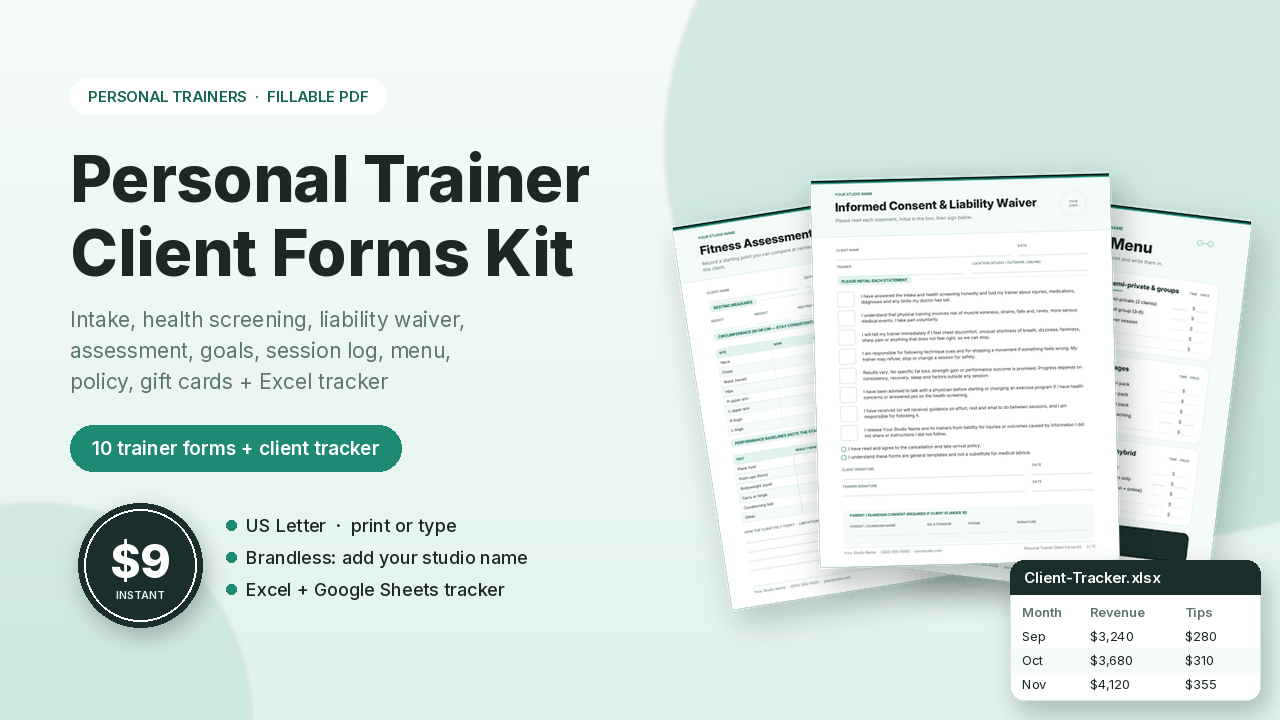
Personal Trainer Client Forms Kit
10 fillable forms (intake and lifestyle questionnaire, health screening, informed consent and liability waiver, fitness assessment, goal setting and training plan, session log, training menu, cancellation policy, photo release, gift certificates) plus an Excel client tracker. Want every kit? See the bundle.
Get it →6. Redemption: intake, health screening and waiver come first
This is where training differs from most gift certificates. The person who paid is not the person who will be exercising. The recipient still needs to go through your normal onboarding before the first session, and the buyer cannot sign on their behalf.
- Intake. Contact details, goals, schedule, training history and preferences. The intake form guide covers what to ask.
- Health screening. A pre-exercise questionnaire, such as the PAR-Q+, or your own health history form. If answers suggest a risk, ask the recipient to get medical clearance before training, the same as any other client.
- Informed consent and waiver. The recipient signs their own waiver. If the recipient is a minor, a parent or legal guardian needs to sign, and your insurance may have rules about training minors. See the liability waiver guide.
- Policies. Cancellation, late arrival and photo release, signed or acknowledged like any other client.
- Assessment. If the package includes a fitness assessment, it gives you a baseline and is the natural first session. See the fitness assessment form guide.
Send these forms when the recipient books, not on the day, so the first session is spent training rather than filling in paperwork. If medical clearance is needed and delays the start, note it in your log so the certificate does not look unused.
7. Worked example: pricing a Starter Package certificate
Here is one way a trainer might turn existing rates into a gift package without discounting their core rate. All figures are examples only.
| Item | Calculation | Amount |
|---|---|---|
| Standard 60-minute session (example rate) | — | $80 |
| Four sessions at the standard rate | 4 × $80 | $320 |
| Fitness assessment (normally charged at a session rate) | 1 × $80 | $80 |
| Value if bought separately | $320 + $80 | $400 |
| Starter Package gift price (assessment included at no charge) | 4 × $80 | $320 |
| Value to the recipient vs paying separately | $400 − $320 | $80 |
| Single Session Taster (assessment + 1 session) | $80 + $80 = $160, offered at | $120 |
Example only. Rates, package contents, names, numbers and dates are made up to show the method. Use your own prices, your own policies and the rules that apply where you work.
The core session rate stays at $80; the gift value comes from including the assessment, not from cutting the per-session price. That protects your pricing in January, when the recipient may want to continue at your standard rate. If you offer a dollar-value certificate as well, amounts that match real purchases ($80, $160, $320 in this example) are easier to redeem than round numbers that leave odd balances.
8. Worked example: how many certificates you can actually serve in January
Gift certificates are prepaid work. If most recipients want to start in the first weeks of January, the risk is not selling too few, it is selling more than you can schedule. Work backward from your open hours.
| Step | Calculation | Result |
|---|---|---|
| Open hours per week for new clients in January (example) | — | 10 hours |
| Weeks you plan to onboard gift recipients | Mon Jan 4 to Fri Jan 29, 2027 | 4 weeks |
| Total hours available for gift recipients | 10 × 4 | 40 hours |
| Hours each Starter Package needs | 1 assessment + 4 sessions | 5 hours |
| Maximum Starter Packages to sell | 40 ÷ 5 | 8 certificates |
| December revenue if all 8 sell (example) | 8 × $320 | $2,560 |
Example only. Rates, package contents, names, numbers and dates are made up to show the method. Use your own prices, your own policies and the rules that apply where you work.
Not every recipient redeems in January, but planning as if they will keeps you from overbooking. Once you reach your limit, stop selling that package or move to a later start window ("sessions available from February"). Treat the December money as payment for work you still owe: many trainers keep it aside until the sessions are delivered. Ask your accountant how to record prepaid sessions in your books.
9. Keep a gift certificate log
Every certificate you sell is a promise you still owe. A simple log, in a spreadsheet or your client tracker, makes it easy to answer "has this one been used?" and shows you what is still outstanding.
| Certificate # | Sold | Buyer | Recipient | Package / value | Paid | Status |
|---|---|---|---|---|---|---|
| PT-GC-2026-001 | Fri Dec 4, 2026 | J. Rivera | M. Rivera | Starter Package | $320 card | Booked; assessment Mon Jan 4, 2027 |
| PT-GC-2026-002 | Fri Dec 11, 2026 | A. Chen | D. Chen | Single Session Taster | $120 transfer | Not yet booked |
| PT-GC-2026-003 | Fri Dec 18, 2026 | S. Patel | R. Patel | $160 credit | $160 card | Redeemed $80 Mon Jan 11, 2027; $80 left |
| PT-GC-2026-004 | Thu Dec 24, 2026 | L. Brooks | K. Brooks | Starter Package (PDF) | $320 card | Waiting on medical clearance |
Example only. Rates, package contents, names, numbers and dates are made up to show the method. Use your own prices, your own policies and the rules that apply where you work.
Useful columns beyond these: sessions used and remaining, date intake and waiver were received, and notes on transfers. Review the log monthly and send a friendly reminder to recipients who have not booked. In this example, the outstanding amount after the January redemption is $320 + $120 + $80 + $320 = $840.
10. Selling certificates in December
- Tell current clients first. They already trust you and often buy for partners, parents or adult children.
- Set a delivery cutoff. For example: printed certificates ordered by Fri Dec 18, 2026 for pickup; PDF certificates any time up to Thu Dec 24, 2026. Christmas Day 2026 falls on a Friday.
- Make buying easy. One page or link that lists the packages, prices and what is included, with payment and a field for the recipient's name.
- Deliver fast. Send the PDF within a day of payment and add the certificate to your log immediately.
- Show the next step. Include a short note for the recipient on how to book and what to expect at the first visit.
- Cap packages to your capacity. Use the January capacity math above and say "limited spots" only if it is true.
Common gift certificate mistakes for trainers
- No certificate number. Without one you cannot tell which certificates are used.
- Vague value. "Training gift" does not tell anyone what is included.
- Printing an expiry date without checking the rules. Many places restrict or ban expiry dates on certificates bought with money.
- Skipping the screening because it is a gift. The recipient needs the same intake, health questionnaire and waiver as any client.
- Letting the buyer sign the waiver. An adult recipient signs their own; a minor needs a parent or guardian.
- Body-focused wording. Keep the message about strength, energy and support.
- Overselling January. Sell only what your open hours can deliver.
- Spending prepaid money early. It pays for sessions you still owe.
One-page gift certificate checklist
- Packages defined from services you already offer, at your core rate
- Dollar-value option in amounts that match real purchases
- Business details, booking line and certificate number on every certificate
- To/From, package or value, format and location, issue date
- Expiry and refund terms checked against the rules where you work
- First-visit note: intake, health questionnaire and waiver required
- Positive, goal-neutral wording
- January capacity limit worked out and respected
- Delivery cutoffs for printed and PDF certificates
- Every sale added to the gift certificate log
- Monthly log review and reminders for unbooked recipients
FAQ
What should a personal training gift certificate include?
Your business name and contact details, how to book, a unique certificate number, who it is to and from, the dollar value or the named package with the number and length of sessions, where training happens (in person or online), a note that new clients complete an intake, health questionnaire and waiver, the issue date, expiry terms that follow the rules where you work, and short terms such as your cancellation policy.
Is a package or a dollar amount better for a training gift?
A named package, such as an assessment plus four sessions, is usually easier for a first-time recipient because it says exactly what they get. A dollar-value certificate suits buyers who want a set budget or existing clients. Many trainers offer both.
Can a personal training gift certificate expire?
It depends on where you work. In the US, federal rules generally do not allow gift certificates bought with money to expire sooner than five years after they are issued, and many states have stricter rules or ban expiry dates. Check your state's current rules, or ask an accountant or attorney, before printing an expiry date.
Does the gift recipient need to sign a waiver?
Yes. The recipient, not the buyer, completes your intake and health screening and signs their own informed consent and waiver before the first session. For a minor, a parent or legal guardian signs, and you should check your insurance rules for training minors.
How many training gift certificates should I sell?
Work backward from the hours you can open for new clients in January. For example, 10 open hours a week for 4 weeks is 40 hours; if each package needs 5 hours, that is 8 packages. Stop selling or offer a later start date once you reach that limit.
How do I word a fitness gift so it does not offend?
Keep it about strength, energy, confidence and having a coach in their corner, and let the recipient set their own goals at the first session. Avoid weight-loss or body-focused wording and avoid promising results.
This page is general information for personal trainers and fitness coaches, not legal, tax, medical or accounting advice. Gift certificate rules on expiry dates, fees, cash refunds, unclaimed property and sales tax vary by country, state and locality and can change; check with your state, a qualified accountant or an attorney. Clients with health concerns should get medical clearance before training. All rates, names, numbers, dates and amounts shown are examples only.
Related templates
Free Personal Trainer Intake Form
A printable client intake and 7-question health screening plus a training session log for trainers and coaches.
Download free →Personal Trainer Client Forms Kit
Fillable intake, health screening, waiver, fitness assessment, session log, cancellation policy and gift certificates plus an Excel client tracker.
Get it →