How Much to Charge for Mobile Bartending: Hourly Rates, Per-Guest Packages, Travel and Deposits (Plus Free Forms)
How to price mobile bartending services: find your target hourly rate, count setup, travel and shopping time, compare hourly, per-guest and package pricing, and set deposit and cancellation rules, with a worked example and free printable forms.
Why mobile bartending prices are hard to set
The hours behind the bar are only part of the job. Every event also needs a consultation, menu planning, a shopping list, loading and unloading, travel, setup, breakdown and cleaning. Bartenders who quote only service hours often find their real pay is far lower than it looks. A simple method fixes that: know what every working hour must earn, count all the time an event really takes, and choose a pricing model clients understand.
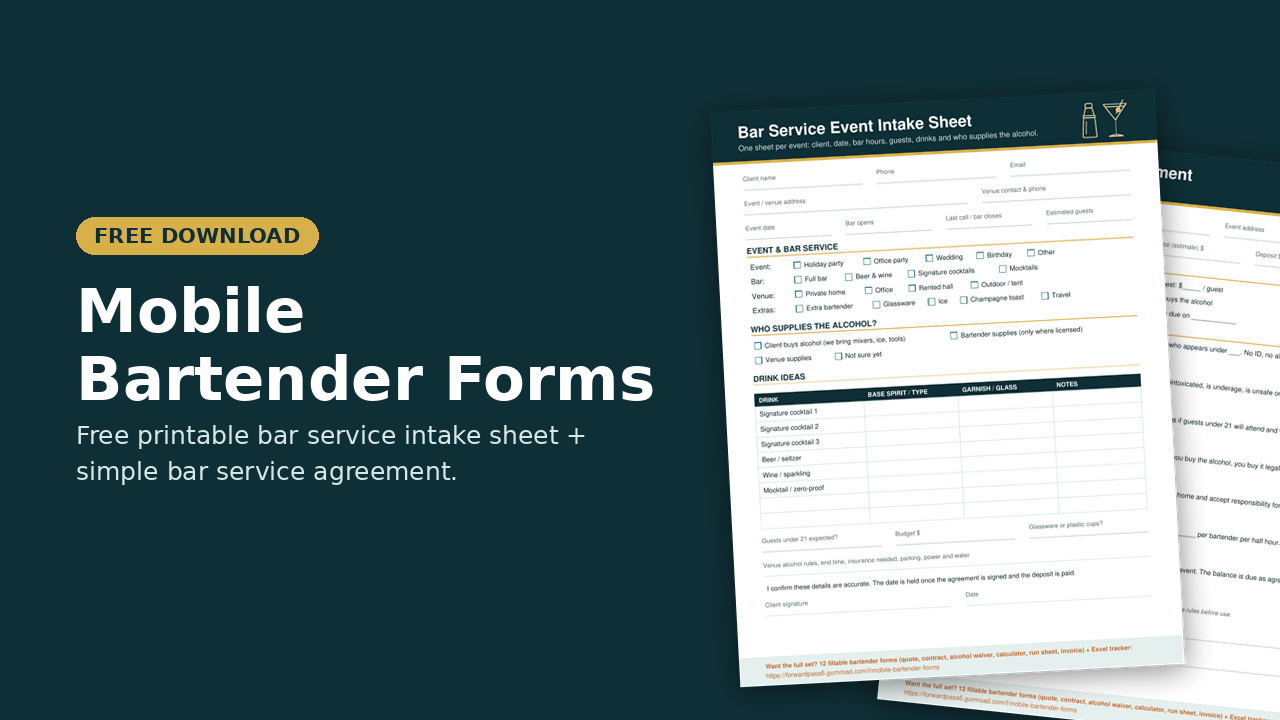
Free Mobile Bartender Forms
A printable bar service event intake sheet plus a simple bar service agreement for mobile bartenders and small bar services.
Download free →1. Work out your target hourly rate
List what your bar business costs each year: the pay you want, liability and liquor liability insurance, permits or licenses where required, the bar setup, tools, glassware or disposables, ice chests, vehicle costs, marketing, software, card fees and money set aside for taxes. Then estimate how many events you can realistically work in a year, allowing for slow months. Divide your yearly costs by total working hours (not just service hours) to see what each hour must clear.
2. Count the hidden time per event
- Planning: inquiry calls, menu design, drink counts and the shopping list
- Shopping and prep: buying mixers, garnishes and ice, juicing and batching
- Travel: driving to and from the venue, plus parking and loading
- Setup and breakdown: often 1 to 2 hours on top of service time
- Admin: contracts, invoices, follow-ups and reviews
Add these up for a typical event. If a 4-hour wedding really takes 9 hours of your time, your price needs to cover all 9.
3. Pick a pricing model
- Hourly per bartender: simple and common, usually with a minimum number of hours. Add setup and breakdown time or a flat setup fee.
- Per guest: easy for clients to compare, and it scales staffing and supplies with headcount.
- Packages: bundle service hours, a signature drink menu, mixers, garnishes and cups into tiers such as basic, standard and premium.
- Dry hire vs full service: when the client buys the alcohol you charge for service and supplies only; when you provide drinks, price the alcohol at cost plus a markup and follow local liquor rules.
4. Adjust for the event
Raise or lower the base price for guest count (and the number of bartenders needed, often one per 50 to 100 guests depending on the menu), menu complexity, specialty cocktails, travel distance, peak dates such as Saturdays in wedding season and holidays, venue rules, and extras like a mobile bar rental, glassware or a champagne toast. Late-night overtime should have its own hourly rate in the contract.
5. Set deposit, cancellation and payment rules
Date holds are where mobile bartenders lose the most money. Put the rules in writing before the event: a non-refundable deposit to book the date (25 to 50 percent is common), when the balance is due, what happens if the guest count changes, overtime rates, and the cancellation terms. A signed service agreement and a clear alcohol policy (ID checks, the right to refuse service, last call) protect you and show clients you run a professional business.
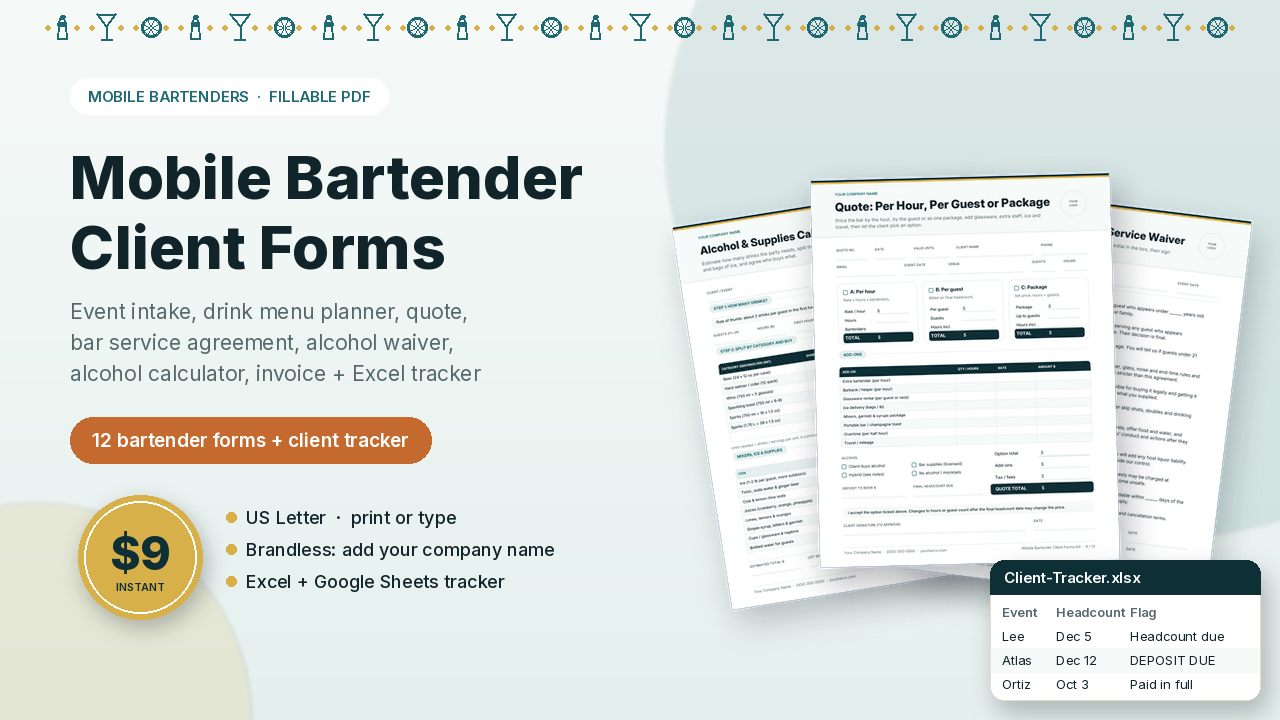
Mobile Bartender Client Forms Kit
12 fillable forms (event intake, drink menu & signature cocktail planner, quote with per-hour, per-guest and package pricing, bar service agreement, alcohol service waiver, alcohol & supplies calculator, incident & refusal of service log, invoice and more) plus an Excel client tracker.
Get it →Worked example (example numbers only)
Say a bartender needs $45 per working hour to cover pay, costs and taxes. A 100-guest wedding with 5 service hours also takes 1.5 hours of setup and breakdown, 1.5 hours of travel and 2 hours of planning and shopping, so 10 hours in total, or $450. Two bartenders are needed, so labor is about $900 before supplies. If mixers, garnishes, ice and cups cost $3 per guest, add $300, then a 20 percent markup on supplies. The quote might be a standard package at $1,260, or about $12.60 per guest, with a $400 deposit, $75 per bartender per hour of overtime and a travel fee beyond 30 miles. Use your own numbers and local market rates.
Common pricing mistakes
- Quoting service hours only and ignoring setup, travel and shopping
- No minimum hours, so small parties are not worth the trip
- Taking bookings without a non-refundable deposit
- Not putting overtime and guest count changes in the contract
- Underestimating ice, cups and garnishes for big events
- Skipping the written agreement and alcohol policy
FAQ
How much should a mobile bartender charge per hour?
Work out what you need to cover your pay, insurance, supplies, vehicle, marketing and taxes, then divide by the total hours you actually work, including setup, travel and planning. Check local bartending services so your rate fits your market.
Is it better to charge per hour or per guest?
Hourly pricing is simple for small events, while per-guest pricing and packages are easier for clients to compare on large events. Many mobile bartenders quote packages and keep an hourly rate for overtime.
How many bartenders do I need for an event?
A common rule of thumb is one bartender per 50 to 100 guests, depending on how complex the drink menu is. Full cocktail menus need more staff than beer and wine only.
Should mobile bartenders charge for travel?
Usually yes. Many include a set distance in the base price and add a travel fee per mile or a flat fee beyond it.
How much deposit should a mobile bartender take?
A non-refundable deposit of 25 to 50 percent to hold the date is common, with the balance due before the event. Put it in the signed agreement.
Can a mobile bartender provide the alcohol?
It depends on local liquor laws. In many areas the client buys the alcohol and the bartender provides service, so check the licensing rules where you work before selling drinks.
This page is general guidance, not legal, tax or business advice. Liquor licensing, insurance and tax rules vary by location, so check the rules where you work.
Related templates
Free Mobile Bartender Forms
A printable bar service event intake sheet plus a simple bar service agreement for mobile bartenders and small bar services.
Download free →Mobile Bartender Client Forms Kit
12 fillable bar service forms (intake, quote, agreement, alcohol waiver, supplies calculator, invoice) plus an Excel client tracker.
Get it →