Mobile Bartender Client Questionnaire: What to Ask Before You Quote an Event
A practical guide for mobile bartenders and small bar services: the questions to ask every client before you quote a wedding, party or corporate event, how to turn the answers into an accurate quote and staffing plan, and the forms to have ready once the date is booked.
Why every bar booking should start with a client questionnaire
Most mobile bartending headaches start with a quote built on a two-line inquiry. "About 100 people, open bar, Saturday night" sounds simple until you learn the venue requires two licensed bartenders and a certificate of insurance, the client expected you to bring all the alcohol, half the guests are under 21, and the bar has to be set up on a lawn two hundred feet from the nearest outlet. Every one of those details changes your price, your staffing and sometimes whether you can legally take the job at all.
A short questionnaire, sent before you quote, puts those details on paper while they are still easy to plan around. It filters out events that are not a fit, gives you the numbers you need for a fast, accurate quote, and shows the client that you run a professional, organized service. Clients comparing three bartenders usually book the one who asks clear questions and answers with a clear plan. Below are the sections to include, the questions in each, and how to turn the answers into a quote.
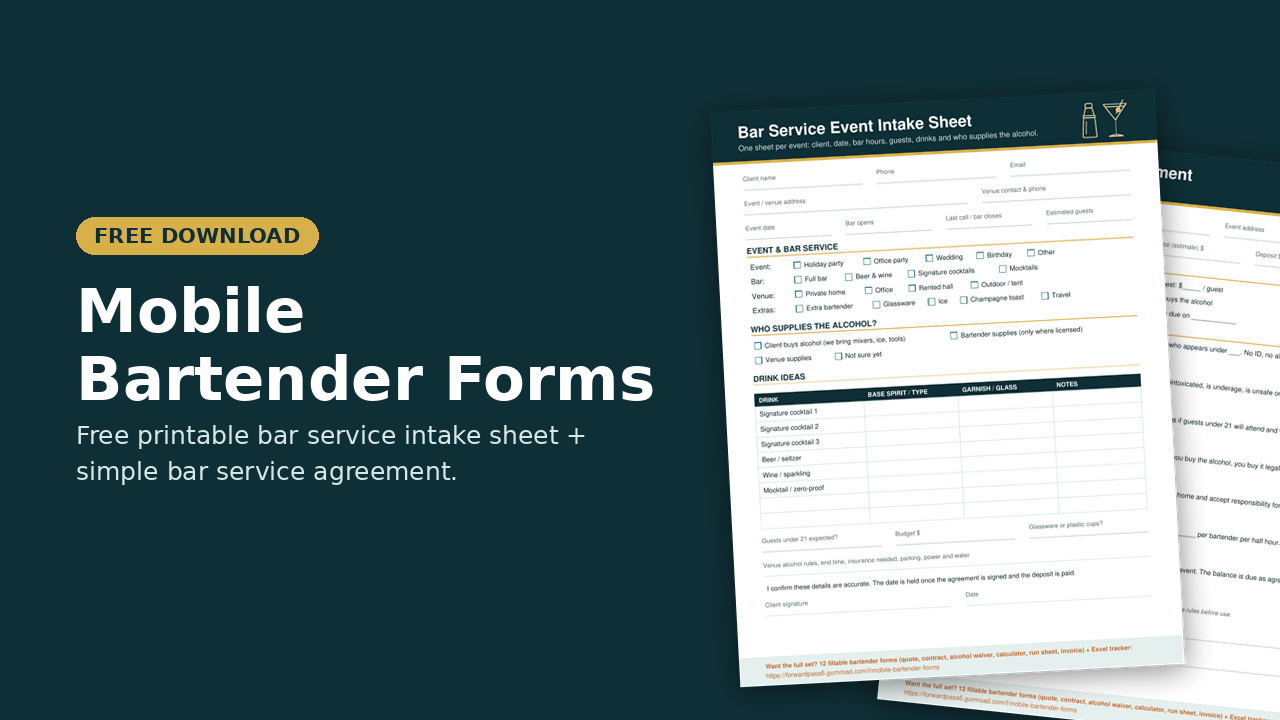
Free Mobile Bartender Forms
A printable bar service event intake sheet plus a simple bar service agreement for mobile bartenders and small bar services.
Download free →Section 1: Contact and event basics
- Client full name, phone number and email address
- Preferred contact method and best times to reach them
- Type of event: wedding, birthday, holiday party, corporate event, fundraiser, private dinner
- Event date, and whether the date is confirmed or still flexible
- Venue name and address, or the home address for a private party
- Indoor, outdoor or both, and a backup plan for weather
- Who the day-of contact will be if it is not the client, such as a planner or venue coordinator
- How they found you, and whether they have other vendors booked (caterer, DJ, rentals)
Ask about other vendors early. If a caterer is already providing glassware, ice or a bar table, you do not want to pack and charge for duplicates. If a planner is running the timeline, you will coordinate setup times with them rather than the client.
Section 2: Guest count and crowd
Guest count drives almost everything in a bar quote: staffing, supplies, ice and how long the line gets. Ask:
- Expected number of adult guests, and the total including anyone under the legal drinking age
- Whether the count is final or an estimate, and when it will be confirmed
- The general crowd: heavy drinkers, light drinkers, mostly beer and wine, or cocktail lovers
- Whether guests will arrive all at once (a wedding reception) or spread out (an open house)
- Any VIP or speech moments when the bar should pause or serve a toast
Many bartenders plan staffing around a guests-per-bartender ratio, with more staff for full cocktail service than for beer and wine only. Set your own ratio based on your experience and the menu. A firm count date, written into your policies, keeps last-minute guest increases from becoming your problem.
Section 3: Who supplies the alcohol
This is the question that matters most, because it affects your licensing, liability and price. Ask the client which model they want:
- Client-provided alcohol, with you supplying service, mixers or both (often called a "dry hire")
- Bartender-provided alcohol, if you are licensed and allowed to sell or supply it in your area
- Venue- or caterer-provided alcohol, with you supplying staff only
- Whether the bar will be open (host pays), cash, a drink-ticket system or a mix
- Whether any beer, wine or spirits have already been bought
| Supply model | What it usually means for the quote (example only) |
|---|---|
| Client buys alcohol; you provide service only | Labor-based quote; give the client a shopping list |
| Client buys alcohol; you provide mixers, garnish and ice | Labor plus a per-guest supply fee |
| You supply everything (if licensed) | Per-guest or package price; check permits and insurance first |
| Cash bar or drink tickets | Check local rules on selling; may need extra permits or a register |
| Venue supplies bar and alcohol | Staffing-only quote; follow the venue's rules |
Rules on who may buy, sell, serve and transport alcohol for an event vary widely by state, county and city. Some places require a license or permit to sell drinks, and some venues only allow licensed or insured bartenders. Record the client's answer, then check what applies to you before you quote. This guide is general information, not legal advice.
Section 4: Drink menu and signature cocktails
The menu decides your shopping list, prep time and how fast the bar can serve. Ask:
- Full bar, limited bar, beer and wine only, or a short cocktail menu
- Signature cocktails the client wants, with names, recipes or inspiration photos
- Preferred brands, or whether house brands are fine
- Mocktails and non-alcoholic options for guests who do not drink and for anyone under age
- Champagne or sparkling toast, and how many pours
- Coffee, hot drinks or a shots policy (many bartenders do not serve shots)
- Allergies or dietary needs that affect mixers or garnishes, such as nuts, dairy or gluten
Two or three signature drinks are usually plenty. Long menus slow service, need more ingredients and create waste. Batched cocktails can help large events move quickly. Finalize the menu by a set date and record it on a signed drink menu sheet, so the shopping list and prep match what the client approved.
Section 5: Venue rules, insurance and setup
Many venues have rules that affect what you can do and what it costs. Ask the client, or the venue directly with permission:
- Whether the venue requires a certificate of insurance (COI), and the coverage amounts and names to list
- Whether bartenders must be licensed, certified or approved by the venue
- Venue rules on outside alcohol, glass, open flames or last call times
- Where the bar will go, and whether a bar table, linens or a portable bar are provided
- Access to power, running water and a sink for cleanup
- Load-in and parking: loading dock, stairs, elevators, distance from parking to the bar
- Setup and breakdown windows, and when the venue must be empty
- Who supplies glassware or disposable cups, ice, coolers, trash and recycling
Ice is the item most often forgotten. Agree in writing who brings it, how much and where it will be stored. If you are working outdoors with no water source, plan and price for extra coolers, water jugs and cleanup time.
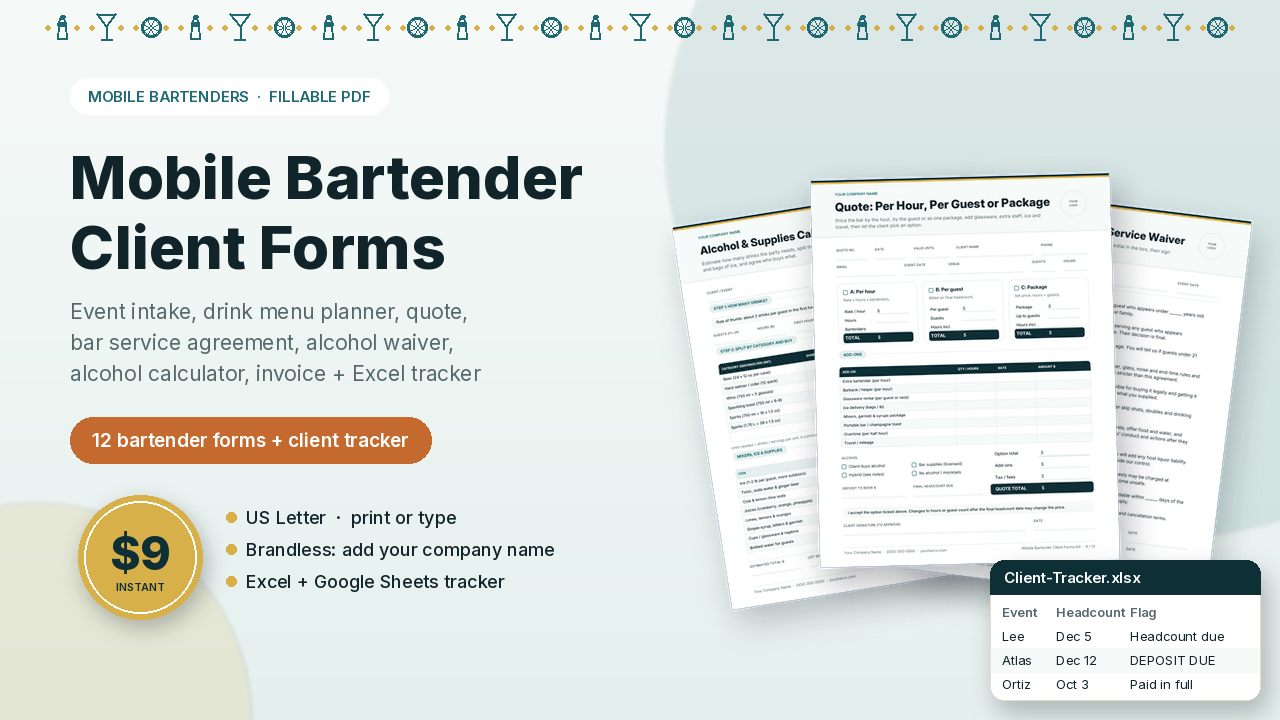
Mobile Bartender Client Forms Kit
12 fillable forms (event intake, drink menu & signature cocktail planner, quote with per-hour, per-guest and package pricing, bar service agreement, alcohol service waiver, alcohol & supplies calculator, incident & refusal of service log, invoice and more) plus an Excel client tracker.
Get it →Section 6: Service hours and staffing
- Bar opening time and closing time, plus setup and breakdown time
- Any breaks in service, such as during a ceremony, dinner or speeches
- Last call time and whether the client wants a hard stop
- Number of bars or serving stations
- Whether you will also pass drinks, serve a toast or run a champagne wall
- Whether barbacks or extra staff are needed for large crowds or long distances
- Dress code for staff, if any
Quote setup and breakdown time clearly, even if you bill them as part of a package. A four-hour event is often six or more hours of work once you include loading, setup, breakdown and cleanup. If the client wants to extend service on the night, your policies should say how overtime is approved and billed.
Section 7: Responsible service and safety
Make your responsible service rules part of the booking conversation, not a surprise on the night. Ask and confirm:
- That the client understands you will check ID and will not serve anyone under the legal drinking age
- That you may refuse service to anyone who appears intoxicated, and may close the bar early if needed
- Whether minors will be present, and how they will be identified (wristbands, separate drinks)
- Transportation plans for guests: shuttles, rideshare, designated drivers
- Who on the client side has authority to make decisions if there is an issue
- Whether any drinking games, shots or self-serve stations are planned, and your policy on them
Keep notes of any refusals or incidents in a simple log on the night. Ask the client to acknowledge your service rules in writing, usually in the contract or an alcohol service waiver. Laws on host and server liability vary by location, so check what applies to you and talk to your insurer.
Section 8: Budget and policies preview
Ask for a budget range, even a rough one. It lets you offer options, such as beer and wine with one signature cocktail instead of a full bar, rather than a single take-it-or-leave-it price. Then preview your main policies so there are no surprises when the contract arrives. The table below uses bracketed placeholders only; it is not recommended wording.
| Policy | What to show (placeholders) |
|---|---|
| Deposit | A deposit of [amount or %] is due to reserve the date. |
| Final payment | The balance is due [when, e.g. days before the event]. |
| Final guest count | The final count is due by [date]; increases after that are [policy]. |
| Menu deadline | The drink menu is final by [date]; later changes are [policy]. |
| Overtime | Service past the agreed end time is [rate] per [hour or half hour], approved by [who]. |
| Responsible service | Staff will check ID and may refuse service or close the bar [conditions]. |
| Cancellation | If the client cancels [timeframe], [what happens to the deposit]. |
| Gratuity | [Whether a tip jar is allowed or gratuity is included]. |
The policies themselves belong in a signed bar service agreement. The questionnaire just previews them so the client is not surprised later.
Turning the answers into a quote
With a completed questionnaire, you can build an itemized quote and staffing plan quickly. The example below is for illustration only. The prices are placeholders; set your own based on your costs, market, licensing and experience.
| Questionnaire answer | How it affects the quote (example only) |
|---|---|
| 120 adult guests, wedding reception | Staff 2 bartenders plus a barback; $[rate] per bartender per hour |
| Client buys alcohol; you bring mixers, garnish and ice | Service package plus $[per-guest] supply fee; send a shopping list |
| Two signature cocktails and a mocktail | Batch prep time; add $[prep fee] if pre-batched |
| Bar open 5 to 10 pm with a break for dinner | Quote 5 service hours plus [setup and breakdown] hours |
| Venue requires COI and licensed staff | Confirm coverage; add any certificate cost to the quote |
| Outdoor lawn, no sink | Extra coolers, water and cleanup time; $[outdoor setup fee] |
| Toast for all guests | Champagne pour service; $[toast fee] or included in package |
Send the quote with a short plan: arrival and setup time, service hours, staff count, what you bring and what the client needs to provide. A client who can see the plan is more likely to book quickly than one who only sees a total.
Common mistakes to avoid
- Quoting from a guest count alone. Ask about the menu, supply model and venue before you send a number.
- Not asking who buys the alcohol. It changes your licensing, liability and price.
- Forgetting venue rules. A missing COI or unapproved bartender can cancel the booking at the last minute.
- Leaving ice and cups vague. Decide in writing who supplies them and how much.
- No firm guest count or menu deadline. Late changes break your shopping list and staffing plan.
- Skipping the responsible service conversation. Agree on ID checks, refusals and last call before the event, not during it.
- Not pricing setup and breakdown. They are real hours; show them in the quote.
- Holding a date without a signed agreement and deposit. The date is only booked once both are in.
One-page mobile bartender client questionnaire checklist
- Contact details, day-of contact and other vendors
- Event type, date, venue, indoor or outdoor and weather backup
- Adult guest count, minors present and count deadline
- Alcohol supply model and open, cash or ticket bar
- Drink menu, signature cocktails, mocktails and toast
- Allergies affecting mixers or garnishes
- Venue rules, COI and bartender requirements
- Bar location, power, water, load-in and parking
- Glassware, ice, coolers and trash: who supplies what
- Service hours, breaks, last call and staffing
- Responsible service rules acknowledged and transport plans
- Budget range, deposit, payment, overtime and cancellation policies acknowledged
Send the questionnaire as soon as a client asks for a quote, review it before you price, and keep it with the quote, drink menu sheet and signed bar service agreement for every event.
FAQ
What should a mobile bartender ask a client before quoting?
Ask about the event type, date and venue, adult guest count, who supplies the alcohol, the drink menu and signature cocktails, venue rules and insurance requirements, bar setup and access, service hours, staffing needs, responsible service expectations and a budget range.
Why does it matter who supplies the alcohol?
It changes your price, your liability and possibly what licenses or permits you need. Providing service only is usually priced by labor, while supplying alcohol may require a license where you work. Check the rules in your area before you quote.
How many bartenders do I need for an event?
Many bartenders use a guests-per-bartender ratio and add staff for full cocktail service, large arrival rushes or long distances to supplies. Set your own ratio based on your experience, the menu and the venue layout.
Should the questionnaire ask about insurance?
Yes. Ask whether the venue requires a certificate of insurance, what coverage amounts it needs and who must be listed, so you can confirm you can meet the requirement before booking.
Is a client questionnaire the same as a bar service agreement?
No. The questionnaire collects information about the event. The quote is your priced proposal based on those answers, and the signed bar service agreement sets the terms, policies and responsibilities.
When should the guest count and drink menu be final?
Set firm deadlines before the event, often one to two weeks ahead, so you can shop, prep and staff accurately. Put the deadlines in your policies and treat later changes according to those terms.
This page is general information for mobile bartenders and bar services, not legal, insurance or licensing advice. Rules on selling, serving and transporting alcohol, permits, server training, host and server liability, deposits and contracts vary by location. Check the current requirements that apply to you and have your own forms and agreement reviewed.
Related templates
Free Mobile Bartender Forms
A printable bar service event intake sheet plus a simple bar service agreement for mobile bartenders and small bar services.
Download free →Mobile Bartender Client Forms Kit
Fillable event intake, drink menu planner, quote, bar service agreement, alcohol service waiver, supplies calculator and invoice plus an Excel client tracker.
Get it →