How Much to Charge for Event Planning: Flat Fee, Percentage and Hourly Pricing (Plus Free Event Planner Forms)
How event and party planners can price their services: choose a flat fee, percentage of budget or hourly rate, price full planning vs day-of coordination, bill extras, and protect yourself with a retainer and written contract, with a worked example and free printable event planner forms.
Why event planning quotes go wrong
New planners often name a number that feels safe, then discover the job included forty vendor emails, three venue walk-throughs, a rehearsal, a twelve-hour event day and a client who changed the theme twice. Planning is mostly invisible time, so the price has to be built from the hours the event really takes, not from what the decorations cost. A clear method protects you: pick a pricing model, estimate your hours honestly, bill extras on their own lines, and lock it all in with a retainer and a written agreement.
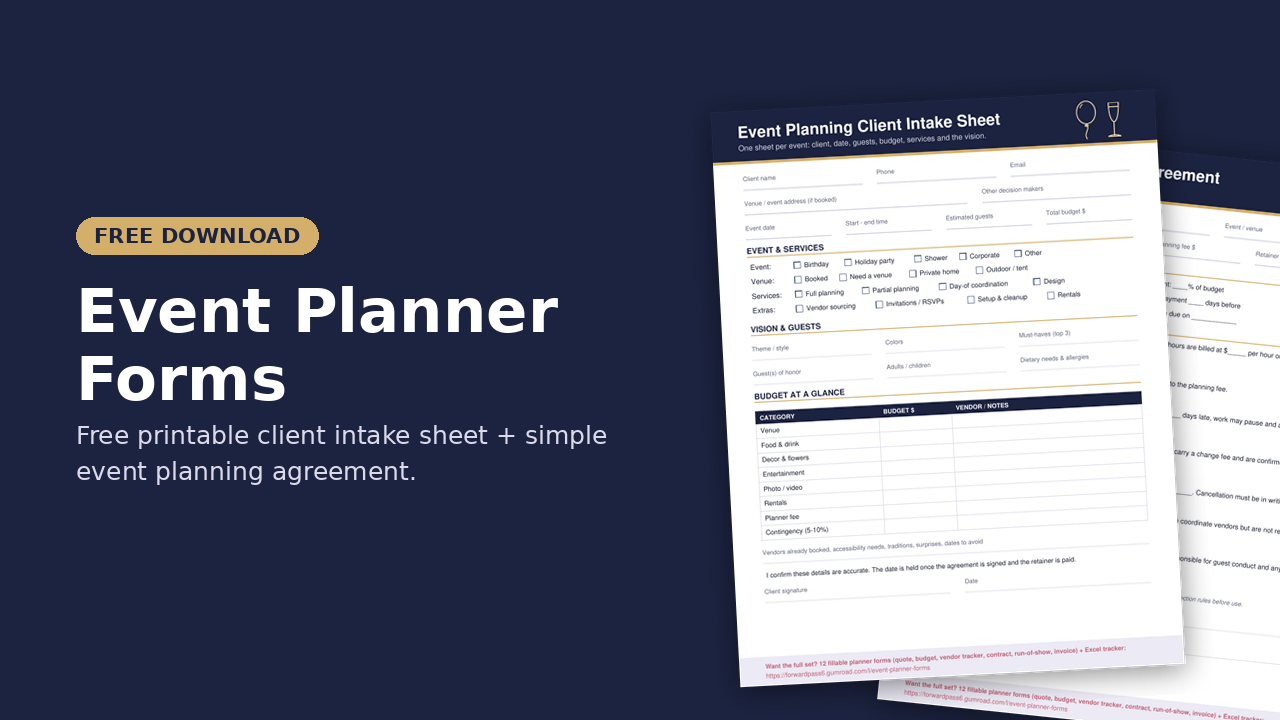
Free Event Planner Forms
A printable event planning client intake sheet plus a simple event planning agreement for event and party planners.
Download free →1. Choose flat fee, percentage or hourly pricing
Flat fee pricing is the easiest for clients to understand and the most common for small planners: one number for a defined package. Percentage of budget pricing ties your fee to the size of the event, which suits large weddings and corporate events but can feel unpredictable to clients and penalizes you on budget events that still take a lot of work. Hourly pricing works for consultations, partial planning and open-ended scopes. Many planners combine them: a flat package price with an hourly rate for anything outside the scope, or a percentage with a minimum fee.
2. Price full planning, partial planning and day-of coordination separately
Offer clear tiers instead of one custom quote every time. Full planning covers everything from concept and budget to vendor sourcing, contracts, design and the event day, and usually runs for months. Partial planning picks up after the client has booked the main vendors. Day-of (or month-of) coordination means you take over the timeline, confirm vendors and run the event, which is fewer hours but a long, intense day. Price each tier from the hours it really takes, not from a percentage of the full-planning price.
3. Estimate your hours honestly
List every task for each tier: discovery call, proposal, budget, vendor research and meetings, site visits, design, timeline and run-of-show, vendor confirmations, rehearsal, setup, the event itself and teardown. Add time for email and messages, which is often the biggest hidden cost. Multiply the total hours by the hourly rate you need to cover your income goal, business costs, taxes and unpaid admin time. That number is your floor for the package price.
4. Bill extras as their own lines
Keep your planning fee separate from pass-through costs. Common extras include assistants on the event day, travel beyond a set radius, overnight stays for destination events, additional events such as a rehearsal dinner or after-party, extra meetings or site visits beyond the package, rush bookings with a short lead time, and peak dates like Saturdays in high season or holidays. Vendor costs, rentals and decor should be paid by the client directly or billed at cost plus a stated handling fee, so nobody is confused about where the money goes.
5. Take a retainer and put it in writing
A non-refundable retainer reserves the date and pays for the work you start right away; many planners ask for a meaningful share of the fee at signing, with the balance due before the event. Your written agreement should spell out the scope of each tier, what is not included, the payment schedule, how many meetings and revisions are included, change fees for scope added later, the cancellation and rescheduling policy, who contracts and pays each vendor, and that you are not responsible for vendor no-shows. A signed agreement is what turns a vague promise into a business deal.
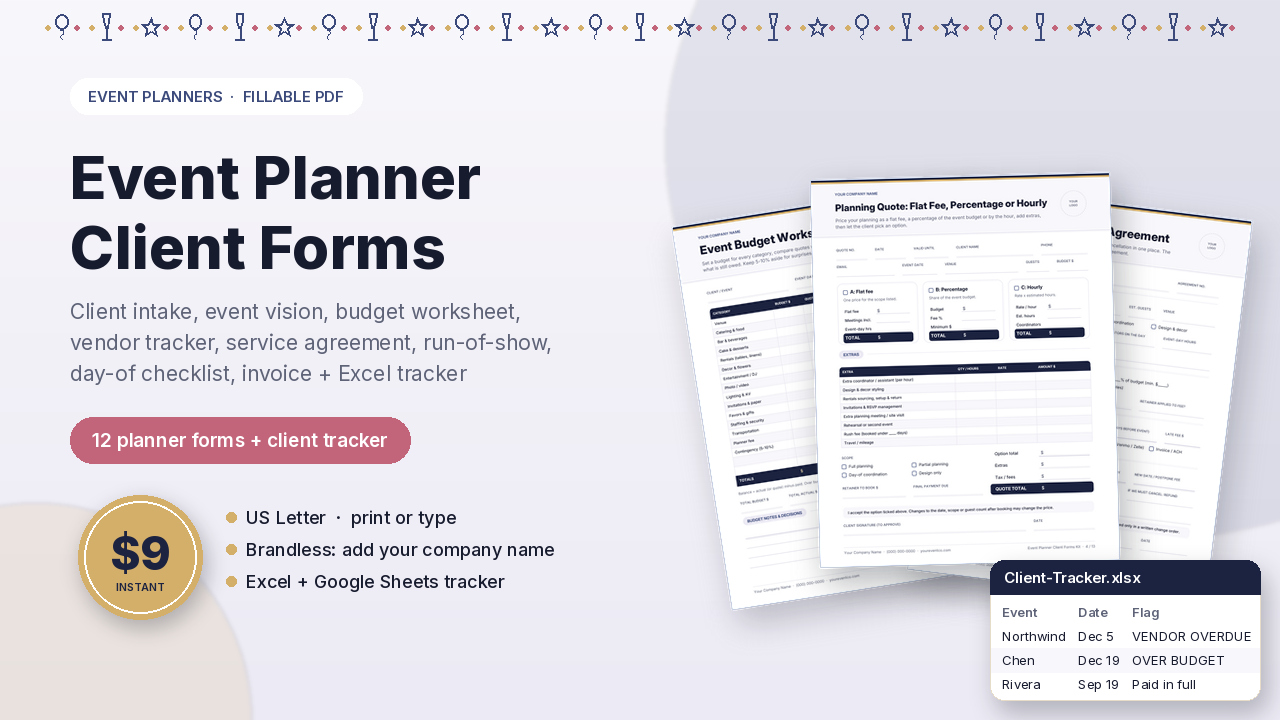
Event Planner Client Forms Kit
12 fillable forms (client intake, event vision & guest details, planning quote, event budget worksheet, vendor booking tracker, service agreement with retainer and change fees, timeline / run-of-show, day-of checklist, invoice and more) plus an Excel client tracker.
Get it →6. A worked example (example numbers only)
Say a planner wants to earn $50 an hour after costs. Day-of coordination is estimated at 25 hours (two planning meetings, vendor confirmations, timeline, rehearsal and a 12-hour event day), so the base is 25 × $50 = $1,250. An assistant for 10 hours at $25 adds $250, for a quoted price of about $1,500. Partial planning at 60 hours lands near $3,000 plus the event-day assistant. These are example numbers to show the math, not a recommendation; your rate, hours and local market will differ.
Use forms so the price holds
Most pricing problems start with unclear scope. A client intake sheet captures the event type, date, guest count, budget and vision before you quote. A planning quote and budget worksheet show the client where every dollar goes. A vendor tracker and run-of-show keep the event day on schedule, and a service agreement with retainer and change fees makes the price stick. The free forms above cover the basics, and the full kit adds the rest.
FAQ
How much should an event planner charge?
Estimate the hours each package really takes, multiply by the hourly rate you need to cover income, costs and taxes, then compare with planners near you. Many small planners quote flat packages for full planning, partial planning and day-of coordination.
What percentage do event planners charge?
Percentage-based planners commonly charge somewhere in the range of 10 to 20 percent of the event budget, often with a minimum fee. Many small planners prefer a flat fee because it is easier for clients to understand.
How much should I charge for day-of coordination?
Price it from the hours it takes, including pre-event meetings, vendor confirmations, the timeline, rehearsal and the full event day, plus any assistants. It is fewer hours than full planning, but the event day itself is long.
Should event planners charge a retainer?
Yes. A non-refundable retainer at signing reserves the date and covers early work. State the amount, when the balance is due and the cancellation policy in a written agreement.
Do event planners mark up vendor costs?
Some do and some do not. Whatever you choose, be transparent: have clients pay vendors directly, or bill vendor costs at cost plus a clearly stated handling fee in your agreement.
What should an event planning contract include?
The scope of services, what is not included, the fee and payment schedule, retainer terms, included meetings, change fees, cancellation and rescheduling terms, who contracts each vendor, and liability limits for vendor issues.
This page is general guidance, not legal, tax or business advice. Business licensing, sales tax and contract rules vary by location, so check the rules where you operate and have important contracts reviewed locally.
Related templates
Free Event Planner Forms
A printable event planning client intake sheet plus a simple event planning agreement for event and party planners.
Download free →Event Planner Client Forms Kit
Client intake, planning quote, budget worksheet, vendor tracker, service agreement with retainer, run-of-show and invoice plus an Excel client tracker.
Get it →