How Much Alcohol for a Party: A Bartender's Calculator Worksheet for Holiday Events (+ Free Forms)
A practical method for mobile bartenders, caterers and hosts: turn guest count and party length into a clear shopping list of beer, wine, spirits, mixers, ice and zero-proof drinks, with worked examples you can copy and adjust for holiday and New Year's parties.
Why the shopping list deserves its own worksheet
December is when the question arrives in every inbox: “How much should we buy?” The client has a guest count and a start time, and they want a number. Guess too low and the bar runs dry at 9 pm with the boss still mingling. Guess too high and the client is stuck with cases of wine they did not want, or they blame you for the bill.
A simple, written calculation solves both problems. It shows the client how you got to the number, it gives everyone the same list to shop from, and it protects you when someone asks later why the bar ran out of something. This guide walks through the method step by step, then turns it into a worked example you can copy for holiday parties, office events and New Year's Eve.
This page is about quantities and supplies. To collect the event details first, see the mobile bartender client questionnaire guide. For what to charge for your time, see mobile bartending pricing and holiday party bartender pricing, and for terms such as who buys the alcohol, see the mobile bartender contract guide.
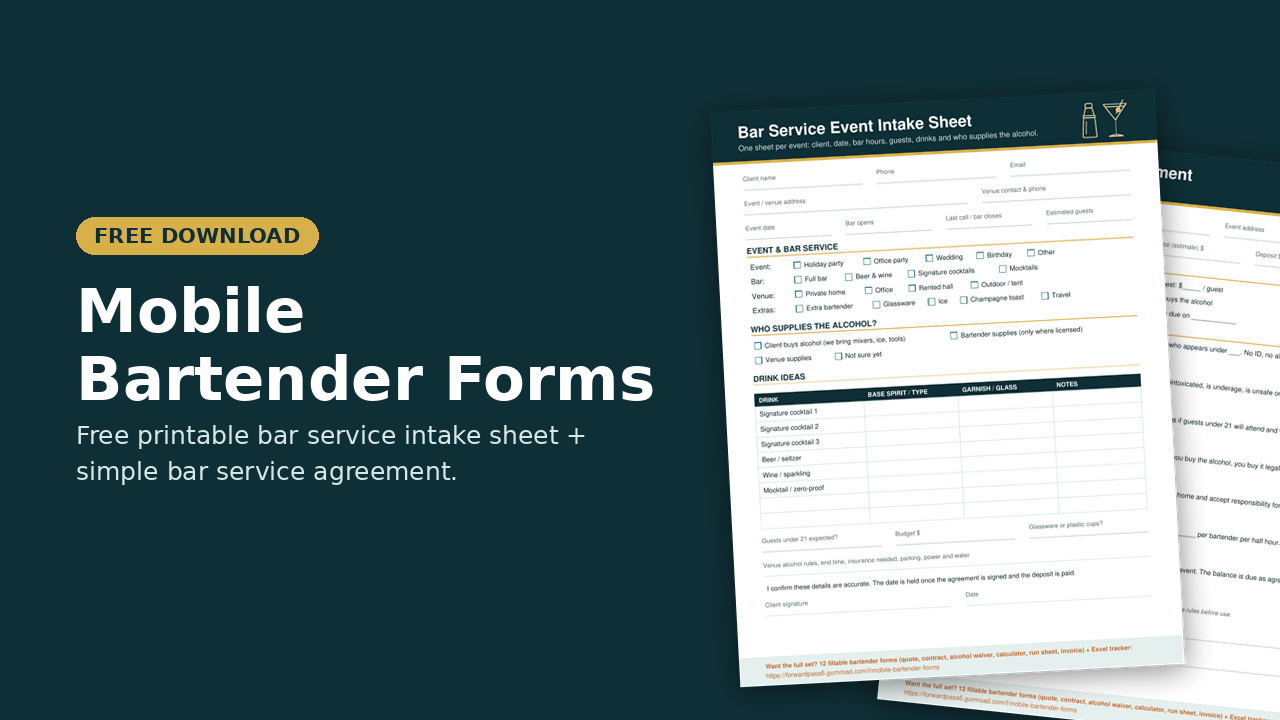
Free Mobile Bartender Forms
A printable bar service event intake sheet plus a simple bar service agreement for mobile bartenders and small bar services.
Download free →What you need to know before you calculate
The math is easy. The inputs are where most mistakes happen. Get these from the client in writing before you send a list:
| Input | Why it matters | Where it comes from |
|---|---|---|
| Guest count (adults of legal drinking age) | Only drinking-age guests count toward alcohol; everyone counts toward water, soda and ice | Intake form; confirm a final count closer to the date |
| Bar open and close times | More hours means more drinks, but the rate usually slows after the first hour | Intake form and run sheet |
| Type of event and crowd | An office party, a wedding-style celebration and a family dinner drink differently | Conversation with the client |
| Drink menu | Full bar, beer and wine only, or a short signature menu changes the split completely | Drink menu planner |
| Food | A full meal and a few snacks lead to different evenings | Caterer or client |
| Who buys the alcohol | Decides who shops, who keeps leftovers and what the contract says | Agreement |
| Venue rules | Some venues ban glass, shots or outside alcohol, or set an end time | Venue contract or contact |
If the client cannot give you an exact guest count yet, calculate a range (low and high) and agree which number you will shop for.
Step 1: Estimate total drinks
A common starting assumption used by many bartenders and planners is about one drink per drinking guest per hour, with the first hour often a little busier. Treat it as a starting point, not a rule. Some crowds drink less, some more, and a long dinner usually slows things down.
The basic formula:
Total drinks = drinking guests × hours the bar is open × drinks per guest per hour
Then add a buffer for spills, broken bottles, a slightly larger crowd and a strong first hour. Many bartenders round up rather than add a fixed percentage; what matters is that you write down the buffer you chose so the client can see it.
| Drinking guests | Bar open | Starting estimate (1 per guest per hour) | With a small buffer (example) |
|---|---|---|---|
| 25 | 3 hours | 75 drinks | About 85 |
| 50 | 4 hours | 200 drinks | About 220 |
| 80 | 4 hours | 320 drinks | About 350 |
| 120 | 5 hours | 600 drinks | About 650 |
Example only. Adjust for your crowd, your pour sizes, local law and the venue's rules.
Step 2: Split drinks by category
Next, decide how those drinks divide between beer, wine, spirits (cocktails and mixed drinks) and anything else on the menu. The best source is the client: ask what their guests usually drink at similar events, and look at the drink menu you agreed. If the client has no idea, start from an even split and adjust.
| Type of event (example) | Beer | Wine | Spirits / cocktails |
|---|---|---|---|
| Mixed crowd, full bar | About a third | About a third | About a third |
| Dinner party or wine-focused | Smaller share | Largest share | Smaller share |
| Casual party or game-night style | Largest share | Smaller share | Smaller share |
| Signature cocktail party | Small share | Small share | Largest share |
Example only. Adjust for your crowd, your pour sizes, local law and the venue's rules.
If the menu is beer and wine only, split between those two. If there is one or two signature cocktails plus beer and wine, give the cocktails their own line so you can batch them (see below).
Step 3: Convert drinks into bottles, cans and cases
Now turn drink counts into things you can buy. These are simple volume conversions; adjust them to your own pour sizes and the containers sold where you are.
| Container | Volume | Approximate servings |
|---|---|---|
| Standard wine bottle | 750 ml (about 25 oz) | About 5 glasses at 5 oz |
| Sparkling wine for a toast | 750 ml (about 25 oz) | About 6 to 8 toast pours, depending on pour size |
| Spirits bottle | 750 ml (about 25 oz) | About 16 pours at 1.5 oz, allowing a little for spillage |
| Large spirits bottle | 1.75 L (about 59 oz) | About 39 pours at 1.5 oz |
| Beer case | 24 cans or bottles | 24 servings |
| Full-size keg (US half barrel) | 15.5 gallons | About 165 servings at 12 oz |
| Mixer bottle | 1 L (about 34 oz) | About 8 highballs at 4 oz of mixer |
Bottles needed = drinks in that category ÷ servings per bottle, rounded up. Record pour sizes on the worksheet. If you pour 2 oz instead of 1.5 oz, the spirits count changes, and so does the client's bill.
Worked example: a 60-guest holiday office party
Here is the full method for a four-hour holiday party with 60 guests, all of drinking age, a full dinner buffet and a full bar. The client said their team drinks a bit more wine than beer.
| Line | Calculation | Shopping list (example) |
|---|---|---|
| Total drinks | 60 guests × 4 hours × 1 = 240; round up to about 260 with a buffer | 260 drinks |
| Wine (40%) | About 104 glasses ÷ 5 per bottle | 21 bottles (for example 12 red, 9 white) |
| Beer (30%) | About 78 servings ÷ 24 per case | 4 cases (96 servings) |
| Spirits (30%) | About 78 pours ÷ 16 per 750 ml | 5 bottles of 750 ml (or a mix of large and standard bottles) |
| Mixers | Most spirits drinks need 3 to 4 oz of mixer | About 8 to 10 liters across soda, tonic and juice |
| Zero-proof | Every guest, plus designated drivers | Sparkling water, sodas and one alcohol-free special |
Example only. Adjust for your crowd, your pour sizes, local law and the venue's rules.
Write the calculation on the worksheet exactly like this, with each assumption on its own line. If the client wants to change the split or the buffer, they can see what moves.
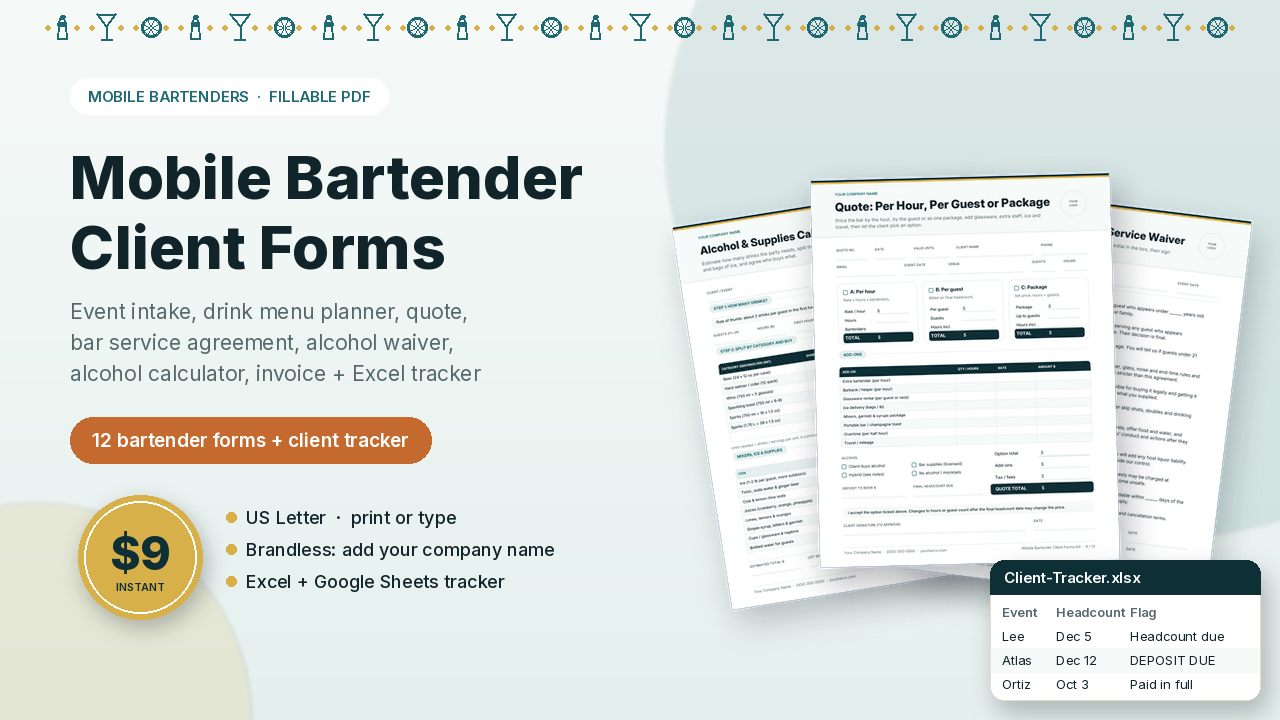
Mobile Bartender Client Forms Kit
Fillable event intake, drink menu and signature cocktail planner, quote (per hour, per guest or package), bar service agreement, alcohol service waiver, alcohol and supplies calculator worksheet, event run sheet and venue setup checklist, plus an Excel client tracker.
Get it →Signature cocktails and batching
One or two signature drinks keep the bar fast and give a holiday party something to remember. They also make the math cleaner. For each cocktail, write the recipe in ounces, multiply by the number of servings you expect, and convert to bottles of each ingredient.
| Ingredient (example recipe) | Per drink | For 60 servings | To buy |
|---|---|---|---|
| Spirit | 1.5 oz | 90 oz | 4 bottles of 750 ml (about 101 oz) |
| Cranberry juice | 2 oz | 120 oz | 2 bottles of about 64 oz (128 oz) |
| Fresh lime juice | 0.5 oz | 30 oz | Limes or bottled juice to cover about 30 oz |
| Simple syrup | 0.5 oz | 30 oz | Make 1 quart |
| Garnish | 1 sprig or wheel | 60 | Rosemary or orange; buy extra |
Example only. Adjust for your crowd, your pour sizes, local law and the venue's rules.
If you pre-batch, keep batched cocktails cold, label them clearly with the contents and the date, and follow local food safety and alcohol rules. Some places do not allow pre-mixing for service; check before you plan it.
Mixers, garnish, ice and supplies
The alcohol is only part of the list. Running out of ice or cups ends the party just as fast as running out of wine. Treat these as their own section of the worksheet:
| Item | How to estimate (example) | Notes |
|---|---|---|
| Ice for drinks | Plan generously per guest, more for cocktails and warm rooms | Buy for chilling separately |
| Ice for chilling | Enough to cover bottles and cans in tubs or coolers | Indoor winter parties still need chilling ice |
| Cups or glassware | At least 2 to 3 per guest for a long event | Separate wine, rocks and toast glasses if used |
| Mixers and juice | Based on the spirits line and recipes | Include diet and sugar-free options |
| Garnish | Citrus, herbs or seasonal garnish for each cocktail | Cut on site when possible |
| Bar tools and extras | Napkins, straws, picks, bottle openers, trash bags | Check the venue's list of what they supply |
Example only. Adjust for your crowd, your pour sizes, local law and the venue's rules.
Do not forget zero-proof drinks
Many guests choose not to drink, drive home, or switch to water after the first hour. Every guest counts for non-alcoholic drinks, not just the drinking-age adults. Put at least one appealing alcohol-free option on the menu, such as a sparkling cranberry spritz with the same garnish as the signature cocktail, plus still and sparkling water and a few sodas. Write it on the menu card so it does not feel like an afterthought.
Holiday and New Year's Eve adjustments
Seasonal events change the math in small but important ways:
| Situation | What to adjust (example) |
|---|---|
| Midnight toast | Add sparkling wine for a toast pour per guest who wants one; ask whether they want a zero-proof toast too |
| Long New Year's Eve party | More hours on the formula, but plan for a slower middle and a busier countdown |
| Office holiday party | Check whether the company wants drink tickets, a cap or a cash bar after a set time |
| Family holiday gathering | Mixed ages; more zero-proof drinks and fewer drinking-age guests |
| Cold weather or outdoor fire pit | Warm drinks such as spiced cider (with and without alcohol) may replace some cold drinks |
| Busy shopping weeks | Order popular wines and sparkling early and confirm stock and return policies |
Example only. Adjust for your crowd, your pour sizes, local law and the venue's rules.
Who buys the alcohol, and what happens to leftovers
Decide this in writing before anyone shops. If the client buys the alcohol, give them the list as a recommendation, show the assumptions, and note that the final choice is theirs. If you buy it, follow your local licensing rules and explain how you charge for it and what happens to unopened bottles. Some stores accept returns of unopened bottles and some do not, so ask before the event if the client is counting on it.
Put the answer in the agreement: who supplies what, who keeps unopened and opened bottles, and who is responsible for transporting alcohol. The mobile bartender contract guide covers the clauses.
Responsible service still comes first
A good shopping list is enough for the event, not a target to finish. Plan last call before the end of the event, keep water visible and easy to reach, check ID, never serve minors or visibly intoxicated guests, and follow the venue's end time. If the client asks for more alcohol than the plan suggests, note it on the worksheet and stick to your service rules on the night. Alcohol laws and host responsibilities vary by location, so check what applies to you.
Common mistakes
- Counting all guests for alcohol, including guests under drinking age and non-drinkers.
- Forgetting mixers, ice and cups, which run out before the alcohol does.
- Not writing down pour sizes, so the numbers cannot be checked.
- Ignoring the client's own knowledge of their crowd.
- Leaving the champagne toast off the list until the last minute.
- Not agreeing who keeps leftovers and who handles returns.
One-page alcohol and supplies checklist
- Drinking-age guest count (low and high)
- Bar open and close times, last call
- Drink menu: full bar, beer and wine, or signature cocktails
- Total drinks with the buffer written down
- Category split agreed with the client
- Bottles, cans and cases with pour sizes noted
- Signature cocktail recipes multiplied out
- Mixers, garnish, ice for drinks and ice for chilling
- Cups or glassware, tools and extras
- Zero-proof options and water
- Toast pours for New Year's Eve or speeches
- Who buys, who transports, who keeps leftovers
FAQ
How much alcohol do I need for a party of 50?
A common starting point is about one drink per drinking-age guest per hour. For 50 drinking guests over four hours that is about 200 drinks before a buffer. Split that across beer, wine and spirits based on the crowd, then convert to bottles and cases. Treat the result as a starting estimate and adjust for your event.
How many drinks are in a bottle of wine or spirits?
A standard 750 ml bottle holds about 25 oz. That is about 5 glasses of wine at 5 oz, or about 16 spirit pours at 1.5 oz once you allow for a little spillage. Larger 1.75 L spirits bottles hold about 59 oz, or about 39 pours.
How much champagne do I need for a New Year's Eve toast?
A 750 ml bottle gives about 6 to 8 toast pours, depending on how full you pour. Ask the client how many guests will toast, divide by the pours per bottle, round up, and consider a zero-proof sparkling option too.
Should the bartender or the client buy the alcohol?
Either can work. It depends on local licensing rules, the venue and what the client prefers. Whatever you choose, write it in the agreement, including who keeps leftovers and who transports the alcohol.
How much ice do I need for a party?
Plan ice for drinks and ice for chilling separately. Cocktails and warm rooms need more ice per guest, and tubs of bottles and cans need enough ice to cover them. When in doubt, buy extra; it is cheap compared with a warm bar.
Is a drink calculator accurate for every event?
No. A calculator gives a reasonable starting estimate. The client's knowledge of their guests, the food, the length of the event and the drink menu all change the real number, so review the list with the client and keep a small buffer.
This page is general information for bartenders, caterers, event planners and hosts, not legal, licensing or insurance advice. Alcohol laws, licensing rules, host responsibilities and venue rules vary by location, so check what applies to you or talk to a professional if you are unsure. Always serve responsibly. Quantities, splits, recipes and example entries shown are examples only.
Related templates
Free Mobile Bartender Forms
A printable bar service event intake sheet plus a simple bar service agreement for mobile bartenders and small bar services.
Download free →Mobile Bartender Client Forms Kit
Event intake, cocktail planner, quote, bar service agreement, alcohol and supplies calculator worksheet and more, plus an Excel tracker.
Get it →