Holiday Party Rental Pricing: How to Price Tables, Chairs, Linens, Tents, Heaters and Lighting for December, New Year’s Eve and January (Plus Free Forms)
How party and event rental businesses can price late November through January: December peak-date minimums, delivery, setup, teardown and holiday-day fees, winter weather rules, tent heater and sidewall add-ons, lighting, damage waivers and deposits, cancellation and date-change policies, New Year’s Eve and January slow-season packages, with a worked example and free party rental forms.
Why holiday party rentals need their own price sheet
For most party rental companies, summer is bounce house and backyard season. December is different. The calls are for office parties, family dinners that outgrew the dining room, church and school events, holiday markets and New Year’s Eve celebrations. The orders are bigger and more formal: banquet tables, chairs, linens, chargers, dance floors, tents with sidewalls, heaters and string lighting. And almost everyone wants the same few Fridays and Saturdays.
That combination of high demand, heavy equipment, short daylight and winter weather is exactly when an unwritten pricing policy costs money. Crews get double-booked, small orders take up prime delivery slots, linens come back stained, and a snowstorm turns into an argument about refunds. A clear holiday price sheet, shared before clients book, solves most of that.
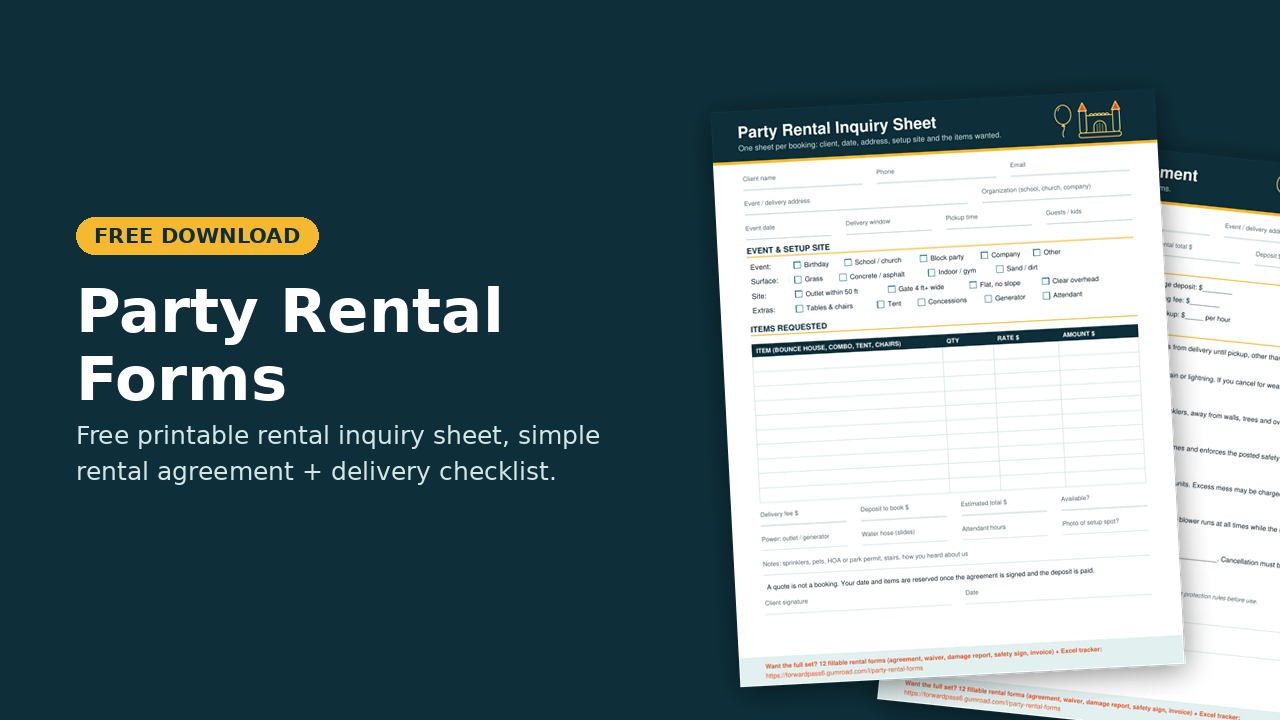
Free Party Rental Forms
A printable party rental inquiry sheet, a simple rental agreement and a delivery, setup & pickup checklist for bounce house and party rental businesses.
Download free →1. Start from your regular rental rates
Keep your year-round item prices as the base: a per-item rate for tables, chairs and linens, package prices for tents, and your normal delivery zones. If you have not written those down yet, start with our party rental pricing guide and our rental agreement guide.
For the holidays, add clear seasonal rules on top instead of quietly raising every item price. A visible peak-date minimum or holiday-day fee is easier to explain, and it keeps your pricing consistent for repeat customers who rent from you all year.
2. Set December peak-date pricing and order minimums
Your inventory and your crews are the real limits in December. A few rules protect both:
- Name your peak dates. For many rental companies that means the Fridays and Saturdays from early to late December, plus New Year’s Eve. Publish them so clients know in advance.
- Raise the order minimum on peak dates. A small order of a few tables can take the same truck slot as a full tent package. A higher minimum for delivered orders on peak dates keeps those slots for jobs that pay for the crew’s time.
- Offer will-call for small orders. Customer pickup and return at your warehouse lets you say yes to small orders without using a delivery slot.
- Reward early and off-peak bookings. Weeknight parties, Sunday events and orders booked well ahead can stay at regular pricing. That moves demand away from the busiest nights without discounting.
3. Price delivery, setup, teardown and holiday-day fees separately
Holiday orders often include more labor than summer drop-offs. Itemize it so the quote shows what the client is paying for:
- Delivery and pickup: your normal zone or mileage pricing. Note that same-night pickup after a late party usually costs more than next-day pickup.
- Setup and teardown: a per-item or per-table fee for setting tables and chairs, dressing linens, or building a dance floor, and a separate tent installation price. Clients who only need equipment dropped off can skip it.
- Timed delivery windows: a fee for a guaranteed arrival time, since office parties and venues often have tight access windows.
- Stairs, long carries and indoor venues: a carry fee when equipment has to go up stairs, through a building or a long way from the truck.
- Holiday-day fee: a flat surcharge for deliveries or pickups on Christmas Eve, Christmas Day, New Year’s Eve and New Year’s Day, when crews are hardest to staff.
4. Winter weather, tent heaters and lighting add-ons
Outdoor holiday events need a few winter extras. Price them as clear add-ons:
- Tent sidewalls: per side or per tent, because they add install time and wind exposure.
- Tent heaters: per heater per event, with fuel either included or billed separately. State who supplies the fuel, how long a tank typically lasts in your experience, and that heaters must be used according to the manufacturer’s rules and local fire codes.
- Flooring or ground cover: for muddy or frozen lawns where guests would otherwise stand on wet ground.
- Lighting: string lights, uplights and tent lighting packages, priced per run or per package, with a note on power requirements and whether a generator is needed.
- Snow and ice clause: state that you may delay or cancel installs or removals for unsafe weather, that the client keeps the site clear of snow and ice where equipment will go, and what happens to the booking when weather forces a change.
Tents and heaters can require permits or inspections in some areas. Tell the client in writing who is responsible for checking and obtaining them.
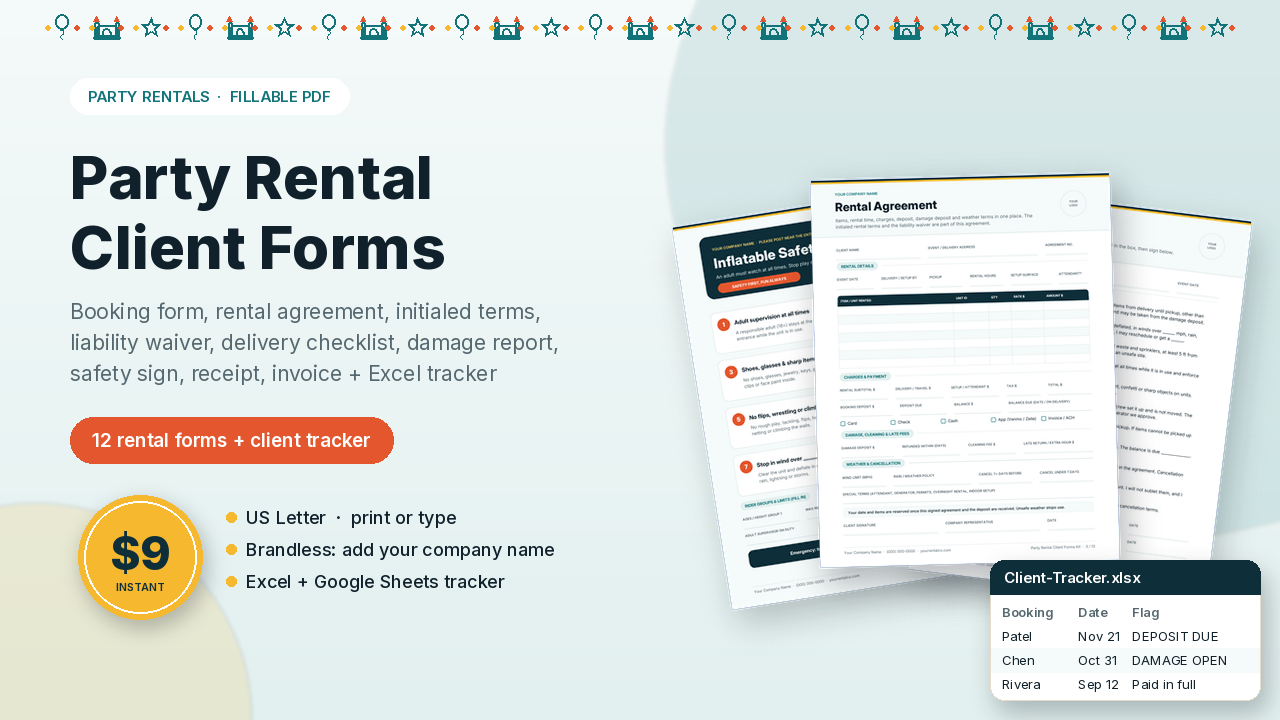
Party Rental Client Forms Kit
12 fillable forms (rental inquiry & booking, rental agreement, 10 initialed rental terms, liability waiver & release, delivery & pickup checklist, inventory check-out / check-in, damage report, inflatable safety rules sign, invoice and more) plus an Excel client tracker.
Get it →5. Damage waivers and security deposits
Red wine on white linens, chairs left out in the rain and wax on tablecloths are common holiday damages. Two tools cover most of them:
- Damage waiver: an optional or required fee, often a percentage of the rental subtotal, that covers ordinary accidental damage. Spell out what it does not cover, such as loss, theft, misuse or equipment left outside against instructions.
- Security deposit: a refundable amount held for larger orders or tents and returned after inspection. Write down the inspection steps and how quickly you refund.
- Linen rules: ask clients to shake out food and not wash linens themselves, and list a replacement fee for burns, wax and permanent stains.
- Check-out and check-in: count items at delivery and pickup and note condition with photos, so any charges are based on records rather than memory.
6. Cancellation and date-change policies
A December Saturday that cancels late usually cannot be resold. Put the rules in the agreement:
- Booking deposit: a non-refundable or partly refundable deposit to hold peak dates, applied to the final invoice.
- Cancellation windows: for example, a full or partial refund before a set number of days out and no refund on the deposit after that.
- Date changes: allow one date change to an available date, with the deposit transferred, so clients have an option other than cancelling.
- Guest-count changes: set a final count deadline a few days before delivery. Additions after that depend on availability; reductions may not be refunded.
- Weather changes: say whether a weather cancellation earns credit toward a future date, a partial refund or no refund, and who decides.
7. New Year’s Eve pricing
New Year’s Eve combines a peak night with a holiday pickup. Treat it as its own package: a higher minimum, late-night or next-morning pickup pricing, a holiday-day fee for January 1 pickups, and add-ons like dance floors, cocktail tables, lighting and heaters. Many rental companies also require a larger booking deposit and an earlier final-count deadline for that night, because inventory is fully committed.
8. January slow-season packages
After the holidays, demand for most party rentals drops. Rather than cutting item prices, package the inventory for the events that still happen:
- Indoor event packages: tables, chairs and linens for winter birthdays, baby showers, game-day parties and community events, with a simple package price.
- Weeknight and Sunday rates: regular pricing with a lower minimum or free will-call, available only on off-peak days.
- Early-booking offers for spring and graduation season: a deposit taken in January locks in this year’s rates for a spring date.
- Corporate rebooking: offer December office-party clients next year’s date at this year’s price if they book in January.
Packages keep your rates intact and help fill trucks during the quiet weeks, without teaching customers to wait for a sale.
9. A worked example (example numbers only)
These numbers are invented to show the math. Use your own costs, inventory and local market rates.
- Base pricing (example): 6-foot banquet table $10, folding chair $2.50, tablecloth $12, 20x30 frame tent $600 installed, sidewalls $40 each, tent heater $95 including fuel, string light package $150.
- Holiday policy (example): $500 delivered minimum on peak dates; setup and linen dressing $3 per table; 10% damage waiver; $150 booking deposit; holiday-day fee $100.
- Booking (example): a backyard family party on a December Saturday for 60 guests: 8 tables, 60 chairs, 8 tablecloths, a 20x30 tent with 3 sidewalls, 2 heaters and the string light package.
Tables: 8 × $10 = $80. Chairs: 60 × $2.50 = $150. Linens: 8 × $12 = $96. Tent: $600. Sidewalls: 3 × $40 = $120. Heaters: 2 × $95 = $190. Lighting: $150. Rental subtotal: $1,386, well above the $500 peak-date minimum. Setup and linen dressing: 8 × $3 = $24. Damage waiver: 10% of $1,386 = $138.60. Example total: $1,548.60 plus delivery and tax, with the $150 deposit taken at booking. If the client wanted pickup on New Year’s Day instead of the next business day, the $100 holiday-day fee would be added.
Put it on one page and send it early
Write your peak dates, minimums, delivery and labor fees, holiday-day fee, winter add-ons, damage waiver, deposit, cancellation and date-change rules, New Year’s Eve package and January offers on one sheet. Send it to past corporate and family clients in early November. Use the same inquiry form, rental agreement and delivery and pickup checklist for every order so the invoice matches the quote and damage charges are backed by records.
FAQ
Do party rental companies charge more in December?
Many keep their regular item prices and add holiday rules instead: higher delivered-order minimums on peak dates, timed-delivery fees and a holiday-day fee for deliveries or pickups on major holidays. Off-peak dates often stay at regular pricing.
What is a good minimum order for holiday party rentals?
There is no single standard. Base it on what a delivery slot costs you in crew time, fuel and truck use on your busiest nights. Many rental companies set a higher minimum on peak dates than on weekdays and offer will-call pickup for small orders.
How should I price tent heaters?
Most rental companies price heaters per unit per event, either with fuel included or billed separately. State who supplies the fuel, how heaters must be placed and used, and that the client must follow the manufacturer’s instructions and local fire rules.
Should I charge a damage waiver or a security deposit?
Many rental companies use both: a damage waiver, often a percentage of the rental, for ordinary accidental damage, and a refundable security deposit for larger orders or tents. Write down what each covers and how you inspect returned items.
What happens if a holiday party is cancelled because of snow?
That depends on your agreement. Common options are credit toward a future date, a partial refund or keeping the deposit. State who decides when weather is unsafe and what the client receives in each case before they book.
How can a party rental business stay busy in January?
Common approaches are indoor event packages for winter parties, weeknight and Sunday rates, early-booking offers for spring and graduation season, and rebooking December office-party clients for next year.
This page is general guidance, not legal, tax or safety advice. Tents, heaters, generators and lighting can be subject to permits, fire codes and insurance requirements that vary by location. Follow manufacturer instructions and local rules, and have an attorney review your rental agreement and waiver.
Related templates
Free Party Rental Forms
A printable party rental inquiry sheet, a simple rental agreement and a delivery, setup & pickup checklist for bounce house and party rental businesses.
Download free →Party Rental Client Forms Kit
Fillable party rental forms plus an Excel tracker for bookings, inventory, deposits and damage charges.
Get it →