Party Rental Client Questionnaire: What to Ask Before You Quote a Booking
A practical guide for small bounce house, inflatable, tent and party rental businesses: the questions to ask on a new inquiry before you give a price or hold a date, how each answer changes the quote, and what to confirm before the delivery truck leaves.
Why you need a questionnaire before you quote
"Is the castle bounce house available on the 14th, and how much?" sounds like a simple question. It is not. The same unit can be a quick drop-off on a flat backyard lawn ten minutes from your shop, or a two-person haul up a sloped side yard with no outlet nearby, at a park that needs a permit, on a day with a wind forecast your manufacturer says is too high to operate. The customer sees one price. You see very different jobs.
A short pre-quote questionnaire is the set of questions you ask on the phone, by text or in a web form before you give a price or hold a date. It tells you whether the booking is a fit, which items and add-ons to quote, what delivery and setup will really take, and what could go wrong on the day. That way the price you give is close to the final invoice, and your crew arrives with the right stakes or sandbags, extension cords, tarps, blower and help.
This guide covers the intake questions only. For how to build the price itself (base rental, delivery zones, setup fees, add-ons and minimums), see the bounce house and party rental pricing guide. For the signed terms, waiver and safety rules, see the bounce house rental agreement guide. If you are quoting winter events with tents and heaters, the holiday party rental pricing guide covers the seasonal side.
Keep the first contact short. Ask for the date, the location, the item they want, the setup surface and a photo of the space. That is usually enough to say "yes, we can do it, here is the range" or "that date is booked, here is what we have." Save the rest of the questions for a follow-up call or for your booking form once the customer is ready to hold the date.
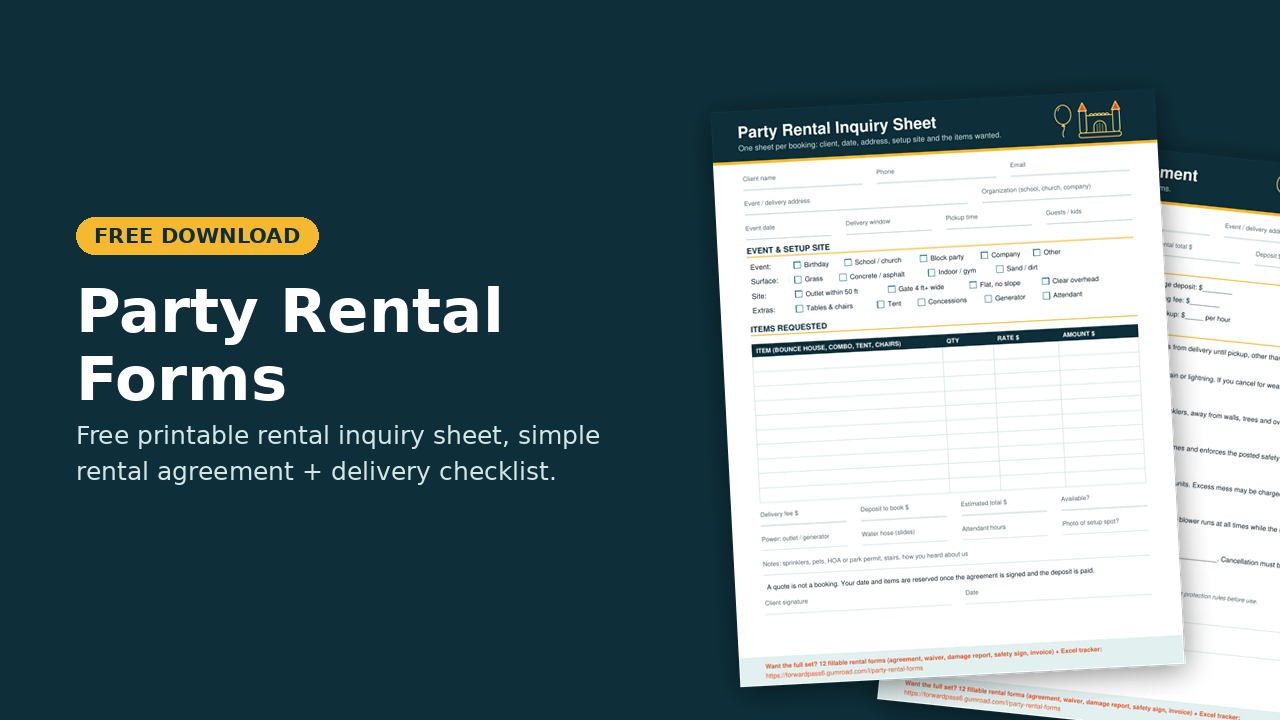
Free Party Rental Forms
A printable party rental inquiry sheet, a simple rental agreement and a delivery, setup & pickup checklist for bounce house and party rental businesses.
Download free →Section 1: Contact details and event basics
Start with the facts that tell you whether you can take the booking at all. If the date is full or the address is outside your delivery area, you can say so quickly and move on.
- Customer name, phone number, email and preferred contact method (text is easiest for photos)
- Event date and the start and end time of the party itself
- Event address, including gate codes, community names or the park pavilion number
- Type of event: backyard birthday, school or church event, company picnic, community festival, graduation, holiday party, wedding or other
- Is the event at a private home, a rented venue, a park, a school or a business property?
- Who is the day-of contact, and will that person be on site at delivery and pickup?
- Who books and pays? (A parent, a PTA volunteer, an HR coordinator and a venue manager all behave differently around invoices and deposits.)
- Which items are they interested in: bounce house, combo or water slide, obstacle course, tables and chairs, tent, concessions machines, games or other add-ons?
- How did they hear about you? (Useful for your marketing, not the quote.)
Ask who pays and who signs early. On school, church and corporate events, the person who calls is often a volunteer or coordinator who needs approval first. Knowing that helps you set a realistic deadline for the deposit and the signed agreement before you hold the date for them.
Section 2: Guests, ages and how the rental will be used
Who will use the equipment changes which unit you recommend, how many attendants or rules you need, and sometimes whether you should take the booking at all.
- Rough guest count, and how many children are expected
- Age range of the children, and whether teens or adults will want to use the inflatable
- Will there be a mix of small and older children at the same time? (Most operators recommend grouping users by size; follow your manufacturer’s rider limits and rules.)
- Will an adult supervise the inflatable the whole time it is in use, or do they want you to provide an attendant if you offer one?
- Is it a water event (water slide, wet combo), and do they understand the extra setup, hose access and cleanup?
- Are any guests expected to have mobility needs or special requirements you should know about?
| What the customer says | Follow-up question | Why it matters for the quote |
|---|---|---|
| "A bounce house for my son’s party." | How old is he, and how many kids? Any older siblings or adults planning to jump? | Unit size and rider limits; may point to a larger unit or combo |
| "It’s a school field day." | How many students at a time, and who supervises? Do you need attendants? | Multiple units, staffing, longer rental window |
| "We want the water slide." | Is there a hose bib within reach, and is the ground okay getting wet? | Water access, setup surface, extra cleaning and drying time |
| "Adults will use it too." | Which unit are you thinking of, and how many adults? | Check the unit’s rated limits; may need a different item |
Table is an example only. Use your own equipment manuals and rules.
Use the answers to recommend the right unit rather than just quoting the one they named. A customer who asked for a small toddler bouncer for a party of mostly eight-year-olds will be happier with a different suggestion now than with a crowded unit on the day.
Section 3: Setup surface, space and site photos
The setup area causes more day-of problems than anything else. Ask for photos every time, and ask about the surface specifically, because customers rarely think about it.
- Where will the item go: front yard, backyard, driveway, parking lot, gym floor, park lawn, indoor hall?
- Surface type: grass, artificial turf, dirt, concrete, asphalt, gravel, wood floor or other. (Grass usually allows stakes; hard surfaces usually need sandbags or water weights. Follow your manufacturer’s anchoring instructions.)
- Approximate size of the flat area available, measured in feet if they can (length, width and overhead clearance)
- Is the area level? Any slope, holes, roots, rocks or sprinkler heads?
- Overhead hazards: tree branches, power lines, roof edges, basketball hoops, string lights
- Buried lines: will stakes go into lawn where there could be irrigation, invisible pet fence or utility lines? (Ask the customer to have lines marked where required.)
- Pets: will the customer pick up after dogs before setup?
- Photos: one wide photo of the area from the gate or driveway, and one from the far side looking back
| Setup detail | Common answers | What it may change |
|---|---|---|
| Surface | Grass / turf / concrete / gravel / indoor floor | Stakes vs sandbags, tarps, floor protection |
| Space | Fits with clearance / tight / unsure | Unit choice, or a site check before you confirm |
| Level | Flat / slight slope / steep | Whether the spot works at all; a different location on the property |
| Overhead | Clear / trees / wires | Moving the unit or declining that spot |
| Distance from truck | Short and paved / long / stairs or gate | Dolly, extra crew, extra setup time or fee |
Table is an example only. Measure on site and follow your equipment manuals.
Ask for the measurements in writing, not only by phone. If the space turns out to be smaller than described, you can point back to what was agreed instead of arguing about it on the lawn with a party about to start.
Section 4: Power, access and carry distance
Blowers need power, and units are heavy. Two questions here save a lot of trouble: where is the nearest outlet, and how does the crew get from the truck to the setup spot?
- Is there a standard outdoor outlet within reach of the setup area? How far away, roughly?
- Is the outlet on a circuit shared with other high-draw items (heaters, coffee urns, popcorn or cotton candy machines, sound systems)?
- If there is no power, do they want to rent a generator from you, if you offer one?
- Where can the truck or trailer park, and how far is the carry to the setup spot?
- Any gates (and how wide), steps, stairs, narrow side yards, steep driveways or soft ground on the path?
- For indoor events: loading dock or door width, elevator, floor protection rules, and setup and teardown times allowed by the venue
- For parks and parking lots: where the truck can stop, and whether vehicles are allowed on the grass
Note the answers on the job ticket so the crew can plan the load and bring the right gear. If a customer describes a carry route that sounds difficult, ask for a photo of the path too. A long carry or a set of steps is a real cost in time and labor, and it is fair to price it in up front rather than surprise the customer with a fee on the day.
Do not promise that a particular outlet or circuit will work. You can tell customers what your equipment needs and recommend a dedicated circuit or generator; anything beyond plugging into existing outlets is a job for a licensed electrician, not your crew.
Section 5: Venue rules, permits and insurance requests
Many bookings at parks, schools, churches, HOA communities and event venues come with rules that the customer has not read yet. Ask now so they can check before you hold the date.
- Does the venue, park or HOA allow inflatables, tents or stakes in the ground?
- Does the location require a permit, and who is responsible for getting it?
- Does the venue or organizer require a certificate of insurance or to be named on one? By what date?
- Are there setup or teardown time limits, noise rules or quiet hours (blowers are not silent)?
- Is there a vendor check-in process or a site contact for the venue?
- Are any other vendors setting up in the same area (caterer, DJ, tent company)?
Requirements for permits, insurance and inspections vary by location and by venue. Do not tell a customer that a permit is not needed unless you know that for the specific location; ask them to confirm with the venue or local authority. If the event also has catering or a bar, the catering client questionnaire and event planner client questionnaire cover what those vendors usually ask, which can help you coordinate setup space and timing.
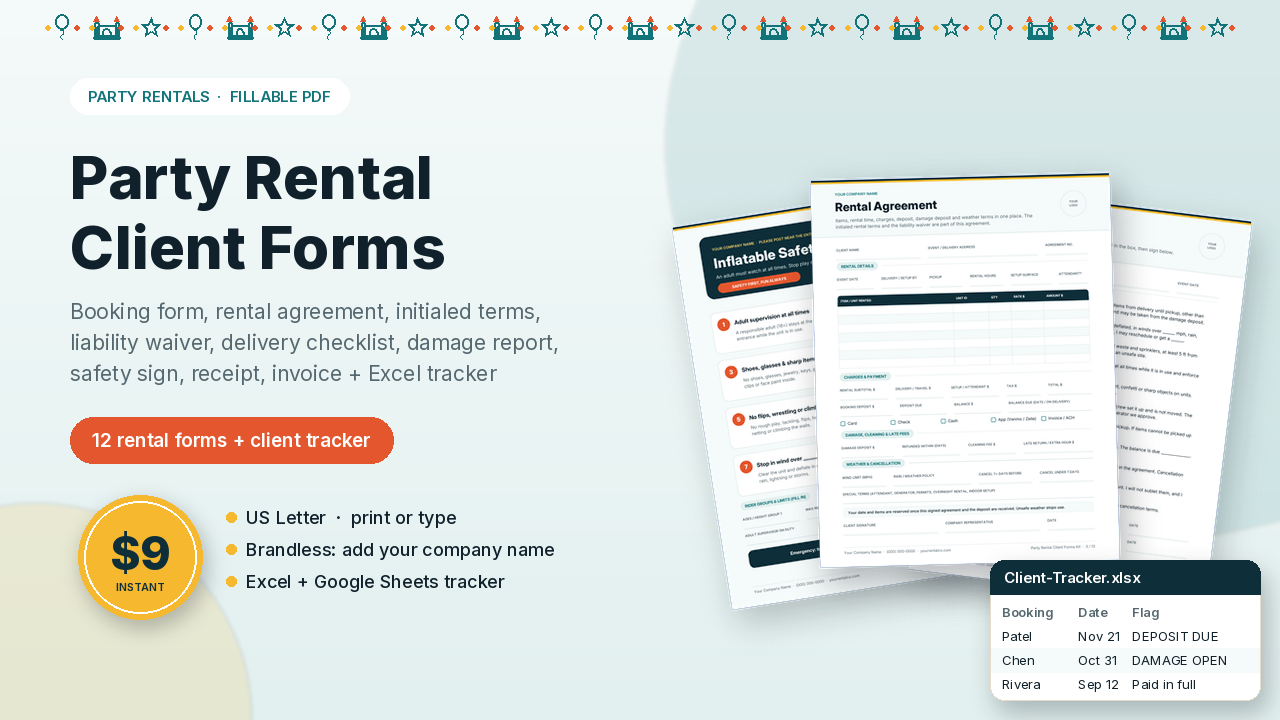
Party Rental Client Forms Kit
12 fillable forms (rental inquiry & booking, rental agreement, 10 initialed rental terms, liability waiver & release, delivery & pickup checklist, inventory check-out / check-in, damage report, inflatable safety rules sign, invoice and more) plus an Excel client tracker.
Get it →Section 6: Weather plan
Weather is the most common reason party rentals are cancelled or moved, so agree on the plan before anyone pays a deposit. The customer should know your rules now, not when it starts raining.
- Is there an indoor or covered backup location, and does it fit the unit (including height)?
- Would they rather move the date, switch to a different item, or cancel if the weather is bad?
- Do they understand that you will follow your manufacturer’s wind and weather limits and may take a unit down during the event if conditions change?
- For winter or evening events: do they need a tent, sidewalls, heaters or lighting? (See the holiday party rental pricing guide for how those add-ons are usually priced.)
- Preview your weather and rescheduling policy: who decides, by when, and what happens to the deposit
Write the weather policy in your agreement and point to it when you quote. The bounce house rental agreement guide covers how operators usually word weather, cancellation and early takedown terms.
Section 7: Delivery, setup and pickup windows
Party customers think about the party time. You need to think about the delivery and pickup windows, because they decide how many bookings you can fit in one day with the crew and trucks you have.
- What time does the party start and end?
- How early can you deliver and set up? Will someone be home to meet the crew?
- When can you pick up: right after the party, later that evening, or the next morning?
- Do they want an overnight or multi-day rental, and is the item secure overnight?
- Any hard limits: venue lockout time, school bell schedule, HOA hours?
- Is it an all-day rental or a set number of hours?
Do not confirm a delivery time you cannot hold on a busy weekend. Give a window instead, and confirm the exact time a day or two before. If the customer needs an exact setup time (for example, before a school assembly), price and schedule that booking accordingly.
Section 8: Budget, deposit and terms preview
Before you send a quote, preview the money terms so there are no surprises. Customers who know the deposit, cancellation and damage rules up front are much less likely to dispute them later.
| Term | How you might phrase it on the quote |
|---|---|
| Rental price | [Item] for [hours] rental: [your price] |
| Delivery | [Zone or distance]: [your delivery fee or "included"] |
| Setup extras | Stairs / long carry / hard-surface anchoring: [fee or "included"] |
| Add-ons | Generator / attendant / tables and chairs / concessions: [prices] |
| Deposit | [Amount or %] to hold the date, due by [date] |
| Balance | Due [before delivery / at delivery], via [payment methods] |
| Cancellation | [Your notice period and refund or credit terms] |
| Weather | [Who decides, by when, and credit or reschedule terms] |
| Cleaning or damage | [Your cleaning fee and damage terms, per your agreement] |
Table is an example only. Brackets are placeholders; use your own prices and policies.
Ask about the budget openly: "Do you have a budget in mind for rentals?" A customer with a tight budget may be happier with one well-chosen unit and a shorter window than a package they cannot afford. A customer with a larger budget may want add-ons you would not have suggested.
How the answers turn into a quote
Once you have the answers, the quote mostly writes itself. Use the table below to map common answers to quote lines. Then use your own pricing method for the numbers.
| Answer | What goes on the quote |
|---|---|
| Event date, start and end time | Rental window and delivery and pickup windows |
| Item chosen, guest ages | Recommended unit (or alternative) and rental price |
| Address and distance | Delivery zone fee, or out-of-area fee |
| Surface and space | Anchoring method, tarps, and any site-check note |
| Power available or not | Generator add-on, or a customer note about a dedicated outlet |
| Carry distance, stairs, gates | Setup extra or extra crew time |
| Venue rules, permit, insurance request | Note who is responsible and any certificate deadline |
| Weather plan | Reference to your weather and rescheduling policy |
| Add-ons requested | Separate line items for each add-on |
| Deposit and balance | Deposit amount and due dates |
Table is an example only.
Send the quote in writing, even when you also talk on the phone, and include the details the customer gave you (date, address, item, surface, space). If anything was different on the day, you have a clear record of what the price was based on.
When a site check is worth it
Most backyard bookings can be quoted from answers and photos. A site check, or at least a video call walk-through, is worth it when:
- It is a large event with several units, tents or a stage
- The space is tight, sloped or unclear from the photos
- It is a new venue you have never set up at
- The carry route is long or difficult
- The customer wants a firm, final price for a corporate or school budget
- There are venue rules about stakes, power or vehicles that you want to see in person
If you charge for site checks, say so and say whether the fee is credited to the booking.
Common mistakes to avoid
- Quoting the unit without asking about the surface. Hard surfaces, slopes and gravel change your anchoring and sometimes whether the item can go there at all.
- Skipping photos. A two-photo request takes the customer a minute and can save you a wasted trip.
- Not asking about power. A missing outlet or an overloaded circuit is a day-of problem that is easy to solve in advance.
- Confirming exact delivery times on a busy day. Give windows, and confirm closer to the date.
- Leaving the weather policy until it rains. Agree on it before the deposit.
- Assuming the venue allows inflatables. Ask the customer to check rules, permits and insurance requests.
- Not writing down who pays. On group and organization events, get the payer’s name and contact details.
- Letting the customer pick a unit that does not fit the guests. Recommend the right size and type for the ages and numbers.
One-page party rental questionnaire checklist
- Customer name, phone, email, preferred contact method
- Event date, party start and end time
- Event address, gate codes, park or pavilion details
- Event type and venue type (home, park, school, venue, business)
- Day-of contact; who books and who pays
- Items wanted and add-ons
- Guest count, children’s ages, adults using it?
- Supervision or attendant needed?
- Water item: hose access, ground OK getting wet?
- Setup location and surface type
- Space measurements and overhead clearance
- Level ground? Slope, roots, sprinklers, buried lines
- Overhead hazards: trees, wires, roof edges
- Photos of the setup area and carry path
- Outlet location and distance; generator needed?
- Truck parking, carry distance, gates, stairs
- Venue rules, permit, insurance certificate request
- Weather backup plan and policy previewed
- Delivery window, pickup window, overnight?
- Price, delivery, extras, deposit, balance and cancellation previewed
- Site check needed?
Keep this list in your booking form or on your phone. Ask the first five or six items on the first call or text, then fill in the rest before you hold the date.
FAQ
What should a party rental client questionnaire include?
Contact details and who pays, the event date, time and address, the venue type, the items wanted, guest count and ages, the setup surface and space with photos, power and carry distance, venue rules and permits, a weather plan, delivery and pickup windows, and a preview of your price, deposit and terms.
Can I quote a bounce house rental from photos?
For most backyard bookings, yes. Ask for a wide photo of the setup area and one of the path from the truck, plus the surface type and rough measurements. Note on the quote that the setup spot is confirmed on site.
How is a questionnaire different from a rental agreement?
The questionnaire collects the information you need to quote and plan the booking. The rental agreement is what the customer signs, with your terms for payment, cancellation, weather, safety rules, supervision and damage.
Should I ask about the setup surface every time?
Yes. Grass, concrete, gravel and indoor floors usually need different anchoring and protection, and a slope or overhead hazard can mean the spot does not work. Follow your equipment manufacturer’s instructions.
What if the customer does not know whether their park or venue allows inflatables?
Ask them to check with the venue or local authority before you hold the date, including permits and any insurance certificate requests. Do not assume it is allowed.
When should I do a site check instead of a photo quote?
For large events with several items, tight or sloped spaces, new venues, difficult carry routes, or when the customer needs a firm price for a school or corporate budget.
This page is general information for bounce house, inflatable and party rental businesses, not legal, insurance, safety, electrical or permitting advice. Rules on permits, insurance, inspections, inflatable operation, contracts, deposits and cancellations vary by location and venue. Always follow your equipment manufacturer’s instructions, check the current requirements that apply to you and have your own forms and agreements reviewed.
Related templates
Free Party Rental Forms
A printable party rental inquiry sheet, a simple rental agreement and a delivery, setup & pickup checklist for bounce house and party rental businesses.
Download free →Party Rental Client Forms Kit
Fillable party rental forms (inquiry, agreement, waiver, delivery checklist, damage report, invoice) plus an Excel client tracker.
Get it →