Holiday Event Planner Pricing: How to Price Office Parties, Family Gatherings, Holiday Galas and New Year’s Eve Events (Plus Free Forms)
How event and party planners can price late November through early January: corporate holiday party packages, family and private gatherings, short-notice rush fees, peak-date minimums, vendor deposits and markups, retainers and payment schedules, guest-count and weather rules, New Year’s Eve pricing and January packages, with a worked example and free event planner forms.
Why the holidays need their own planning price sheet
For most event planners, the season from Thanksgiving to New Year’s Day is short, crowded and unusually profitable. Office parties, family gatherings, galas, community events and New Year’s Eve parties all compete for the same calendar. Nearly all of them want the same three or four weekends in December.
That demand changes the work. Vendors book up early and ask for deposits sooner, clients call late, and guest counts move around. Priced like any other month, December means more work for the same fee and small events taking your best dates. A written holiday price sheet fixes most of that before the phone starts ringing.
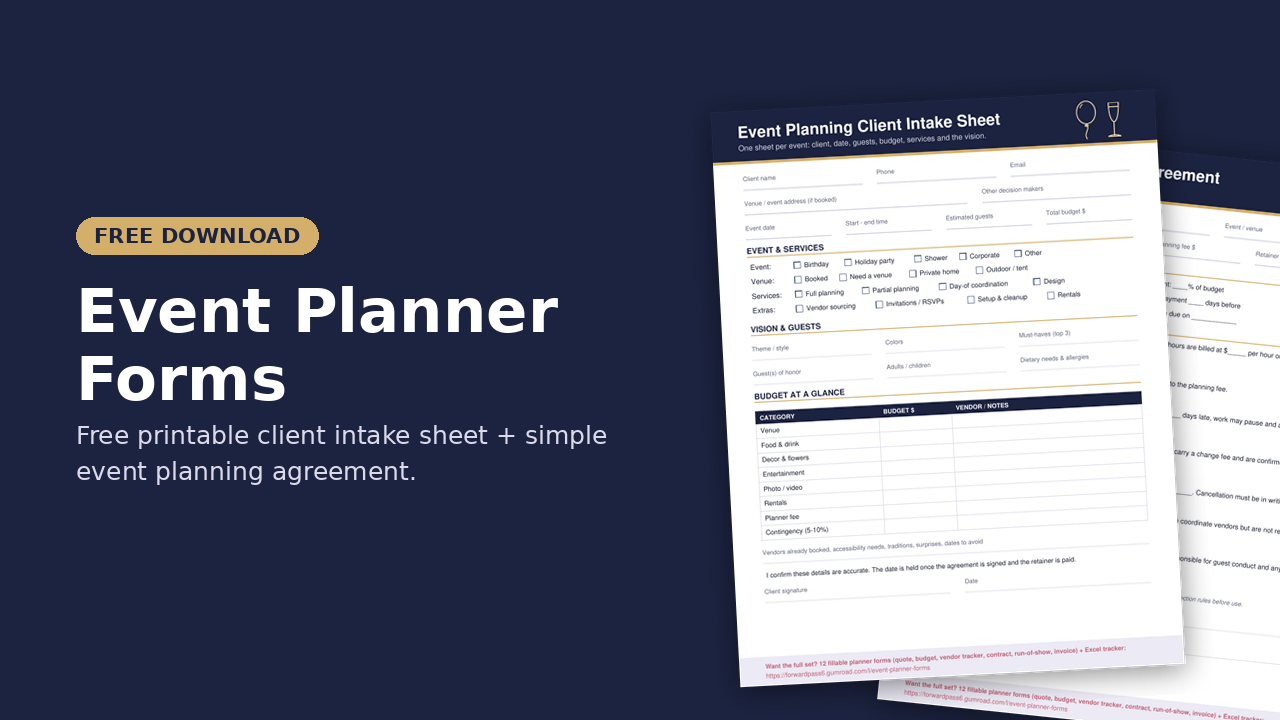
Free Event Planner Forms
A printable event planning client intake sheet plus a simple event planning agreement for event and party planners.
Download free →1. Start from your regular packages
Keep your year-round structure as the base: a flat fee for full planning, partial planning and day-of coordination, or a percentage of the event budget with a minimum, or an hourly rate for consulting. If you have not written those down yet, start with our event planning pricing guide and our event planner contract template, then build the holiday rules on top.
The holiday sheet adds only what matters this season: peak dates, rush timelines, vendor deposits, guest-count and weather rules, and New Year’s Eve and January offers. Clients accept seasonal policies more easily than an unexplained price increase.
2. Package the three main holiday event types
Most holiday inquiries fall into three groups. Each one involves different work, so give each its own package description:
- Corporate holiday parties. Office parties, client appreciation events and team dinners. The work is venue sourcing, catering and bar coordination, entertainment, decor, a run-of-show, and often an awards or speech segment. Corporate clients often need formal proposals and approvals from several people, so price for the extra meetings.
- Private and family gatherings. Holiday dinners, open houses, cookie exchanges and reunions. Fewer vendors, but more hands-on work: rentals, food, decor and a coordinator on the day.
- Galas, fundraisers and community events. Sponsors, ticketing, auctions, volunteers and permits take the most hours and carry the most risk, so many planners quote them as full planning with a higher minimum or as a percentage of the budget.
Write down what each package includes: number of planning meetings, vendor recommendations or full vendor management, design and decor help, timeline, rehearsal or walkthrough, day-of hours and the number of assistants. When a client asks for something outside the list, it becomes a priced add-on instead of a free favor.
3. Rush fees, peak dates and minimums
Your calendar is the real constraint in December, so price it on purpose:
- Name your peak dates. For many planners that means the first three Fridays and Saturdays of December plus New Year’s Eve.
- Set a peak-date minimum. A minimum planning fee for peak dates stops a small event from taking a slot a full-planning client would have booked. Off-peak weeknights, Sundays and early November dates can keep your regular minimum.
- Charge a short-notice fee. A three-week holiday party has the same tasks as a three-month one, with fewer vendors left. Many planners add a rush fee for events booked inside a set window, such as four weeks out, and state it as a flat amount or a percentage of the planning fee.
- Limit events per day. Decide how many events you and your team can run on one date, and how many coordinators each event needs.
4. Vendor deposits, markups and who pays whom
Holiday vendors fill up early and often ask for larger or earlier deposits. Make the money flow clear in writing:
- Direct vendor contracts. Many planners have clients sign and pay vendors directly.
- Pass-through billing. If you pay vendors and bill the client, state whether you bill at cost or at cost plus a handling or coordination fee, and collect the client’s money before you pay any vendor deposit.
- Deposit timeline. Put vendor deposit due dates in the client timeline so the client knows that, for example, the venue deposit is due at signing and the caterer’s final count is due a set number of days before the event.
- Commissions. If a vendor pays you a referral fee, many planners disclose it to the client.
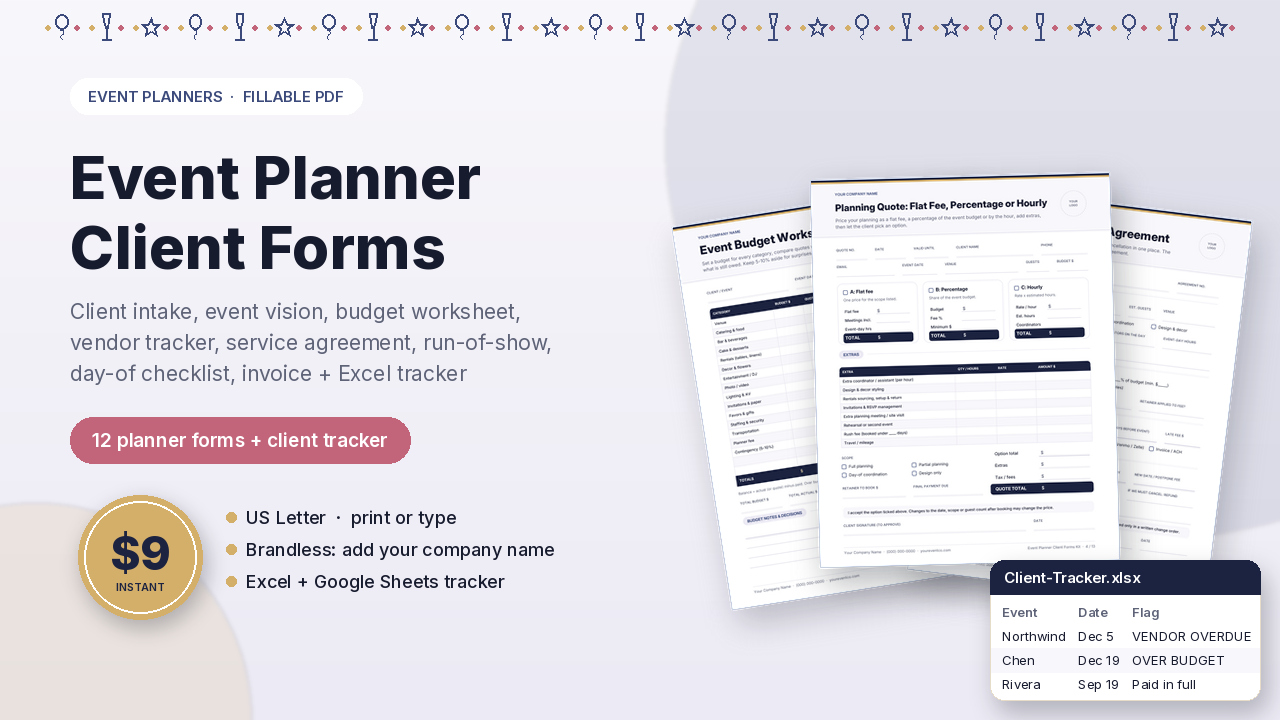
Event Planner Client Forms Kit
12 fillable forms (client intake, event vision & guest details, planning quote, event budget worksheet, vendor booking tracker, service agreement with retainer and change fees, timeline / run-of-show, day-of checklist, invoice and more) plus an Excel client tracker.
Get it →5. Retainers and payment schedules
A retainer is what turns an inquiry into a booked date. For the holidays, a few adjustments help:
- Retainer at signing. A non-refundable retainer, usually a stated share of the planning fee, reserves the date and covers early work.
- Shorter payment schedule. Because holiday events are booked closer to the date, many planners use two or three payments instead of monthly installments, with the final balance due before the event week.
- Paid in full for rush bookings. For events booked inside your short-notice window, some planners require the full planning fee at signing.
- Corporate terms. If a company needs net-30 invoicing, decide whether you accept it and whether the retainer must still be paid up front. Put it in the agreement.
6. Guest counts, changes and add-ons
Holiday guest lists move constantly, and every change touches several vendors. Protect your time:
- Final count deadline. Set a date for the final guest count that matches your caterer’s and rental company’s deadlines, and state what happens if the count rises after it.
- Change fees. Include a set number of revisions to the plan or timeline, then bill extra changes hourly. Changing the venue or date after vendors are booked is a bigger change and should have its own fee.
- Add-ons. Extra coordinators, decor installation, favor sourcing, photo backdrops, awards segments and transportation coordination are each their own line.
- Extra hours. State how many on-site hours the package includes and the hourly rate for coordinators if the party runs late.
7. Weather, cancellation and date-change rules
A December Saturday that cancels a week out almost never gets rebooked, and winter weather is a real risk in many areas. Write these terms down before anyone signs:
- Cancellation by the client. The retainer is kept, and a stated share of the remaining fee is owed depending on how close to the event the cancellation happens. Vendor cancellation terms apply separately under each vendor’s contract.
- Date changes. Offer to move the event to another available date for a change fee, with the retainer carried over.
- Weather. Say who decides whether the event goes ahead, how a weather postponement works and what the client owes for work already done.
- Backup plans. For outdoor portions such as tree lightings or tented receptions, include a weather backup in the plan and price any extra tent, heater or indoor venue costs as add-ons.
8. New Year’s Eve and January packages
New Year’s Eve is its own product. Vendors charge more, staff want more pay to work it, and the event runs past midnight. Many planners quote it as a separate package with a higher minimum, an overnight or late-night coordinator rate, and a clear end time for on-site work.
January is usually quiet. Instead of cutting your fee, package the work that still happens: post-holiday corporate kickoff events and awards nights, winter birthdays and showers, and early planning for spring weddings, graduations and summer events. A modest early-booking incentive for next December’s office parties can lock your best dates a year ahead.
9. A worked example (example numbers only)
These numbers are invented to show the math. Use your own hours, costs and local market rates.
- Example corporate holiday party, 80 guests, booked five weeks out for a peak Saturday.
- Example estimate: 26 planning hours (meetings, venue and vendor sourcing, budget, timeline, approvals) plus 9 event-day hours for the lead planner and 7 hours for one assistant.
- Example rates: lead planner $75 per hour, assistant $35 per hour. Planning: 26 × $75 = $1,950. Event day: 9 × $75 = $675, plus 7 × $35 = $245. Subtotal: $2,870.
- Example peak-date minimum: $2,500, so the minimum does not apply here.
- Example short-notice fee: none, because the booking is outside the example four-week window. Booked three weeks out, an example 15 percent rush fee would add $430.50.
- Example quote: round to a $2,900 planning fee, with an example 40 percent retainer of $1,160 due at signing and the $1,740 balance due seven days before the event. Vendors are contracted and paid by the client directly.
Every number on the quote should trace back to estimated hours, a rate that covers your costs, and rules the client saw before signing.
Put it on one page and send it early
Write your packages, peak dates, minimums, rush fee, vendor payment rules, retainer and payment schedule, guest-count and change rules, weather and cancellation terms, New Year’s Eve package and January offers on one sheet. Send it early to past corporate clients and the venues and caterers you work with; the earliest inquiries take your best dates.
Then use the same forms for every booking: an intake sheet so you know the scope before you quote, a planning quote with every line item, an agreement with the retainer, change and cancellation terms, a vendor tracker and a run-of-show for the day. That is what keeps your price holding when December gets busy.
FAQ
Do event planners charge more for holiday parties?
Many keep their regular package prices and add holiday rules instead: a higher minimum on peak December dates, a short-notice fee for rush bookings and a separate New Year’s Eve package. Off-peak weeknights and early November dates often stay at regular pricing.
How much should I charge to plan a corporate holiday party?
Estimate the planning and event-day hours it really takes, including extra meetings and approvals that corporate clients need, multiply by the rate that covers your income and costs, and compare the result with your peak-date minimum and planners near you. There is no single standard price.
Should I charge a rush fee for last-minute holiday events?
Many planners do, because short-notice events compress the same work into fewer days with fewer vendors available. State the booking window that triggers it and whether it is a flat amount or a percentage of the planning fee.
Who pays vendor deposits for holiday events?
It depends on your agreement. Many planners have clients contract and pay vendors directly. If you pay vendors yourself, collect the client’s funds first and state in writing whether you bill at cost or add a handling fee.
What happens if a holiday event is cancelled because of snow?
That depends on your agreement and each vendor’s contract. Common options are moving to a new date for a change fee, keeping the retainer, or charging for work completed. State who decides when weather is unsafe before the client signs.
How should I price a New Year’s Eve event?
Treat it as its own package with a higher minimum, late-night coordinator rates and a clear end time for on-site work, because vendors and staff charge more and the event runs past midnight.
This page is general guidance, not legal, tax or financial advice. Contracts, deposits, cancellation terms, permits and event insurance requirements vary by location and event type. Have an attorney review your event planning agreement.
Related templates
Free Event Planner Forms
A printable event planning client intake sheet plus a simple event planning agreement for event and party planners.
Download free →Event Planner Client Forms Kit
Client intake, planning quote, budget worksheet, vendor tracker, service agreement with retainer, run-of-show and invoice plus an Excel client tracker.
Get it →