Event Planner Client Questionnaire: Questions to Ask Before You Quote
A practical guide for independent event and party planners: the questions to ask every new client before the consultation, how to turn the answers into an accurate quote and scope, and the forms to collect before you start planning.
Why every event planning inquiry needs a questionnaire
Most scope problems in event planning start with the first conversation: a quote built from a short email, a guest count that doubles, a venue that has not been booked, or a client who assumed "planning" included running the bar. A client questionnaire collects the same information from every inquiry, in writing, before you price the job or block the date.
A good questionnaire does three jobs. It tells you whether the event is a good fit (date, type, size, budget). It gives you what you need to quote and scope accurately (services wanted, vendors already booked, venue and logistics). And it sets expectations early (what planning includes, how retainers and changes work) so the contract conversation is shorter.
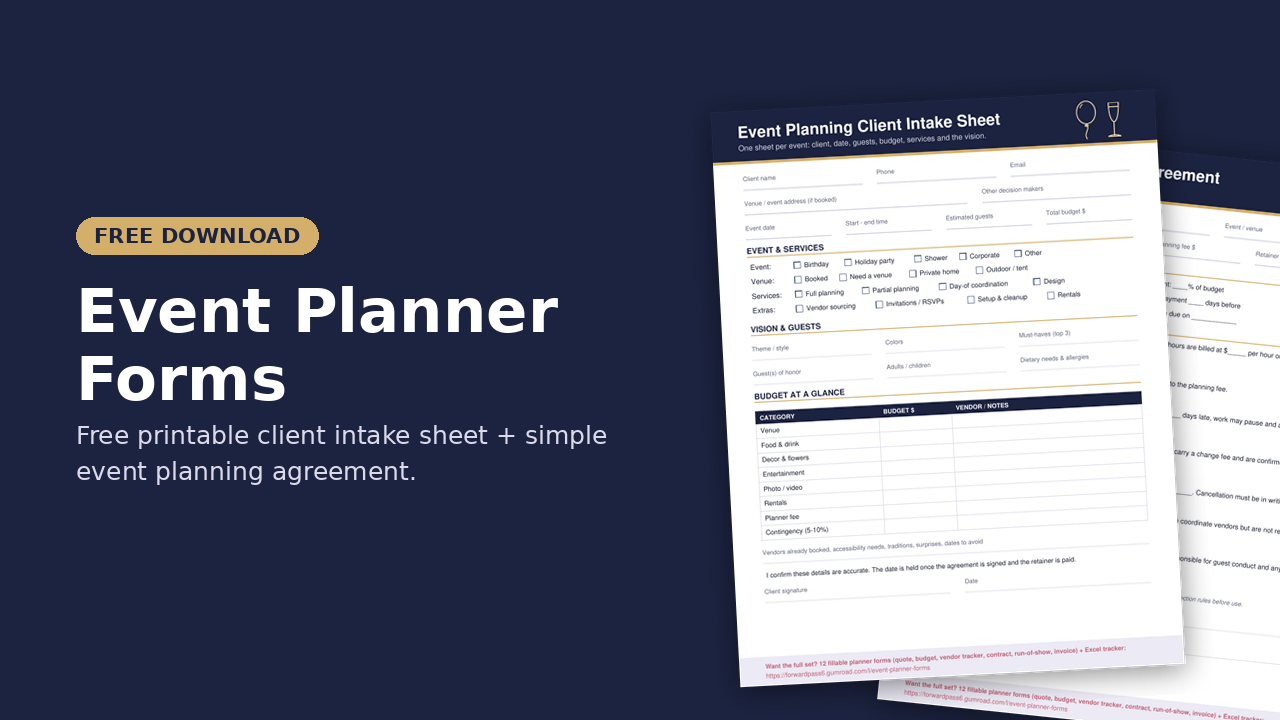
Free Event Planner Forms
A printable event planning client intake sheet plus a simple event planning agreement for event and party planners.
Download free →Section 1: Contact details and decision-makers
- Full name, phone, email and preferred contact method
- Who else is involved in decisions (partner, parent, committee, company contact) and who has final sign-off
- Who is paying, and the billing contact if it is a company or organization
- Best times to reach the client and expected response time
- How they heard about you (useful for your own marketing records)
Knowing who signs off is one of the most useful answers on the form. Planning slows down when three people give feedback and nobody approves.
Section 2: Event basics
- Event type: wedding, birthday, anniversary, corporate party, holiday party, fundraiser, shower, launch or other
- Event date, and whether the date is fixed or flexible
- Start and end time, plus any setup and teardown windows the client already knows about
- Estimated guest count: a low and a high number, adults and children
- Is the event public or private, and does it need tickets or RSVPs
- Is this a single event or part of a series (rehearsal dinner, after-party, multi-day conference)
Ask for a guest range rather than one number. The high end drives venue capacity, rentals and catering, so it is the number to plan around.
Section 3: Venue and location
- Has a venue been booked? If yes: name, address, contact, contract dates and any venue rules
- If not: indoor or outdoor, preferred area, travel limits for guests
- Venue restrictions: load-in times, approved vendor lists, noise curfew, open flame, décor and alcohol rules
- Parking, accessibility and transport needs for guests
- Weather backup plan for outdoor events (tent, indoor space, rain date)
- Power, kitchen and restroom access for vendors
If the venue is not booked yet, venue search is part of the scope. Note it so it shows up in the quote.
Section 4: Budget
Many clients hesitate to share a budget, but without one you cannot scope the event. Ask for a total event budget range, then what it should cover.
| Question | Why it matters |
|---|---|
| Total event budget (range) | Sets the size and style of everything else |
| Does the budget include your planning fee? | Avoids a gap between their number and yours |
| Who is contributing, and are amounts fixed? | Shows how flexible the budget really is |
| Top three priorities to spend on | Tells you where to protect money (food, venue, music, décor) |
| Items where they want to save | Tells you where to look for alternatives |
| Deposits already paid to vendors | Shows money already committed |
If a client will not give a number, offer ranges to choose from, for example "under a set amount", "a middle range" and "above a set amount" that fit the events you usually plan.
Section 5: Vision, style and guest experience
- Three words that describe how the event should feel
- Theme, colors or style references (photos, boards, past events they liked)
- Formality: casual, cocktail, formal
- Must-haves and absolute no's
- Program: speeches, performances, ceremony, awards, games, first dance
- Food and drink style: plated, buffet, food stations, heavy appetizers, open or limited bar, no alcohol
- Entertainment: DJ, live band, photo booth, activities for children
Vision questions are where clients tend to say the most. Leave space for free-text answers, then summarize them back in your proposal so they know you listened.
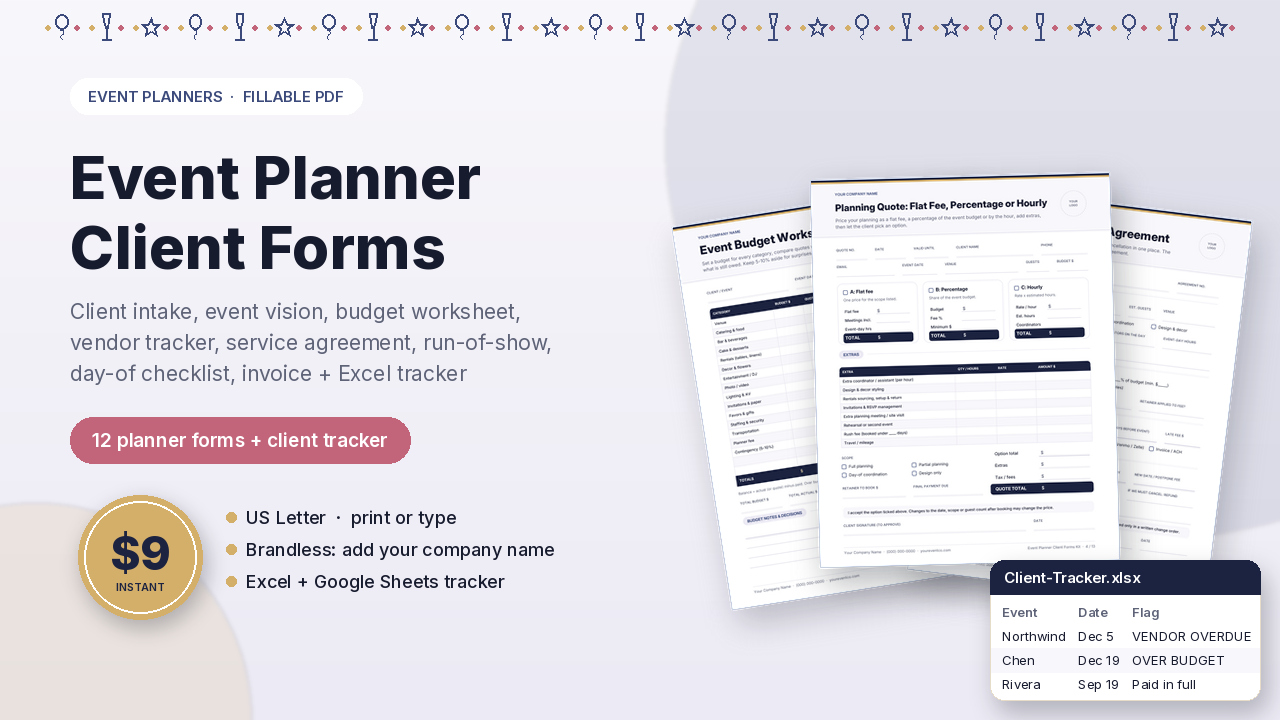
Event Planner Client Forms Kit
12 fillable forms (client intake, event vision & guest details, planning quote, event budget worksheet, vendor booking tracker, service agreement with retainer and change fees, timeline / run-of-show, day-of checklist, invoice and more) plus an Excel client tracker.
Get it →Section 6: Vendors already booked and still needed
A vendor grid makes it clear what you are coordinating and what you are sourcing.
| Vendor | Booked? (Y/N) | Name and contact | Client wants you to source? |
|---|---|---|---|
| Venue | |||
| Catering | |||
| Bar / bartending | |||
| Cake / desserts | |||
| Photography / video | |||
| DJ / band | |||
| Florist / décor | |||
| Rentals (tables, chairs, linens, tent) | |||
| Officiant / host / MC | |||
| Transportation |
Coordinating vendors the client already booked and sourcing new ones are different amounts of work. Price them separately if your fee structure allows it.
Section 7: Services the client wants from you
- Full planning: from early planning through the event day
- Partial planning: you join part-way and take over specific tasks
- Day-of or month-of coordination: you run the timeline and vendors on the day
- Design and styling only
- Vendor sourcing only
- Add-ons: guest communication, RSVP tracking, travel or hotel blocks, setup and teardown, rehearsal coordination
Clients often do not know these terms. A short description next to each option helps them choose, and their answer becomes the first line of your scope of services.
Section 8: Timeline and planning process
- When do they want to start planning, and how far away is the event
- How many planning meetings they expect, and in-person or video
- Any fixed deadlines: invitation dates, venue payment dates, guest travel dates
- How they prefer to review and approve decisions
- Who will be on site on the event day as the client contact
Short lead times usually mean more hours per week. If your pricing includes a rush or short-notice fee, note the lead time on the form.
Section 9: Special requirements
- Dietary needs and food allergies among guests
- Accessibility needs (mobility, seating, hearing, visual)
- Children, older guests or VIPs needing special arrangements
- Cultural or religious traditions to include
- Security, privacy or no-photo requests
- Permits that may be needed (public spaces, street closures, amplified sound, alcohol)
Requirements such as permits and insurance vary by location. Flag them early and confirm local rules with the venue or authorities rather than guessing.
Section 10: Policies and agreement preview
End the questionnaire with a short preview of how you work, so nothing in your contract is a surprise. The example terms below are placeholders, not recommendations.
| Policy | What to state | Example wording (example only) |
|---|---|---|
| Retainer | Amount or percent, when due, refundable or not | "A non-refundable retainer of [X]% reserves your date." |
| Payment schedule | Milestones and final due date | "Balance due [X] days before the event." |
| Changes | How scope changes are priced | "Changes after sign-off are billed at [rate] per hour." |
| Cancellation | What is owed at each stage | "Cancellations within [X] days forfeit [amount]." |
| Vendor contracts | Who signs and pays vendors | "Vendors contract directly with the client." |
| Overtime | Rate if the event runs past the agreed end time | "Time past [end time] billed at [rate] per hour." |
Fill in the brackets with your own terms. The full terms belong in your signed event planning agreement, not just the questionnaire.
Turning answers into a quote and consultation
Read the questionnaire before the consultation and use it as your agenda. Confirm the date, guest range, budget and services first, then go through vision and vendors. After the call, send a proposal that restates their answers, lists the services you will provide, and shows your fee and payment schedule.
| Answer on the form | How it affects the quote (example) |
|---|---|
| Guest range is wide | Quote for the high end, or offer two options |
| Venue not booked | Add venue search to the scope |
| Several vendors still needed | Add sourcing time |
| Event in a few weeks | Apply your short-notice terms, if you have them |
| Multi-day or multiple events | Price each event or add a per-event amount |
These are ways to think about scope, not fixed rules. Your own pricing method (flat fee, percentage or hourly) decides the numbers.
Common questionnaire mistakes
- Asking for one guest count instead of a range
- Skipping the budget question, then quoting blind
- Not asking who makes the final decision
- No vendor grid, so it is unclear what you are coordinating
- Mixing questionnaire and contract, so key terms never get signed
- Sending a form that is so long clients abandon it: keep it to what you need to quote, and collect the rest after booking
One-page questionnaire checklist
- Contact details, decision-makers and payer
- Event type, date, times and guest range
- Venue status and restrictions
- Budget range and priorities
- Vision, style and program
- Vendor grid: booked vs needed
- Services wanted from you
- Timeline and meeting preferences
- Special requirements
- Policy preview and next steps
FAQ
What should an event planner client questionnaire include?
Contact details and decision-makers, event type and date, guest range, venue status, budget range and priorities, vision and style, vendors booked and needed, services wanted, timeline, special requirements and a short preview of your policies.
Should I send the questionnaire before the consultation?
Yes. Sending it when a client first inquires lets you check fit, prepare for the call and quote from real answers instead of guesses.
How do I ask about budget without scaring clients off?
Explain that the budget helps you recommend the right venue, vendors and services, and offer budget ranges to choose from if they are unsure of a single number.
Is a questionnaire the same as an event planning contract?
No. The questionnaire collects information; the contract sets the terms (scope, fees, retainer, payment schedule, changes, cancellation, liability). Use both.
How long should the questionnaire be?
Long enough to quote accurately and no longer. Many planners keep the first form short and collect detailed guest, vendor and timeline information after the client books.
Can I use the same questionnaire for weddings and corporate events?
You can use one core form and add a few event-specific questions, for example ceremony details for weddings or billing and approval contacts for corporate events.
This page is general information for independent event and party planners, not legal, tax or insurance advice. Contract, permit, alcohol and insurance requirements vary by location, so check local rules or talk to a professional if you are unsure. Example wording and terms shown are placeholders only.
Related templates
Free Event Planner Forms
A printable event planning client intake sheet plus a simple event planning agreement for event and party planners.
Download free →Event Planner Client Forms Kit
Fillable event and party planner forms plus an Excel tracker with planning fees, retainers, vendors and budgets.
Get it →