Dog Walking Pricing: How Much to Charge Per Walk
How to price dog walking: cost per working hour, prices for 20, 30 and 60 minute walks, solo vs group walks, extra dogs, weekly packages, holiday and weekend rates, cancellations and a worked weekly quote.
Why dog walking needs its own pricing
Dog walking looks like the simplest pet service to price: one dog, one walk, one fee. But the walk itself is only part of the time. Driving between homes, getting keys, leashing up, wiping paws, refilling water and sending a visit report all take minutes you are not paid for unless your price covers them. A walker who charges only for the minutes on the sidewalk can be busy all day and still earn very little per hour.
A clear method fixes that: know your cost and target rate per working hour, price each walk length by the real time it takes, decide how extra dogs and group walks work, and set clear rules for packages, holidays and cancellations. The steps below end with a worked weekly quote. All numbers on this page are example numbers, not market data.
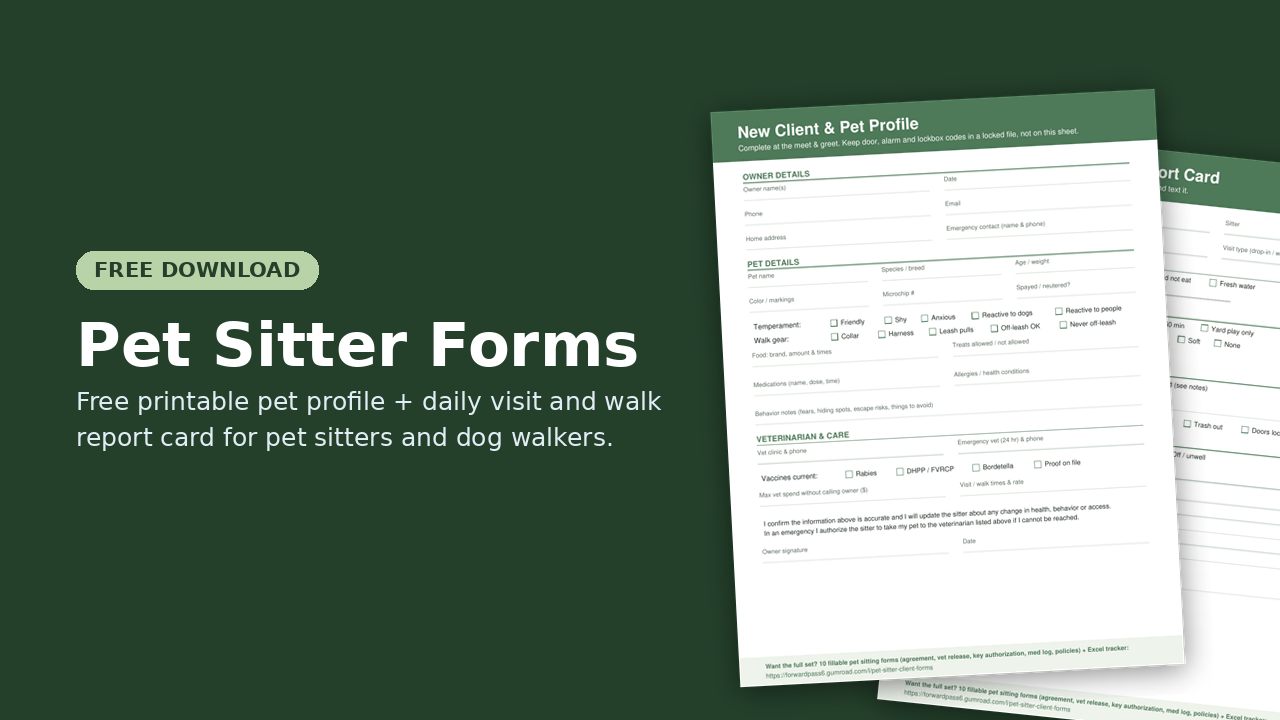
Free Pet Sitter Forms
A printable new client & pet profile plus a daily visit and walk report card for pet sitters and dog walkers.
Download free →1. Work out your cost per working hour
Start with your own costs, not a competitor's price. Add up what one working hour costs you: the pay you want, self-employment taxes, pet care insurance and bonding, fuel and vehicle wear, phone and booking app, leashes, waste bags, treats and towels, and card or invoicing fees.
- Example pay target: $20 an hour, plus about $3 in self-employment tax.
- Example insurance, bonding and supplies: about $2 per working hour.
- Example overhead: fuel, phone, app and fees about $5 per working hour.
- Example cost: about $30 per working hour before profit.
- Add profit: at an example 25-35% margin you would aim to earn around $40-45 per working hour.
Count every working hour, not only walking time. If you fit four 30-minute walks into a three-hour stretch because of driving, those three hours are what your prices have to cover.
2. Price each walk length by the real time it takes
Time a few typical walks from the moment you leave the last client to the moment you leave this one. Then turn that time into per-walk prices. The table below uses example numbers for one dog on a solo walk in a nearby neighborhood.
| Walk | Example time incl. travel and report | Example price (at about $42 per working hour) |
|---|---|---|
| 20-minute potty walk | About 35 minutes | $22-25 |
| 30-minute walk | About 45 minutes | $28-32 |
| 45-minute walk | About 60 minutes | $38-42 |
| 60-minute walk | About 75-80 minutes | $50-55 |
| Extra dog, same home | About 5 extra minutes | Add an example $8-12 |
Short walks carry the same driving and setup time as long ones, so their price per minute should be higher. If a 20-minute walk barely covers your drive, set it as your minimum or only offer it on routes you already run.
3. Solo walks, group walks and extra dogs
- Solo walk: one dog or one household's dogs. The highest price per dog, for puppies, seniors, reactive dogs and clients who want full attention.
- Group walk: several dogs from different homes in one outing. A lower example price per dog (for example $20-25 for an hour out), but more income per hour for you. Screen every dog first and cap the group size.
- Extra dog from the same home: an add-on fee rather than a second full price, as long as the dogs walk well together.
Keep solo and group prices clearly separate on your rate sheet so clients can see what they are choosing, and so a solo walk is never quietly turned into a group walk.
4. Adjust for the dog and the job
Add time or a set fee, not a vague surcharge, for anything that changes the work:
- Puppy visits that need a potty break, feeding and play rather than a real walk
- Large, strong or reactive dogs that need solo walks or quiet routes
- Medication, feeding or crate cleanup during the visit
- Muddy or snowy days that mean towel-drying and paw wiping
- Apartment buildings with long elevator waits, door codes or parking costs
- Homes outside your usual area, with a mileage fee or a higher minimum
Do a meet and greet before the first walk. It shows you the dog's behavior, the leash and harness, and the home access, so you can price accurately before you commit.
5. Weekly packages and regular schedules
Regular weekday clients are the core of a dog walking business. A small discount for a fixed weekly schedule rewards that commitment and fills your route in a predictable way. For example, you might charge an example $30 for a one-off 30-minute walk and $28 per walk for five walks a week, billed weekly or monthly in advance.
Group nearby clients into the same time windows so your driving time drops. A route of close-together homes lets you earn more per hour without raising prices.
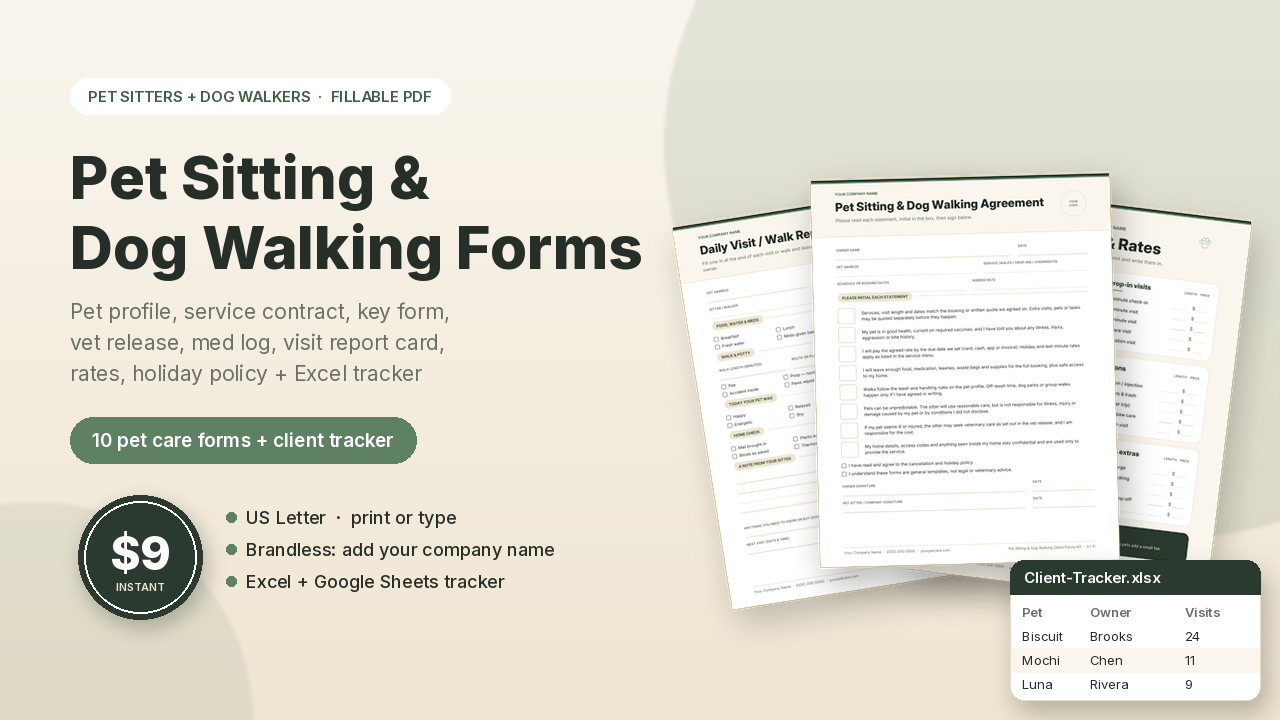
Pet Sitting & Dog Walking Client Forms Kit
10 fillable forms (client & pet profile, service agreement, key and alarm authorization, veterinary release, medication log, visit report card, meet & greet checklist, services and rates, cancellation & holiday policy, photo release) plus an Excel client and pet tracker.
Get it →6. Holidays, weekends and rush requests
Demand jumps around Thanksgiving, the winter holidays and summer travel, when owners are away or working long days. Many walkers add a holiday surcharge (for example $5-10 per walk) on listed holiday dates and a smaller weekend fee. Last-minute same-day requests can carry a rush fee.
Publish your holiday dates and fees early, ask regular clients to book ahead, and take deposits for holiday bookings if you are turning other work away. If clients are traveling, your pet sitting and drop-in prices may apply instead; see the pet sitting guides linked below.
7. Cancellations, weather and payment terms
Write down your rules before you need them: how much notice a client must give to cancel a walk (for example 24 hours, or the walk is charged), what you do in storms, heat or ice (shorter potty breaks, rescheduling, or indoor play), and when payment is due. Prepaid weekly or monthly billing avoids chasing small invoices.
Keep a visit report for every walk: time in and out, bathroom breaks, behavior and anything unusual. It builds trust and protects you if a question comes up later. The free forms below include a client and pet profile and a visit report card you can adapt.
Worked example: a weekday client with two dogs
Here is how the method comes together, using the example numbers above.
- Two friendly dogs from one home, 30-minute solo walk, Monday to Friday, 10 minutes from your route.
- Time per visit: about 45 minutes including travel, leashing, towel and report, plus about 5 minutes for the second dog = 50 minutes.
- Price per visit: example $30 for the walk + $10 for the second dog = $40. Weekly package discount of $2 per walk = $38.
- Weekly quote: 5 x $38 = $190, billed weekly in advance.
- Example cost to you: about 50 minutes x 5 visits = about 4.2 hours x $30 = about $125, leaving about $65 per week before income taxes.
- Holiday weeks: an example $8 per walk surcharge on listed holiday dates, stated in the agreement.
These are example numbers to show the math, not market rates. Use your own costs and local prices.
FAQ
How much should I charge for a 30-minute dog walk?
Start from your own costs and the pay you want per working hour, then remember that a 30-minute walk usually takes 45 minutes or more once you add driving, pickup, drop-off and the visit report. Price the whole block of time, not just the walk, and compare with walkers in your area. Any prices on this page are example numbers, not market data.
Should I charge per walk or per hour?
Most clients prefer a simple per-walk price for set lengths, such as 20, 30 or 60 minutes. Work out your hourly target behind the scenes and turn it into per-walk prices, so every walk length pays for your time and travel.
How much more should I charge for a second dog?
Many walkers add a smaller fee for each extra dog from the same home rather than charging full price again, because the travel and pickup time is shared. Set a limit on how many dogs you will walk at once and keep the fee high enough to cover the extra care.
Are group walks cheaper than solo walks?
Group walks are usually priced lower per dog, because several clients share one block of your time, but they earn more per hour. Only offer them to dogs that are friendly and screened at a meet and greet, and check any local limits on how many dogs one walker can handle.
Should I charge more on holidays and weekends?
Many walkers add a holiday surcharge on the main holidays and sometimes a smaller weekend fee, because demand is high and those are days you give up. Publish the dates and the fee in advance and put them in your cancellation and holiday policy.
What should a dog walking agreement include?
Client and dog details, vet and emergency contacts, walk length and schedule, solo or group, how keys and alarms are handled, leash and off-leash rules, weather policy, what happens if a dog is sick or hurt, cancellation notice, holiday rates, and payment terms. The forms kit below includes these pieces.
This page is general guidance, not legal, tax, insurance or veterinary advice. Business licensing, insurance and local rules on dog walking and group sizes vary by state and city, so check your local rules.
Related templates
Free Pet Sitter Forms
A printable new client & pet profile plus a daily visit and walk report card for pet sitters and dog walkers.
Download free →Pet Sitting & Dog Walking Client Forms Kit
10 fillable pet sitter and dog walker forms plus an Excel client and pet tracker.
Get it →