Dog Grooming Contract Template: What to Include (Free Template + Example)
A plain-English walkthrough of the clauses groomers put in their dog grooming service agreements: owner and pet details, vaccinations, services and pricing, matting and shave-down release, senior, medical and aggressive pet policy, muzzle use, emergency vet authorization, fleas and ticks, late pickup, cancellations and no-shows, mobile grooming, photo consent and payment, with a worked example and free grooming forms.
Why groomers need a written service agreement
Most problems in a grooming salon or van are not about the haircut itself. They come from surprises. A matted doodle comes back shaved short and the owner is upset. A senior dog has a seizure on the table and nobody knows which vet to call. A client picks up two hours late, or skips the busiest Saturday slot.
A dog grooming contract, often called a grooming service agreement, settles these questions before the first appointment. A release covers grooming risks; a service agreement also sets prices, fees, vaccine rules, cancellations, pickup, mobile terms, photo consent and payment.
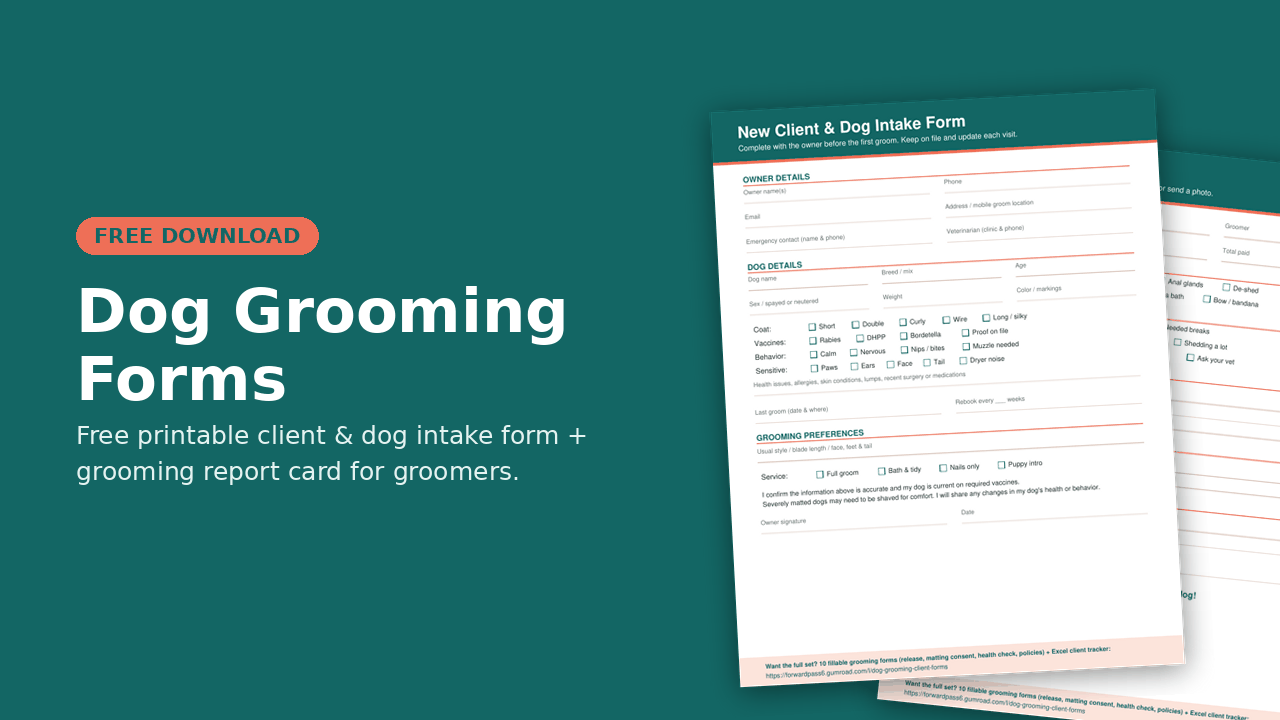
Free Dog Grooming Forms
A printable new client intake form plus a grooming release and consent form.
Download free →1. Parties, owner details and pet information
Start with your business name, address or service area, phone and email. Add the owner's full name, address, phone, email and an emergency contact who can make decisions and pick up the dog if the owner cannot be reached.
Then record each pet separately: name, breed or mix, age, sex, spayed or neutered, approximate weight, coat type, and the dog's regular veterinarian with clinic phone. Ask about sensitivities (feet, ears, nails, dryers), skin conditions, allergies, medications and any history of biting.
2. Vaccinations and proof of rabies
Most groomers require proof of a current rabies vaccination, and many also ask for other vaccines such as distemper/parvo or Bordetella (kennel cough), especially in salons where dogs share space. State which vaccines you require, that the owner must provide a vet record or certificate, and that you may refuse or reschedule the appointment if proof is missing or expired.
Rabies vaccination laws and any rules for grooming businesses vary by state, county and city, so check your local rules and set your policy to at least that standard. Also say how you handle puppies that are not yet fully vaccinated.
3. Services and pricing
List the services you offer and what each includes. A typical menu has a bath and brush (bath, dry, brush-out, nails, ears, sanitary trim), a full groom (bath plus haircut) and add-ons such as teeth brushing or de-shedding.
Say that quoted prices are starting prices based on size and coat, and that the final price depends on condition, behavior and time, with significant extra fees explained to the owner first.
Example price list only; set your own prices for your market: bath and brush, small dog $45, medium $55, large $70; full groom, small $65, medium $80, large $100, giant from $120; de-matting $15 per 15 minutes; nail trim only $15; teeth brushing $10; de-shedding treatment from $20.
4. Matting, de-matting and shave-down release
Matting is the single biggest source of conflict in grooming. Brushing out heavy mats is slow and painful for the dog. Your agreement should explain that when mats are tight or close to the skin, you may recommend a shave-down for the dog's comfort instead of de-matting, and that you will charge de-matting time at the posted rate when you do brush mats out.
Include a separate matting and shave-down release the owner initials. It should explain that shaving can reveal hidden skin irritation, hot spots or cuts, that the skin may itch or redden afterward, and that the coat may grow back differently. The owner agrees to the shave-down if you recommend it.
5. Senior, medical and aggressive pet policy
Some dogs are at higher risk on the table. Add a clause covering:
- Senior dogs and dogs with health conditions. Heart or breathing problems, seizures, arthritis, recent surgery or flat-faced breeds. The owner must disclose these, and you may shorten the groom, skip the dryer or decline if it is unsafe.
- Pregnant or recently injured dogs. Many groomers require vet approval first.
- Anxious or aggressive dogs. The owner must disclose any history of biting, snapping or fear of handling. You may charge a handling fee, use a muzzle, stop partway or refuse future service.
Make clear that you may end a groom at any time if continuing would put the dog or staff at risk, and that the owner pays for the services completed up to that point.
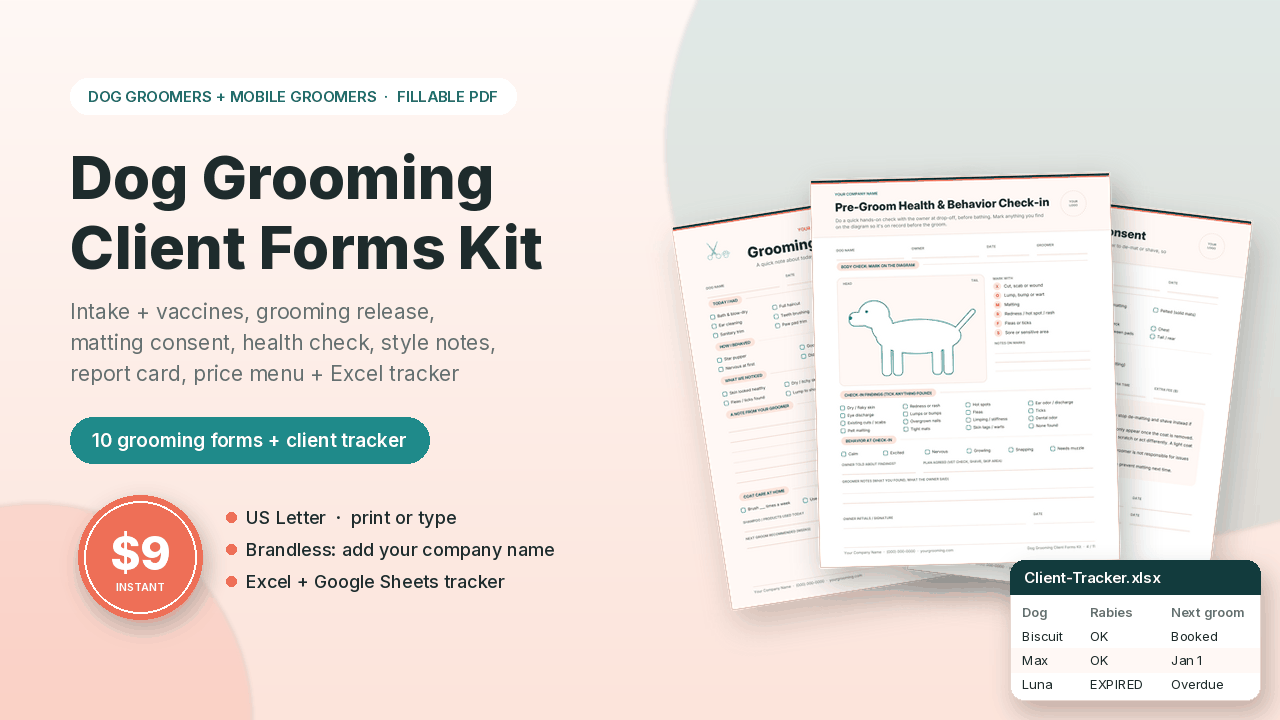
Dog Grooming Client Forms Kit
Fillable grooming forms (client & dog profile with vaccine record, grooming agreement & release, pre-groom health check, matting consent, style notes, report card and more) plus an Excel client tracker with next-groom-due dates and vaccine expiry alerts.
Get it →6. Muzzle use and handling
A muzzle can protect both the dog and the groomer during nail trims or face work. Say in the agreement that you may use a basket or soft muzzle, a grooming loop or other standard restraints when needed for safety, and that a muzzle is only used for short periods and removed if the dog shows signs of distress.
If the owner refuses muzzle use, record it and state that you may skip parts of the groom that cannot be done safely without one.
7. Injury, illness and emergency vet authorization
Nicks, quicked nails, clipper irritation or a dog falling ill can happen to careful groomers. Say that you will report any injury or concern, and that the owner should report any reaction within, for example, 48 hours.
Include an emergency vet authorization: if the dog needs urgent care and you cannot reach the owner or emergency contact, you may take the dog to their regular vet or the nearest emergency clinic. State who pays for that care. Many agreements say the owner pays for care related to pre-existing conditions. Let the owner set a spending limit if they want one.
8. Fleas, ticks and parasites
Fleas spread quickly in a salon or van. State that if you find fleas or ticks, you will treat the dog with a flea bath (or stop the groom and call the owner), charge a flea treatment fee, and add a sanitizing fee for cleaning your space and equipment. You may also refuse dogs with contagious skin conditions until a vet clears them.
Example fees only; set your own: flea bath $15 to $25 depending on size; tick removal $10; sanitizing fee $20.
9. Drop-off, late pickup and holding
Say how long grooming usually takes (for example 2 to 4 hours), that you will text when the dog is ready, and how long the owner has to pick up before a late fee applies.
Example only: 15-minute grace period, then $10 per 15 minutes; $25 after closing. If a dog is not picked up by a set time, state what you will do, such as boarding at a nearby facility at the owner's cost. Any rules about abandoned animals vary by location, so check your local rules.
10. Booking, cancellation and no-show policy
State how much notice the owner must give to cancel or reschedule without a fee. A 24- or 48-hour notice period is common.
Example only: cancellations with less than 24 hours' notice, or no-shows, are charged 50% of the booked service; after two no-shows a $25 non-refundable deposit is required to book. Also cover late drop-offs and what you do if you must cancel.
11. Mobile grooming terms
If you groom from a van or trailer, add a short section. Say whether you need power or water at the home, that the owner must provide parking and bring the dog to the van. State your travel area and any travel or trip fee outside it, and what happens if you arrive and the dog is not ready or no one is home (often treated as a no-show). You may reschedule for extreme weather. Parking and business rules for mobile services vary by location.
12. Photo consent
Before-and-after photos are great marketing, but ask first. Add separate checkboxes for photos kept in the dog's file (useful for style notes and documenting matting or skin issues), and for sharing photos of the dog on your website or social media, with or without the owner's name.
13. Payment terms
State that payment is due at pickup (or at the end of a mobile appointment), which payment methods you accept, and whether you charge a card on file for no-shows or late pickup fees. Note that prices may change with notice (for example 30 days), holiday surcharges appear on your price list, and unpaid balances must be settled before the next booking.
Liability wording: a note of caution
Many agreements include a release in which the owner accepts normal grooming risks (stress, minor nicks, skin irritation) and problems caused by pre-existing conditions, age, matting or undisclosed issues.
How far a release can limit your liability depends on local law, and in many places it cannot excuse negligence. Do not treat it as a guarantee. Check your local rules, have a qualified professional review the wording, and carry insurance suited to grooming, such as general liability and animal bailee or care, custody and control coverage, which may cover pets in your care.
Common mistakes in dog grooming agreements
- No written vaccination requirement or no rule for expired records
- Shaving a matted dog without a signed matting and shave-down release
- Not asking about seizures, heart problems, biting history or past grooming reactions
- No emergency vet authorization or contact who can make decisions
- Unwritten flea, late pickup and no-show fees that are hard to enforce
- Posting before-and-after photos without permission
- Relying on a release alone instead of insurance and careful handling
Worked example: a matted doodle on her first visit
Example numbers only; set your own prices for your market. An owner books a full groom for a 45-pound goldendoodle, a medium dog on the groomer's price list ($80). She signs the agreement, sends a current rabies certificate and notes the dog dislikes nail trims. At drop-off the groomer finds tight matting and recommends a shave-down. The owner initials the matting release and agrees. The groomer spends 30 minutes extra on the coat ($30 de-matting at $15 per 15 minutes) and finds fleas, so adds a flea bath ($20). The owner picks up 25 minutes late, after the 15-minute grace period ($10). Total: $80 + $30 + $20 + $10 = $140. The groomer photographs mild belly redness for the file (the owner allowed file photos, not social media) and books the next groom in six weeks.
How to send and store your agreement
Send the agreement and intake form at booking and have them signed before drop-off. Keep agreements, vaccine records, releases and photos in one file per dog, and ask owners to update details when health or vaccines change.
FAQ
Do dog groomers need a contract with clients?
It is strongly recommended. A short service agreement records the owner and pet details, vaccine rules, prices, matting and shave-down consent, emergency vet authorization and your cancellation and late pickup fees, which prevents most disputes.
What is the difference between a grooming release form and a grooming contract?
A release form mainly covers the risks of grooming and the owner's consent. A service agreement includes that and also sets prices, fees, vaccination rules, booking, cancellations, pickup, mobile terms, photo consent and payment.
Should groomers require proof of rabies vaccination?
Most groomers do, and many ask for other vaccines too. Rabies laws and any business rules vary by state, county and city, so check your local rules and set your policy to at least that standard.
Can I shave a matted dog without the owner's permission?
It is best not to. Get a signed matting and shave-down release that explains the risks, and call the owner before shaving when possible. Document the coat condition with dated photos.
What should a grooming no-show policy say?
State the notice needed to cancel (often 24 or 48 hours), the fee for late cancellations and no-shows, and whether a deposit is required after repeated no-shows.
Does a grooming waiver protect me from liability?
Only partly. How much a release protects you depends on local law, and many places do not allow it to excuse negligence. Use it with careful handling, clear disclosure questions and grooming insurance.
This page is general guidance, not legal or veterinary advice. Vaccination laws, animal handling and business rules, release and waiver enforceability, consumer rules and insurance requirements vary by state, county and city. Check your local rules and have a qualified professional review your dog grooming contract before you use it.
Related templates
Free Dog Grooming Forms
A printable new client intake form plus a grooming release and consent form.
Download free →Dog Grooming Client Forms Kit
Grooming agreement, matting consent, pre-groom health check and an Excel tracker with rebooking dates and vaccine expiry alerts.
Get it →