Dog Grooming Client Questionnaire: What to Ask Before the First Appointment
A practical guide for salon and mobile groomers: the questions to ask a new client before you book their dog, how each answer changes the time slot and the price, and what to have ready for the first visit.
Why you need a questionnaire before the first appointment
"How much for a groom?" is the message every groomer gets, often with nothing more than a breed name, and sometimes not even that. The honest answer is "it depends." A short-coated adult dog who has been groomed every few weeks since puppyhood is a very different appointment from a large doodle who has not seen a groomer in a long time, has never had a nail trim without a struggle, and whose owner wants a fluffy teddy bear face. Both owners may describe their dog in one word: "friendly."
A short pre-booking questionnaire fixes that. Sent by text, email or an online booking form as soon as a new client asks for an appointment, it collects the details that decide how long to book, which groomer and which table or van slot to use, what to charge, and whether the dog is a good fit for your setup at all. It is not the same as the documents you use later. Your dog grooming intake form is the record the owner completes and signs for your files, usually at or just before check-in; your grooming release form and dog grooming contract record the consent and terms; and dog grooming pricing explains how to set prices by size, coat and service. The questionnaire has one narrower job: help you decide whether, when and for how long to book this dog, and give the owner a realistic price range before they arrive.
Keep it short enough to finish on a phone in a few minutes. The sections below are a menu; pick the questions that match the dogs and services you offer.
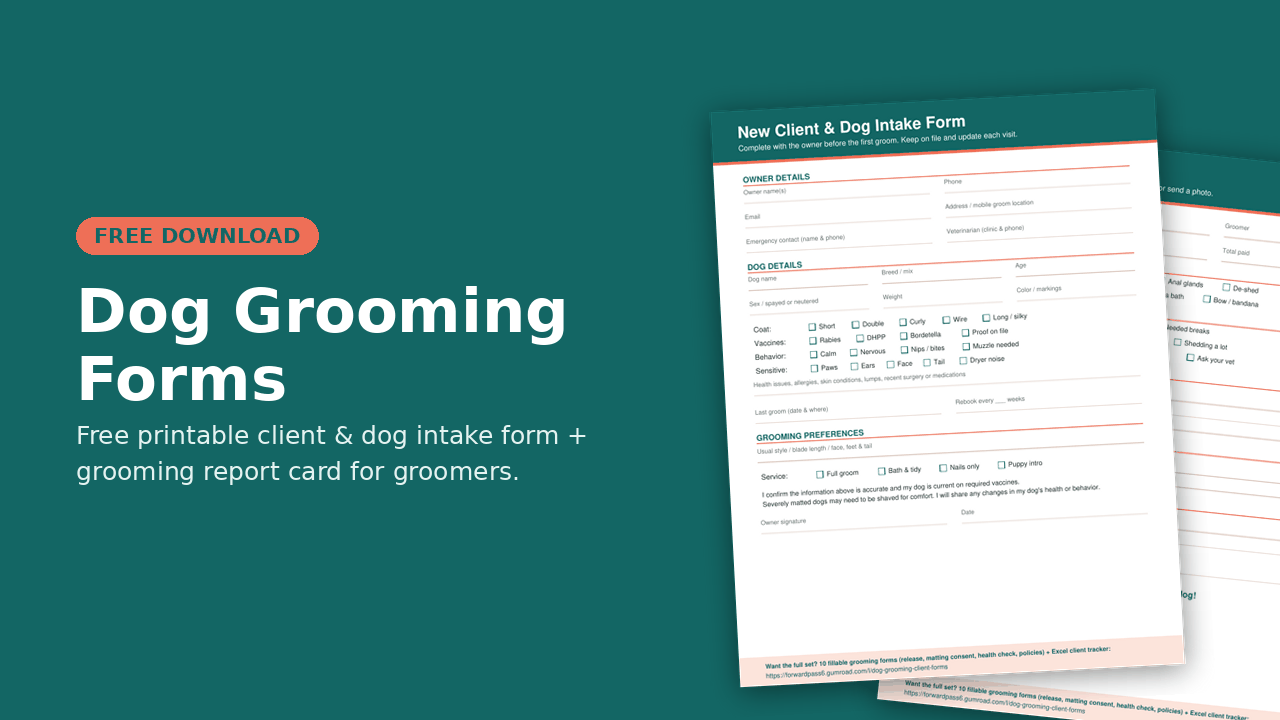
Free Dog Grooming Forms
A printable new client intake form plus a grooming release and consent form.
Download free →Section 1: Owner details and how they want to book
- Owner name, phone number, email and preferred contact method (text, call or email)
- How they heard about you, and whether they have more than one dog to book
- Their address or area, especially if you are mobile or have a service radius
- Is anyone else allowed to drop off, pick up or make decisions about the dog?
- What made them look for a new groomer: a move, a schedule change, a bad experience, or a first groom for a puppy?
- Do they have a date in mind or a deadline, such as a holiday, a family photo, travel or a boarding stay?
- Are they hoping for a one-time groom or a regular schedule?
The last question matters more than it looks. A client who wants a regular rebooking interval is easier to plan around and often has a dog whose coat stays in better condition between visits. Asking up front also gives you a natural moment to explain your rebooking options later.
Section 2: The dog: breed, size, age and coat
Breed alone does not tell you enough. Mixed breeds, doodles and dogs with unknown history vary widely in coat and size, so ask for the details and a few current photos.
- Dog name, breed or best-guess mix, age and sex; spayed or neutered?
- Approximate weight, and whether they would call the dog small, medium, large or giant
- Coat type in their own words (short and smooth, double coat, curly, wiry, long and silky) and a full-body photo standing up
- Is this the first professional groom, or has the dog been groomed before? If so, how often, and when was the last one?
- For puppies: how old, and have they been handled for brushing, nail trims and baths at home?
The table below shows how coat type typically changes what you ask next. It is an example only; your categories, times and prices will differ.
| Coat type the owner describes | What it changes (example only) |
|---|---|
| Short, smooth coat | Mostly bath, dry, nails and ears; ask about shedding and any skin concerns; [base price by size] |
| Double coat (heavy undercoat) | Drying time and de-shedding; ask when the dog was last brushed out; [de-shedding add-on] |
| Curly or wavy coat (poodle, doodle mixes) | Haircut length, face style, matting risk; ask how often it is brushed at home; [price by size and style] |
| Wiry coat | Clipping vs hand-stripping, if you offer it; ask what was done before; [price by method] |
| Long, silky coat | Length kept vs trimmed, tangles behind ears and legs; [price by size and length] |
| Unknown or mixed coat | Ask for close-up photos of the coat on the back, legs and ears; [confirm at the first visit] |
A current full-body photo and a close-up of the coat often tell you more than a breed name. Ask for both in natural light.
Section 3: Coat condition, matting and the last groom
Condition decides how long the appointment takes and which conversations you need to have before the dog arrives. Ask neutral questions so the owner does not feel judged:
- When was the dog last professionally groomed or clipped?
- How often is the dog brushed at home, and with what kind of brush or comb?
- Are there any tangles or mats? Where: behind the ears, under the legs, on the belly, around the collar, on the tail?
- Can they slide a comb through the coat down to the skin, or does it stop?
- Has the dog had a full shave-down before? How did the skin and coat look afterward?
- Any burrs, sticky residue, paint, or anything unusual stuck in the coat?
Ask for close-up photos of any matted areas. If the coat looks tightly matted, say so before the appointment: explain that a comfortable brush-out may not be possible, that a shorter clip may be the kinder option, and that matted coats can hide skin problems that only show once the coat is removed. Then point to your matting policy and consent form instead of making promises. The grooming release form guide covers what that consent usually includes.
Section 4: Health, vaccinations and vet details
You are not diagnosing anything here. You are collecting the information you need to decide whether to book, what to watch for, and when to ask the owner to check with their vet first.
- Vet clinic name and phone number
- Which vaccinations your policy requires, and whether they can send proof before the appointment (state your own policy; requirements can vary by location)
- Any current health conditions: skin problems, ear infections, allergies, heart or breathing issues, seizures, joint pain, diabetes, recent surgery?
- Any medications, and anything you should know about how they affect the dog?
- Any lumps, hot spots, sore areas, or places the dog does not like touched?
- Any allergies or sensitivities to shampoos or products they know of?
- Fleas or ticks recently, and is the dog on a preventive? (Ask so you can follow your own parasite policy.)
- For senior dogs: can the dog stand for long periods, and does the owner prefer shorter sessions or breaks?
- Is the dog in season, pregnant or recently given birth?
If the answers raise a concern, it is reasonable to ask the owner to check with their vet before booking, or to offer a shorter, simpler first visit. Note what the owner told you so you can confirm it on the intake form at check-in.
Section 5: Behavior and handling history
Behavior questions protect the dog, your team and other dogs in the salon. Ask them plainly, and explain why you ask so owners answer honestly:
- How does the dog react to nail trims, ear cleaning, face trimming, bathing and blow dryers?
- Has the dog ever growled, snapped or bitten anyone, including a groomer, vet or family member? In what situation?
- Has a previous groomer or vet used a muzzle, asked for the owner to stay, or declined to finish a groom?
- How does the dog behave around other dogs, in a crate, or when left with strangers?
- Any fear of noises, being lifted, or particular body parts being touched?
- Has the vet ever prescribed anything for anxiety before visits? (Ask only so you know; any medication decisions stay with the owner and their vet.)
- Is the dog used to a grooming table, a tub, or being on a leash during handling?
A dog with a difficult handling history may still be a good client. The answers simply tell you to book a quieter time, allow extra minutes, start with a shorter visit, or explain your muzzle and handling policy before the day. Those policies belong in your signed grooming agreement.
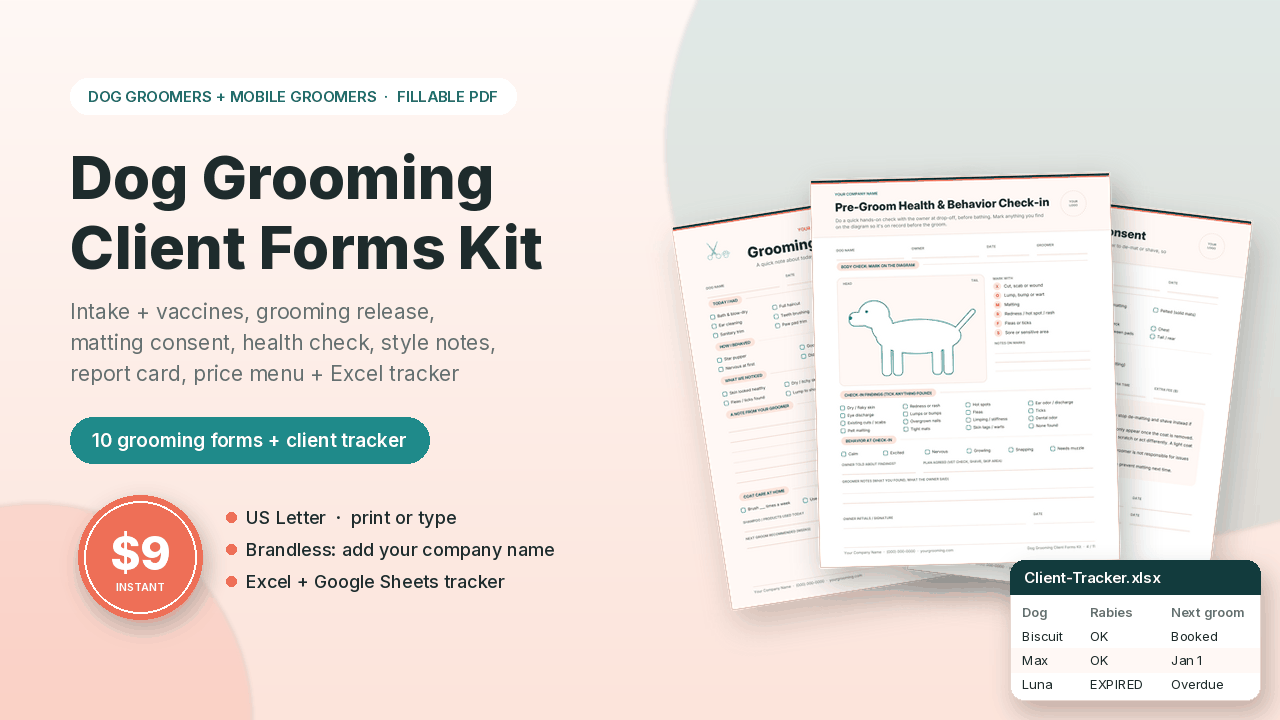
Dog Grooming Client Forms Kit
Fillable grooming forms (client & dog profile with vaccine record, grooming agreement & release, pre-groom health check, matting consent, style notes, report card and more) plus an Excel client tracker with next-groom-due dates and vaccine expiry alerts.
Get it →Section 6: Services, style and expectations
Many disputes in grooming come from a gap between what the owner pictured and what was realistic for the coat. Ask specifically what they want:
- Which service: bath and brush, bath and tidy, full haircut, de-shedding, nails only, or a puppy introduction visit?
- Haircut length on the body, legs, head and ears, in their own words, plus a photo of a style they like
- Face style, tail and feet: rounded, short, natural, breed-standard?
- Add-ons they expect: nail grinding, teeth brushing, gland expression (if you offer it), bows or bandanas, special shampoos?
- Anything they do not want: shaving certain areas, scented products, bows, sedatives, or photos of the dog on social media?
- Do they have a photo of the dog after a groom they were happy with?
Use the photos to set expectations kindly. If the style they want is not possible with the current coat condition, say so before booking and offer what is realistic on this visit, with a plan for the style on future visits.
Section 7: Salon or mobile, scheduling and logistics
- Salon: what drop-off and pickup times work, and can they pick up promptly when you text that the dog is ready?
- Is the dog comfortable being crated while waiting, or do they prefer an express or one-on-one slot (if you offer it)?
- Mobile: where can the van park, is the spot level and legal for parking, and is there any HOA or building rule about service vehicles?
- Mobile: will someone be home to hand over the dog, and is there a gate code or other pets to keep away from the door?
- Any days or times to avoid, such as work hours, school runs or other appointments?
- Will the owner want to watch, stay nearby, or be called during the groom?
Logistics answers decide your slot length and route more than people expect. A dog who needs a quiet room, a long drying time or a one-on-one slot may fit better at a particular time of day.
Section 8: Budget and policies preview
Ask whether they have a price range in mind. It lets you suggest the right service, such as a bath and tidy this time with a full haircut once the coat is brushed out, or a shorter first visit for a nervous dog. Then preview your main policies so the paperwork at check-in holds no surprises. The table below uses bracketed placeholders only; it is not recommended wording.
| Policy | What to show (placeholders) |
|---|---|
| Pricing basis | Prices are based on [size, coat type, condition and service]; your quote is confirmed after [we see the dog / the pre-groom check]. |
| Matting and coat condition | Matted coats may need [de-matting at amount per time unit / a shorter clip]; [policy on consent]. |
| Vaccination proof | We require proof of [vaccinations per your policy] before [the first appointment / check-in]. |
| Health and senior dogs | Dogs with [conditions] may need [vet note / shorter sessions / owner on call]. |
| Behavior and handling | We may [use a muzzle / pause / stop the groom] if [condition]; [fee policy if the groom ends early]. |
| Late pickup | Dogs not picked up within [time] of the ready message may be charged [amount]. |
| Deposit, cancellation and no-show | A deposit of [amount] holds new-client appointments; cancellations within [notice period] [policy]. |
The policies themselves belong in your signed dog grooming contract and release form. The questionnaire only previews them so the owner knows how you work before they book.
Turning the answers into a booking and a quote
With a completed questionnaire and a few photos, you can choose the right slot length, groomer and service, and give a price range before the first visit. The example below is for illustration only. The prices and times are placeholders; set your own based on your costs, market and experience, and see how to price dog grooming for the method.
| Questionnaire answer | How it affects the booking or quote (example only) |
|---|---|
| Medium curly-coated mix, last groomed a while ago | Full haircut at $[amount], plus a [minutes] buffer for coat condition |
| Mats behind ears and under legs in photos | Matting conversation before booking; de-matting at $[amount] or a shorter clip with consent |
| Hates nail trims, has snapped at a vet | Quieter time slot, extra [minutes], handling policy shared in advance |
| Senior dog with joint stiffness | Shorter session or breaks; [vet note policy]; price at $[amount] |
| Wants teddy bear face and fluffy legs | Style photo saved; realistic length explained for this visit |
| Mobile, parking on a busy street | Confirm a legal, level spot before booking; [travel or mobile fee] |
| Wants a regular schedule | Rebooking interval of [weeks] and recurring price of $[amount] |
Send the owner a short confirmation that lists the service, the price range and what could change it, such as coat condition, matting or behavior on the day. Then send your intake form and release to complete before drop-off, and confirm the details together at check-in.
Common mistakes to avoid
- Quoting by breed name alone. Ask for weight, coat type, last groom date and photos.
- Not asking about matting before the day. Owners are less upset by a shorter clip when they heard about it before booking.
- Skipping the behavior questions. Ask about nail trims, dryers, past bites and muzzles; it protects the dog and your staff.
- Giving health advice. Collect the information and refer health questions to the owner's vet.
- Booking a new dog into a short slot. First visits often take longer; leave room for the unknown.
- Not saving style photos. A photo of what the owner wants avoids "that is not what I asked for" at pickup.
- Leaving policies for check-in. Preview matting, late pickup and cancellation policies in the questionnaire so nothing comes as a surprise.
- Treating the questionnaire as the signed record. Keep the signed intake form, release and agreement on file as well.
One-page dog grooming client questionnaire checklist
- Owner contact details, preferred contact method, address or service area and how they found you
- Who else can drop off, pick up or make decisions
- Dog name, breed or mix, age, sex, weight and size
- Coat type, full-body and close-up photos
- Last professional groom, home brushing routine, any mats and where
- Vet details and proof of the vaccinations your policy requires
- Health conditions, medications, sore areas, product sensitivities, parasites, senior needs
- Behavior with nails, ears, face, bath, dryer, other dogs, crates; any bite history or muzzle use
- Service wanted, style and length, style photo, add-ons, things they do not want
- Salon drop-off and pickup times, or mobile parking, access and other pets
- Preferred dates, any deadline, one-time or regular schedule
- Budget range and acknowledgment of your policies preview
The dog grooming intake form guide covers what to keep on file once they book, and the free and paid templates on this page include ready-made versions you can adapt.
FAQ
What should a groomer ask a new client before the first appointment?
Ask for the owner's contact details, the dog's breed or mix, age, weight and coat type, when the dog was last groomed, whether there are any mats, vet details and vaccination proof per your policy, health conditions and medications, behavior with nail trims, dryers and other dogs, any bite history, the style they want, salon or mobile logistics, timing and a rough budget. Current photos help a lot.
How is a client questionnaire different from a dog grooming intake form?
The questionnaire is sent before booking to help you decide whether, when and for how long to book the dog and what price range to give. The intake form is the record the owner completes and signs for your files, usually just before or at check-in, and is reviewed at every visit. Many groomers use both, with the questionnaire answers carried over into the intake form.
Can I quote a dog groom without seeing the dog?
You can usually give a price range from the questionnaire and photos, as long as you say the final price is confirmed after you see the dog. Coat condition, matting and behavior on the day can change the time needed, so explain what could change the price before the appointment.
Should I ask for photos of matting before booking?
Yes. Close-up photos of matted areas let you raise the conversation before the day, explain your matting policy, and book enough time. They do not replace checking the coat in person at drop-off.
What if the owner does not know the dog's history?
That is common with rescues and newly adopted dogs. Ask what they do know, book a longer or simpler first visit, and treat it as an introduction. Note the unknowns so you can update the record after the first groom.
Should the first appointment be longer than a regular one?
Many groomers book extra time for a new dog, because they do not yet know the coat, handling or drying needs. The questionnaire answers help you decide how much extra time to allow.
This page is general information for dog grooming businesses, not legal, veterinary or insurance advice. Rules on business licensing, vaccination requirements, contracts, deposits and animal handling vary by location. Check the current requirements that apply to you, refer health questions to the owner's veterinarian, and have your own forms and agreements reviewed.
Related templates
Free Dog Grooming Forms
A printable new client intake form plus a grooming release and consent form.
Download free →Dog Grooming Client Forms Kit
11 fillable grooming forms (intake, release, matting and senior pet waivers, report card) plus an Excel client tracker.
Get it →