Deep Cleaning Pricing: How Much to Charge for a Deep Clean
How house cleaners can price a deep clean: cost per working hour, how much longer a deep clean takes, flat rates by home size, add-ons, first-clean pricing, holiday and rush fees, deposits and a worked quote.
Why deep cleans need their own price
A deep clean is not a standard clean done a little slower. It means scrubbing grout, degreasing the stove and range hood, wiping baseboards and door frames, cleaning light switches and vents, descaling showers and getting into corners a weekly clean skips. Quote it at your regular price and you can end up working six hours for a four-hour fee.
A simple method fixes that: know your cost and target rate per working hour, estimate how long the deep clean will really take, then turn that into a flat rate with a clear list of what is included. Add separate prices for add-ons and firm rules for deposits and cancellations. The steps below end with a worked quote. All numbers on this page are example numbers, not market data.
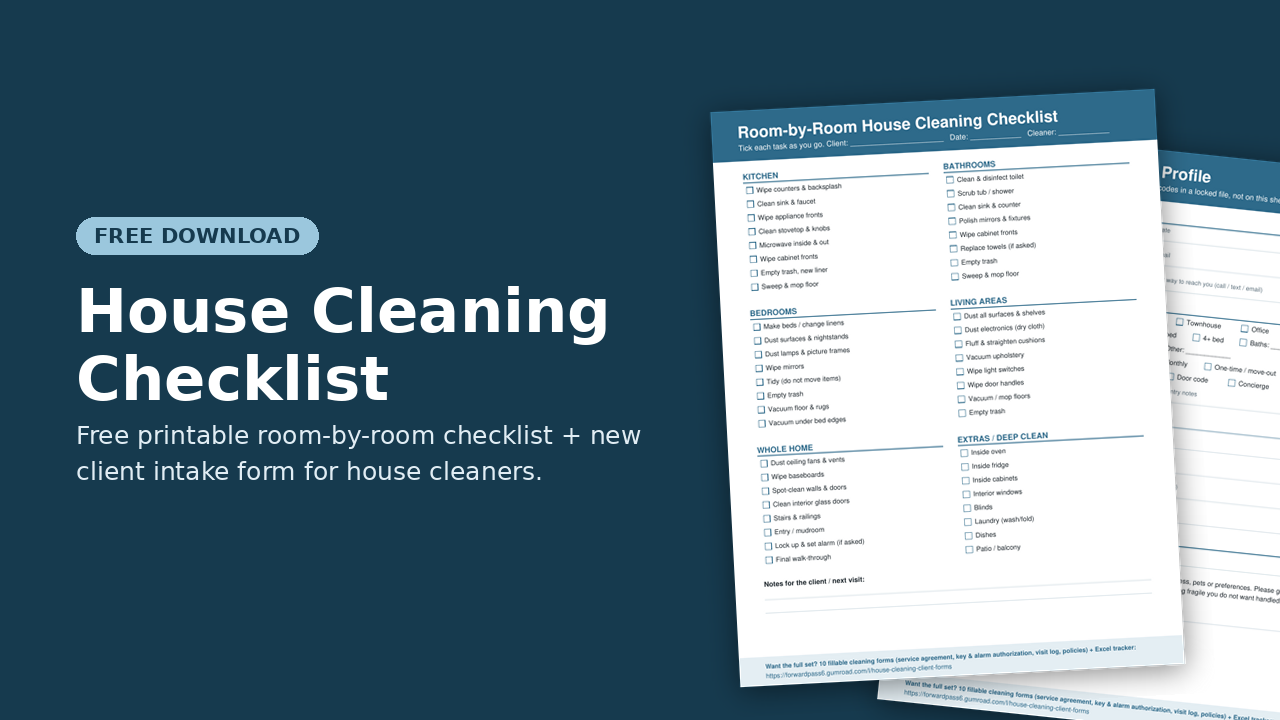
Free House Cleaning Checklist
A printable room-by-room cleaning checklist with 48 tasks plus a new client intake and home profile form.
Download free →1. Work out your cost per working hour
Start with your own costs, not a competitor's price list. Add up what one working hour costs you: the pay you want, self-employment taxes, supplies, equipment wear, insurance, travel, your booking app and card fees.
- Example pay target: $25 an hour, plus about $4 in self-employment tax.
- Example overhead: supplies, equipment, insurance, fuel, app and fees about $7 per working hour.
- Example cost: about $36 per working hour before profit.
- Add profit: at an example 25-35% margin you would aim to charge around $45-50 per working hour. This guide uses an example $48.
If you bring a helper, count their pay and payroll costs too, and remember two people finish faster but cost about twice as much per hour.
2. Estimate how long the deep clean will take
Time is the biggest part of the price, so estimate it with care. Ask for photos or do a short walkthrough, and ask when the home was last cleaned professionally. Then start from your standard clean time and adjust:
| Home condition | Example time vs a standard clean |
|---|---|
| Kept up, cleaned in the last month | About 1.5x |
| Not cleaned for 2-6 months | About 2x |
| Heavy buildup, pets, move-out or post-party | 2.5x or more |
Write down how long each deep clean really took. After a few jobs you will have your own numbers by home size and condition, which beat any rule of thumb.
3. Turn the hours into a flat rate
Most clients prefer a set price. Multiply the hours by your hourly rate, add a small amount for supplies used up on heavy jobs, and round. The table uses example numbers at about $48 per working hour.
| Home size | Example deep clean hours (one cleaner) | Example deep clean price |
|---|---|---|
| 1 bedroom, 1 bath | 4-5 hours | $190-240 |
| 2 bedrooms, 2 baths | 5.5-7 hours | $265-335 |
| 3 bedrooms, 2 baths | 7-9 hours | $335-430 |
| 4 bedrooms, 3 baths | 9-12 hours | $430-575 |
List exactly what the flat rate includes, room by room. A clear checklist stops scope creep and makes it easy to show the client what extra work would cost.
4. Price add-ons separately
Give each extra task a set price or time so clients can build their own quote:
- Inside the oven and inside the fridge
- Inside kitchen cabinets and drawers
- Interior windows, tracks and sills
- Blinds, walls and ceiling fans in detail
- Heavy pet hair or a very dirty garage or basement
- Laundry, dishes or organizing
Show these on your intake form with example prices. Clients often add one or two once they see the list, which raises the job value without any hard selling.
5. First-clean pricing for new regular clients
Many cleaners ask for a deep clean before starting weekly or biweekly service. Price that first visit as a deep clean, then quote the ongoing visits at your standard rate. It sets a clean baseline, so regular visits stay on time and on budget.
Explain it plainly: the first visit takes longer because it removes buildup, and later visits keep it that way. Clients who understand why usually accept it.
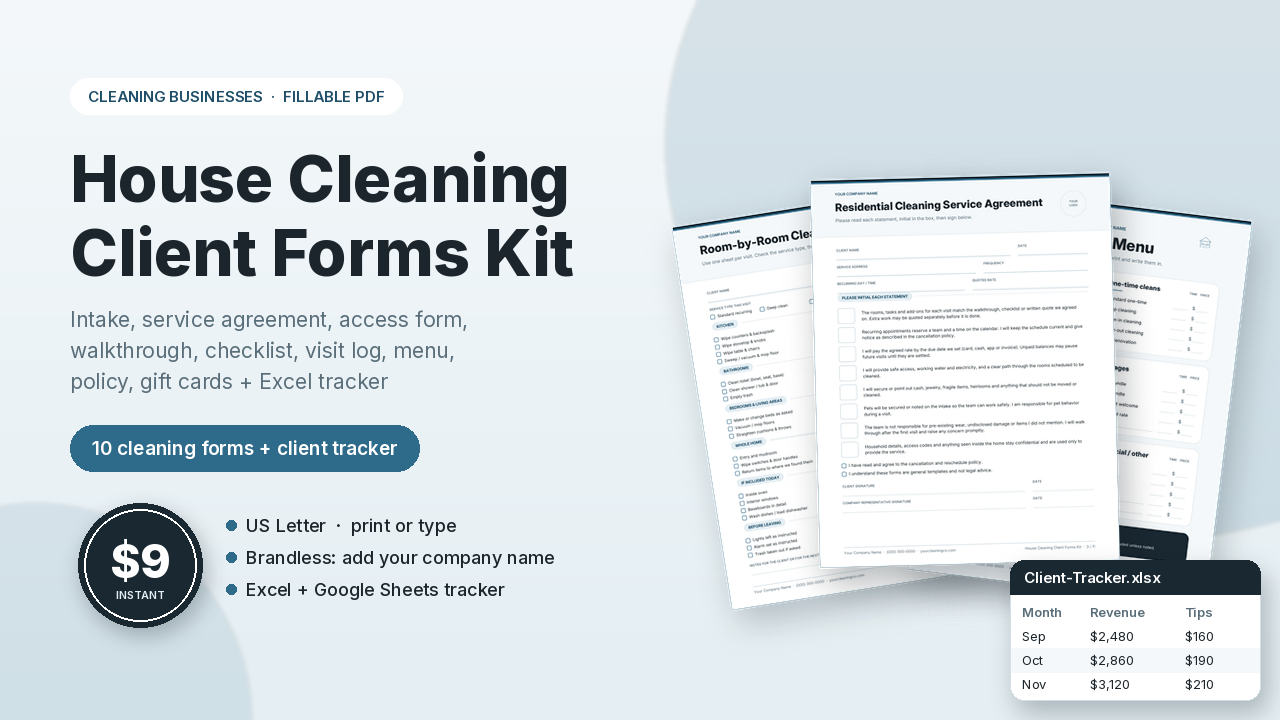
House Cleaning Client Forms Kit
10 fillable forms (intake and home profile, service agreement, key and alarm authorization, walkthrough sheet, room-by-room checklist, visit and quality log, service menu, cancellation policy, photo release, gift certificates) plus an Excel client tracker.
Get it →6. Holidays, move-outs and rush jobs
Demand for deep cleans jumps before Thanksgiving and Christmas, after parties, in spring and at the end of leases. Many cleaners add a modest holiday or rush fee for short-notice bookings and fill their calendar early with deposits.
For pre-holiday cleans and post-party resets, see the holiday deep cleaning guide, and for end-of-lease jobs see the move-out cleaning guide, both linked below.
7. Deposits, cancellations and written terms
Write down your rules before you need them: the deposit to hold a date for large jobs, how much notice you need to reschedule or cancel, what happens if you arrive and cannot get in, and what you will not clean, such as biohazards or mold.
Use a client intake form and a simple service agreement for every new client: address, access, pets, problem areas, what is included, add-ons, price and terms. It saves back-and-forth messages and protects you if a question comes up later.
Worked example: a 3-bedroom deep clean
Here is how the method comes together, using the example numbers above.
- A 3-bedroom, 2-bath home, last cleaned professionally about four months ago, with one dog.
- Standard clean estimate: about 4 hours. Condition multiplier: about 2x, so about 8 hours for one cleaner.
- Base price: 8 hours x $48 = $384, plus an example $10 for extra supplies = $394, rounded to $395.
- Add-ons chosen: inside the oven (example $35) and inside the fridge (example $30), adding about 1.25 hours. Total quote: $460.
- Example cost to you: about 9.25 hours x $36 = about $333, leaving about $127 profit on top of your $25 an hour pay.
- Deposit: an example 25% ($115) to hold the date, balance due on completion.
These are example numbers to show the math, not market rates. Use your own costs and local prices.
FAQ
How much should I charge for a deep clean?
Estimate the hours the home will really take, multiply by the hourly rate you need, and add supplies and any add-ons. A deep clean usually takes much longer than a standard clean of the same home, so it should cost more. Compare with cleaners in your area. Any prices on this page are example numbers, not market data.
How much longer does a deep clean take than a regular clean?
It depends on the home, but many cleaners plan for a deep clean to take around one and a half to two times as long as a standard clean, and longer for a home that has not been cleaned in months. Time your own jobs and use your real numbers.
Should I charge by the hour or a flat rate for deep cleaning?
Flat rates are easier for clients to say yes to, but only if you can estimate well. Many cleaners quote a flat rate after a walkthrough or photos, with a clear list of what is included, and switch to hourly for homes in very poor condition.
Should the first clean cost more?
Often yes. Many cleaners require a deep clean before starting regular service, priced higher than the ongoing visits, because the first visit removes built-up dirt that later visits only maintain.
What add-ons should I price separately?
Inside the oven, inside the fridge, inside cabinets, interior windows, baseboard detailing, walls, blinds, laundry and heavy pet hair are common add-ons. Give each one a set price or time so clients can choose.
Should I take a deposit for a deep clean?
Many cleaners take a deposit for large one-time jobs to hold the date and cover lost time if the client cancels late. Put the deposit, cancellation rules and what is included on a written agreement before the job.
This page is general guidance, not legal, tax or business advice. Licensing, insurance and tax rules vary by location, so check the rules where you sell.
Related templates
Free House Cleaning Checklist
A printable room-by-room cleaning checklist with 48 tasks plus a new client intake and home profile form.
Download free →House Cleaning Client Forms Kit
10 fillable house cleaning forms plus an Excel client tracker.
Get it →More free guides
- House Cleaning Client Questionnaire
- Cleaning Client Intake Form
- Move-Out Cleaning Checklist
- House Cleaning Checklist
- How to Price House Cleaning
- Holiday Deep Cleaning Pricing
- Move-Out Cleaning Pricing
- Airbnb Cleaning Pricing
- Office Cleaning Pricing
- House Cleaning Service Agreement
- Post-Construction Cleaning Pricing