Move-Out Cleaning Pricing: How Much to Charge for a Move-Out or Move-In Clean (Plus Free Checklist)
How cleaners can price move-out and move-in cleaning: cost per labor hour, hours by bedrooms, bathrooms and square feet, empty vs furnished homes, oven, fridge and cabinet add-ons, condition surcharges, deposits, access and re-clean rules, with a worked example quote.
Why move-out cleaning needs its own price list
Move-out and move-in cleans are some of the best-paying one-time jobs a cleaner can book, but they are also the easiest to underprice. The home is empty, every mark shows, and the client often has a landlord inspection or a closing date the next day. If you quote it like a standard visit, you can end up working twice as long for the same money.
A clear move-out price list fixes that. Know your cost per labor hour, estimate hours by size and condition, list the extras such as inside the oven and fridge, and write down your rules for deposits, access and re-cleans. The sections below walk through each step, with a worked example at the end. All numbers on this page are example numbers, not market data.
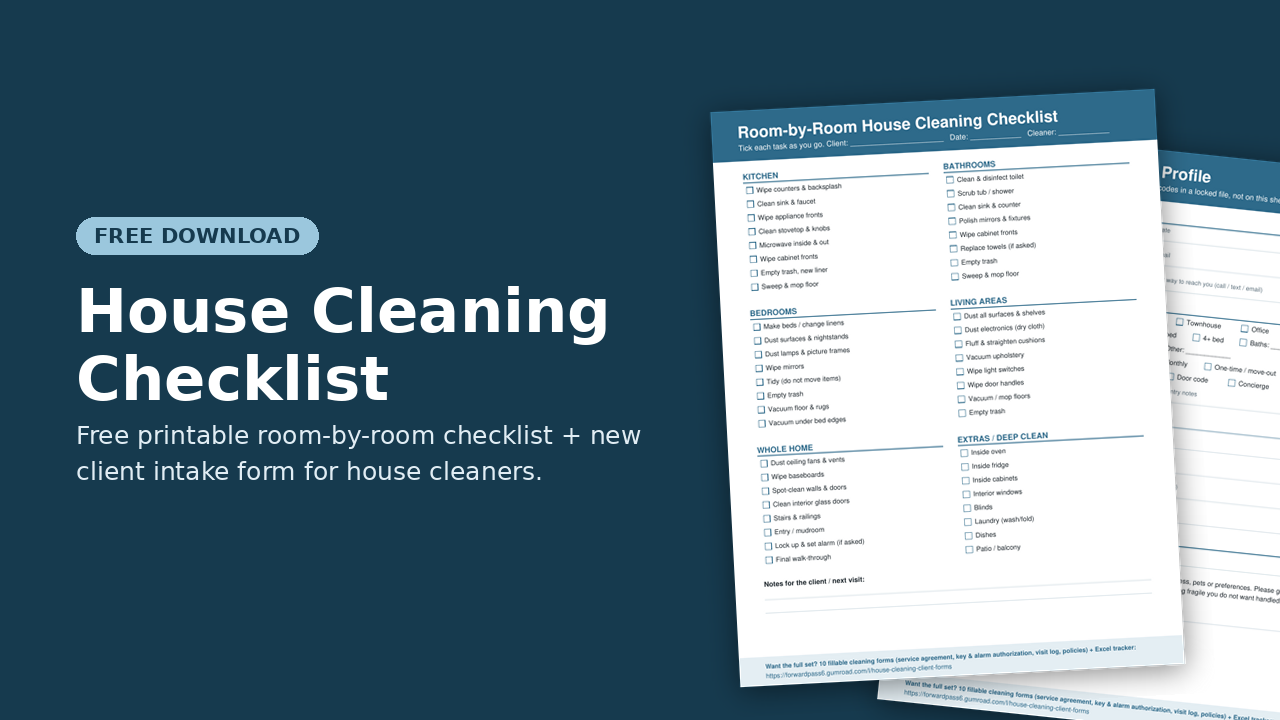
Free House Cleaning Checklist
A printable room-by-room cleaning checklist with 48 tasks plus a new client intake and home profile form.
Download free →1. Work out your cost per labor hour
Start with your own floor, not a competitor's price. Add up what one hour of cleaning costs you: your pay or your cleaner's wage, payroll costs if you have staff, supplies, equipment wear, travel time and fuel, insurance, booking software and card fees.
- Example labor: $22 an hour for a cleaner, plus about $3 in payroll costs.
- Example supplies and equipment: about $3 per labor hour (move-out cleans use more degreaser, magic erasers and microfiber).
- Example overhead: insurance, software, fuel and card fees about $7 per labor hour.
- Example cost: about $35 per labor hour before profit.
- Add profit: at an example 30-40% margin, you would charge around $50-55 per labor hour.
Labor hours are not clock hours. Two cleaners working three hours is six labor hours. Always price on labor hours.
2. Estimate hours by bedrooms, bathrooms and square feet
Most cleaners build a simple table of typical hours for an empty home in average condition, then adjust from there. Bathrooms and kitchens take the most time, so count them separately.
- Studio or 1 bed / 1 bath (example 3-4 labor hours, under about 700 sq ft).
- 2 bed / 1-2 bath (example 4-6 labor hours).
- 3 bed / 2 bath (example 6-8 labor hours, about 1,200-1,800 sq ft).
- 4 bed / 2-3 bath (example 8-11 labor hours).
- Larger homes: quote per square foot or after a walkthrough, for example an extra 1 labor hour per 300-400 sq ft.
Multiply the hours by your hourly rate to get a starting price, then round. For example, 7 labor hours at $52 is $364, which you might list as a starting price of $360-380 for a 3 bed / 2 bath empty home.
3. Empty vs furnished homes
An empty home is faster to clean properly because you can reach every floor, wall and baseboard. A furnished move-out, where the client is still packing, takes longer and you may have to come back for areas under furniture.
- Empty home: your standard move-out table.
- Furnished or partly packed: example add 20-30% or quote hourly, and agree which rooms will be clear on the day.
- Boxes and junk left behind: not part of cleaning. Refer junk hauling out or price it separately (see the junk removal pricing guide).
4. Itemize the add-ons
Add-ons keep your base price competitive and make it clear what the client is paying for. Many cleaners include some of these in a move-out package and list the rest separately. Either way, write it down.
- Inside oven: example $25-45, more if heavily baked on.
- Inside fridge and freezer: example $25-40.
- Inside cabinets and drawers: often included in move-outs, or example $5 per cabinet section for large kitchens.
- Interior windows and tracks: example $5-8 per window.
- Wall spot cleaning: example $30-60 per home, light marks only (not repainting).
- Blinds: example $5-10 per blind for a full wipe.
- Garage, balcony or patio sweep: example $25-50.
- Carpet shampooing: many cleaners refer this out or price it as a separate service.
If you include the inside of appliances and cabinets in your move-out package, say so in bold on your quote. It is the main reason a move-out price is higher than a regular clean.
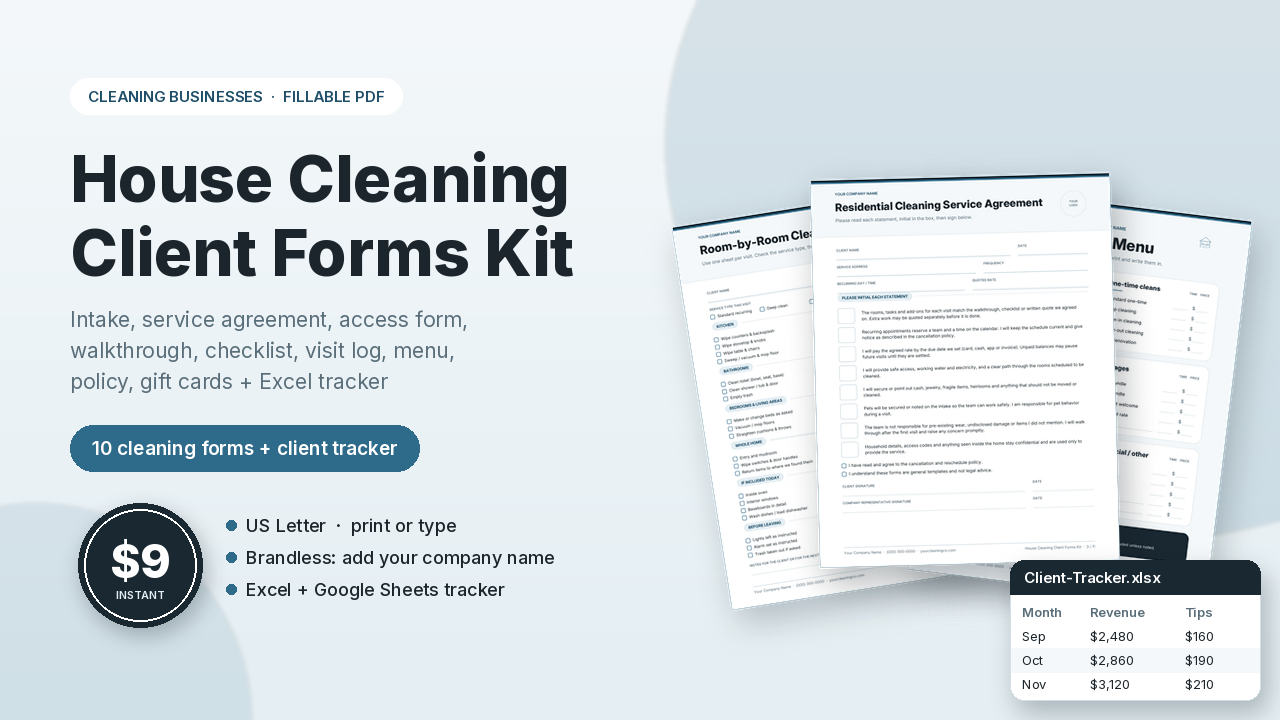
House Cleaning Client Forms Kit
10 fillable forms (intake and home profile, service agreement, key and alarm authorization, walkthrough sheet, room-by-room checklist, visit and quality log, service menu, cancellation policy, photo release, gift certificates) plus an Excel client tracker.
Get it →5. Adjust for condition
Condition changes the job more than size does. Ask for photos of the kitchen, bathrooms and oven before you quote, or do a short walkthrough for larger homes.
- Light condition (cleaned regularly): your standard table.
- Moderate (grease build-up, soap scum, pet hair): example add 15-25%.
- Heavy (thick grease, mold spots, smoke residue, lots of pet hair): example add 30-50% or quote hourly with a minimum.
- Hazards such as biohazards, pests or hoarding: many cleaners decline these or refer them to specialists.
Put a condition clause in your agreement: if the home is much worse than the photos, you can re-quote on arrival or switch to hourly with the client's approval.
6. Who books move-out cleans, and how to quote each
Tenants want their deposit back, landlords and property managers want units ready to rent, real estate agents want listings to show well, and buyers want a fresh start on move-in day. Each group cares about different things.
- Tenants: share your checklist up front so they can compare it with their lease. Do not promise a deposit outcome.
- Landlords and property managers: offer a set price per unit size and a simple invoice. Repeat turnovers can be worth a small volume discount.
- Real estate agents: fast scheduling and before/after photos matter more than the lowest price.
- Move-in clients: often book the same checklist plus inside cabinets before they unpack.
For repeat property managers, a short written agreement such as a house cleaning service agreement keeps pricing, access and payment terms clear.
7. Deposits, access and the re-clean window
Move-out days are tight. Write down the practical rules before the job, not on the doorstep.
- Example deposit: 25-50% to hold the date, applied to the final bill.
- Example cancellation notice: 48 hours, because month-end dates are hard to refill.
- Access: who provides keys or a lockbox code, and what happens if no one is there.
- Utilities: water and electricity must be on, or the job is rescheduled with a trip fee.
- Example re-clean window: 24-48 hours to report anything on the checklist that was missed, fixed for free. Damage, wear and items not on the checklist are excluded.
Check local consumer rules before calling a deposit non-refundable, and keep a signed checklist and before/after photos for every job.
Worked example: a 3 bed / 2 bath move-out quote
Here is a labeled example, not market data. A tenant moving out of an empty 3 bedroom, 2 bathroom apartment (about 1,400 sq ft) sends photos showing moderate kitchen grease and a dirty oven.
- Base move-out clean, 3 bed / 2 bath, empty (7 labor hours at $52): $364
- Moderate condition adjustment (+15%): $55
- Inside oven: $35
- Inside fridge and freezer: $30
- Interior windows, 8 at $6: $48
- Total quote: $532, with a 30% deposit of about $160 to hold the date
- Example costs: about 8.5 labor hours at $35 = about $298
- About $234 left as profit before tax
If you had quoted this as a regular clean at, say, $180, you would have worked the same eight and a half labor hours and lost money. Pricing by hours, condition and add-ons keeps the job fair for both sides.
Common move-out cleaning pricing mistakes
- Quoting a move-out like a regular weekly clean.
- Quoting without photos, then finding a much dirtier home on the day.
- Not listing what is and is not included, especially inside appliances, cabinets and walls.
- Promising the client will get their deposit back.
- No deposit or cancellation rule for month-end dates.
- Pricing on clock hours instead of labor hours when two cleaners go.
- No signed checklist or photos to show the work was done.
FAQ
How much should I charge for a move-out cleaning?
There is no single right number. Work out what an hour of cleaning costs you (pay, supplies, travel, insurance and card fees), estimate how many labor hours the home will take based on bedrooms, bathrooms, square feet and condition, then add any extras such as inside the oven or fridge. Compare with cleaners near you. Any prices on this page are example numbers, not market data.
Why does a move-out clean cost more than a regular clean?
A move-out clean covers areas a regular visit skips: inside cabinets and drawers, inside appliances, baseboards, door frames, light switches, window sills and marks left behind by furniture. It is usually a one-time job on a home that has not been deep cleaned in a while, so it often takes two to three times longer than a standard visit.
Should I charge by the hour or a flat rate for move-out cleaning?
Many cleaners give a flat quote so landlords, tenants and agents know the price up front, but they build the flat price from an hourly estimate. If you have not seen the home, quote a range or a starting price and confirm it after photos or a walkthrough. Say in writing what happens if the condition is much worse than described.
Is a move-in clean priced the same as a move-out clean?
Often the checklist is almost the same, because both happen in an empty home. Some cleaners price them the same, others charge slightly less for a move-in clean if the previous occupant already had the home cleaned. Base it on the time the job actually takes.
Do I guarantee the tenant gets their deposit back?
No. You can promise to complete a written checklist and offer a re-clean window for anything on that list that was missed, but you cannot promise a landlord's decision. Damage, wear, carpet stains and repairs are outside a cleaning job. Write this into your service agreement.
Should I take a deposit for move-out cleaning?
Many cleaners take a deposit to hold the date, because move-out days are tight and last-minute cancellations are common at month end. Write down the amount, the notice needed to cancel and what happens if the home is not empty or the utilities are off when you arrive. Check local consumer rules before calling any deposit non-refundable.
This page is general guidance, not legal, tax or insurance advice. Business licensing, insurance, consumer and deposit rules vary by state and city, so check your local rules.
Related templates
Free House Cleaning Checklist
A printable room-by-room cleaning checklist with 48 tasks plus a new client intake and home profile form.
Download free →House Cleaning Client Forms Kit
10 fillable house cleaning forms plus an Excel client tracker.
Get it →