Holiday Deep Cleaning Pricing: How to Price Pre-Holiday and Post-Party Cleans, Add-Ons and Deposits (Plus a Free Checklist)
How house cleaners can price pre-holiday and after-party deep cleans: choose hourly or flat pricing, estimate the hours, price add-ons like ovens, fridges and inside windows, use a guest-ready checklist, take deposits and set cancellation terms, with a worked example and a free cleaning checklist.
Why holiday cleans are priced differently
Between mid-November and early January, house cleaners get two kinds of extra requests. Before the holidays, clients want the home guest-ready: guest rooms made up, bathrooms spotless, the kitchen ready for heavy cooking, and the corners that get skipped all year finally done. After a party, they want the home back to normal: dishes, spills, sticky floors, overflowing bins and a kitchen that looks like it hosted forty people. Both jobs take longer than a regular maintenance clean, both are hard to estimate, and both cluster on the same few days. Quoting them like a normal visit is the fastest way to work through December for less than your usual rate.
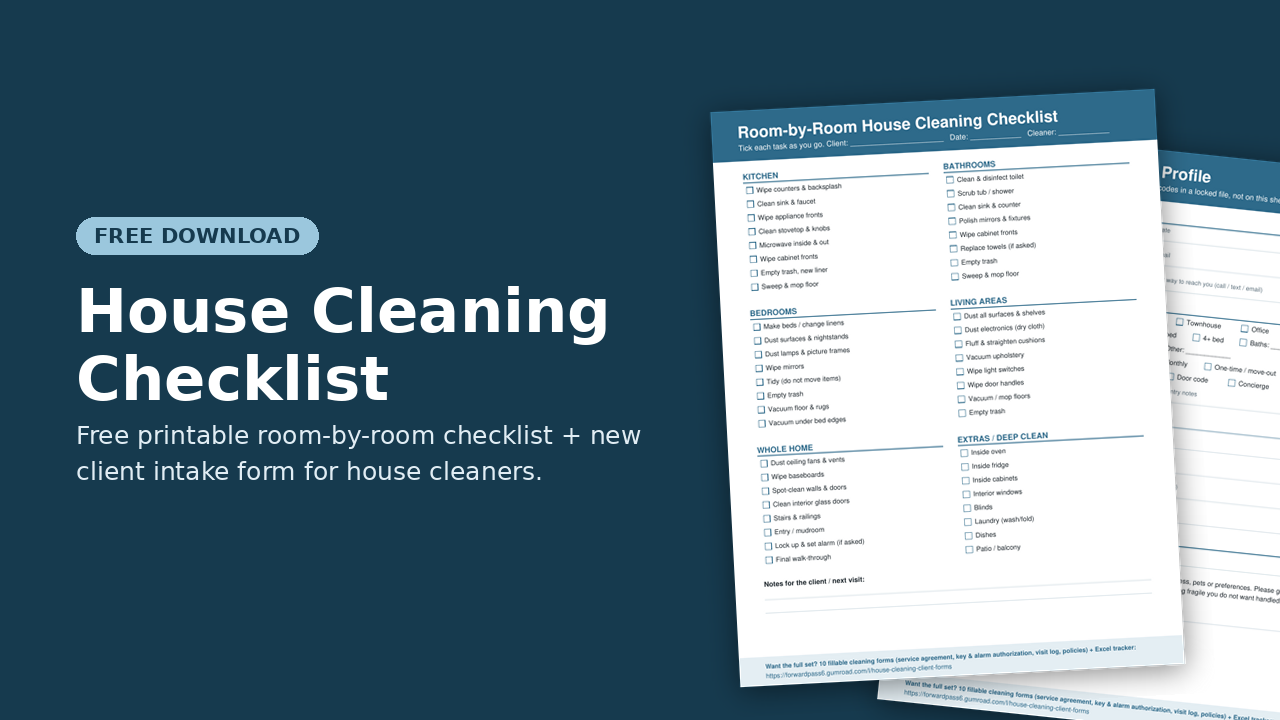
Free House Cleaning Checklist
A printable room-by-room cleaning checklist with 48 tasks plus a new client intake and home profile form.
Download free →1. Hourly or flat: pick a model per job
Hourly pricing (per cleaner, per hour) protects you when you cannot see how bad the home is, which is common with post-party cleans and first-time clients. The risk for the client is an open-ended bill, so give an estimated range of hours and agree to check in before going over it. Flat pricing is easier to sell and works well once you have seen the home, either in person, on a video call or from recent photos. Many cleaners use both: flat prices for regular clients whose homes they know, and hourly with an estimate for new clients and post-event jobs. Whichever you choose, base it on the hourly rate you actually need after travel time, supplies, insurance and taxes.
2. Estimate deep clean hours honestly
A deep clean is not a regular clean done slowly. It adds tasks: baseboards, door frames and switches, cabinet fronts, behind and under furniture, light fixtures, vents, grout scrubbing and buildup in showers. A practical way to estimate is to start from the time a regular clean of that home takes, then multiply. For example, if a home normally takes 3 hours, a first deep clean might take 1.5 to 2 times as long, more if it has not been cleaned professionally in a while. Ask the client the questions that change the hours: number of bedrooms and bathrooms, pets, when it was last deep cleaned, how many guests are expected, and which rooms matter most. For post-party cleans, also ask how many guests attended, whether food was served buffet-style, and whether there are spills on carpet or upholstery.
3. Price add-ons separately
Add-ons keep your base price competitive while making sure the slow jobs are paid. List them on a holiday menu with a price or a time allowance each. Common holiday add-ons include:
- Inside the oven (often the longest single task before a big meal)
- Inside the fridge, emptied and wiped, ideally before the holiday shopping
- Inside windows and tracks, priced per window or per room
- Inside cabinets and drawers, emptied by the client in advance
- Guest room setup: making beds with fresh linens, clearing surfaces, laying out towels
- Dishes and loads of laundry after a party, priced per load or by time
- Balcony, patio or entryway sweep and wipe-down before guests arrive
A simple way to price each add-on is to time it once or twice, multiply by your hourly rate, and round up. Price per item (oven, fridge) when the time is predictable, and per hour when it varies a lot (dishes, laundry).
4. Use a guest-ready checklist
Most disputes about holiday cleans come from different ideas of what “deep” means. Send a written checklist with the quote that lists every room and task included, and mark which items are add-ons. A guest-ready list usually covers the entry and coat area, living and dining rooms, guest bathroom (including restocking toilet paper and hand towels the client provides), kitchen surfaces and appliances, guest bedroom and floors throughout. A post-party list adds dishes, trash and recycling, sticky surfaces, floor spot cleaning, and a final pass in the bathrooms guests used. Walk through the checklist with the client at the start, and tick it off at the end so nobody wonders what was done.
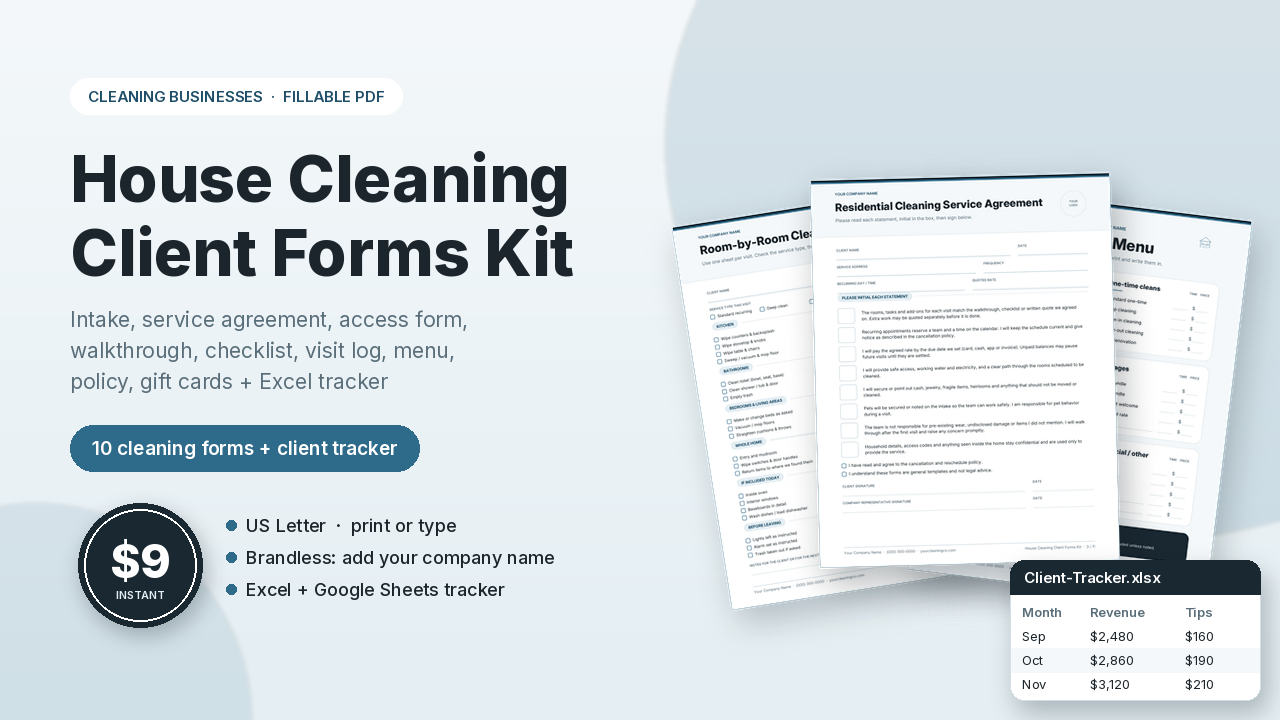
House Cleaning Client Forms Kit
10 fillable forms (intake and home profile, service agreement, key and alarm authorization, walkthrough sheet, room-by-room checklist, visit and quality log, service menu, cancellation policy, photo release, gift certificates) plus an Excel client tracker.
Get it →5. Take deposits and set holiday booking terms
Holiday slots fill up and are hard to resell on short notice, so hold them with a deposit. Cleaners commonly ask for a fixed amount or a percentage (for example 25% to 50%) at booking for one-time deep cleans, with the balance due on the day of the clean. Add a booking deadline for the busiest dates, such as the days before Thanksgiving and Christmas, and a cancellation window, for example 48 to 72 hours, after which the deposit is kept. For post-party cleans, agree on access in advance: the day after a party can be a holiday, and late starts eat into the rest of your schedule. If you charge a holiday-date surcharge, write which dates it applies to.
A worked example (example numbers)
Suppose you need $50 per cleaner hour, and a 3-bedroom, 2-bathroom home that usually takes 3 hours needs a pre-holiday deep clean. You estimate 1.7 times the normal time, and the client adds an oven and a fridge.
- Base deep clean: 3 hours × 1.7 = about 5 hours × $50 = $250
- Oven add-on (timed at about 1 hour): $50
- Fridge add-on (timed at about 45 minutes): $40
- Total quote: $340, or a range of $320 to $380 if you quote hourly
- Deposit at 30%: about $100 to hold the date, balance due on completion
Swap in your own hourly rate and time estimates. The math is the same for a post-party clean: estimate the hours from the size of the event, add per-load or per-hour extras for dishes and laundry, and quote a range when you have not seen the aftermath.
Turn holiday cleans into regular clients
Holiday deep cleans are often a client's first experience with your service, which makes them a good time to offer what comes next. At the end of the job, leave a short note with what you did, offer a slot for an after-holiday reset in early January, and mention your regular schedule and its price. Clients who have just seen their home fully cleaned are more likely to book recurring visits, and a regular client fills your calendar after the December rush ends.
FAQ
How much should I charge for a holiday deep clean?
Start from the hourly rate you need, estimate the hours (often more than a regular clean of the same home, for example 1.5 to 2 times as long the first time), then add priced add-ons. Quote a range when you have not seen the home.
Should holiday cleans be hourly or flat rate?
Hourly with an estimated range is safer for new clients and post-party cleans. Flat pricing works well for homes you already know. Many cleaners use both.
What add-ons should a holiday cleaning menu include?
Common add-ons are inside the oven, inside the fridge, inside windows, inside cabinets, guest room setup with fresh linens, dishes and laundry after a party, and patio or entryway cleaning.
How do you price a post-party clean?
Ask about the number of guests, the food served and any spills, estimate the hours from that, charge hourly or quote a range, and price dishes and laundry per load or by time.
Should I take a deposit for a one-time deep clean?
Many cleaners do during the holidays. A fixed amount or a share of the quote at booking holds the date, with the balance due on completion and a clear cancellation window.
What goes on a guest-ready cleaning checklist?
Entry, living and dining rooms, the guest bathroom, kitchen surfaces and appliances, the guest bedroom with fresh linens, and floors throughout, with add-ons clearly marked.
This page is general guidance, not legal, tax or insurance advice. Business, licensing, employment and consumer rules vary by state and city, so check your local rules and have your agreement reviewed by an attorney or insurer.
Related templates
Free House Cleaning Checklist
A printable room-by-room cleaning checklist with 48 tasks plus a new client intake and home profile form.
Download free →House Cleaning Client Forms Kit
Walkthrough sheet, service menu, cancellation policy, room-by-room checklist and an Excel client tracker.
Get it →More free guides
- Holiday Hours Announcement Templates
- Cleaning Gift Certificate
- House Cleaning Pricing
- House Cleaning Service Agreement
- Airbnb Cleaning Checklist
- Airbnb Holiday Hosting Checklist
- Window Cleaning Pricing
- Mattress Cleaning Pricing
- Area Rug Cleaning Pricing
- Carpet Cleaning Pricing
- Tile and Grout Cleaning Pricing
- Deep Cleaning Pricing
- Move-Out Cleaning Pricing