Cleaning Client Intake Form: Questions to Ask New House Cleaning Clients
A practical guide for independent house cleaners and small cleaning businesses: the questions to ask every new client before the first clean, how to use the answers to quote accurately, what to confirm at the walkthrough, and the forms to collect before you start.
Why every new cleaning client needs an intake form
Most problems in a cleaning business start before the first clean: a quote based on a two-line text message, a dog nobody mentioned, a lockbox code that does not work, or a client who expected the inside of the oven to be included. An intake form fixes this by collecting the same information from every client, in writing, before you price the job or show up.
A good intake form does three jobs. It gives you what you need to quote accurately (size, condition, frequency, extras). It gives you what you need to do the job safely (access, pets, alarms, allergies, off-limits areas). And it sets expectations (what is and is not included, how scheduling and payment work) so there are fewer surprises later.
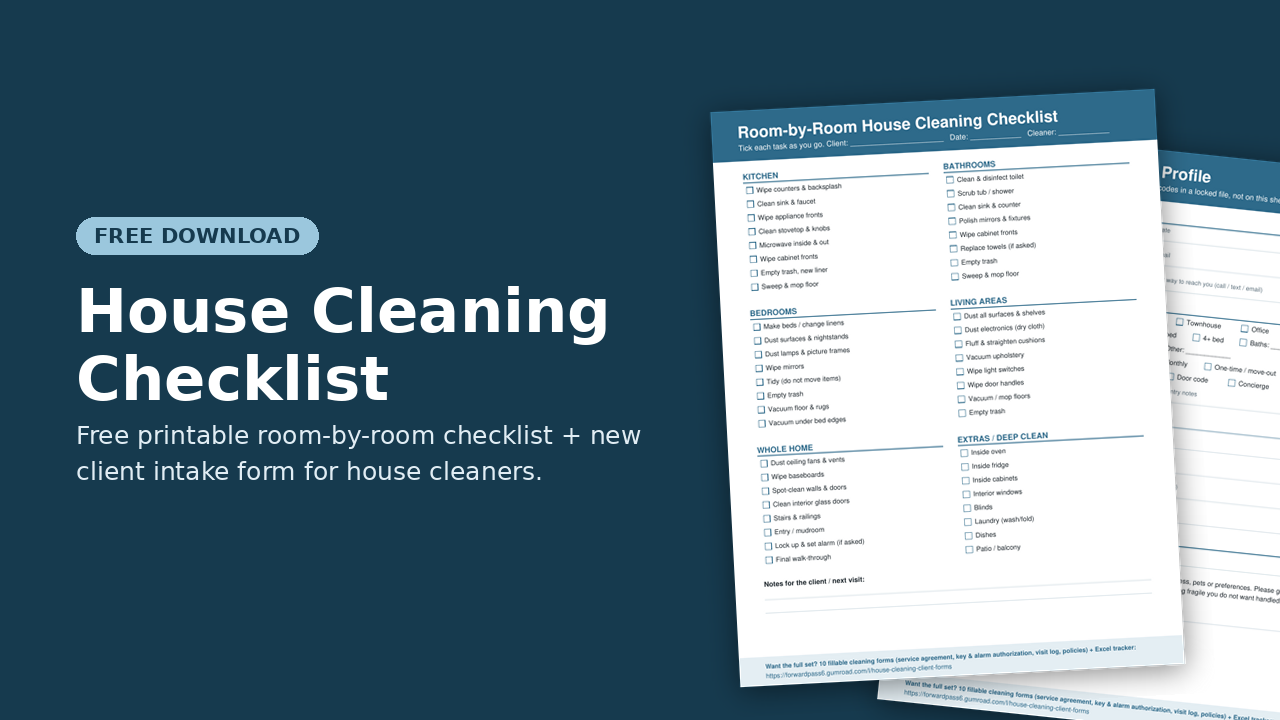
Free House Cleaning Checklist
A printable room-by-room cleaning checklist with 48 tasks plus a new client intake and home profile form.
Download free →Section 1: Contact and home basics
- Full name, phone, email and preferred contact method (text, call or email)
- Service address, and a billing address if it is different
- Home type: house, apartment, condo or townhouse; floor and elevator for apartments
- Parking: driveway, street, permit needed, building visitor rules
- Number of bedrooms, bathrooms (full and half) and approximate square footage
- Number of floors and any finished basement
- Who lives in the home (adults, children) and who will usually be home during cleans
- An alternate contact if you cannot reach the client
Bedrooms, bathrooms and square footage are the backbone of most cleaning quotes, so make those fields required.
Section 2: Pets
Ask about every animal, not just dogs.
- Type, name and number of pets
- Will they be loose, crated or in a closed room during the clean?
- Any pets that should not get out (indoor cats, escape artists)?
- Behavior notes: nervous, protective, jumps up, chews cords
- Litter boxes, cages or tanks: should you clean them, or leave them alone?
- Pet hair level, so you can plan time and vacuum attachments
Heavy shedding adds real time. Many cleaners add a small pet surcharge or price homes with pets slightly higher; whatever you do, say it on the quote.
Section 3: Access, keys and alarms
- How you will get in: client home, hidden key, lockbox, smart lock code, doorman or key kept on file
- Alarm system: yes or no, the code, and what to do if it goes off (who to call, the alarm company number)
- Doors or rooms to keep locked
- Garage or side entrance instructions
- What to do with the key and lights when you leave
If you will hold a key or code, get a short key and alarm authorization signed: it records what you were given, who gave permission and how it is returned. It protects you if something goes missing or a code changes without notice.
Section 4: Priorities, products and allergies
- Top three priorities: for example kitchen, bathrooms, floors, dusting, pet hair
- Problem areas: hard water stains, soap scum, grease, heavy dust
- Surfaces that need special care: natural stone, hardwood, stainless steel, antiques, electronics
- Product preferences: use your products or theirs, fragrance-free, green or non-toxic only
- Allergies or sensitivities in the household (to products, fragrances or latex)
- Supplies the client provides: vacuum, mop, specific cleaners
Products and allergies matter for safety and for repeat business. A client who asks for fragrance-free and smells bleach on the first visit rarely books a second.
Section 5: Scope, extras and off-limits areas
Spell out what a standard clean includes and let the client tick extras. This is where most disputes come from.
| Item | Standard clean? | Typical add-on? |
|---|---|---|
| Dusting reachable surfaces, wiping counters, sinks, toilets, mirrors | Yes | – |
| Vacuum and mop floors | Yes | – |
| Making beds, emptying trash | Usually | – |
| Inside oven | No | Yes |
| Inside fridge | No | Yes |
| Interior windows, blinds | No | Yes |
| Baseboards (detailed), doors, light switches | Often on first or deep clean | Yes |
| Laundry, dishes, changing linens | No | Yes |
| Inside cabinets, closets, garage, patio | No | Yes |
Also ask about off-limits areas: home offices, children's rooms, valuables, a safe, certain closets. Write them down so every cleaner on your team respects them.
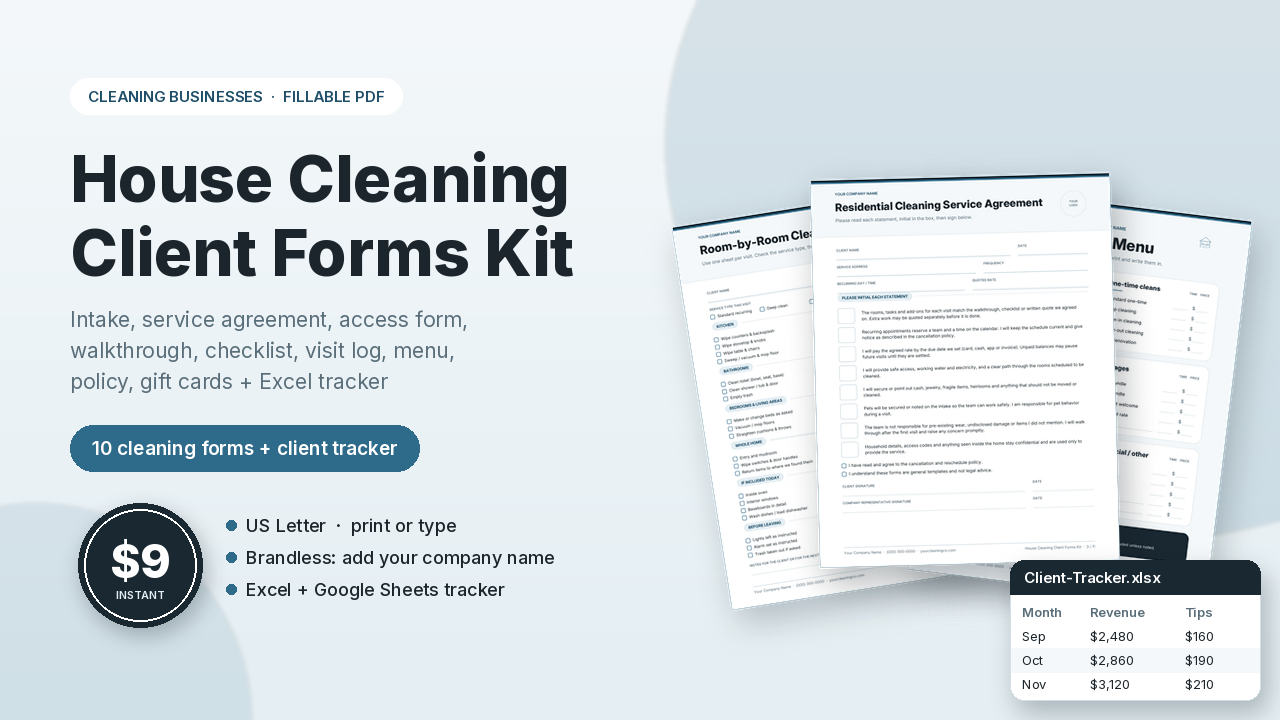
House Cleaning Client Forms Kit
10 fillable forms (intake and home profile, service agreement, key and alarm authorization, walkthrough sheet, room-by-room checklist, visit and quality log, service menu, cancellation policy, photo release, gift certificates) plus an Excel client tracker.
Get it →Section 6: Frequency, scheduling and condition
- Type of clean: one-time, deep clean, move-in or move-out, recurring
- Frequency for recurring: weekly, every two weeks, monthly
- Preferred days and time windows; days that do not work
- When was the home last professionally cleaned?
- Honest condition rating (1 to 5) and photos if possible
The last-cleaned date and photos tell you whether the first visit is really a deep clean. Many cleaners require a deep clean before starting a recurring rate, because the first visit usually takes much longer. Put that rule on the form so the client is not surprised by the first invoice.
Section 7: Pricing, payment and policies
The intake form is the right place to get acknowledgement of your basic policies, even if you also use a longer service agreement:
- How you price (flat rate per visit, hourly, or by rooms and square footage) and that the quote may change after the walkthrough
- Payment method and timing (card on file, pay after each clean, monthly invoice)
- Cancellation and lockout policy: notice required and any fee if you cannot get in
- Breakage and damage process: how the client should report it and within what time
- Safety limits: no climbing above a certain height, no moving heavy furniture, no biohazards
- Photo permission for before-and-after pictures (optional, with a clear yes or no)
Keep the wording plain. A short checkbox line such as “I have read the cancellation policy” with a signature and date does more than a page of fine print nobody reads.
Using intake answers to quote
Once the form is back, you can quote in a few minutes instead of guessing. One simple approach (example only; set your own numbers for your market):
| Factor from the form | How it affects the quote (example) |
|---|---|
| Bedrooms, bathrooms, square footage | Sets the base price or estimated hours |
| Condition rating 4 to 5, or not cleaned in months | First visit priced as a deep clean |
| Heavy pet hair | Adds time, or a small surcharge |
| Extras ticked (oven, fridge, windows) | Each priced as an add-on |
| Recurring weekly or biweekly | Lower per-visit rate than one-time cleans |
| Client supplies products | Usually no change; note it for the team |
For a fuller pricing walkthrough, see the house cleaning pricing guide and the deep cleaning pricing guide.
The first-visit walkthrough
Even with a complete form, do a short walkthrough on the first visit (or before it). Use it to confirm, not to start from scratch:
- Walk every room on the form and note anything that changes the time estimate
- Test the key, lockbox or code and the alarm instructions
- Confirm off-limits areas and fragile items in person
- Agree what a finished clean looks like in the client's top-priority rooms
- Adjust the quote now if the home is very different from the form, before you start
Write the result on a walkthrough sheet and keep it with the client's file so the next cleaner knows the home.
Common intake mistakes
- Quoting from bedrooms and bathrooms only without asking condition or last-clean date
- Not asking about pets until a dog is at the door
- Keeping keys and codes in text messages instead of one secure, written record
- No written scope, so “clean the kitchen” means the inside of the fridge to the client
- Skipping allergies and product preferences
- Never updating the form: ask recurring clients to review it once or twice a year or when anything changes (new pet, new alarm code, renovation)
A one-page intake checklist
If you only use one page, make sure it covers:
- Contact details and an alternate contact
- Address, parking and home type
- Bedrooms, bathrooms, square footage, floors
- Pets and how they will be handled
- Access method, key or code, alarm instructions
- Top priorities and problem areas
- Product preferences and allergies
- Extras wanted and off-limits areas
- Frequency, preferred days and last professional clean
- Payment, cancellation and photo permission acknowledgement, with signature and date
The free checklist above includes a basic new client intake and home profile you can print today. The paid kit adds the service agreement, key and alarm authorization, walkthrough sheet and a client tracker so the whole process is on paper.
FAQ
What should a cleaning client intake form include?
Contact details, the home address and type, bedrooms, bathrooms and square footage, pets, access and alarm instructions, cleaning priorities, product preferences and allergies, extras and off-limits areas, frequency and scheduling, and acknowledgement of payment and cancellation policies.
Should I send the intake form before or after quoting?
Before. Send it when a client first asks for a price, then quote from the answers and photos. Confirm the details at the first-visit walkthrough and adjust only if the home is very different.
Do I still need a service agreement if I have an intake form?
The intake form collects information; a service agreement sets the terms of the work (scope, payment, cancellation, liability, termination). Many cleaners use both, and the intake form can reference the agreement.
How do I handle client keys and alarm codes safely?
Record them in one place, not in text threads, get a signed key and alarm authorization, label keys with a code instead of the address, and note how and when keys are returned.
Should recurring clients fill out a new intake form?
Ask them to review and update it once or twice a year, or whenever something changes, such as a new pet, a new alarm code or a renovation.
Can I use a digital intake form?
Yes. A fillable PDF or online form works well; the important part is that every client answers the same questions and that you keep a copy with their file.
This page is general information for independent house cleaners and small cleaning businesses, not legal or insurance advice. Rules for service agreements, liability and the handling of client keys and data vary by location, so check local requirements or talk to a professional if you are unsure. Prices and policies shown are examples only.
Related templates
Free House Cleaning Checklist
A printable room-by-room cleaning checklist with 48 tasks plus a new client intake and home profile form.
Download free →House Cleaning Client Forms Kit
Fillable intake and home profile, service agreement, key authorization, walkthrough sheet and more, plus an Excel client tracker.
Get it →