House Cleaning Client Questionnaire: What to Ask Before You Quote
A practical guide for house cleaners and small cleaning businesses: the questions to ask a prospective client before you give a price, how each answer changes the quote, and what to have ready once they book.
Why you need a questionnaire before you quote a cleaning
"How much do you charge to clean a house?" is the question every cleaner hears, and the honest answer is always "it depends." A tidy two-bedroom condo cleaned every two weeks and a four-bedroom house with three dogs that has not been cleaned since the spring are completely different jobs, even if both owners describe them as "a normal clean." Quote from square footage alone and you either price yourself out of the good jobs or spend six hours on a job you priced at three.
A short pre-quote questionnaire solves that. Sent by text, email or a simple online form when someone asks for a price, it collects the handful of details that actually drive your time: size and layout, condition and when the home was last professionally cleaned, pets, the type of clean, products, access and the client's priorities. It is different from your full client intake form, which you use after booking to record keys, alarm codes and room-by-room preferences. The questionnaire is shorter and has one job: get you to an accurate quote quickly. Below are the sections to include, the questions in each, and how to turn the answers into a price.
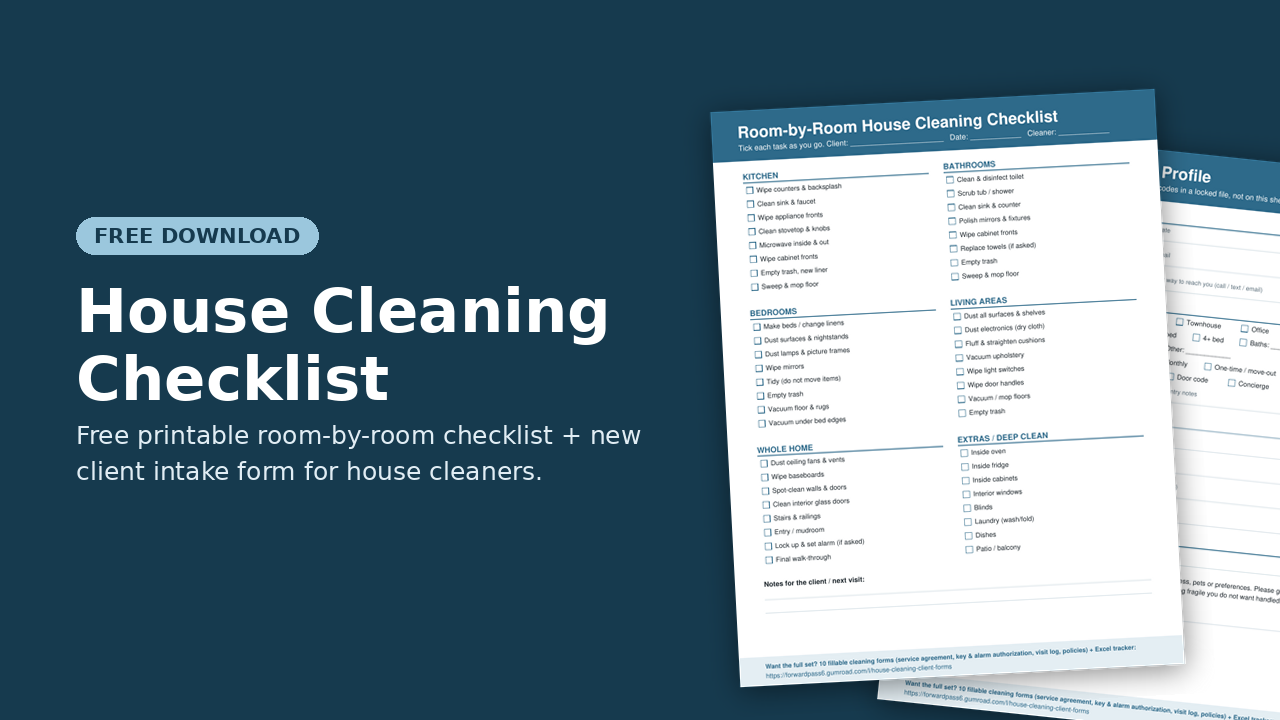
Free House Cleaning Checklist
A printable room-by-room cleaning checklist with 48 tasks plus a new client intake and home profile form.
Download free →Section 1: Contact details, home size and layout
- Client name, phone number, email and preferred contact method
- Service address and how they heard about you
- Home type: apartment, condo, townhouse, single-family house
- Approximate square footage, if they know it
- Number of bedrooms and number of full and half bathrooms
- Number of floors, and whether there is a finished basement or bonus room
- Rooms that should be included and rooms that should be skipped
- Main floor types: carpet, hardwood, tile, laminate, stone
- How many people live in the home, including children
Bathrooms and kitchens take the most time per square foot, so the bedroom and bathroom count is often a better predictor than square footage. Floors matter too: a lot of stairs, delicate stone or large carpeted areas all change how long a visit takes. If the client does not know the square footage, that is fine; the room count plus a few photos is usually enough.
Section 2: Current condition and last professional clean
Condition is the single biggest variable in a first cleaning, and it is the one clients most often underestimate. Ask in a neutral, judgment-free way:
- When was the home last cleaned by a professional, if ever?
- On a scale of 1 to 5, how would they rate the current condition?
- Any areas with heavy buildup: shower glass, tub, stovetop, oven, grout, baseboards?
- Any clutter on counters, floors or surfaces that would need tidying before cleaning?
- Any recent renovation dust, a party, or a move?
- Would they send a few photos of the kitchen and main bathroom?
Photos of the kitchen and the main bathroom tell you more than any rating scale. Many cleaners price the first visit as a deep or "initial" clean and then quote the recurring rate separately, because the first visit brings the home up to a standard that later visits maintain. Explain that clearly so the higher first price does not feel like a surprise. If clutter is significant, say up front whether tidying is included or billed by time, since cleaning around piles takes far longer than cleaning surfaces.
Section 3: Type of clean: recurring, one-time, deep or move-out
Ask what kind of service they want and why. The same home can need very different amounts of work depending on the answer:
- Recurring: weekly, every two weeks, or monthly?
- One-time: a regular clean before guests, a holiday or an event?
- Deep clean: inside cabinets, baseboards, doors, light fixtures, detailed scrubbing?
- Move-in or move-out: is the home empty, and is there a landlord checklist or deposit inspection?
- Any add-ons: inside the oven, inside the fridge, interior windows, laundry, changing beds?
- Do they have a date or deadline, such as a closing date, a lease end or a guest arrival?
| Service type | What it usually means for the quote (example only) |
|---|---|
| Weekly or every two weeks | Lowest per-visit rate after an initial clean; [recurring rate] |
| Monthly | More buildup between visits; often priced between recurring and one-time |
| One-time standard clean | Single visit at [one-time rate]; may require a minimum |
| Deep clean | Longer visit with a set task list; [deep clean rate or hourly with estimate] |
| Move-out, empty home | Inside cabinets, appliances and closets; [move-out rate]; confirm utilities are on |
| Add-ons | Priced per item, such as oven, fridge or interior windows at [add-on price] |
Write down exactly which list of tasks belongs to each service so "deep clean" means the same thing to you and the client. For move-outs, ask whether the landlord or property manager has a checklist, and be clear that you are cleaning to your own task list, not guaranteeing a deposit refund. See deep cleaning pricing and move-out cleaning pricing for more on pricing those jobs.
Section 4: Pets
- Do they have pets? What kind, how many and how big?
- Do pets shed heavily, and on which furniture or rooms?
- Will pets be home during the visit, and should they be crated or kept in a room?
- Any litter boxes, cages, tanks or pet beds they want cleaned, or not touched?
- Any pets that are nervous, may try to escape, or should not be let outside?
Pet hair can add real time to every visit, especially on upholstery, stairs and carpet. Ask early so you can price for it and bring the right vacuum attachments. Also note any team member allergies before accepting the job. Ask clients to secure pets that may be anxious around strangers, and agree what happens if a pet is loose when you arrive. Most cleaners exclude pet waste cleanup, so say so if that is your policy.
Section 5: Supplies, products and allergies
- Do they want you to bring all supplies and equipment, or use their own?
- Any preferred products, such as fragrance-free, plant-based or a particular brand?
- Any allergies, asthma or chemical sensitivities in the household?
- Surfaces that need special care: natural stone, unsealed wood, antique furniture, stainless steel, specialty floors
- Products or tools they do not want used, such as bleach or steam on certain floors
- Is a working vacuum available if you prefer not to carry one between homes?
Product questions protect both the client and your business. Using the wrong cleaner on marble or a waxed floor can cause damage that costs far more than the job is worth. If a client asks you to use their products, note that on the quote. If they ask for a specific product you do not normally carry, decide whether you will supply it at cost or ask them to provide it. Always follow product labels and never mix chemicals.
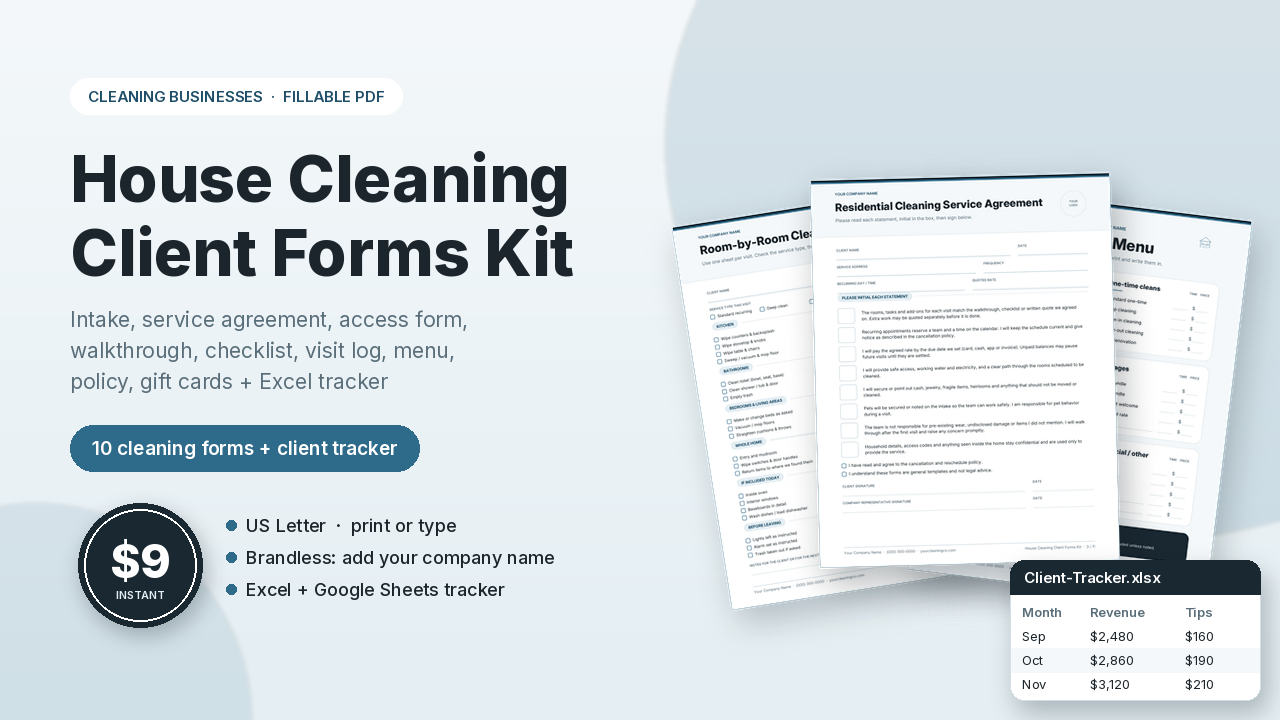
House Cleaning Client Forms Kit
10 fillable forms (intake and home profile, service agreement, key and alarm authorization, walkthrough sheet, room-by-room checklist, visit and quality log, service menu, cancellation policy, photo release, gift certificates) plus an Excel client tracker.
Get it →Section 6: Access, keys and alarm
- Will someone be home during the visit, or will you let yourself in?
- How will you get in: key handed over, lockbox, keypad or smart lock code, doorman or concierge?
- Is there an alarm, and who will give you the code and instructions?
- Parking: driveway, street, permit, paid garage or building loading rules?
- Building rules: elevator booking, service entrance, or hours when work is allowed?
- Anyone working from home, or rooms that should be cleaned at a certain time?
Access details affect both price and scheduling. Paid parking, a long walk from the car with equipment or a fourth-floor walk-up all add time. For the quote, you only need to know how access will work. Collect the actual codes and keys later, once the client has booked and signed, using a key and alarm authorization form. Avoid having clients send alarm codes or key photos by text before they are a confirmed client.
Section 7: Priorities, extras and exclusions
Ask the client what matters most to them. Two homes of the same size can have completely different priorities:
- What are the top three things they want to notice after every visit?
- Which rooms get the most use or the most mess?
- Anything they are particularly picky about: streak-free glass, made beds, folded towels?
- Any areas or items that are off-limits, such as a home office, collections or valuables?
- Any tasks they want added: laundry, dishes, organizing, interior windows, inside appliances?
Then be clear about what you do not do. Many cleaners exclude things like heavy furniture moving, ladder work above a set height, exterior windows, biohazards, mold remediation, pest infestations and pet waste. Listing exclusions on the questionnaire and the quote prevents awkward conversations on cleaning day. If a client has a priority you cannot meet in the time quoted, offer an add-on or a longer first visit rather than quietly rushing other rooms.
Section 8: Budget and policies preview
Ask for a rough budget or the price range they expect. It helps you suggest a frequency or scope that fits, such as every two weeks instead of weekly, or a focus on kitchens and bathrooms. Then preview your main policies so the service agreement holds no surprises. The table below uses bracketed placeholders only; it is not recommended wording.
| Policy | What to show (placeholders) |
|---|---|
| First clean | The first visit is [priced as an initial or deep clean / at the regular rate]. |
| Pricing basis | Visits are priced [flat rate per visit / hourly with an estimate]. |
| Minimum | Visits have a minimum of [amount or hours]. |
| Deposit or card on file | [Deposit amount or card on file] is required to book [one-time / move-out] cleans. |
| Cancellation | Cancelling within [timeframe] means [fee or policy]. |
| Lockout | If we cannot get in at the booked time, [lockout fee or policy]. |
| Satisfaction | If something was missed, tell us within [timeframe] and we will [policy]. |
| Payment | Payment is due [when], by [methods]. |
The policies themselves belong in your signed house cleaning service agreement. The questionnaire only previews them so the client knows how you work before you send a number.
Turning the answers into a quote
With a completed questionnaire and a few photos, you can estimate time, choose the right service type and send a clear quote, often without a walkthrough. The example below is for illustration only. The prices are placeholders; set your own based on your costs, market and experience. For a full pricing method, see how to price house cleaning.
| Questionnaire answer | How it affects the quote (example only) |
|---|---|
| 3 bed, 2.5 bath, 1,800 sq ft, two floors | Base time estimate of [hours]; base rate of $[amount] |
| Last professional clean: never; condition 2 of 5 | First visit priced as a deep clean at $[amount], then recurring rate |
| Every two weeks after the first visit | Recurring rate of $[amount] per visit |
| Two large dogs, heavy shedding on sofa and stairs | Add [time or pet fee]; bring pet hair tools |
| Fragrance-free products, child with asthma | Note product requirement; adjust supplies at [cost or no change] |
| Marble counters and hardwood floors | Note surface-safe products; no extra charge or [specialty fee] |
| Lockbox access, street parking only | Note access plan; add [parking or travel fee] if applicable |
| Add-on: inside oven and fridge | Add-on lines at $[price] each |
Send the quote with the service type, what is included, any add-ons, the first-visit price and the recurring price shown separately, exclusions, and a note that the price assumes the home matches the answers and photos provided. If the home is very different on the first visit, explain how you will handle it before you start.
Common mistakes to avoid
- Quoting from square footage alone. Bathrooms, condition and pets often matter more than size.
- Not asking when the home was last cleaned. A first clean can take twice as long as a maintenance visit.
- Pricing the first visit at the recurring rate. Show the initial and recurring prices separately.
- Leaving "deep clean" undefined. Attach a task list so both sides agree on scope.
- Skipping product and surface questions. The wrong cleaner on stone or wood can cause costly damage.
- Forgetting pets. Heavy shedding adds time, and nervous pets need a plan.
- Collecting keys and alarm codes too early. Get them after booking, on an authorization form.
- No written exclusions. Say what you do not clean before cleaning day.
- Booking without a signed agreement. Hold the slot only once the agreement and any deposit or card are in.
One-page house cleaning client questionnaire checklist
- Contact details, service address and preferred contact method
- Home type, square footage, bedrooms, full and half bathrooms, floors
- Rooms included and skipped, main floor types, household size
- Last professional clean, condition rating, problem areas and photos
- Service type: recurring frequency, one-time, deep, move-in or move-out
- Add-ons such as oven, fridge, interior windows, laundry
- Dates or deadlines, such as guests, closing or lease end
- Pets: type, number, shedding, where they will be during visits
- Supplies, preferred products, allergies and sensitive surfaces
- Access method, alarm (codes collected after booking), parking and building rules
- Top priorities, off-limits areas and your exclusions
- Budget range and policies previewed: first clean, minimum, cancellation, lockout, payment
Send the questionnaire as soon as someone asks for a price, review it with the photos before you quote, and once they book, move them onto your full intake form and service agreement.
FAQ
What should a house cleaner ask before giving a quote?
Ask for the home type and size, the number of bedrooms and bathrooms, the current condition and when it was last professionally cleaned, pets, the type of clean (recurring, one-time, deep or move-out), product preferences and allergies, how you will get in, priorities and a rough budget.
Can you quote house cleaning without a walkthrough?
Often, yes. Many cleaners quote from a questionnaire plus photos of the kitchen and main bathroom, with a note that the price assumes the home matches the answers. A walkthrough is more useful for large homes, very heavy buildup or move-out cleans with a landlord checklist.
Why is the first house cleaning more expensive?
The first visit usually takes longer because it removes buildup that regular visits then maintain. Many cleaners price it as a deep or initial clean and show the lower recurring rate separately.
What is the difference between a client questionnaire and a client intake form?
The questionnaire is short and collected before quoting, to get to an accurate price. The intake form is completed after booking and records the details you need to do the work, such as keys, alarm instructions and room-by-room preferences.
Should I ask about pets before quoting a cleaning?
Yes. Pet hair can add significant time, some pets need to be secured during visits, and team members with allergies need to know in advance.
When should I collect keys and alarm codes?
After the client has booked and signed your service agreement, ideally on a key and alarm authorization form. Before quoting, you only need to know how access will work.
This page is general information for house cleaners and cleaning businesses, not legal, insurance or safety advice. Consumer protection rules on deposits, cancellation fees and contracts, and requirements for business licenses and insurance vary by location. Check the current requirements that apply to you, follow product labels and safe work practices, and have your own forms and agreement reviewed.
Related templates
Free House Cleaning Checklist
A printable room-by-room cleaning checklist with 48 tasks plus a new client intake and home profile form.
Download free →House Cleaning Client Forms Kit
10 fillable house cleaning forms plus an Excel client tracker.
Get it →