Office Cleaning Pricing: How to Price Commercial Cleaning Jobs
How small cleaning businesses can price office and commercial cleaning: cost per labor hour, time by square footage, per visit vs monthly contract vs per square foot, consumables, add-ons, after-hours access and contract terms, with a worked monthly quote.
Why office cleaning needs its own pricing
Commercial cleaning is a different job from cleaning homes. You usually work after hours, on a fixed schedule, from a written scope, and you are paid by monthly invoice. Restrooms, kitchens and trash take most of the time, while open desk areas go fast. If you price an office like a house, you can quote far too high for a simple space or far too low for one with busy restrooms.
A clear method fixes that: know your cost per labor hour, estimate time per visit, multiply by visits per month, then add consumables and extras on their own lines. The steps below end with a worked monthly quote. All numbers on this page are example numbers, not market data.
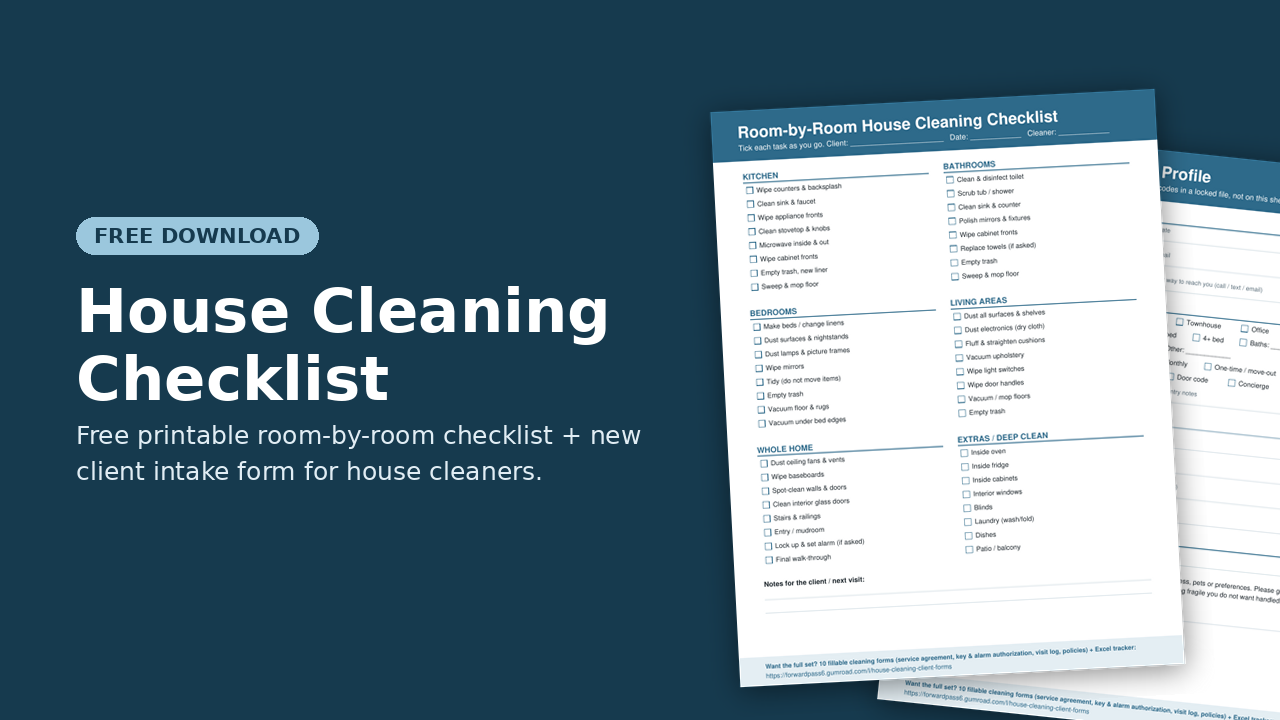
Free House Cleaning Checklist
A printable room-by-room cleaning checklist with 48 tasks plus a new client intake and home profile form.
Download free →1. Work out your cost per labor hour
Start with your own floor, not a competitor's price. Add up what one hour of cleaning costs you: your pay or your cleaner's wage, payroll costs, supplies, equipment wear, travel between sites, insurance (many offices ask for proof of liability insurance), software and card or invoicing fees.
- Example labor: $22 an hour for a cleaner, plus about $3 in payroll costs.
- Example supplies and equipment: about $2-3 per labor hour.
- Example overhead: insurance, software, fuel and fees about $7-8 per labor hour.
- Example cost: about $35 per labor hour before profit.
- Add profit: at an example 30-40% margin, you would charge around $50-55 per labor hour.
Labor hours are not clock hours. Two cleaners working one hour is two labor hours. Always price on labor hours.
2. Estimate time per visit from square footage and rooms
Walk the space before you quote. Note the square footage, number of restrooms and fixtures, kitchens or break rooms, hard floor vs carpet, how many people work there and how many trash bins there are. Then time a routine visit. The table below uses example numbers for a light-use office with one or two restrooms.
| Office size | Example labor hours per visit | Example price per visit (at about $52 per labor hour) |
|---|---|---|
| Up to 1,500 sq ft | 0.75-1 | Example minimum visit charge $60 |
| 2,500 sq ft | 1-1.25 | $52-65, so the $60 minimum often applies |
| 5,000 sq ft | 2-2.5 | $104-130 |
| 10,000 sq ft | 4-5 | $208-260 |
| 20,000 sq ft and larger | 8+ | Quote after a full walkthrough |
Add time for each extra restroom, a busy kitchen, medical or lab areas, lots of glass, stairs without an elevator and heavy foot traffic. A 3,000 sq ft office with 40 staff will take longer than a 3,000 sq ft office with eight.
3. Per visit, monthly contract or per square foot
Clients compare quotes in different ways, so know all three numbers even if you only show one.
- Per visit: labor hours times your hourly rate, with a minimum charge. Good for one-off and weekly cleans.
- Monthly contract: price per visit times visits per month. For a fixed weekly schedule, visits per month is visits per week x 52 / 12, for example 3 x 52 / 12 = 13. Most offices prefer this.
- Per square foot: the monthly price divided by the square footage. Use it as a check against other quotes, not as your starting point.
If a client asks for a per-square-foot price, work it out from your time-based monthly price, not the other way around.
4. Frequency and minimums
Offices book anything from daily to every other week. More visits usually means each visit is a little quicker, because dirt and trash do not build up.
- Daily (5 per week): re-time the visit; trash, restrooms and kitchen every visit, deep tasks rotated through the week.
- 2-3 per week: the most common choice for small offices.
- Weekly: each visit is longer; time it on its own.
- Every other week: price close to a first clean each time.
- Minimum charge: an example $60 per visit so small sites still cover travel and setup.
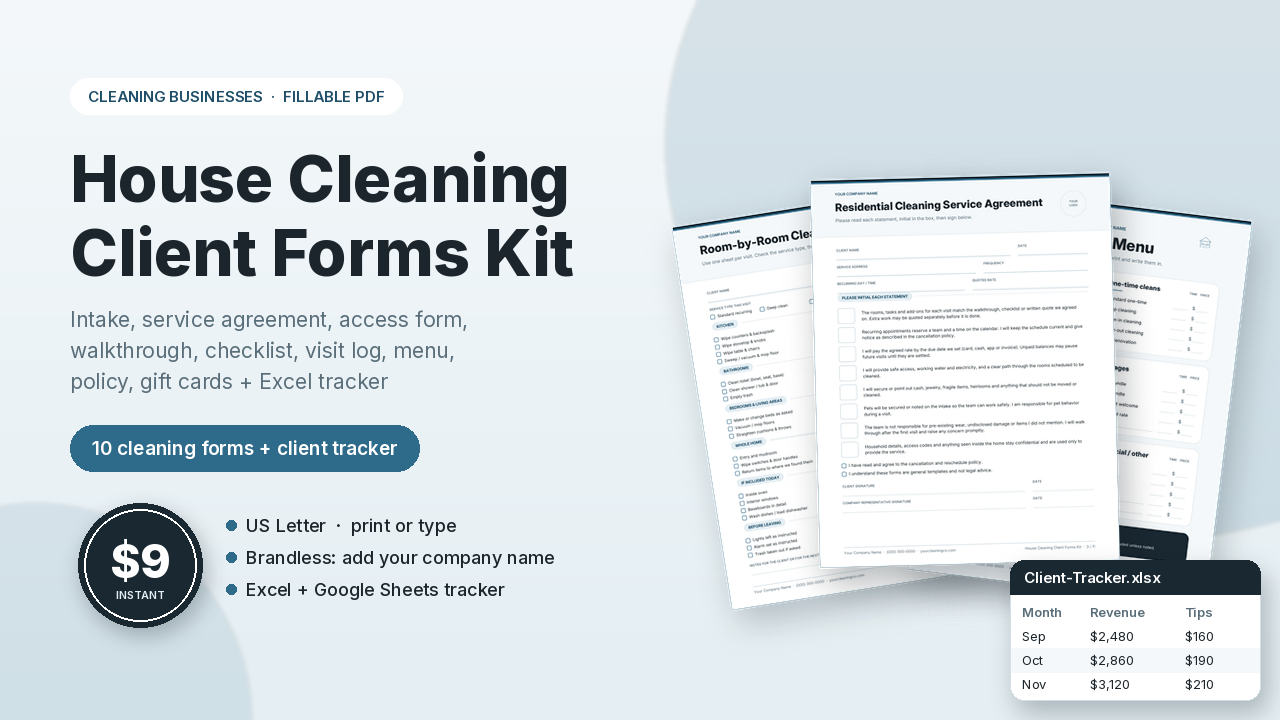
House Cleaning Client Forms Kit
10 fillable forms (intake and home profile, service agreement, key and alarm authorization, walkthrough sheet, room-by-room checklist, visit and quality log, service menu, cancellation policy, photo release, gift certificates) plus an Excel client tracker.
Get it →5. Restroom supplies and consumables
Toilet paper, paper towels, hand soap, trash liners and air freshener are used up at a rate you do not control. Keep them out of your cleaning price.
- Client buys, you refill: simplest; send a low-stock note when anything is down to one week's supply.
- You supply: bill at cost plus an example 10-15% handling fee, with receipts.
- Trash liners: agree which of the two options covers these too.
6. Add-on services
Extras are where commercial cleaning can earn well, as long as they are priced on their own.
- Carpet extraction: priced per square foot or by the hour, often quarterly.
- Hard floor strip and wax, or burnish: per square foot, quoted after seeing the floor.
- Interior glass and windows: per pane or by the hour; see the window cleaning pricing guide.
- Office party or event cleanup: hourly, booked ahead, with a minimum.
- Move-in, move-out or post-renovation clean: quoted as a one-time job, similar to move-out cleaning pricing.
- Exterior walkways and entrances: see pressure washing pricing.
Holiday closures in late December are a good time to offer deep cleans, carpet work and floor care, because the office is empty. See the holiday deep cleaning pricing guide for how to price seasonal work.
7. After-hours access, keys and security
Most office cleaning happens when staff have gone home, so trust and clear rules matter as much as price.
- Keep a key and alarm code log, and agree what happens if a code changes without notice.
- Set the visit window, for example after 6 PM, and say how long a visit usually takes.
- Agree a lockout fee or rebooking rule if your crew cannot get in.
- Keep proof of insurance ready; many offices ask for a certificate before you start.
- Agree how you report problems such as leaks, broken fixtures or doors left unlocked.
8. Put the terms in a written contract
A short written agreement prevents scope creep, the most common way office contracts become unprofitable. A cleaning service agreement is a good starting point. For office work, make sure it covers:
- A task checklist for each visit and what is done weekly or monthly.
- Visit days, time window and the monthly price.
- What counts as extra work and your hourly rate for it.
- Consumables: who buys them and how they are billed.
- Keys, alarm codes, lockouts and insurance.
- Holidays and office closures: whether skipped visits are credited.
- Payment terms, notice to cancel (for example 30 days) and when the price can be reviewed, for example once a year.
Worked example: a 4,000 sq ft office, three visits a week
Here is a labeled example, not market data. A 4,000 sq ft office with 20 staff, two restrooms and a small kitchen wants cleaning on Monday, Wednesday and Friday evenings. The client buys their own consumables.
- Estimated time per visit: 1.75 labor hours
- Price per visit: 1.75 x $52 = $91
- Visits per month: 3 x 52 / 12 = 13
- Example monthly price: 13 x $91 = $1,183, rounded to $1,185
- Per square foot check: $1,185 / 4,000 = about $0.30 per sq ft per month
- Example costs: 13 x 1.75 = 22.75 labor hours at $35 = about $796
- About $389 left each month as profit before tax
- Optional add-on: carpet extraction during the December closure, quoted separately
If you had quoted this office at a house-cleaning style flat $60 per visit, you would bring in $780 a month against about $796 in costs, and lose money before any extras. Pricing from labor hours, visits per month and separate consumables keeps it fair for both sides. For regular residential work, compare how to price house cleaning, and for tracking costs see small business expense categories.
FAQ
How much should I charge to clean an office?
There is no single right number. Work out what an hour of cleaning costs you (pay, payroll costs, supplies, travel, insurance and fees), estimate the labor hours each visit takes from the square footage, restrooms and kitchen areas, add your profit margin, then turn it into a monthly price. Compare with commercial cleaners near you. Any prices on this page are example numbers, not market data.
Should I charge per visit, per month or per square foot?
Most offices want one predictable monthly invoice, so many cleaners quote a monthly contract price. Build it from an estimate of labor hours per visit times visits per month. Price per square foot is a useful sanity check, but time per visit is what decides whether you make money.
Do I charge less for more frequent cleaning?
Often a little per visit, because an office cleaned three times a week stays cleaner and each visit is faster. Re-time the visits rather than giving a blanket discount, and keep a minimum charge per visit so small offices still cover travel.
Who pays for toilet paper, paper towels and soap?
Agree it in writing. Some offices buy their own consumables and you just refill them; others want you to supply them and bill at cost plus a handling fee. Do not hide consumables inside the cleaning price, because usage changes with headcount.
How do I price extra work like carpet cleaning or floor waxing?
Price it separately from the routine contract, usually per square foot or by the hour, and quote it after seeing the floors. Many offices book these quarterly or once a year, often during a holiday closure.
What should an office cleaning contract include?
The scope and checklist for each visit, visit days and times, monthly price, what is extra, consumables, keys and alarm codes, insurance, how complaints are handled, payment terms, notice to cancel and when the price can be reviewed.
This page is general guidance, not legal, tax or insurance advice. Business licensing, insurance, employment and consumer rules vary by state and city, so check your local rules.
Related templates
Free House Cleaning Checklist
A printable room-by-room cleaning checklist with 48 tasks plus a new client intake and home profile form.
Download free →House Cleaning Client Forms Kit
10 fillable house cleaning forms plus an Excel client tracker.
Get it →