Personal Chef Pricing: How to Charge for Meal Prep, Dinner Parties and Holiday Dinners
A practical guide for personal and private chefs: choose between per-session, per-person and hourly pricing, bill groceries the right way, set holiday and New Year rates, and protect your bookings with a deposit and a written agreement, with a worked example and free printable forms.
Why personal chef pricing is different from catering
A caterer usually cooks in a commercial kitchen and delivers food for a crowd. A personal chef shops for one household, cooks in the client's kitchen, packs or serves the food and leaves the kitchen clean. That means most of your cost is time, not ingredients: planning the menu, shopping, driving, cooking, labeling, cleanup and messages back and forth. If you price only the hours at the stove, you work for free during the rest. The fix is to pick a pricing model that captures the whole job and to keep groceries as a separate line.
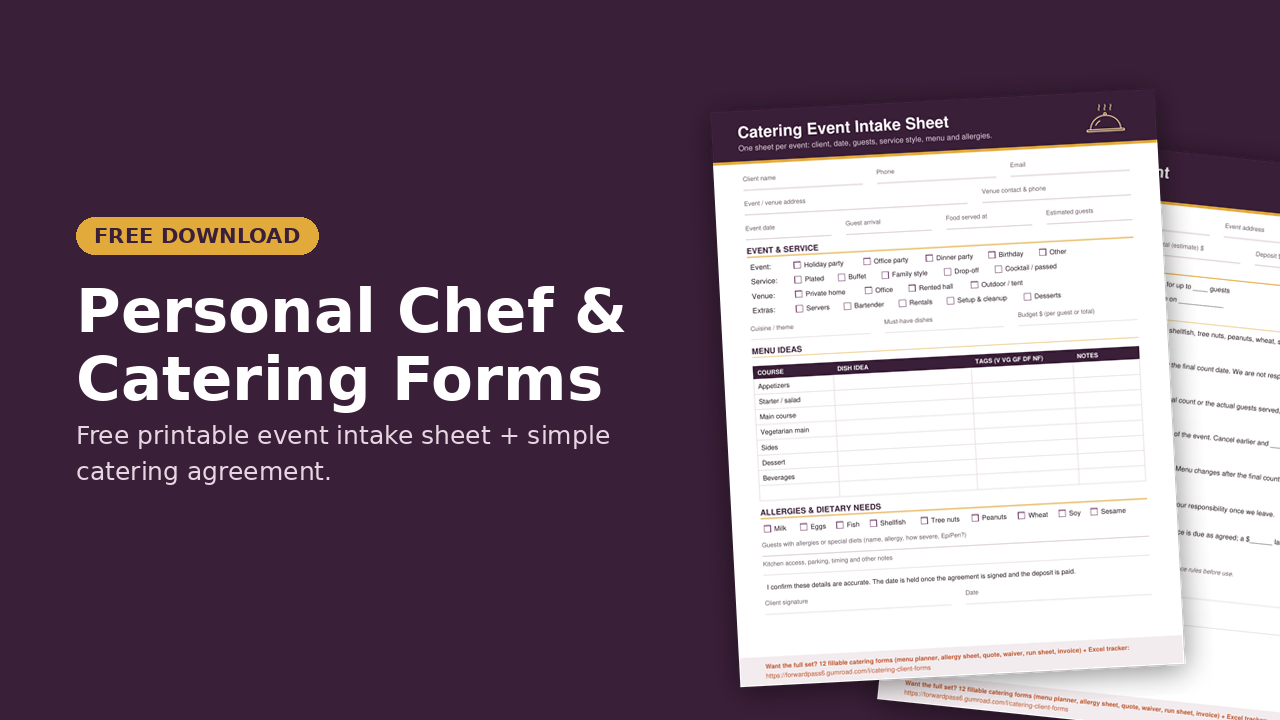
Free Personal Chef & Catering Forms
A printable event intake sheet plus a simple catering agreement for personal chefs and small caterers.
Download free →1. Pick a pricing model for each service
Most personal chefs use more than one model, depending on the service:
| Service | Common pricing model | What the fee should cover |
|---|---|---|
| Weekly or biweekly meal prep | Flat fee per cook session, groceries extra | Menu planning, shopping, cooking, packaging, labels, cleanup |
| Private dinner party | Per person with a minimum, groceries included or extra | Menu design, shopping, prep, plated or family-style service, cleanup |
| Holiday dinner (Thanksgiving, Christmas, New Year's) | Flat package or per person with a holiday minimum | Longer prep, peak-date demand, extra courses and serving help |
| Cooking class or demo | Per person or flat per class | Lesson plan, ingredients for students, recipe cards |
| Short one-off tasks | Hourly with a minimum | Your time, travel and setup |
Flat session fees are easy for clients to budget and reward you for working efficiently. Per-person pricing scales with guest count, which matters for dinner parties. Hourly pricing is best kept for small, unpredictable jobs.
2. Bill groceries separately (and say how)
Grocery costs change every week, so most personal chefs keep them out of the service fee. Common options are billing groceries at cost with receipts, at cost plus a small shopping or handling fee, or asking for a grocery deposit before you shop. Write down which method you use, whether specialty items (seafood, premium cuts, wine) need approval first, and how quickly the client reimburses you. If you include groceries in a per-person dinner price, cost the menu first and keep a buffer for price swings.
3. Count every hour of a meal prep session
A "four-hour" cook day is often much longer once you add the parts clients never see. Track a few sessions and add up:
- Menu planning and client messages
- Shopping, including the drive and putting food away
- Travel to and from the client's home
- Cooking, cooling, portioning and labeling
- Cleanup and kitchen reset
- Invoicing and admin
Divide your target weekly income by these real hours, not just cooking hours, to find a fair session fee. Add a travel zone or per-mile fee for clients outside your normal area.
4. Set holiday and January rates
Late November through New Year's Eve is peak season for dinner parties, family gatherings and holiday meals, and many chefs book these dates weeks ahead. It is common to set a higher minimum for Thanksgiving, Christmas Eve, Christmas Day and New Year's Eve, require a larger deposit, and cap how many events you take per day. January usually brings a different kind of demand: clients looking for healthier weekly meal prep after the holidays. A multi-week meal prep package (for example, four weekly sessions paid upfront) can fill your calendar for the new year and smooth out income after December.
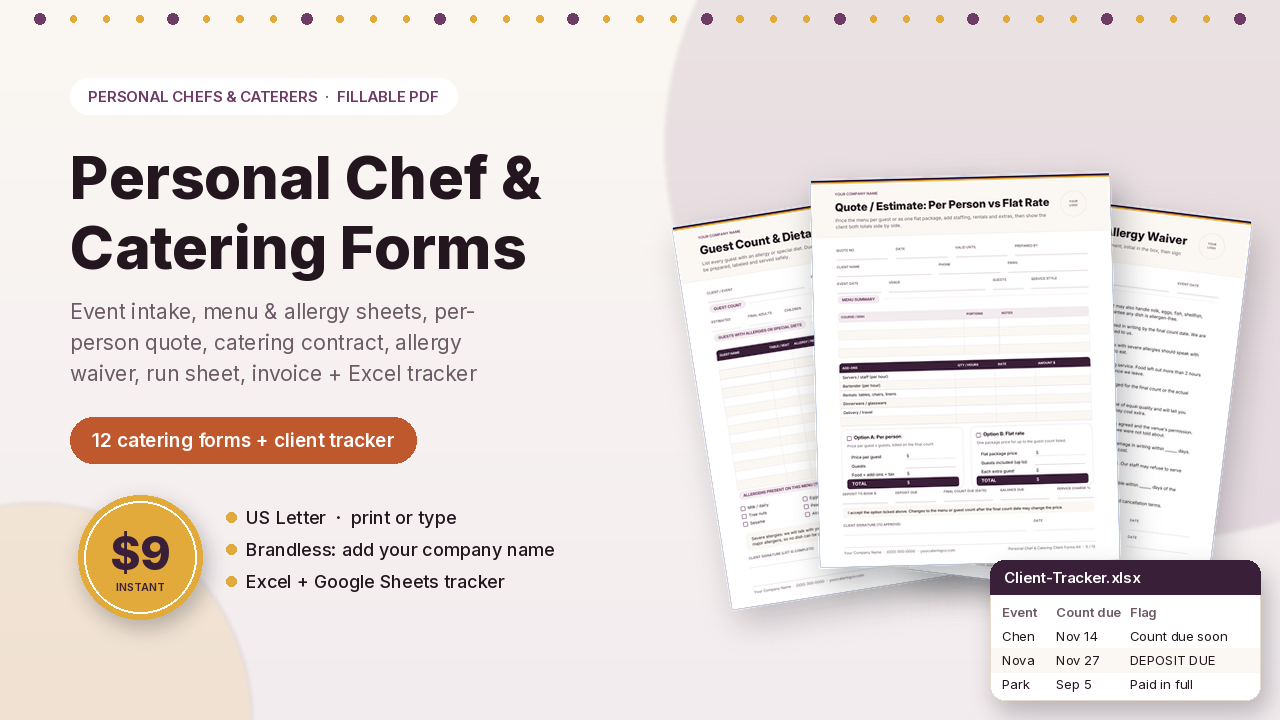
Personal Chef & Catering Client Forms Kit
12 fillable forms (client intake, menu planning & tasting worksheet, guest count & allergy sheet, per-person vs flat-rate quote, service agreement, food allergy waiver, run sheet, grocery & prep list, invoice and more) plus an Excel client tracker.
Get it →5. Take a deposit and use a written agreement
Put every booking in writing: dates, service type, number of meals or guests, menu approval process, grocery billing, kitchen access, allergies and dietary needs, deposit, payment due dates, cancellation terms and what happens to leftovers. A non-refundable deposit to hold a date is standard for dinner parties and holidays, often 25 to 50 percent. For recurring meal prep, many chefs bill weekly or monthly in advance and ask for notice, such as 48 hours, to skip a session. An allergy disclosure and waiver is important when you cook in someone else's kitchen.
Worked example (example numbers only)
These numbers show the math; they are not market rates. Use your own costs and local prices.
| Line item | Weekly meal prep (family of 4) | Holiday dinner party (10 guests) |
|---|---|---|
| Service fee | $250 flat session (about 6 real hours incl. planning, shopping, travel) | $85 per person = $850 (holiday minimum $800) |
| Groceries | About $160 at cost with receipts | About $300 at cost |
| Shopping fee | 10% of groceries = $16 | 10% of groceries = $30 |
| Serving help | None | 1 assistant, 5 hours at $30 = $150 |
| Travel | Inside free zone | $25 outside zone |
| Total | $426 | $1,355 |
| Deposit | Billed weekly in advance | 50% = $678 to hold the date |
If the meal prep client buys a four-week January package upfront, the chef might offer a small package discount on the service fee only, never on groceries.
Common personal chef pricing mistakes
- Pricing from cooking hours only and ignoring planning, shopping and travel
- Rolling groceries into a flat fee and absorbing price increases
- Charging the same for December holidays as for a regular Tuesday
- No minimum for small dinner parties
- Booking without a deposit, written agreement or allergy disclosure
- Discounting packages so deeply that the busiest weeks pay the least
FAQ
How much do personal chefs charge?
It varies widely by city, experience and service. Many personal chefs charge a flat fee per meal prep session or a per-person price for dinner parties, with groceries billed separately. Work out your real hours per job and your target income, then compare with chefs near you.
Should groceries be included in a personal chef's price?
Most personal chefs bill groceries separately, either at cost with receipts or at cost plus a small shopping fee, because grocery prices change. If you include groceries in a per-person price, cost the menu first and keep a buffer.
How do I price weekly meal prep?
Track how long a full session really takes, including menu planning, shopping, travel, cooking, packaging and cleanup. Divide your target income by those hours to set a flat session fee, then add groceries and any travel fee on top.
Should I charge more for holiday dinners?
Many chefs set higher minimums and larger deposits for peak dates like Thanksgiving, Christmas and New Year's Eve because demand is high and the menus are bigger. State holiday rates clearly in your quote and agreement.
How much deposit should a personal chef take?
For dinner parties and holidays, a non-refundable deposit of around 25 to 50 percent to hold the date is common. For recurring meal prep, billing weekly or monthly in advance with a notice period to skip a session works well.
Do personal chefs need a contract?
A written agreement is strongly recommended. It should cover the service, menu approval, grocery billing, kitchen access, allergies, deposit, payment, cancellation and leftovers. Licensing and food safety rules for personal chefs vary by location, so check local requirements.
This page is general guidance, not legal, tax or business advice. All prices on this page are examples to show the math, not market data. Licensing, food handler, sales tax and insurance rules for personal chefs vary by location, so check the rules where you operate.
Related templates
Free Personal Chef & Catering Forms
A printable event intake sheet plus a simple catering agreement for personal chefs and small caterers.
Download free →Personal Chef & Catering Client Forms Kit
Client intake, menu planning, allergy sheet, per-person vs flat-rate quote, service agreement, grocery & prep list and invoice plus an Excel client tracker.
Get it →