Personal Chef Contract Template: What to Include in a Private Chef Service Agreement
A clause-by-clause guide for personal and private chefs: put meal prep, dinner parties and holiday bookings in writing, spell out grocery billing, kitchen access and allergy disclosure, and protect your calendar with deposits and a clear cancellation policy, with a worked example and free printable forms.
Why a personal chef needs a written agreement
Personal chef work happens in someone else's home, with their groceries budget, their kitchen and their family's health on the line. Without a written agreement, small misunderstandings turn into unpaid invoices: a client who expected groceries to be included, a dinner party that grew from 8 to 14 guests, a cancelled Christmas Eve booking you turned other clients away for, or an allergy nobody mentioned. A short, plain-language agreement signed before the first cook day prevents most of these problems and makes you look more professional.
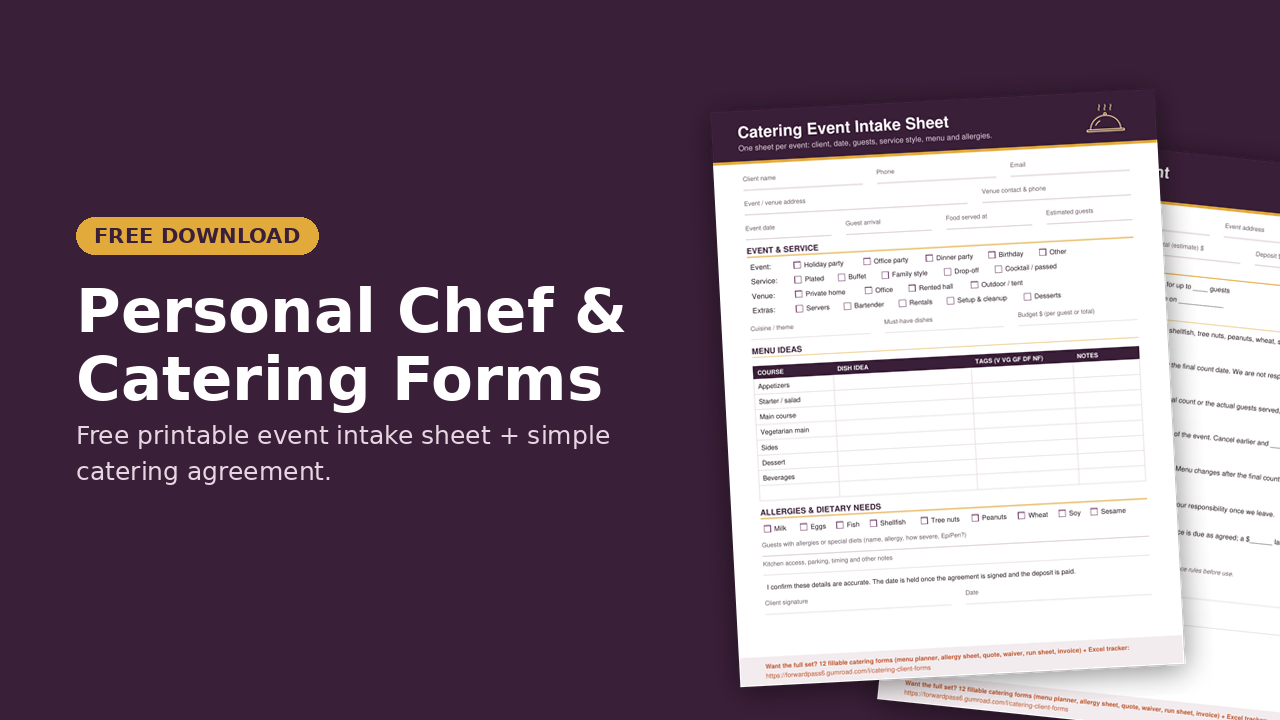
Free Personal Chef & Catering Forms
A printable event intake sheet plus a simple catering agreement for personal chefs and small caterers.
Download free →1. Parties, service type and schedule
Start with the basics: your business name and contact details, the client's name, the service address and the best way to reach them. Then name the service clearly, because each one has different terms:
- Recurring meal prep: number of sessions per week or month, meals or portions per session, day of the week and arrival window
- Private dinner party: date, arrival time, serving time, guest count, number of courses and service style (plated, family-style, buffet)
- Holiday dinner: date, menu package, whether you serve or drop off, and the latest time you will leave
- Cooking class: number of students, length and what they take home
State that the agreement covers only the services listed and that extra services (extra courses, extra guests, serving staff, bartending) are quoted separately.
2. Menu planning and approval
Explain how menus are chosen: you send a proposed menu by a set day, the client approves or requests changes by a deadline, and you may substitute similar ingredients when an item is unavailable or not up to quality. For dinner parties, say whether a tasting is included, priced separately, or credited toward the event. Note that late menu changes after shopping may be billed for ingredients already bought.
3. Groceries, pricing and payment
Grocery billing causes more disputes than anything else, so write down exactly how it works:
| Clause | What to write |
|---|---|
| Service fee | Flat fee per session, per person with a minimum, or hourly with a minimum |
| Groceries | Billed at cost with receipts, cost plus a shopping fee, or a grocery deposit before shopping |
| Specialty items | Premium proteins, seafood, wine or out-of-season produce need approval above a set amount |
| Travel | Included within a set radius; per-mile or zone fee beyond it |
| Payment timing | Deposit to book, balance due before or on the service day, grocery reimbursement within a set number of days |
| Late payment | Reminder schedule and any late fee allowed where you work; services paused while a balance is overdue |
List the payment methods you accept and who pays any card processing fees, if that is allowed where you operate.
4. Kitchen access, equipment and cleanup
Spell out what you need from the client: access to the home at the agreed time (key, code or someone present), working appliances, enough fridge and freezer space for prepared meals, and the containers you will use. Say whether you bring your own knives and equipment, who supplies storage containers and labels, and what "cleanup" means (for example, washing all dishes and tools you used and wiping counters, not deep-cleaning the kitchen). Add that you can reschedule if the kitchen is unsafe or unusable on arrival, and how that visit is billed.
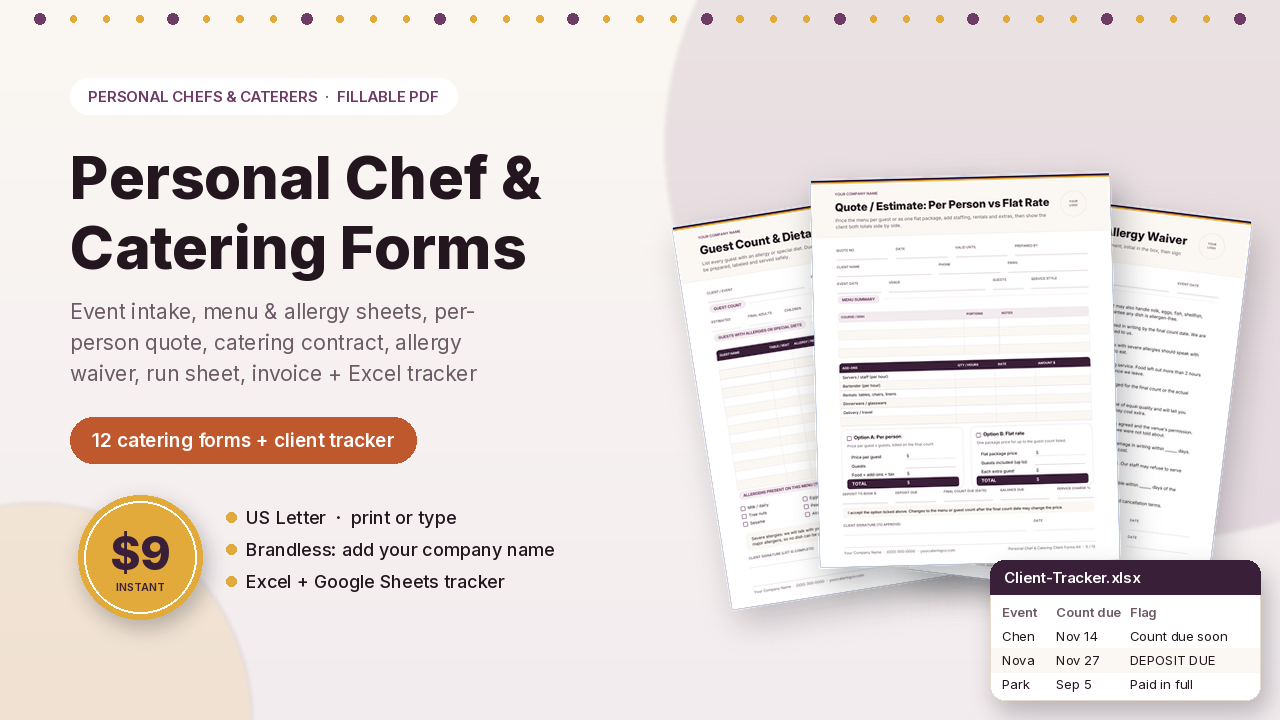
Personal Chef & Catering Client Forms Kit
12 fillable forms (client intake, menu planning & tasting worksheet, guest count & allergy sheet, per-person vs flat-rate quote, service agreement, food allergy waiver, run sheet, grocery & prep list, invoice and more) plus an Excel client tracker.
Get it →5. Allergies, dietary needs and food safety
Ask the client to list every allergy, intolerance and dietary restriction for each person who will eat the food, in writing, and to update you before each session or event. Note that a home kitchen is not an allergen-free environment and that you cannot guarantee food is free of trace allergens. Include storage and reheating instructions (for example, refrigerate within a set time, eat within a set number of days, freeze portions you will not eat in that window) and state that you are not responsible for food that is stored or reheated against those instructions. Food handler, cottage food and licensing rules for personal chefs vary by location, so check what applies where you work.
6. Deposits, cancellations and holiday bookings
Your calendar is your inventory. Protect it with clear rules:
- Deposit: a set percentage or flat amount to reserve a date, stating whether it is refundable and when it is applied to the balance
- Client cancellation: notice required for recurring sessions (for example 48 hours) and a sliding scale for events (for example, deposit kept inside 14 days, full fee inside 72 hours), plus grocery costs already spent
- Guest count: final count due by a set date; you bill the final count or the minimum, whichever is higher
- Holiday dates: Thanksgiving, Christmas Eve, Christmas Day and New Year's Eve can carry a higher minimum, a larger or non-refundable deposit and an earlier final-count deadline
- Chef cancellation: what happens if you are sick or cannot attend (refund of fees paid, or an approved backup chef)
- Weather and emergencies: how you reschedule if travel is unsafe
Deposit and cancellation rules can be limited by local consumer law, so check what is allowed where you operate.
7. Liability, insurance, photos and ending the agreement
Add a short section on responsibility: you take reasonable care with the client's home and equipment, accidental damage is handled through your insurance if you carry it, and you are not responsible for pre-existing appliance problems. Ask permission in a separate checkbox before photographing food or the home for marketing, and promise not to show the client's address or family. For recurring services, say how either side can end the agreement (for example, written notice before the next billing period) and how prepaid sessions are refunded or used up. Finish with signature and date lines for both parties.
Worked example (example numbers only)
A client books weekly meal prep at $200 per session for 4 weeks in January, groceries billed at cost with receipts. Week 1 groceries come to $140. The client also books a Christmas Eve dinner for 10 guests at $95 per person with a holiday minimum of $800, and pays a 30% deposit of $285 to hold the date. Their final guest count drops to 8 after the deadline, so the agreement bills the higher of 8 × $95 = $760 or the $800 minimum: $800, less the $285 deposit = $515 balance due on the day. Because the counts, minimum and deposit were in writing, there is nothing to argue about. These numbers are examples to show the math, not market rates.
Common personal chef contract mistakes
- No written grocery billing method or approval limit for expensive ingredients
- No final guest-count deadline or minimum for dinner parties
- Holiday dates booked on the same terms as an ordinary weeknight
- Allergies collected by text message instead of a signed form
- No storage and reheating instructions with prepared meals
- No rule for chef illness or emergencies
- Photos posted without written permission
FAQ
Do personal chefs need a contract?
A written agreement is strongly recommended. It sets expectations on services, groceries, payment, allergies and cancellations, and gives you something to point to if there is a dispute. Requirements and enforceability vary by location.
Should groceries be included in a personal chef contract?
Many personal chefs bill groceries separately, either at cost with receipts or at cost plus a shopping fee, so price changes do not come out of their service fee. Whatever you choose, write it down along with an approval limit for expensive items.
How much deposit should a personal chef charge?
Many chefs take a deposit to reserve dinner party and holiday dates and apply it to the final bill. The amount and whether it is refundable are business decisions, and local consumer rules may limit them, so check what applies where you work.
What cancellation policy works for meal prep clients?
A common approach is requiring notice before a recurring session (for example 48 hours) and billing the session or groceries already bought for late cancellations. Put the notice period and the charge in the agreement.
How do I handle food allergies in a personal chef agreement?
Collect every allergy and restriction in writing for each person eating the food, ask for updates before each session, and state that a home kitchen cannot be guaranteed free of trace allergens. A separate allergy disclosure or waiver form is useful.
Is this a legal contract I can sign as-is?
No. This page explains what personal chef agreements commonly cover. Use it to prepare your own agreement and have it reviewed by a local professional if you need legal certainty.
This page is general guidance, not legal, tax or business advice. All prices on this page are examples to show the math, not market data. Contract, consumer protection, food safety and licensing rules for personal chefs vary by location, so check the rules where you operate.
Related templates
Free Personal Chef & Catering Forms
A printable event intake sheet plus a simple catering agreement for personal chefs and small caterers.
Download free →Personal Chef & Catering Client Forms Kit
Client intake, menu planning, allergy sheet, per-person vs flat-rate quote, service agreement, grocery & prep list and invoice plus an Excel client tracker.
Get it →