Painting Estimate Template: How to Price a Paint Job by Square Foot (Free Checklist)
How to estimate a painting job by the room and square foot, figure coats and gallons, and what to put on a painting estimate: surfaces, prep, colors, materials, lead-safe notes, change orders, payment terms and a signature line.
Why a written painting estimate matters
Painting jobs go wrong in the gaps between what the client pictured and what the painter quoted. Was the ceiling included? Two coats or one? Who fixes the cracked drywall? Which white, exactly? A written painting estimate closes those gaps. It lists every room and surface you will paint, how much area each covers, how many coats, what prep is included, which colors and sheens, and what the client is agreeing to pay. It also sells better: a homeowner who sees "living room walls, 420 sq ft, 2 coats" understands the price in a way a single number never explains. This guide shows how to measure and price a paint job and what to include on the estimate.
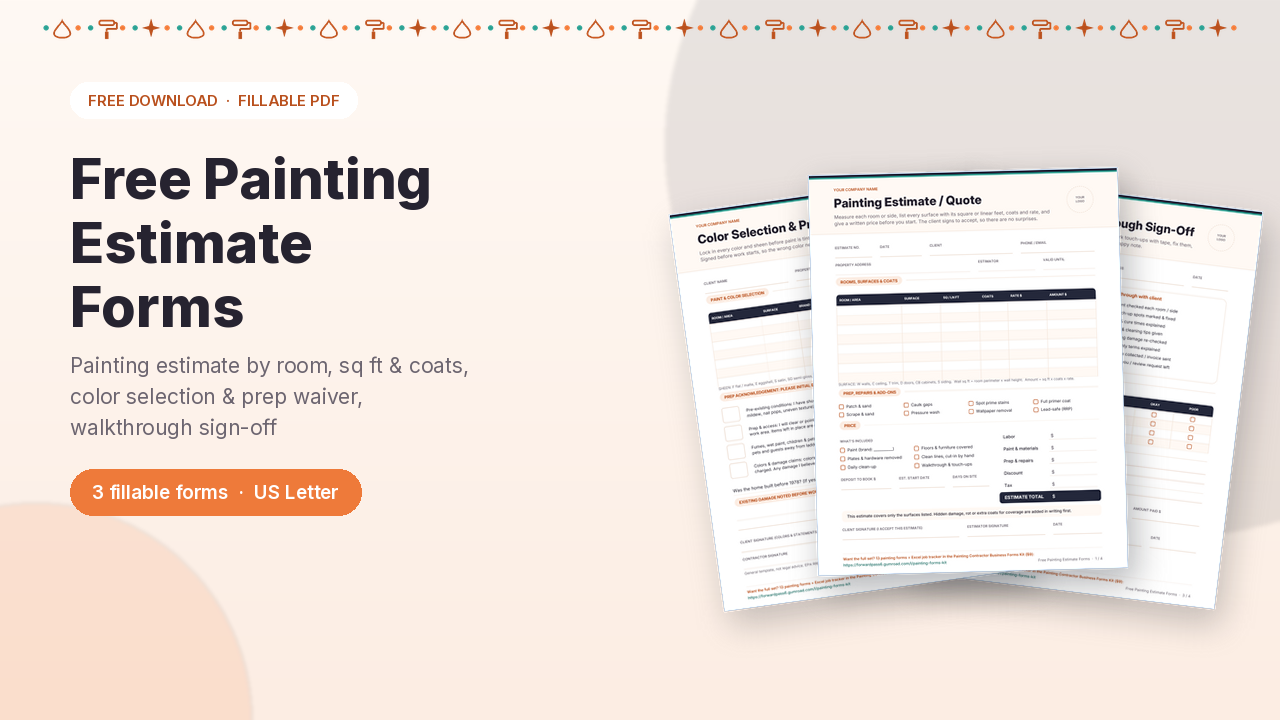
Free Painting Estimate Forms
A free fillable painting estimate / quote sheet with room-by-room sq ft and coats pricing rows, a paint & color selection sheet with prep and liability waiver, and a job completion walkthrough sign-off.
Download free →By the square foot, by the room or by the hour?
There are three common ways to price residential painting, and many painters use a mix:
- By the square foot: you measure the paintable area of each surface and charge a rate per square foot (or per linear foot for trim). It is the most accurate method for walls, ceilings and siding, and it scales from one bedroom to a whole house.
- By the room or by the item: a flat price per room size, door, window or cabinet door. It is quick to quote and easy for clients to understand, but you need separate prices for small, standard and large rooms, and high ceilings.
- By the hour plus materials: simple for repairs, touch-ups and unclear scopes, but harder to sell for full repaints because the client cannot see the final number.
Whichever you use, say on the estimate how you measured. "Wall area" can include or exclude doors and windows, and a "coat" price can include or exclude primer. Write your definitions down so you and the client count the same way.
How to measure and set your price
Do not copy a competitor's rate card. Build your price from your own numbers, then check it against your local market:
- Measure each room. Wall area is roughly the room perimeter times the wall height. For a 12 by 14 foot room with 8 foot walls: (12 + 14 + 12 + 14) x 8 = 416 sq ft. Subtract large openings like wide doorways and picture windows if you want to be precise. Ceiling area is length times width (168 sq ft here). Trim and baseboards are measured in linear feet.
- Know your production rate. Time a few jobs: how many square feet of wall you cut in and roll per hour, per coat, including setup and clean-up. Ceilings, high walls and dark-to-light color changes are slower.
- Pick your hourly target. Decide what an hour of crew time has to earn to cover wages, insurance, vehicle, equipment, marketing and profit.
- Convert to a rate. Divide your hourly target by your production rate, then add paint and supplies. For example, if an hour needs to earn $60 and you paint about 150 sq ft of wall per hour for one coat, labor is about $0.40 per sq ft per coat. Add paint (a $45 gallon covering about 350 sq ft is about $0.13 per sq ft per coat) and sundries.
- Set a minimum job charge so small jobs still cover the drive, setup and clean-up.
These numbers are only an example. Rates vary widely by region, paint quality, house age and season, so test your price, track how long jobs really take and adjust.
1. Your business and the client details
Start the estimate with your business name, logo, phone, email and website, plus your contractor license number and insurance details if your area requires them. Add an estimate number, the date and a "valid until" date (30 days is common, since paint prices change). Record the client's name, phone, email and property address, the number of stories, the approximate year the home was built (this matters for lead paint, below), whether the home will be occupied during the work, and any HOA or landlord approval needed for exterior colors.
2. Every room and surface, with square feet and coats
The heart of the estimate is the room-by-room table. For each room or side of the house, list each surface on its own line with its measurement, coats and color:
- Walls (sq ft) and ceilings (sq ft)
- Trim, baseboards and crown (linear ft)
- Doors and frames (each, per side)
- Cabinets (per door and drawer front)
- Exterior siding (sq ft) and exterior trim, fascia and soffits (linear ft)
- Decks, fences and railings (sq ft or linear ft)
Mark the number of coats on every line. Two coats is standard for most repaints, but a big color change, fresh drywall or a stain may need primer plus two. Clear lines make the price fair, and they let you quote the same house again in seconds.
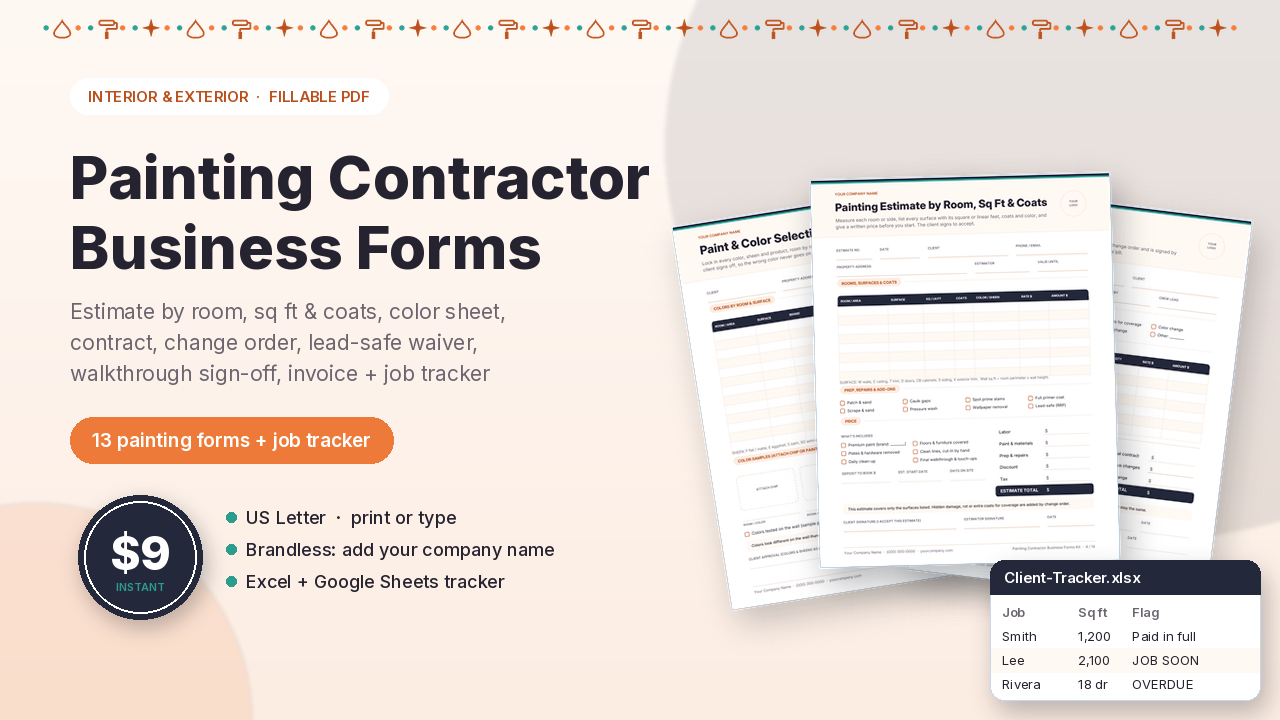
Painting Contractor Business Forms Kit
A 14-page fillable PDF with 13 forms (inquiry and site visit, pricing worksheet, estimate by room, sq ft and coats, paint and color selection sheet, materials list, interior and exterior prep checklist, painting contract, change order, lead-safe and liability waiver acknowledgement, walkthrough sign-off, invoice, touch-up and warranty log, review and referral cards) plus an Excel job tracker that prices by the square foot and shows costs and profit.
Get it →3. Paint quantity: how many gallons?
To estimate paint, multiply the area by the number of coats and divide by the coverage per gallon printed on the can. Many wall paints cover roughly 350 to 400 sq ft per gallon on smooth, primed surfaces, and less on rough, porous or textured surfaces. For the 416 sq ft room above with two coats: 416 x 2 = 832 sq ft, divided by 350 is about 2.4 gallons, so buy 3 gallons (or a 5-gallon bucket if you are doing several rooms in the same color). Add about 10% for touch-ups and leave the leftover paint with the client, labeled by room. Put the brand, product line and sheen on the estimate so the client knows what quality they are paying for.
4. Prep and repairs
Prep is where good paint jobs are won and where most underquotes happen. List it as separate lines or clearly included work:
- Interior: moving and covering furniture, covering floors, removing outlet covers and hardware, patching holes and cracks, sanding, spot-priming stains, caulking trim and taping edges
- Exterior: washing or pressure washing, scraping loose and peeling paint, sanding, replacing rotted wood (often quoted separately), caulking joints and priming bare wood
- Extras: wallpaper removal, popcorn or texture repair, accent walls and extra colors, high ceilings and stairwells
Say what happens if you find hidden damage, like rot behind siding or water damage behind a stain: you stop, show the client, and quote it on a change order.
5. Colors, sheens and approvals
Wrong-color disputes are expensive because the paint is already tinted and on the wall. Use a separate paint and color selection sheet: for every room and surface, write the brand, color name and code, sheen (flat, eggshell, satin, semi-gloss) and number of coats, and have the client sign it before you buy paint. Recommend a sample patch on the wall for any color they are unsure of, and note that changes after paint is bought may be charged.
6. Lead paint in homes built before 1978
In the United States, painting and renovation work that disturbs paint in most homes and child-occupied buildings built before 1978 is generally covered by the EPA Renovation, Repair and Painting (RRP) rule. Among other things, firms doing this work for pay usually need to be EPA lead-safe certified, use a certified renovator and lead-safe work practices, and give the owner or occupants the EPA Renovate Right lead hazard pamphlet before work starts, keeping a record that they did. Some states run their own programs with extra rules. Ask the year the home was built on every estimate, note it, and check epa.gov/lead and your state program for what applies to you.
7. Changes, payments, warranty and cancellations
Add short terms under the price. Changes: any added room, color change or extra coat goes on a signed change order with the new price before the work is done. Payments: the deposit to book (many painters take a deposit for materials), any progress payment, and when the balance is due, usually at the final walkthrough. Weather: exterior work may be rescheduled for rain, cold or high humidity. Warranty: how long your workmanship warranty lasts and what it does not cover. Cancellations: how much notice you need, and that your state may give homeowners a right to cancel certain contracts within a few days of signing.
8. The walkthrough and signature
Finish the estimate with an acceptance line: "I accept this estimate", with the client's signature, printed name and date, plus yours. When the job is done, walk every room with the client, mark touch-ups with painter's tape, fix them, and get a completion sign-off. Leave labeled leftover paint and keep a touch-up log with the exact colors, so warranty calls and future jobs are easy.
A note on the law, safety and insurance
This checklist is educational, not legal advice. Contractor licensing and registration, home improvement contract requirements, lead-safe (EPA RRP) rules, cancellation rights, insurance, ladder safety and sales tax rules vary by state, county and city. Check your local rules, and have an attorney or your insurer review your contract, change order and waiver before you use them.
FAQ
How do you estimate a painting job by square foot?
Measure the paintable area of each surface: wall area is about the room perimeter times the wall height, ceiling area is length times width, and trim is measured in linear feet. Multiply each area by your rate per square foot for the number of coats, add prep, repairs and materials, and set a minimum job charge. Check your rates against your local market.
How many gallons of paint do I need for a room?
Multiply the wall area by the number of coats and divide by the coverage on the can, often 350 to 400 square feet per gallon on smooth surfaces. A 12 by 14 foot room with 8 foot walls has about 416 square feet of wall, so two coats need about 2.4 gallons. Round up and add about 10% for touch-ups.
What should a painting estimate include?
Your business and license details, the client and property, the year the home was built, each room and surface with square or linear feet, coats, color and sheen, prep and repairs, paint brand and product, the price and deposit, change order, payment, warranty and cancellation terms, the valid-until date and a signature line.
Do painters charge for prep work?
Most do, either built into the per-square-foot rate for normal prep or as separate lines for heavy prep such as scraping, wallpaper removal, drywall repair or pressure washing. List it on the estimate so the client sees what is included.
Do I need to be lead-safe certified to paint older homes?
In the United States, paid work that disturbs paint in most homes and child-occupied buildings built before 1978 is generally covered by the EPA RRP rule, which requires firm certification, a certified renovator, lead-safe practices and giving the Renovate Right pamphlet. Some states run their own programs. Check epa.gov/lead and your state rules.
What is a change order in painting?
A change order is a short signed form that records any change to the original estimate, such as an added room, a color change or extra coats, with the new price and schedule. Both sides sign it before the extra work starts.
This page is general guidance, not legal advice. Licensing, lead-safe (EPA RRP), contract, cancellation, insurance and sales tax rules vary by state and city and change over time, so check yours before you quote or sign.
Related templates
Free Painting Estimate Forms
A free fillable painting estimate / quote sheet with room-by-room sq ft and coats pricing rows, a paint & color selection sheet with prep and liability waiver, and a job completion walkthrough sign-off.
Download free →Painting Contractor Business Forms Kit
Fillable estimate by room and sq ft, color selection sheet, contract, change order, lead-safe waiver and invoice plus an Excel job tracker.
Get it →