Painting Contract Template: What to Include (Free Template + Example)
A plain-English walkthrough of the clauses interior and exterior house painters put in their client contracts: scope, surfaces and coats, paint supply, prep work, exclusions, deposits and payment schedule, change orders, weather delays, cleanup, workmanship warranty and final walkthrough, with a worked example and free painting forms.
Why house painters need a written contract
Most painting disputes are not about brush skills. They are about expectations: whether the ceilings were included, who was supposed to move the furniture, how many coats the price covered, whether the trim color changed after the quote, or why the exterior job slipped a week. A short, clear painting contract answers those questions before you open a can, so you are not arguing about them on the last day of the job.
A contract also makes a small painting business look established. Homeowners who receive a tidy estimate, a color selection sheet and a contract to sign tend to treat the booking as a real commitment. This guide walks through the clauses most residential painters include, explains why each one matters and shows example wording you can adapt.
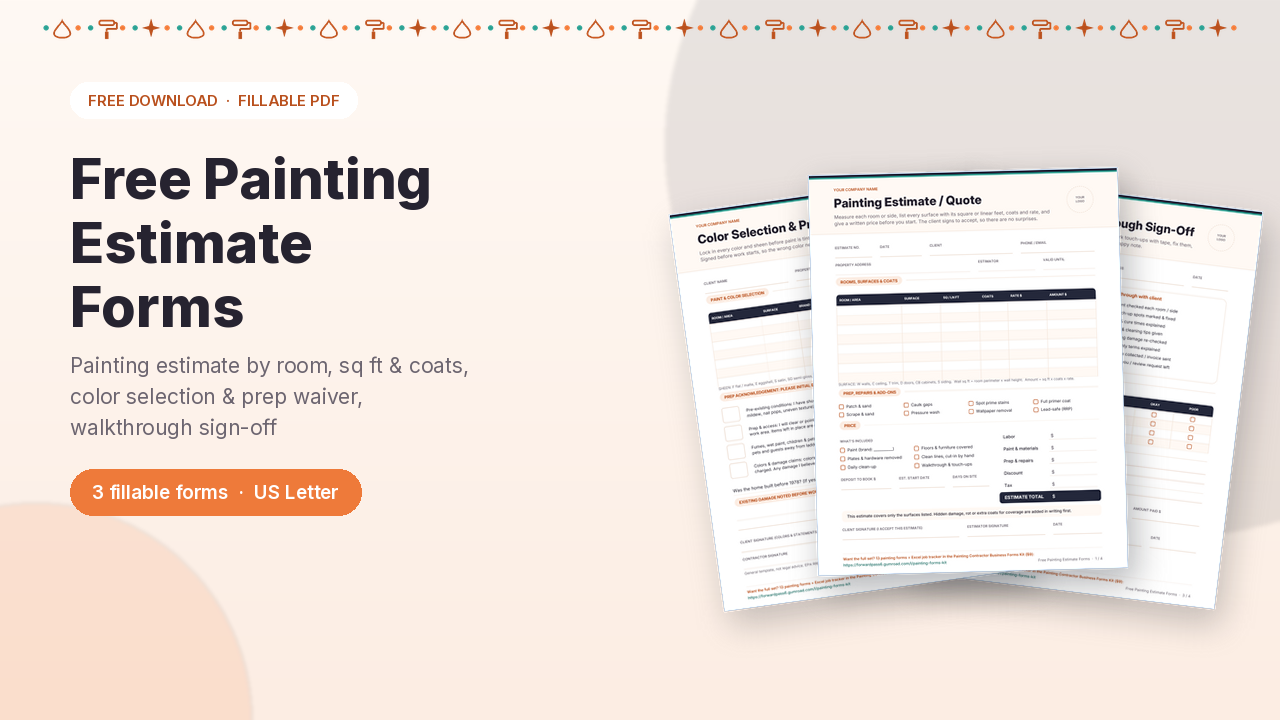
Free Painting Estimate Forms
A free fillable painting estimate / quote sheet with room-by-room sq ft and coats pricing rows, a paint & color selection sheet with prep and liability waiver, and a job completion walkthrough sign-off.
Download free →1. Parties, property address and job summary
Start with the basics, written so a stranger could understand them:
- Who. Your business name, contact details and the client’s full name. If the client is a tenant or property manager, note who owns the property and who has authority to approve the work.
- Where. The full property address, plus any unit number, gate code or parking notes.
- What, in one line. For example: “Interior repaint of living room, hallway and two bedrooms” or “Exterior repaint of siding, trim and front door.”
- Reference documents. Attach the estimate and the color selection sheet and say they form part of the contract.
2. Scope of work: rooms, surfaces, coats and paint
The scope is the heart of the contract. Vague scope is the number one cause of painting disputes, so list everything:
- Interior or exterior, and which rooms or elevations are included.
- Surfaces in each area: walls, ceilings, trim, baseboards, doors and frames, windows, cabinets, closets, siding, soffits, fascia, railings, decks.
- Number of coats, for example one primer coat on patched areas plus two finish coats.
- Paint brand, product line, sheen and colors, written exactly as on the color sheet (for example “eggshell on walls, semi-gloss on trim”).
- Who supplies the paint. If you supply it, say the price includes paint of a stated grade. If the client supplies it, say you are not responsible for coverage or durability problems caused by the product and that extra coats due to client-supplied paint are billed.
3. Prep work (and lead paint in older homes)
Prep is where the hours go, so spell it out: patching small nail holes and minor cracks, sanding glossy surfaces, caulking gaps in trim, spot-priming stains, scraping loose paint, power washing exterior surfaces before painting, masking floors and fixtures, and removing and replacing switch plates. Set a limit on repairs, such as “patching of holes up to 1 inch; larger drywall or wood rot repairs quoted separately.”
State who moves furniture. Many painters move light furniture to the center of the room and cover it, but ask the client to remove fragile items, electronics, artwork and anything heavy.
Lead paint caveat. If the home was built before 1978, it may contain lead-based paint. In the United States, the EPA Renovation, Repair and Painting (RRP) rule generally requires firms that disturb painted surfaces in pre-1978 homes to be certified and follow lead-safe work practices, and to give the owner a lead hazard information pamphlet before work starts. Note the year the home was built in the contract, say whether lead-safe practices apply, and check the current federal, state and local requirements for your area.
4. Exclusions
An exclusions list prevents scope creep. Common examples: major drywall or carpentry repair, wood rot replacement, wallpaper removal, mold remediation, moving heavy furniture or appliances, painting surfaces not listed, color changes after work starts, and damage caused by existing conditions such as moisture or failing previous coats. Anything excluded can still be done through a written change order.
5. Price, deposit, payment schedule and late fees
Write the total price or the pricing method (fixed price, per square foot or per room) and what it includes. Then set the payment terms:
- Deposit to book the start date and buy materials, with the amount and whether it is refundable. Some states limit deposits on home improvement work, so check local rules.
- Progress payment for larger or multi-week jobs, tied to a milestone such as “interior complete” rather than a date.
- Final payment due on completion and walkthrough sign-off, with accepted payment methods.
- Late fees for overdue balances, stated as a flat fee or percentage within any legal limits where you work.

Painting Contractor Business Forms Kit
A 14-page fillable PDF with 13 forms (inquiry and site visit, pricing worksheet, estimate by room, sq ft and coats, paint and color selection sheet, materials list, prep checklist, painting contract, change order, lead-safe and liability waiver acknowledgement, walkthrough sign-off, invoice, touch-up and warranty log) plus an Excel job tracker that prices by the square foot and shows costs and profit.
Get it →6. Change orders in writing
Clients often add “just one more wall” or change the trim color midway. Your contract should say that any change to scope, colors, materials or schedule must be agreed in a written change order, signed or approved by message, showing the extra cost and time before the extra work begins. This keeps your price fair and avoids surprise invoices.
7. Schedule and weather delays
Give an estimated start date and duration, not a guaranteed finish date. For exterior work, add a weather clause: paint is applied only within the manufacturer’s temperature and humidity range and not in rain, so rain, cold, high wind or wet surfaces may delay the job without penalty. Say how you will notify the client of delays and that the schedule may also shift because of hidden repairs, change orders or access problems.
8. Client responsibilities
A painting job runs on time only if the client does their part. List what you need: access to the home and the areas being painted at agreed times, working electricity and water, rooms cleared of valuables and small items, pets kept away from the work area, outdoor items moved away from walls, sprinklers turned off before exterior work, and color choices confirmed before the start date. Add that delays caused by lack of access may be billed or rescheduled.
9. Cleanup and leftover paint
Describe the cleanup standard: drop cloths removed, debris taken away, floors swept, fixtures and plates replaced and furniture returned to its approximate place. Say what happens to leftover paint: many painters leave labeled partial cans with the client for touch-ups, which is useful for future repairs. Note that disposal of empty or unwanted cans follows local rules.
10. Warranty on workmanship
A clear warranty builds trust and limits open-ended callbacks. Cover workmanship defects such as peeling, blistering or flaking caused by your application, for a stated period, for example (example only) 2 years on interior work and 1 year on exterior work. Exclude normal wear, damage, moisture problems, structural movement, client-supplied paint and surfaces you advised needed repair. Say that the paint itself is covered only by the manufacturer’s warranty.
11. Insurance, license and final walkthrough
Insurance and license. State that you carry general liability insurance and, where required, workers’ compensation, and include your contractor license or registration number if your area requires one. Rules differ widely by state and city, so check local requirements before quoting.
Touch-ups and final walkthrough. Before the final invoice, walk the job with the client, mark any touch-ups with painter’s tape, fix them, and have the client sign a completion sign-off. This sign-off shows the work was accepted and usually triggers the final payment.
Cancellation. Say how either party can cancel, how much notice is needed, what happens to the deposit, and that the client pays for work completed and materials bought to date. Some states give homeowners a short cancellation period for certain home improvement contracts, so check whether that applies.
12. Common painting contract mistakes
- “Paint the house” as the whole scope. List rooms, surfaces and coats.
- No color sheet. Colors agreed by text are easy to dispute; attach a signed selection.
- Unlimited repairs. Cap prep repairs and quote larger ones separately.
- No weather clause for exterior jobs.
- Verbal change orders. Always write them down with the price.
- Skipping the walkthrough. Without a sign-off, the touch-up list never ends.
- Ignoring pre-1978 homes. Ask the build year at the estimate stage.
Worked example (example numbers only)
Here is how one painter might fill in the key terms for an interior job. All numbers are an example only; set your own prices and policies based on your costs and market.
- Scope: living room, hallway and two bedrooms; walls and ceilings; one spot-prime coat plus two finish coats; eggshell walls, flat ceilings, semi-gloss trim; painter supplies mid-grade paint.
- Size: about 1,200 sq ft of wall and ceiling area.
- Price: example rate of $3.00 per sq ft = $3,600, plus $300 for trim and doors = $3,900 total.
- Deposit: 25% = $975 to book the start date and buy materials.
- Progress payment: 35% = $1,365 when the bedrooms are complete.
- Final payment: 40% = $1,560 at walkthrough sign-off.
- Late fee: example $25 if the balance is more than 7 days late.
- Warranty: example 2 years on interior workmanship.
To see how to calculate rates like these, read how much to charge for painting and the painting estimate template guide.
How to send and store your contract
Send the contract with the estimate and the deposit invoice, and do not lock in the start date until the signed contract and deposit are in. A fillable PDF that the client can sign electronically saves time. Keep a copy with the color sheet, change orders, photos of the surfaces before you start and the walkthrough sign-off in one job file, so you can answer any warranty question later.
FAQ
Do I need a contract for a small painting job?
Yes, even a one-page agreement helps. It confirms the rooms, surfaces, coats, colors, price, deposit and payment terms, which prevents most disagreements on small jobs.
How much deposit should a painter ask for?
Many painters ask for a deposit that covers materials and secures the date, often a set percentage of the total. Some states cap deposits on home improvement work, so check local rules before setting yours.
Should the painter or the homeowner buy the paint?
Either can work. If you supply it, you control quality and coverage. If the client supplies it, your contract should say you are not responsible for problems caused by the product.
What warranty should a painting contractor offer?
Many painters offer a workmanship warranty covering peeling or flaking caused by their application for a set period, often shorter for exterior work. The paint itself is covered by the manufacturer.
What does a painter need to do in a home built before 1978?
The home may contain lead-based paint. In the United States, the EPA RRP rule generally requires certified firms and lead-safe work practices for jobs that disturb paint in pre-1978 homes. Check current rules for your area.
How do I handle extra work the client asks for?
Use a written change order that lists the extra work, cost and any schedule change, and get the client’s approval before starting it.
This page is general guidance, not legal advice. Contractor licensing, home improvement contract, deposit, lead-safe work and consumer rules vary by location. Have a qualified professional review your painting contract before you use it.
Related templates
Free Painting Estimate Forms
A free fillable painting estimate / quote sheet with room-by-room sq ft and coats pricing rows, a paint & color selection sheet with prep and liability waiver, and a job completion walkthrough sign-off.
Download free →Painting Contractor Business Forms Kit
Fillable estimate by room and sq ft, color selection sheet, contract, change order, lead-safe waiver and invoice plus an Excel job tracker.
Get it →