How Much to Charge as a Handyman: Hourly vs Flat Rates, Minimums and Materials (Plus Free Forms)
How to price handyman work: find your target hourly rate, choose hourly or flat-rate pricing, set a minimum service charge and trip fee, mark up materials, quote multi-task visits, handle change orders and deposits, with a worked example and free printable forms.
Why handyman pricing goes wrong
Handyman work is a long list of small, different jobs, which makes it easy to underprice. A ten-minute fix turns into an hour once you count the drive, the trip to the hardware store and the clean-up. A "quick" drywall patch needs three visits for mud to dry. Materials get bought on your card and passed through at cost. A simple pricing method fixes that: know what each working hour must earn, charge a minimum for every visit, price materials and trips properly, and put scope changes in writing.
Free Handyman Forms
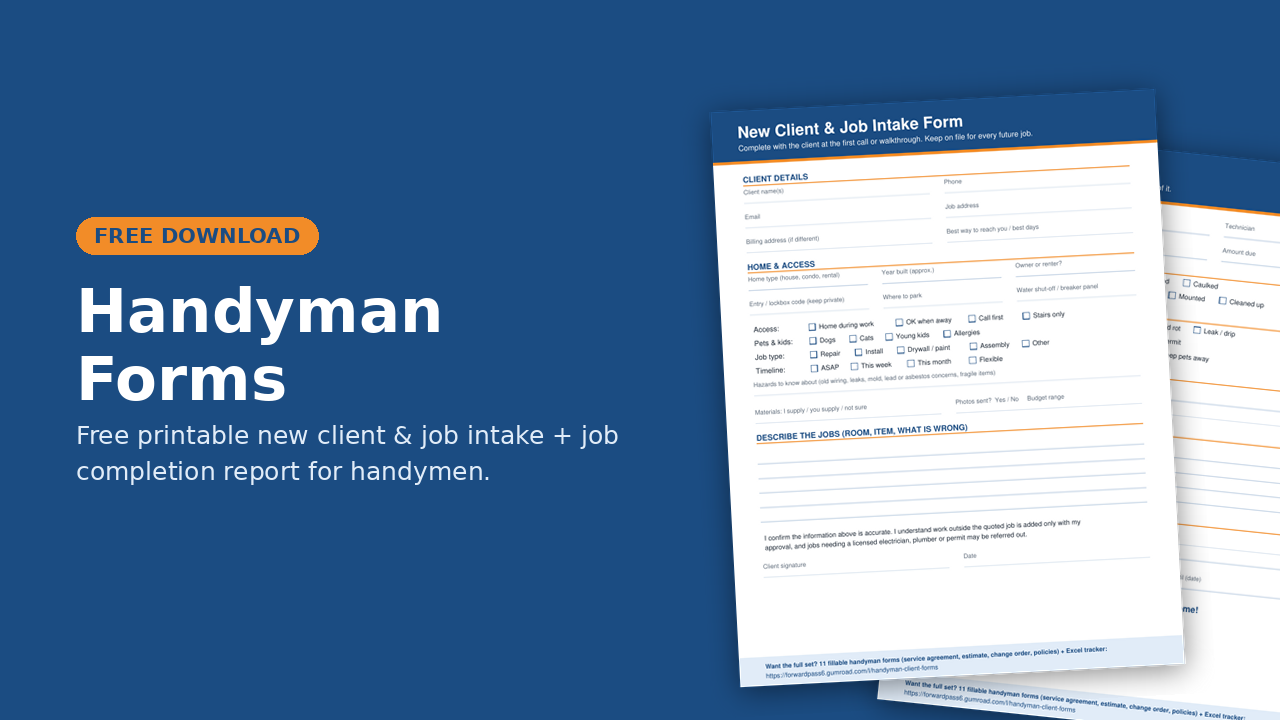
A printable new client and job intake form plus a job completion report for handyman businesses.
Download free →1. Work out your target hourly rate
Add up what the business costs each month: the pay you want, liability insurance, any license or registration fees, vehicle payment, fuel and maintenance, tools and tool replacement, phone and invoicing software, marketing, card fees and money set aside for taxes. Then estimate how many hours you can actually bill each month. Quoting, driving, supply runs, callbacks and bookkeeping are real work but rarely billable, so many solo handymen bill far fewer hours than they work. Divide monthly costs by billable hours and you have the rate every job needs to clear.
2. Hourly, flat rate or both
There are two common approaches, and many handymen mix them.
- Hourly: simple and fair for jobs that are hard to predict, such as repairs behind walls or troubleshooting. State your rate, how time is rounded (for example in 15 or 30 minute blocks), and whether drive time counts.
- Flat rate per task: customers like knowing the price up front, and you earn more as you get faster. Build a price list for your common jobs, such as mounting a TV, hanging a door, installing a light fixture, replacing a faucet or patching drywall, by timing each one and multiplying by your target rate plus a buffer.
- Mixed: flat rates for routine tasks and hourly for anything with unknowns, with a written estimate range and a cap the customer approves.
3. Set a minimum service charge and trip fee
Every visit costs you drive time, set-up and clean-up, even if the job takes five minutes. A minimum charge, often equal to one or two hours of labor, protects you from losing money on tiny jobs. Many handymen also add a trip fee for homes outside a core service area, or charge for a second visit when work has to dry, cure or wait for parts. Encourage customers to bundle small tasks into one visit so the minimum covers more work.
4. Price materials and supply runs
If you buy the materials, you carry the cost, the time to shop and the risk of returns. Common approaches are a markup on materials, a flat supply-run fee or charging the run as labor time. Say in your agreement who buys materials, how they are billed, whether you need a deposit for special-order items and that leftover materials belong to the customer. Keep receipts attached to the job record so you can show what was bought.
5. Quote multi-task visits with a walkthrough
Honey-do lists are the core of handyman work. Walk the home, list every task, note the materials and access issues (ladders, furniture to move, old paint or fixtures), and estimate time per task. Add a buffer for surprises, which are common in older homes. Present the quote as a task list with a price per line or a total with a time estimate, and get the customer to sign off before you start.
Handyman Client Forms Kit
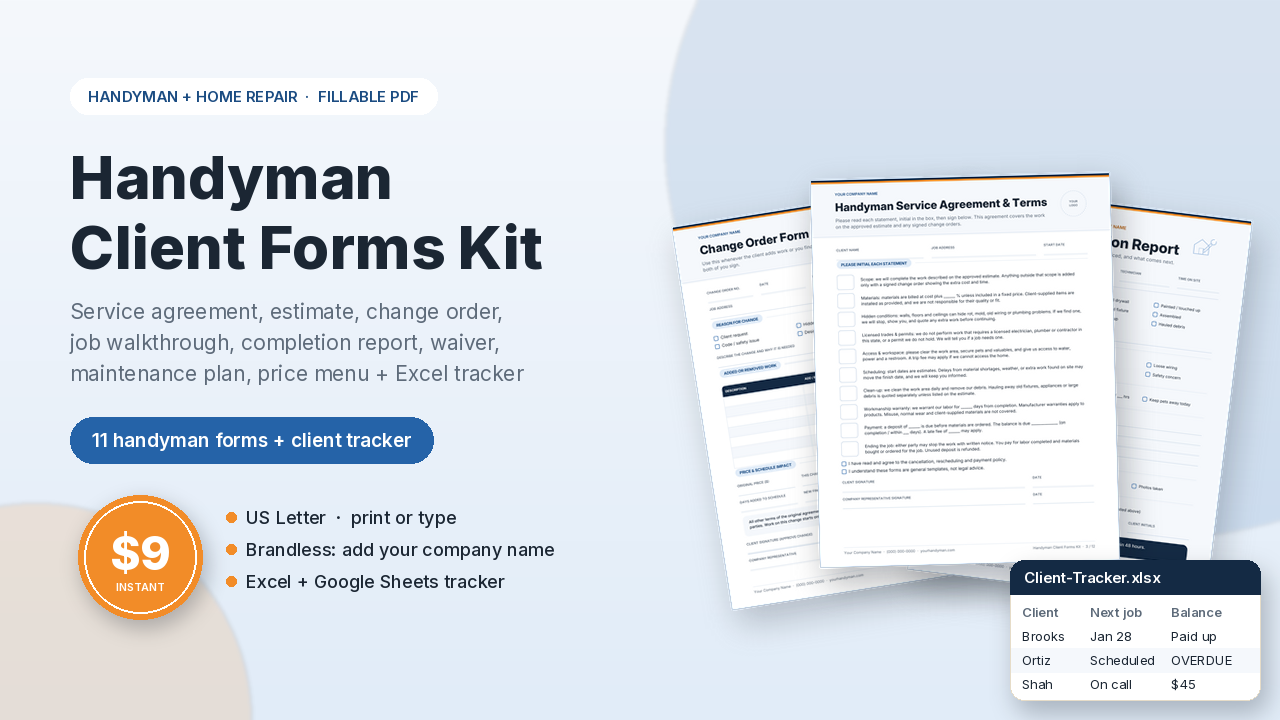
11 fillable and printable handyman forms (new client & home profile, service agreement, job walkthrough with room sketch grid, estimate / quote, change order, job completion report, home maintenance plan and more) plus an Excel client tracker with balances, next-visit dates and overdue payment flags.
Get it →6. Change orders, deposits and payment terms
Scope creep is where handyman profit disappears: "while you are here, could you also..." Use a short written change order for any added work, with the new price, before you do it. For larger jobs, take a deposit to cover materials and secure the date. State when payment is due, how you accept it, what happens with late payments and how cancellations and no-access visits are charged. A signed service agreement with these terms protects both sides.
7. Know your limits
Many states and cities cap the size of job a handyman can take without a contractor license, and electrical, plumbing, gas and structural work often require a licensed trade and permits. Check your local rules, list the work you do and do not do, and price only jobs you are allowed to take. Turning down out-of-scope work protects your business and your customer.
8. Worked example
These are example numbers to show the method, not market rates for your area.
- Target rate: $70 per billable hour
- Minimum service charge: 1 hour = $70
- Visit list: mount a TV (flat $120), replace two light fixtures (1.5 hours = $105), patch and paint a small drywall hole (1 hour labor = $70, plus one return visit after drying, 0.5 hours = $35)
- Materials bought by you: $60 plus a 15% markup = $69
- Labor and flat-rate total: $120 + $105 + $70 + $35 = $330
- Example job total: $330 + $69 = $399, with a deposit covering materials before work starts
Swap in your own costs, timings and local rates. The point is that every number comes from your time and target rate, not a guess.
9. Put it in writing
A new client and home profile, a job walkthrough, a written estimate, a signed service agreement, change orders and a completion report keep jobs clear from first call to final payment. Record the tasks, materials, price, payment terms, warranty on workmanship, what is excluded and any licensing limits. The completion report gives the customer a record of what was done and a natural moment to book the next visit.
Common pricing mistakes
- Pricing without knowing your target hourly rate
- No minimum charge for small jobs
- Ignoring drive time, supply runs and return visits
- Passing materials through at cost
- Doing extra work without a written change order
- No deposit for special-order materials
- Taking work above your license limits
FAQ
How much should a handyman charge per hour?
Work out the rate you need to cover your pay, insurance, vehicle, tools, software and taxes, then divide by the hours you can actually bill each month. Check local competitors so your rate fits your market.
Is it better to charge hourly or by the job?
Flat rates work well for routine tasks you can time accurately, such as mounting a TV or replacing a faucet. Hourly pricing suits troubleshooting and repairs with unknowns. Many handymen use flat rates for common jobs and hourly for the rest.
What is a handyman minimum charge?
A minimum service charge, often one or two hours of labor, covers the drive, set-up and clean-up on very small jobs. It also encourages customers to bundle several small tasks into one visit.
Should a handyman mark up materials?
Many do, because buying materials takes time, uses their money and carries return risk. Common options are a percentage markup, a supply-run fee or billing the shopping time as labor. State the method in your agreement.
How do I handle extra work a customer asks for?
Write a short change order with the added tasks and price, and get it approved before you do the work. This avoids disputes over the final bill.
Does a handyman need a contract?
It is strongly recommended. A signed agreement with scope, price, payment terms, materials, change orders, warranty and exclusions protects both you and the customer.
This page is general guidance, not legal, tax or licensing advice. Handyman licensing limits, permit rules and contract requirements vary by state, county and city and change over time, so check yours before you take jobs.
Related templates
Free Handyman Forms
A printable new client and job intake form plus a job completion report for handyman businesses.
Download free →Handyman Client Forms Kit
11 fillable handyman forms (agreement, walkthrough, estimate, change order, completion report) plus an Excel client tracker.
Get it →