How to Price Pressure Washing Jobs: Per Square Foot, Flat Rate and Hourly (Plus a Free Estimate Form)
How to price pressure washing: per square foot vs flat rate vs hourly, measuring driveways, decks and house siding, soft washing, add-ons, minimum charges and deposits, with a worked quote example and a free printable pressure washing form.
Why pressure washing pricing goes wrong
Pressure washing looks simple to price: you show up, you clean a surface, you get paid. In practice, two driveways of the same size can take very different amounts of time depending on the stains, the surface and how far you have to run hoses. New operators often quote by gut feel, underprice the first season and then struggle to raise rates. A repeatable method fixes that: pick a pricing model, measure every surface the same way, adjust for condition, itemize add-ons and set a minimum charge so small jobs still pay.
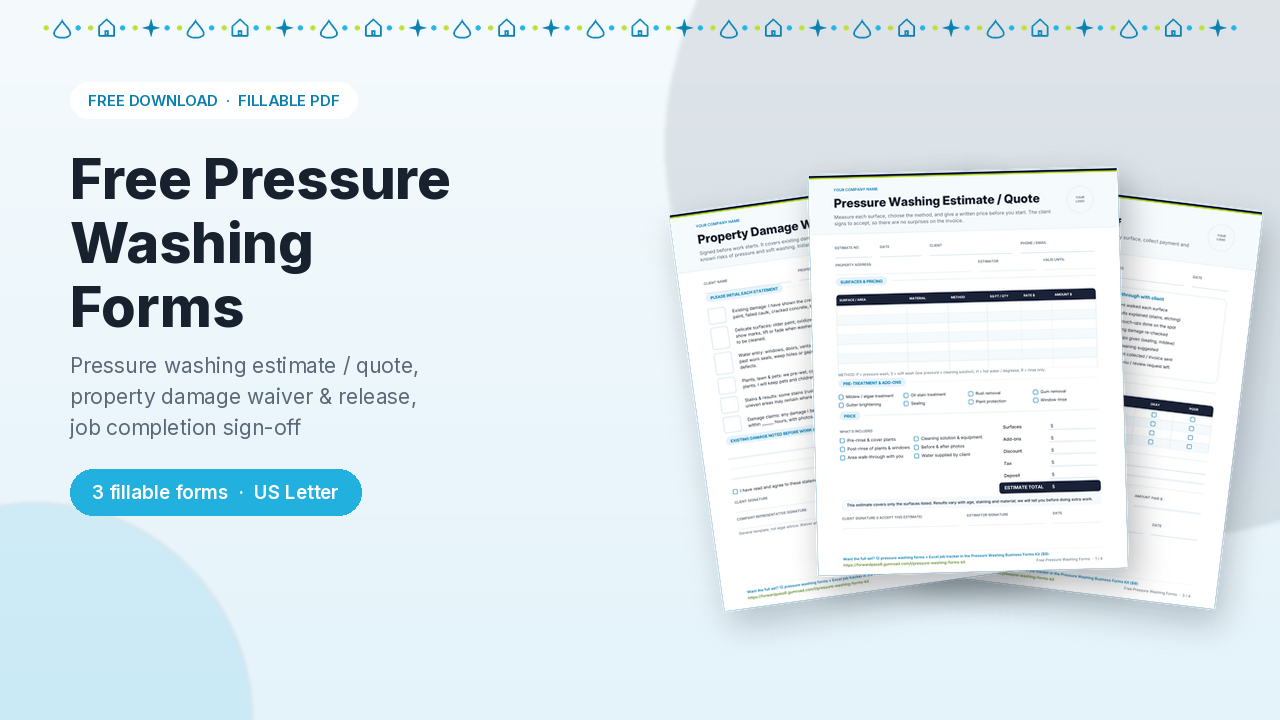
Free Pressure Washing Forms
A printable estimate form plus a simple service agreement for pressure washing and soft washing jobs.
Download free →1. Choose a pricing model: per square foot, flat rate or hourly
Most pressure washing businesses use one of three approaches, often combined:
- Per square foot: measure the area and multiply by a rate for that surface type. It scales fairly from a small patio to a large commercial lot and is easy to explain to customers.
- Flat rate by job type: a set price for common jobs such as a standard two-car driveway, a single-story house wash or an average deck. Fast to quote and simple for homeowners to say yes to; adjust up for size or condition.
- Hourly: useful for jobs that are hard to measure, such as heavy rust or graffiti removal, equipment cleaning or detailed hand work. Always estimate the hours up front and say what happens if the job runs long.
Many operators quote residential work as flat rates built from their per-square-foot numbers, and keep hourly pricing for unusual jobs.
2. Measure surfaces and price each type separately
Different surfaces need different equipment, chemicals and care, so give each its own rate:
- Concrete driveways, walkways and patios: measure length times width; surface cleaners make these fast
- House siding: usually soft washed (low pressure plus cleaning solution); price by the home's footprint and number of stories, since height adds ladder work and time
- Wood decks and fences: lower pressure and more care to avoid damage; price higher per square foot than concrete, and quote sealing or staining separately
- Roofs: soft wash only, with extra safety requirements; many operators price these separately or skip them
- Commercial flatwork: parking areas, storefronts and dumpster pads, often on a recurring schedule
Write the measurements and surface types on the estimate so the customer sees exactly what is included.
3. Adjust for condition and access
Your base rate assumes an average job. Adjust up when the job takes longer:
- Heavy staining: oil, rust, tire marks or thick mildew that needs pre-treatment or extra passes
- First-time cleaning: surfaces that have never been washed take longer than maintenance cleans
- Access: no outdoor water source, long hose runs, steep slopes, tight side yards or delicate landscaping to protect
- Height: second and third stories on house washes
Note these on the walkthrough so the higher price is explained, not argued about.
4. Itemize add-ons
Keep the main price clean and offer extras as line items:
- Gutter exterior brightening
- Window rinse or screen cleaning
- Concrete or paver sealing after cleaning
- Rust or oil stain treatment
- Fence, mailbox, outdoor furniture or trash bin cleaning
- Deck sealing or staining
Itemized add-ons raise the average ticket without making the base quote look expensive.
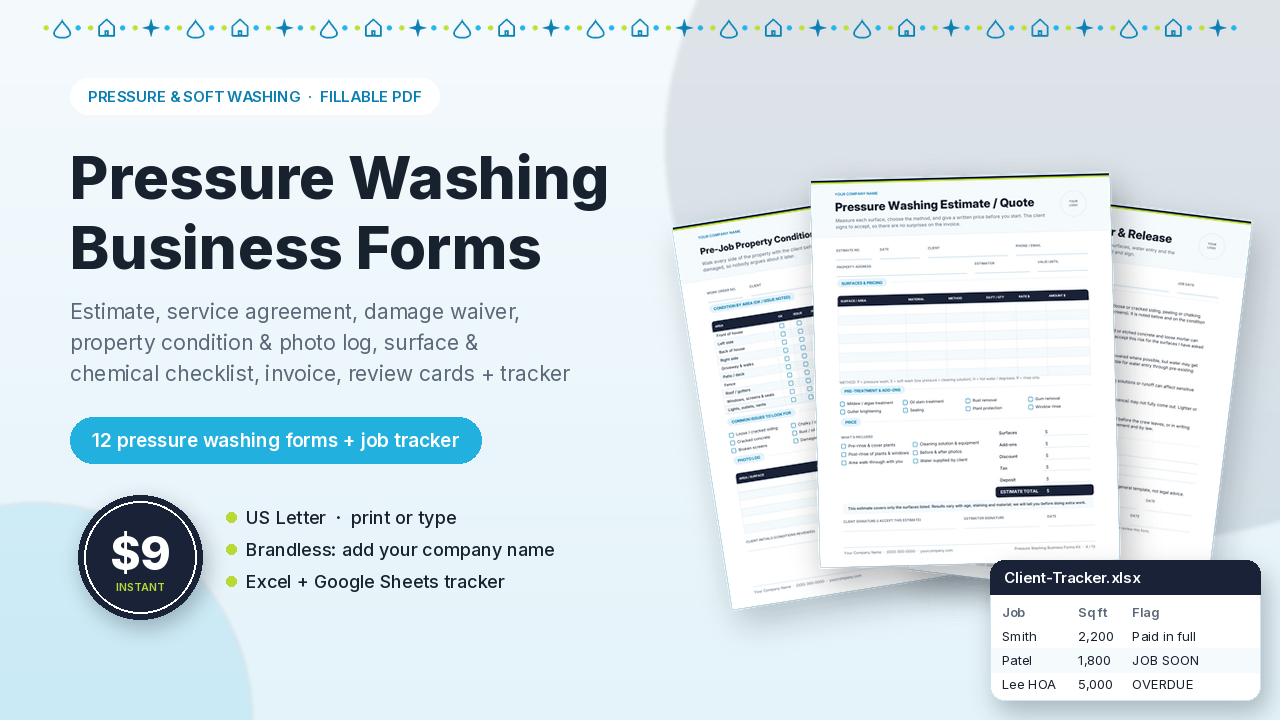
Pressure Washing Business Forms Kit
Fillable pressure washing business forms (client intake, estimate, service agreement, property waiver, pre-job walkthrough, job checklist, invoice and more) plus an Excel client and job tracker.
Get it →5. Set a minimum charge, deposits and payment terms
Every job carries fixed costs: driving, setup, fuel and cleanup. A minimum job charge makes sure a small patio still covers them. For larger jobs, many operators take a deposit to hold the date, and state payment terms clearly: when the balance is due, accepted payment methods and late fees. Add a weather policy (rain or freezing temperatures move the date, not the price) and a cancellation notice period.
6. Worked example (example numbers only)
Here is how a quote comes together. The rates below are example numbers to show the math, not recommended prices for your market:
- Concrete driveway, 20 ft x 40 ft = 800 sq ft at an example rate of $0.20 = $160
- Front walkway, 4 ft x 30 ft = 120 sq ft at $0.20 = $24
- Single-story house soft wash, flat example rate = $250
- Oil stain pre-treatment add-on = $25
- Subtotal = $459 (above the example $150 minimum, so the minimum does not apply)
Research what operators in your area charge, track how long each job actually takes, and adjust your rates until your effective hourly pay covers your costs and goals.
7. Put it in writing
A written estimate and service agreement protect you and the customer. Include the surfaces and measurements, the price and add-ons, the minimum charge, deposit and payment terms, the weather and cancellation policy, and a property waiver covering pre-existing damage, loose paint, oxidized siding, plants and water intrusion around old windows and doors. Do a pre-job walkthrough and photograph existing damage before you start. Then follow up after the job for a review and a repeat booking, since many homeowners need cleaning every year.
Common pricing mistakes
- Quoting without measuring
- Using the same rate for concrete, wood and siding
- No minimum charge on small jobs
- Not charging more for heavy staining or first-time cleans
- Skipping the written waiver and walkthrough photos
- Never raising prices once you are busy
FAQ
How do you price pressure washing jobs?
Measure each surface, apply a rate for that surface type (concrete, siding, wood), adjust for condition and access, itemize add-ons, and apply a minimum job charge. Many operators turn those numbers into flat rates for common residential jobs.
Should I charge per square foot or a flat rate?
Per square foot is fair and scales to any size job; flat rates are faster to quote and easier for homeowners. A common approach is to build flat rates from your per-square-foot numbers and keep hourly pricing for unusual work.
Do you charge more for house washing than driveways?
Usually priced differently. House siding is normally soft washed with cleaning solution at low pressure and is priced by footprint and number of stories, since height adds time and safety work.
What is a minimum charge in pressure washing?
A minimum charge is the lowest price you accept for any job so that driving, setup, fuel and cleanup are covered even on small jobs like a single patio.
Should I take a deposit for pressure washing?
Many operators take a deposit for larger jobs or commercial work to hold the date, and collect the balance on completion. State this, plus weather and cancellation rules, on the written agreement.
What should a pressure washing estimate include?
Surfaces and measurements, price per item and add-ons, the minimum charge, deposit and payment terms, weather and cancellation policy, and a property waiver for pre-existing damage.
This page is general guidance, not legal, tax or insurance advice. Licensing, insurance, water runoff and contract rules vary by state and city and change over time, so check yours before you take jobs.
Related templates
Free Pressure Washing Forms
A printable estimate form plus a simple service agreement for pressure washing and soft washing jobs.
Download free →Pressure Washing Business Forms Kit
Fillable pressure washing forms plus an Excel tracker for clients, jobs, invoices and follow-ups.
Get it →