How Much to Charge for Painting: Price per Square Foot, by Room or by the Hour (Plus Free Estimate Forms)
How to price interior and exterior painting jobs: find your target hourly rate, measure square footage, choose per-square-foot, per-room or hourly pricing, add prep, materials and deposits, with a worked example and free printable estimate forms.
Why painting jobs are easy to underprice
Rolling paint on a wall is the fast part. Moving furniture, masking, patching, caulking, priming, cutting in, cleanup, paint runs and the final walkthrough all take time that clients never see. Painters who guess a number after a quick look often finish the job and realize they earned far less per hour than planned. A repeatable method fixes that: know what each working hour must earn, measure the job, choose a pricing model, and price prep and materials separately.
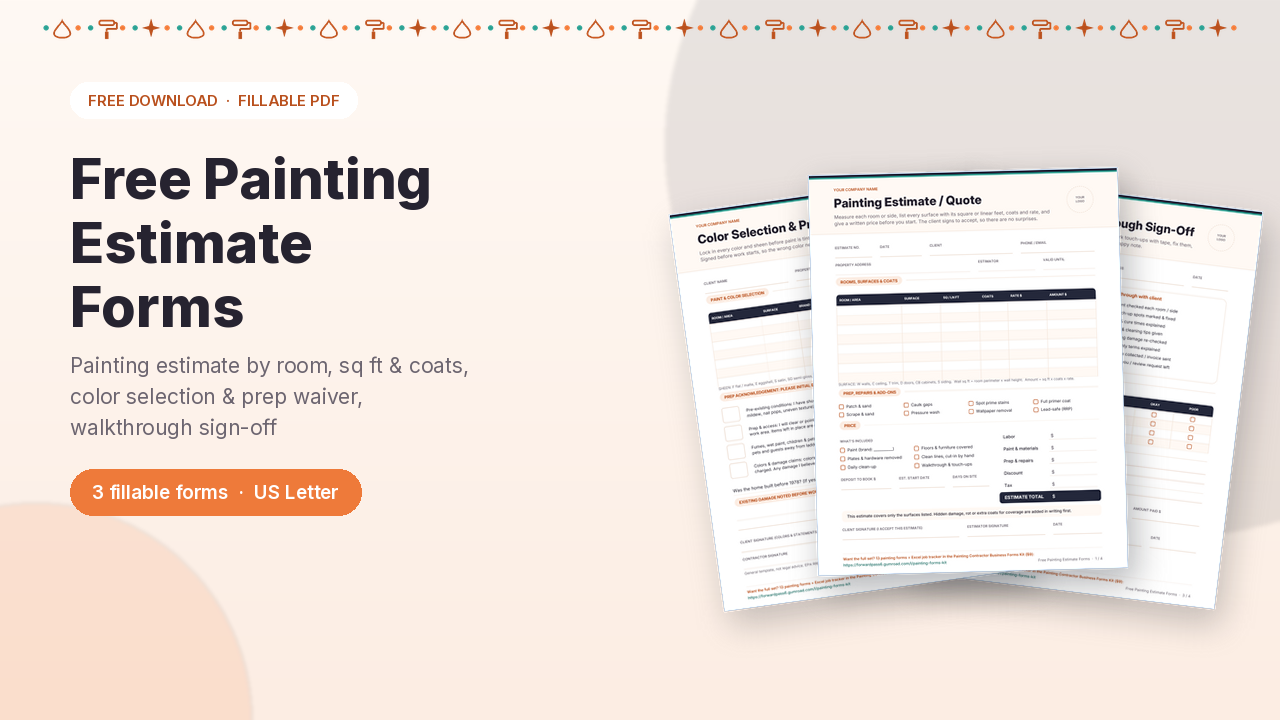
Free Painting Estimate Forms
A free fillable painting estimate / quote sheet with room-by-room sq ft and coats pricing rows, a paint & color selection sheet with prep and liability waiver, and a job completion walkthrough sign-off.
Download free →1. Work out your target hourly rate
List your yearly business costs: the pay you want, liability insurance, any license or registration fees, ladders, sprayers, brushes and rollers, drop cloths, your vehicle, marketing, software, card fees and money set aside for taxes. Estimate how many billable hours you can realistically work in a year after weather, travel, estimates and slow months. Divide costs by billable hours to see what each hour on a job must clear. If you run a crew, add wages, payroll costs and supervision time.
2. Measure the job properly
- Walls: perimeter of the room times wall height, minus large openings such as wide doorways and big windows
- Ceilings: length times width
- Trim and baseboards: linear feet
- Doors, cabinets and windows: count them and price each one
- Exterior: wall area of each side, plus fascia, soffits, shutters and decks as separate line items
Write down the surface, current condition, color change and number of coats for each area. A dark-to-light change or fresh drywall usually needs primer plus two coats.
3. Pick a pricing model
- Per square foot: the most common way to quote walls and ceilings, and easy for clients to compare. Use separate rates for walls, ceilings and exteriors.
- Per room: simple flat prices for standard rooms such as a bedroom, bathroom or living room, with add-ons for ceilings, trim, doors and high walls.
- Hourly plus materials: useful for small jobs, touch-ups and repair-heavy work where scope is hard to predict. Set a minimum charge.
- Per item: doors, cabinet doors, shutters, railings and window frames are easier to price one by one.
Whatever model you quote, check it against your hourly target by estimating how many hours the job will really take.
4. Add prep, materials and job factors
Price prep as its own line: patching and sanding, caulking, spot priming or full priming, scraping, pressure washing, wallpaper removal and furniture moving. Add paint and supplies at your cost plus a markup, using about one gallon per 350 to 400 square feet per coat as a rough planning number and checking the label for the product you use. Adjust for high ceilings and stairwells, heavy furniture, occupied homes, textured or damaged surfaces, many colors, accent walls, travel distance and rush dates. Homes built before 1978 may need lead-safe work practices, which take extra time and training, so ask about the build year at the estimate.
5. Put deposits, changes and payment in writing
Use a written estimate that lists every room, surface, coat count and prep item, then a signed agreement before you start. A deposit to book the start date and cover materials is common, with the balance due at the final walkthrough. Add a change order step for extra rooms or color changes, state how many touch-ups are included, and note how long the estimate is valid. Clear paperwork prevents most scope arguments and makes you look more professional than painters who quote on a text message.
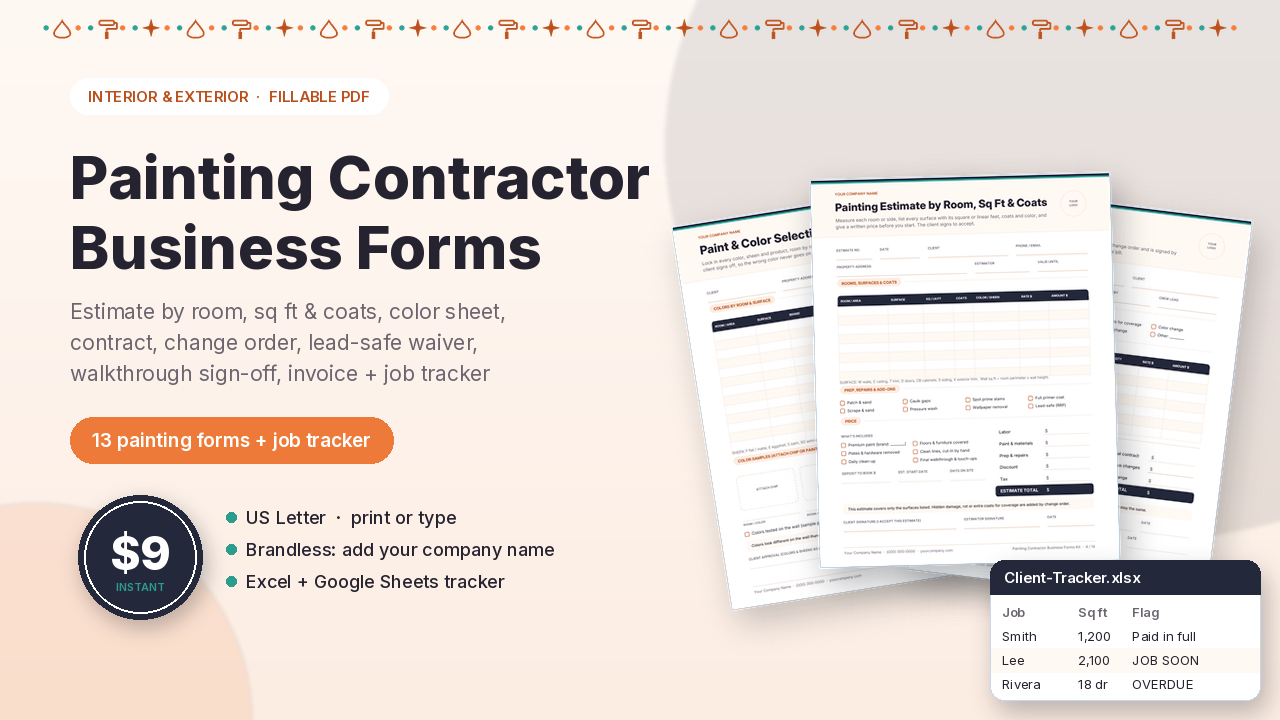
Painting Contractor Business Forms Kit
A 14-page fillable PDF with 13 forms (inquiry and site visit, pricing worksheet, estimate by room, sq ft and coats, paint and color selection sheet, materials list, prep checklist, painting contract, change order, lead-safe and liability waiver acknowledgement, walkthrough sign-off, invoice, touch-up and warranty log) plus an Excel job tracker that prices by the square foot and shows costs and profit.
Get it →Worked example (example numbers only)
Say a painter needs $55 per billable hour. A 12 by 14 foot bedroom with 8-foot walls has 52 feet of perimeter, so about 416 square feet of wall, or roughly 380 square feet after subtracting a door and window. Two coats of a light color plus ceiling and trim are estimated at 9 hours including masking, patching, cutting in and cleanup, which is $495 in labor. Two gallons of wall paint, one of ceiling paint and a quart of trim paint plus tape and patch might cost $130, marked up 15 percent to about $150. The quote comes to about $645, or roughly $1.70 per square foot of wall, with a 30 percent deposit and the balance due at the walkthrough. Use your own costs and local market prices.
Common pricing mistakes
- Quoting from a glance instead of measuring each room
- Leaving out prep, priming and repairs
- Not charging more for ceilings, trim, doors and high walls
- Underestimating paint for color changes and porous surfaces
- Starting without a deposit or a signed estimate
- Doing extra rooms or color changes without a change order
FAQ
How much should a painter charge per square foot?
Start from what you need per billable hour, estimate how long a typical room takes including prep, and divide the price by the wall area. Check local painting companies so your rate fits your market, and use separate rates for walls, ceilings and exteriors.
Is it better to charge per room or per square foot?
Per-square-foot pricing is more accurate for unusual rooms and exteriors, while per-room pricing is simpler for standard bedrooms and bathrooms. Many painters quote per room but check the price against square footage and hours.
Should painters charge for paint separately?
Many do, either as a separate materials line or built into the square foot rate. Listing paint and supplies separately makes it easier to adjust for premium paint or color changes.
How do I estimate how much paint a job needs?
Measure the paintable area, then use the coverage on the product label, often around 350 to 400 square feet per gallon per coat, and multiply by the number of coats. Add extra for primer, textured walls and dark-to-light changes.
How much deposit should a painter take?
A deposit to hold the start date and cover materials is common, often 20 to 50 percent depending on local rules, with the balance due at completion. Some areas limit contractor deposits, so check the rules where you work.
Do painters charge for estimates?
Most residential painters give free estimates, while some charge a small fee for long trips or detailed color consultations and credit it to the job if hired.
This page is general guidance, not legal, tax or business advice. Licensing, deposit limits, lead-safe rules and tax rules vary by location, so check the rules where you work.
Related templates
Free Painting Estimate Forms
A free fillable painting estimate / quote sheet with room-by-room sq ft and coats pricing rows, a paint & color selection sheet with prep and liability waiver, and a job completion walkthrough sign-off.
Download free →Painting Contractor Business Forms Kit
Fillable estimate by room and sq ft, color selection sheet, contract, change order, lead-safe waiver and invoice plus an Excel job tracker.
Get it →