House Painting Client Questionnaire: What to Ask Before You Estimate
A practical guide for residential painters and small painting crews: the questions to ask every homeowner before the site visit, how to turn the answers into an accurate estimate and schedule, and the forms to have ready when the job is booked.
Why every painting job should start with a client questionnaire
Most painting jobs that lose money were priced on a guess. The homeowner said "just the living room," and it turned out to include a two-story stairwell. The walls looked fine in the photos, but in person they were covered in nail holes, water stains and peeling patches. The client wanted to "freshen things up" and then picked a deep red over old beige that needed three coats. A short questionnaire, sent before you drive out for the site visit, catches most of these surprises while they are still easy to price.
It also saves you wasted trips. Some inquiries are not a fit: the budget is far below what the job needs, the timeline is impossible, or the client really needs drywall repair before any paint goes on. A few written answers tell you which leads deserve an in-person estimate. And homeowners comparing three painters tend to trust the one who asks clear, organized questions. Below are the sections to include, the questions in each, and how to turn the answers into an estimate.
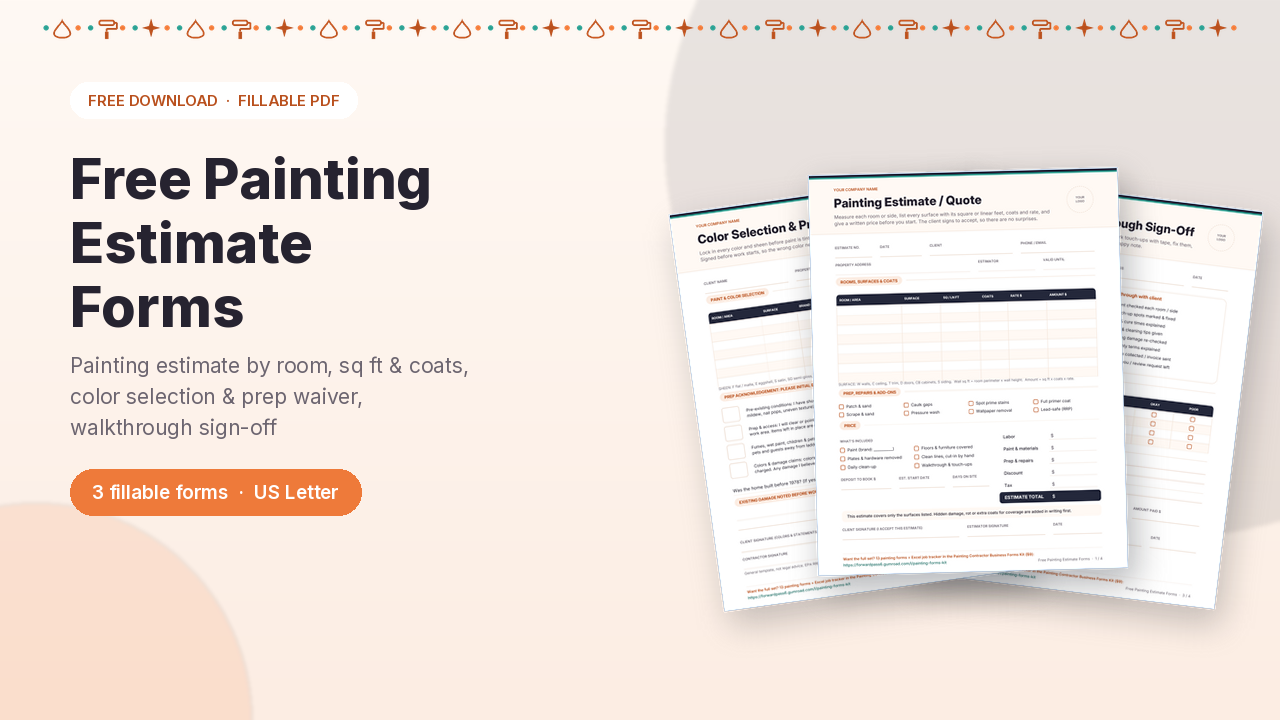
Free Painting Estimate Forms
A free fillable painting estimate / quote sheet with room-by-room sq ft and coats pricing rows, a paint & color selection sheet with prep and liability waiver, and a job completion walkthrough sign-off.
Download free →Section 1: Contact and property details
- Client full name, phone number and email address
- Preferred contact method and the best times to reach them
- Property address, and whether they own the home or rent it
- If renting or in a condo or HOA: who must approve the work and the colors
- Type of property: single-family house, townhouse, condo, apartment, small office
- Approximate size of the home and the number of stories
- Who will be the main contact during the job, and who is paying
- How they found you, and whether they have had the home painted before
Ownership matters more than many painters realize. A tenant may not have permission to paint at all, and condo or HOA rules often limit exterior colors or work hours. Ask early so you do not estimate a job that cannot be approved.
Section 2: Scope: interior, exterior or both
Scope is the biggest driver of your price, and it is where vague answers cost the most. Ask:
- Interior, exterior or both
- For interior: which rooms, hallways, stairwells and closets are included
- Which surfaces in each room: walls, ceilings, trim and baseboards, doors and frames, windows, cabinets
- For exterior: siding, trim, soffits and fascia, doors, shutters, garage door, porch, deck or fence
- Ceiling heights, especially vaulted ceilings, stairwells and two-story entryways
- Whether any specialty work is wanted: cabinet refinishing, accent walls, murals, stripes or wallpaper removal
- Anything they are unsure about, so you can price it as an option
A simple room list helps. Ask the client to fill in one line per room with the surfaces they want painted. You will still measure on site, but you arrive knowing what to look at, and the client has already thought about what is in and out of the job. Price extras like closets and cabinet interiors as separate line items so they are easy to add or remove.
Section 3: Surfaces and current condition
Condition decides how much prep the job needs, and prep is where most time goes. Ask the client to describe, and ideally photograph:
- Current wall and trim condition: good, a few nail holes, cracks, peeling, water stains, smoke or grease
- Any drywall damage, patches or texture that needs to be matched
- For exterior: peeling, chalking, mildew, bare wood, rot, gaps around windows and trim
- Current colors and sheens, and whether the existing paint is oil-based or latex, if they know
- Whether anyone smokes indoors, or there has been a kitchen fire or water leak
- When the home was last painted
| Condition reported | What it usually means for the estimate (example only) |
|---|---|
| A few nail holes, clean walls | Light patching; standard prep time |
| Water stains or smoke | Stain-blocking primer before finish coats |
| Peeling or flaking paint | Scraping, sanding and spot priming; more labor |
| Exterior mildew or chalking | Washing and drying time before painting |
| Rotted trim or siding | Repair or replacement priced separately, or referred out |
| Very dark color to light (or the reverse) | Primer and possibly an extra coat |
Photos are not a replacement for a site visit, but they let you flag big prep items before you quote and decide whether the job is a fit.
Section 4: Home age and lead paint
Always ask what year the home was built. In the United States, homes built before 1978 may contain lead-based paint. Work that disturbs painted surfaces in those homes, such as sanding or scraping, may fall under the EPA's Renovation, Repair and Painting (RRP) rule, which has requirements for certification, lead-safe work practices and giving the homeowner certain information before work starts. Your state or local rules may add more.
- Year the home was built, or best estimate
- Whether the home has been tested for lead, and the results if available
- Whether young children or pregnant people live in or regularly visit the home
- Whether any rooms will be occupied during the work
Keep this section factual. You are recording information that affects how you plan and price the work, not giving legal or health advice. Check the current requirements for your area, and if lead-safe work is required, build the extra setup, containment and cleanup time into your price.
Section 5: Colors, sheens and products
Color decisions cause more delays and redo requests than almost anything else. Ask:
- Whether colors are already chosen, with brand, color name and code if known
- Whether they want help choosing, or a color consultation
- Sheen preferences for walls, ceilings, trim and doors (flat, matte, eggshell, satin, semi-gloss)
- Whether they want sample patches on the wall before deciding
- Any preference for low-odor or low-VOC paint, or a specific brand or product line
- For exterior: HOA color approval, and whether the approval is already in hand
- Who gives the final color approval if more than one person lives in the home
Set a deadline for final colors, usually a few days before the start date, and record the final choices on a signed color selection sheet. That sheet is your protection if someone later says "that is not the color we picked." A big color change, especially dark to light, should be flagged in the estimate because it can mean more primer and extra coats.

Painting Contractor Business Forms Kit
A 14-page fillable PDF with 13 forms (inquiry and site visit, pricing worksheet, estimate by room, sq ft and coats, paint and color selection sheet, materials list, interior and exterior prep checklist, painting contract, change order, lead-safe and liability waiver acknowledgement, walkthrough sign-off, invoice, touch-up and warranty log, review and referral cards) plus an Excel job tracker that prices by the square foot and shows costs and profit.
Get it →Section 6: Prep, furniture and access
Who does what before the crew arrives should be clear in writing. Ask:
- Whether the client will move furniture, or expects your crew to move and cover it
- Items that should not be moved: pianos, large electronics, antiques, heavy cabinets
- Whether wall hangings, curtains, outlet covers and fixtures will be removed by them or by you
- Access to the home: who will let the crew in, keys, lockbox or alarm codes
- Parking for your vehicle and where materials can be stored overnight
- Pets and children at home during work hours, and any areas that must stay usable
- Water and power access for exterior work, and any landscaping to protect
Furniture moving and removal of fixtures take real time. If you include them, price them. If the client handles them, say so in the estimate and the contract.
Section 7: Schedule and budget
- Preferred start date and any hard deadline, such as a move-in, sale, holiday or event
- Days and hours when work is allowed, including HOA or building rules
- Whether the home will be occupied during the work
- For exterior: flexibility for weather delays
- A budget range, even a rough one
- Whether they want options, such as a good / better / best paint choice or a phased plan
Budget questions feel awkward, but a range saves both sides time. If the client hopes to paint a full two-story exterior for a fraction of what it costs, it is better to know before the site visit. You can offer a phased plan, such as front and sides this year and the rest next season.
Section 8: Policies preview
Show your main policies in the questionnaire so there are no surprises when the contract arrives. Keep the wording short and fill in your own terms. The table below uses bracketed placeholders only; it is not recommended wording.
| Policy | What to show (placeholders) |
|---|---|
| Deposit | A deposit of [amount or %] is due to schedule the start date. |
| Payment schedule | [Progress payment terms]; final balance due [when]. |
| Color changes | Color changes after [date or stage] are billed as [policy]. |
| Change orders | Work not in the estimate requires a signed change order; [pricing basis]. |
| Hidden damage | Damage found during prep (such as rot) is [how it is handled and priced]. |
| Weather (exterior) | Weather delays reschedule the work; [policy]. |
| Cancellation | If the client cancels [timeframe], [what happens to the deposit]. |
| Touch-ups and warranty | Touch-ups within [period]; workmanship warranty of [terms]. |
The policies themselves belong in a signed painting contract. The questionnaire just previews them so the homeowner is not surprised later.
Turning the answers into an estimate
With a completed questionnaire and a site visit, you can write an itemized estimate quickly. The example below is for illustration only. The prices are placeholders; set your own based on your costs, market and experience.
| Questionnaire answer | How it affects the estimate (example only) |
|---|---|
| Living room, hall and stairwell: walls, ceilings, trim | Measure each area; price by sq ft or by room, e.g. $[rate] per sq ft |
| Stairwell ceiling about 18 ft | Extra ladder or plank setup; add $[setup fee] or hours |
| Water stain on ceiling | Stain-blocking primer line item |
| Beige to deep navy accent wall | Primer plus extra coat; $[accent wall rate] |
| Home built 1965 | Check lead requirements; add lead-safe setup and cleanup if needed |
| Client moves furniture | No moving fee; note it in the estimate |
| Must finish before [move-in date] | Confirm crew size and schedule; rush fee if applicable |
Send the estimate with a short summary of the plan: start date, how many days the work should take, what prep is included and what the client needs to do before day one. A homeowner who can see the plan is more likely to sign quickly than one who only sees a total.
Common mistakes to avoid
- Estimating from a phone call. "Just a couple of rooms" rarely is. Get the room list and photos first.
- Not asking the year the home was built. Lead requirements change how you work and what it costs.
- Leaving prep vague. Spell out patching, priming, scraping and caulking so the client knows what is included.
- No color deadline. Late color decisions stall the schedule and lead to redo requests.
- Ignoring who moves the furniture. Decide it in writing before the crew arrives.
- Skipping HOA and landlord approvals. An unapproved exterior color can mean repainting at your cost or a canceled job.
- Starting without a signed contract and deposit. A date is only booked once both are in.
One-page painting client questionnaire checklist
- Contact details, main contact and who is paying
- Property address, type, size, stories and ownership
- HOA, condo or landlord approval needed, and status
- Interior, exterior or both, with a room and surface list
- Ceiling heights and specialty work
- Current condition and photos of problem areas
- Year built, lead test results and who is in the home
- Colors, sheens, products and the color deadline
- Furniture, fixtures and who handles prep
- Access, parking, pets and working hours
- Start date, deadline and budget range
- Deposit, payment, change order and cancellation policies acknowledged
Send the questionnaire as soon as a homeowner asks for a quote, review it before the site visit, and keep it with the estimate, color selection sheet and signed contract for every job.
FAQ
What should a painter ask a client before giving an estimate?
Ask which rooms and surfaces are included, ceiling heights, the current condition of walls and trim, the year the home was built, color and sheen choices, who handles furniture and prep, access and working hours, the timeline and a budget range.
Can I give a painting estimate from photos alone?
Photos help you screen the job and spot big prep items, but most painters still measure on site before giving a firm price. You can offer a rough range from photos and confirm it after the visit.
Why ask what year the house was built?
In the United States, homes built before 1978 may contain lead-based paint, and work that disturbs painted surfaces may be covered by the EPA Renovation, Repair and Painting rule. The answer affects how you work and what you charge, so check the rules that apply in your area.
Should the questionnaire ask about budget?
Yes, a rough range is enough. It helps you decide whether a site visit makes sense and lets you offer options, such as a phased plan or a different paint line, instead of a single take-it-or-leave-it price.
Is a client questionnaire the same as a painting estimate?
No. The questionnaire collects information about the job. The estimate is your priced proposal based on those answers and the site visit. The signed contract then sets the terms.
When should colors be finalized?
Set a firm deadline before the start date, often a few days ahead, and record the final colors and sheens on a signed color selection sheet. Treat later changes as change orders.
This page is general information for painting contractors, not legal, safety or health advice. Rules on contracts, deposits, consumer protection, licensing, lead-safe work practices and insurance vary by location. Check the current requirements that apply to you and have your own forms and contract reviewed.
Related templates
Free Painting Estimate Forms
A free fillable painting estimate / quote sheet with room-by-room sq ft and coats pricing rows, a paint & color selection sheet with prep and liability waiver, and a job completion walkthrough sign-off.
Download free →Painting Contractor Business Forms Kit
Fillable inquiry and site visit form, estimate by room and sq ft, color selection sheet, contract, change order and invoice plus an Excel job tracker.
Get it →