How to Price Holiday Cookies and Cookie Boxes: Per Dozen Pricing, Pre-Order Deadlines and Pickup Slots (Plus a Free Order Form)
How home bakers and cottage food sellers can price Christmas cookies, decorated sets and holiday cookie boxes: cost out ingredients and packaging, price per dozen and per box, set a pre-order deadline and pickup slots, take deposits, and handle allergens and labels, with a worked example and a free printable order form.
Why holiday cookie orders lose money
December is the busiest month of the year for many home bakers, and also the month where it is easiest to work for free. Orders arrive by text, message and phone at the same time. Prices get copied from last year or from a big-box bakery. A "dozen decorated cookies" is quoted the same whether it takes twenty minutes or three hours of piping. Then come the last-minute changes, the customer who never picks up, and the butter and packaging bills that quietly doubled. A simple system fixes most of this: cost out every item, price per dozen and per box from real numbers, close orders on a set date, give every customer a pickup slot, and take a deposit before you bake.
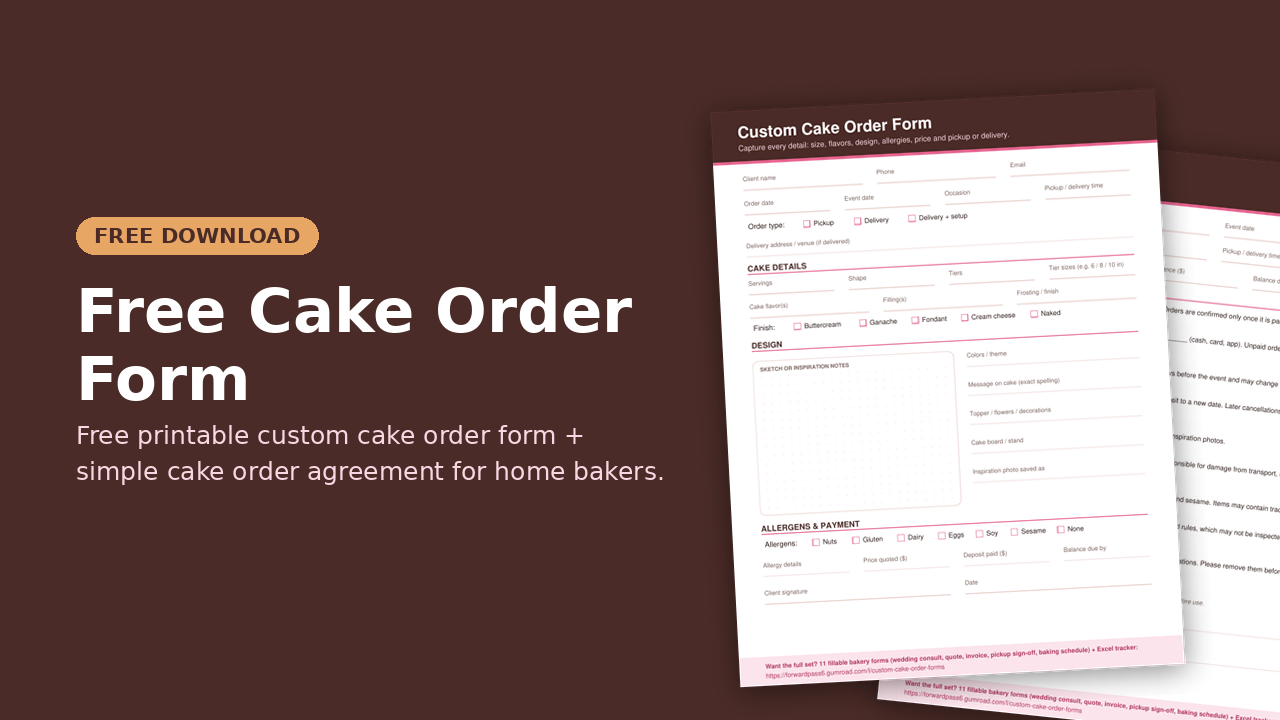
Free Cake and Cookie Order Form
A printable order form for home bakers: customer and pickup details, flavors, design, allergens, price, deposit and balance due.
Download free →1. Cost out ingredients, packaging and your time
For each cookie on your holiday menu, write down what one batch uses and what you paid: flour, sugar, butter, eggs, chocolate, spices, sprinkles, meringue powder and food coloring. Divide by the number of cookies the batch actually makes, not the number the recipe promises. Then add packaging, which is often the surprise cost at Christmas: boxes, liners, bags, ribbon, stickers, labels and gift tags can cost as much as the cookies inside a small box. Finally, add your time. Count mixing, chilling, baking, cooling, decorating, drying, packing and cleanup, and multiply by an hourly rate you would be happy to work for. Decorated sugar cookies take far more time than drop cookies, so they must cost far more. A small share of overhead (electricity, card fees, a permit or license, your booking tools) rounds out the true cost.
2. Price per dozen and per box
Most holiday buyers think in dozens and boxes, so price that way. Start with the cost per dozen from step 1, then add a markup that leaves you a real profit; many bakers aim for a price well above cost so that a slow week or a ruined batch does not wipe out their margin. Keep separate prices for simple cookies (chocolate chip, snickerdoodles, gingersnaps), specialty cookies (filled, dipped or layered bars) and decorated cookies, which are often priced per cookie or per set because the design time varies. For cookie boxes, build two or three fixed sizes, such as a small gift box, a family box and a party tray, each with a set mix of cookies. Fixed boxes are faster to bake, easier to pack and easier for customers to choose. List what is inside each box and how many pieces, so customers can compare value at a glance.
3. Check local prices, then position yourself
Look at the holiday menus local bakeries, farmers market sellers and other home bakers publish on their websites and social profiles. Note what a dozen simple cookies, a dozen decorated cookies and a holiday box sell for, and what size each box is. Compare like with like: a hand-piped custom set is not the same product as a grocery store tray. If local prices sit below your cost, do not simply match them. Raise the value instead with better packaging, a gift tag, a smaller and more special menu, or a decorated set people cannot get elsewhere. Holiday buyers are often buying gifts, and gift buyers care more about presentation and reliability than the lowest price.
4. Set a pre-order deadline and pickup slots
A pre-order deadline is the single most useful rule in holiday baking. Announce your menu early, close orders on a fixed date (for example a week or more before your main pickup days), and do not take orders after that unless you have capacity left. The deadline lets you buy ingredients in bulk, plan bake days and stop orders before you are overbooked. Then give every order a pickup slot: a date and a time window, such as 30-minute or one-hour blocks. Slots stop the whole town arriving at 5 p.m. on Christmas Eve, keep your kitchen and driveway manageable, and make no-shows obvious. Keep a pickup-day sheet listing each slot, customer, order number, items and whether it is paid and picked up.
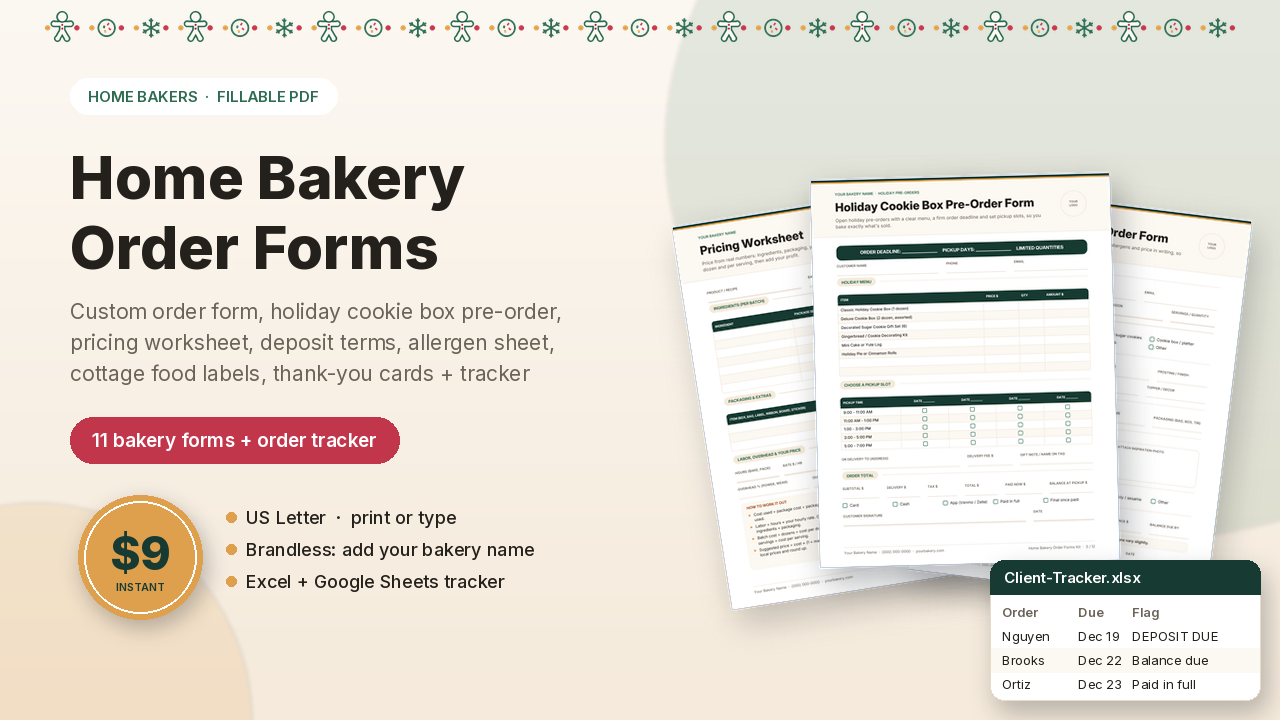
Home Bakery Order Forms Kit
11 fillable forms (custom cake and cookie order form, holiday cookie box pre-order form with deadline and pickup slots, holiday pickup schedule, pricing worksheet with cost per dozen, deposit and order terms, allergen disclosure, cottage food label template, pickup confirmation, invoice and review cards) plus an Excel order tracker with deposits, balances and profit per order.
Get it →5. Take deposits and set clear order terms
Holiday orders tie up ingredients, packaging and oven time that you cannot sell to anyone else. Many home bakers ask for full payment or a deposit at the time of order for holiday boxes, and a deposit for large or custom decorated orders, with any balance due before or at pickup. Write down your terms: when payment is due, the last day for changes, what happens if an order is cancelled, how long you hold an order after a missed pickup, and that hand-decorated designs may vary slightly from photos. Ask customers to agree to the terms when they order. Clear terms are easier to enforce and make customers trust you more, not less.
6. Allergens, labels and cottage food rules
Holiday cookies often contain several major allergens at once: wheat, milk, eggs, tree nuts, peanuts, soy and sesame are common. Tell customers which allergens are in each item, and whether others are used in the same kitchen. In the United States, many states let home bakers sell certain baked goods under cottage food laws, but the rules vary a lot from state to state: some require a permit or registration, a sales limit, a label with the product name, ingredients, allergens and a "made in a home kitchen" statement, or limits on where and how you sell. Check your state and local rules before you sell, and keep your labels consistent across every box.
7. Plan your bake schedule and capacity
Before you open orders, decide how many dozens and boxes you can realistically make on each bake day, and cap your orders at that number. Work backwards from pickup days: which doughs can be made and frozen early, which cookies keep well for several days, and which must be baked close to pickup. Decorated cookies need drying time, so schedule them earliest. When you hit your cap, close the menu or open a waitlist. Selling out is better than baking until 3 a.m. and missing pickups.
Worked example (example numbers)
These are example numbers to show the method, not a recommended price. Say a batch of sugar cookie dough makes 36 cookies and the ingredients cost $9, so about $3 per dozen. Royal icing and sprinkles add $2 per dozen. A box, liner, ribbon and label add $3.50. Simple decorating takes about 1.25 hours per dozen including baking, packing and cleanup, and you value your time at $20 an hour, so labor is $25. Add $1 of overhead and the cost of a dozen decorated cookies is about $3 + $2 + $3.50 + $25 + $1 = $34.50. Pricing at $45 to $48 a dozen leaves room for profit and the odd broken batch. A family box of 18 mixed simple cookies might cost $14 in ingredients, packaging and time, and sell for $24 to $28. If your local market cannot support those numbers, simplify the designs or the box rather than cutting your hourly rate.
Put every order in writing
Most holiday cookie problems start with an order that only lives in a message thread: the wrong pickup day, a missed allergy, a box size nobody agreed on, or a deposit the customer thought was refundable. A written order form records the customer, pickup slot, items and quantities, allergens, price, deposit and balance. A pre-order form with your menu, deadline and pickup grid makes taking holiday orders fast, and a pickup schedule keeps the busiest days calm. Simple forms make you look professional and protect your time.
FAQ
How much should I charge for a dozen holiday cookies?
Add up ingredients, packaging, your time and a share of overhead for one dozen, then add a markup that leaves a real profit. Decorated cookies take more time, so they should cost noticeably more than simple drop cookies. Compare with local bakers before you set your final menu.
Should I price decorated cookies per cookie or per dozen?
Either works. Many bakers price simple designs per dozen and detailed or custom designs per cookie or per set, because decorating time varies so much from design to design.
When should I close holiday cookie pre-orders?
Pick a fixed deadline that leaves time to buy supplies and plan bake days, often a week or more before your main pickup days, and stop taking orders once you reach your capacity.
Should I take a deposit for holiday cookie orders?
Many home bakers ask for full payment or a deposit when the order is placed, because holiday orders tie up ingredients and oven time. Write down your payment, change and cancellation terms.
How do pickup slots help?
Assigning each order a date and time window spreads out pickups, keeps your kitchen and driveway manageable, and makes it easy to see who has and has not collected their order.
Do I need a license to sell cookies from home?
It depends on where you live. Many US states allow some home baked goods under cottage food laws, but permits, labels, sales limits and where you can sell vary by state, so check your local rules.
This page is general guidance, not legal, tax or food safety advice. Cottage food, labeling, permit and sales tax rules vary by state and city, so check the rules where you bake and sell.
Related templates
Free Cake and Cookie Order Form
A printable order form for home bakers: customer and pickup details, flavors, design, allergens, price, deposit and balance due.
Download free →Home Bakery Order Forms Kit
Holiday cookie box pre-order form, pricing worksheet, labels and an Excel order tracker with profit per order.
Get it →More free guides
- Holiday Hours Announcement Templates
- Cookie Order Form
- Holiday Cake and Christmas Dessert Pricing
- How Much to Charge for a Cake
- Cake Order Form Template
- How Much to Charge for Catering
- Small Business Expense Categories
- Tax Deductible Business Expenses Checklist for Small Businesses
- Cookie Pricing
- Cupcake Pricing