Holiday Cake & Christmas Dessert Order Pricing for Home Bakers (Plus Free Order Form)
How home and cottage bakers can price Christmas cakes and holiday desserts: holiday tiers vs normal rates, per-serving pricing, holiday flavor and decor add-ons, order cutoffs and peak-date surcharges, December deposits and cancellations, pickup and delivery fees, and cookie box and dessert platter bundles, with a worked example and a free order form.
Why holiday orders need their own price list
For home bakers, December is the busiest month of the year. Customers want yule log cakes, decorated Christmas cakes, cookie boxes for neighbors and teachers, dessert platters for office parties and something special for New Year's Eve, and they want most of it on the same three or four days. Ingredient prices rise, packaging adds up, your oven can only bake so much at once, and every order competes for the same pickup slots on December 23 and 24.
If you price December exactly like a normal month, you work the hardest weeks of the year for the same pay, and you probably take more orders than you can finish well. A holiday price list fixes that. Decide how holiday designs are priced compared with your normal cakes, set per-serving prices, list your holiday add-ons, publish an order cutoff, add a surcharge for peak dates, and write down deposits, cancellation rules and pickup windows. The sections below walk through each one, with a worked example at the end. All numbers on this page are example numbers, not market data.
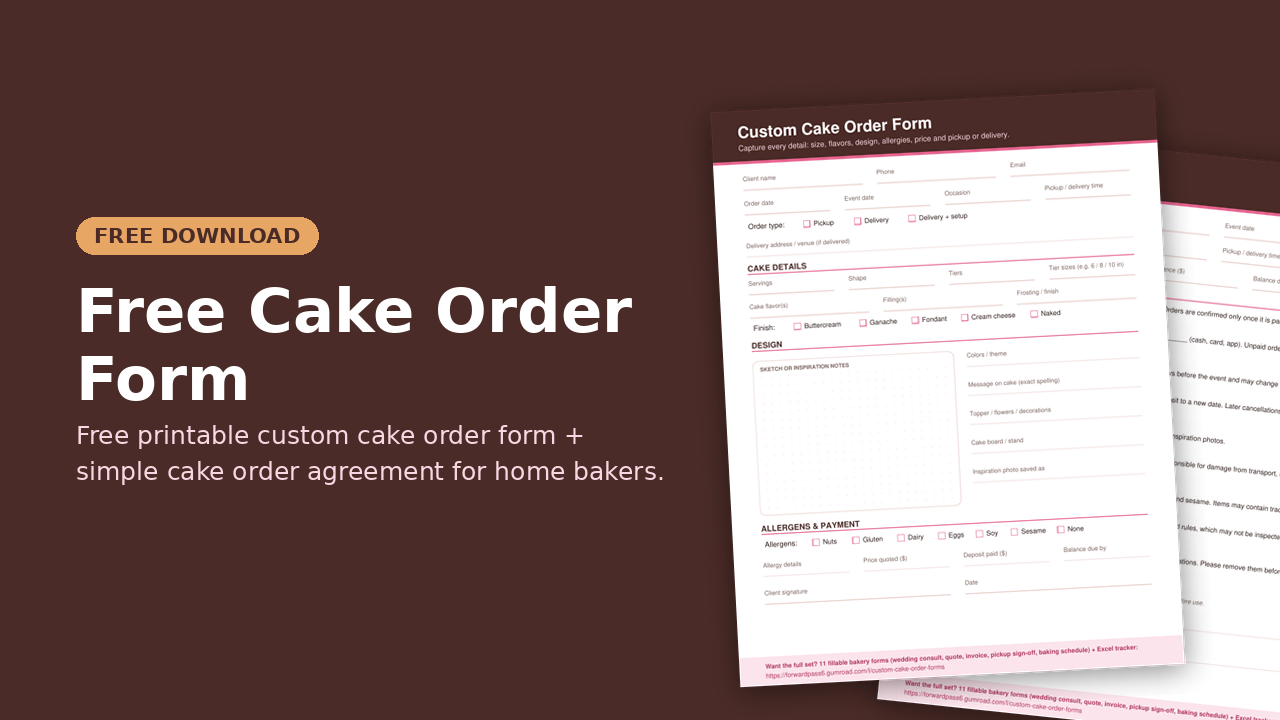
Free Cake Order Form
A free printable custom cake order form with a design sketch box, servings, tiers, flavors, allergens, deposit and balance fields, plus a simple cake order agreement with 9 initialed terms.
Download free →1. Holiday cake tiers vs your normal rates
Keep your normal base price the same, whether you price per serving or by cake size. Then add holiday design tiers on top, so customers can choose quickly and you can plan your decorating time. Tiers are easier to quote than custom prices for every request, and they stop you giving away an extra hour of piping and painting on your busiest days.
- Tier 1: Festive finish. A simple buttercream finish in holiday colors, sprinkles, a piped border and a small topper or greenery accent.
- Tier 2: Holiday design. A themed design such as a snowy village, wreath, ornament or gift box cake, drips, gold leaf touches or a few handmade fondant pieces.
- Tier 3: Showpiece. Fully sculpted or hand-painted designs, multiple fondant figures, sugar flowers, a gingerbread house topper or a matching dessert set for an event.
Show photos of each tier on your order page, and quote anything beyond Tier 3 separately before you accept the order.
2. Per-serving pricing for holiday cakes
Per-serving pricing scales well across sizes and makes quotes easy to explain. Work out your cost per serving (ingredients, boxes, boards and a share of utilities), add your time, and set a base price per serving that covers both. Then multiply by the number of servings and add the holiday tier.
As an example only, a baker might charge $4 per serving for a standard buttercream cake, so a 6-inch cake of about 12 servings starts at $48 and an 8-inch cake of about 24 servings starts at $96. Set a minimum order too, such as one 6-inch cake, so very small orders still cover your time. Bûche de Noël, cheesecakes and specialty desserts can have their own fixed prices instead.
3. Holiday flavors and decor add-ons
Seasonal flavors often cost more to make. Eggnog, gingerbread, peppermint mocha, cranberry orange, chestnut and spiced caramel may need special ingredients or extra steps. Keep a short holiday flavor menu with a small flat add-on per cake, or per serving for large cakes, instead of pricing every flavor differently.
List decor add-ons the same way: edible glitter or gold leaf, fondant toppers, sugar snowflakes, a custom message plaque, sparklers or candles for New Year's Eve, and premium boxes or ribbons. A clear add-on list helps customers upgrade on their own and keeps your quotes consistent.
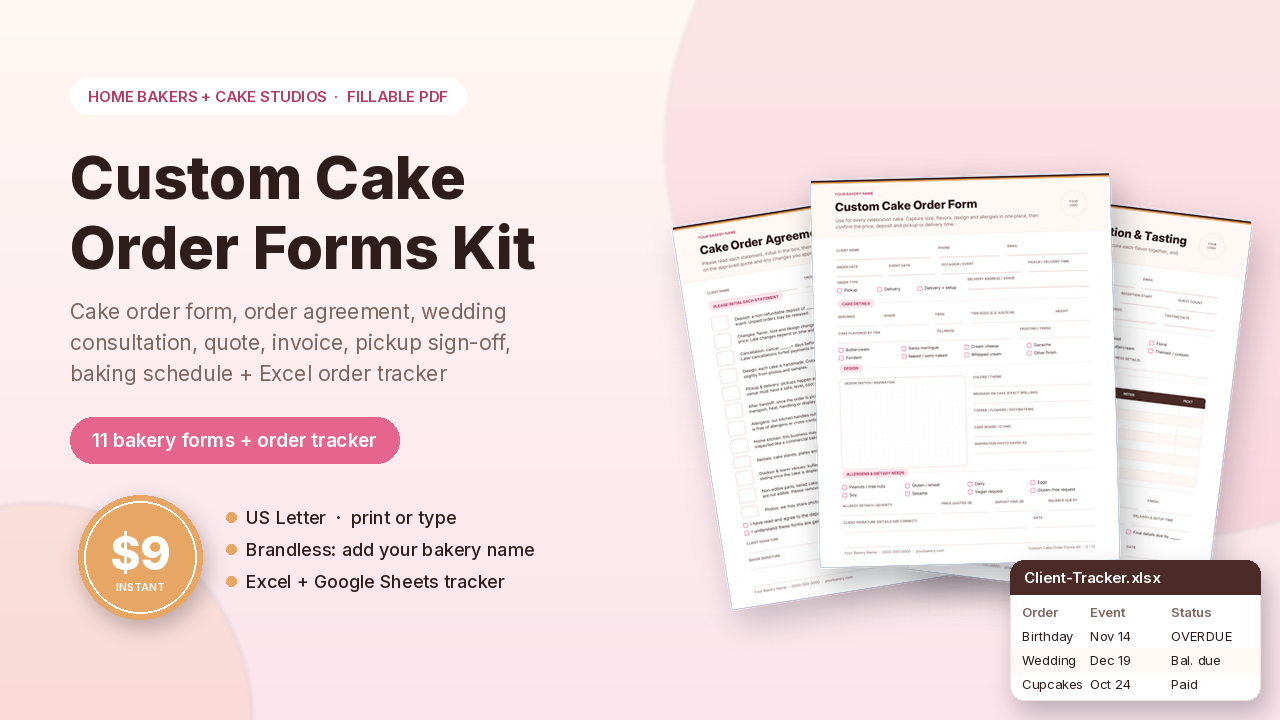
Custom Cake Order Forms Kit for Home Bakers
11 fillable bakery forms (including a custom cake order form, cupcake, cookie and dessert table order, quote and price sheet by servings, order agreement and policies, delivery checklist, pickup sign-off, allergy sheet and invoice) plus an Excel order tracker with deposit, balance and overdue flags. Want every kit? See the bundle.
Get it →4. Order cutoff dates and peak-date surcharges
Your oven, fridge space and decorating hours set a hard limit on December orders. Decide how many cakes, boxes and platters you can make for each pickup day, and stop taking orders once you reach that limit. Publish an order cutoff, such as December 14 for Christmas and December 27 for New Year's Eve, and repeat it in every holiday post.
Not every date is equal. December 23 and 24 and New Year's Eve fill first and are the hardest days to work. A peak-date surcharge is a flat amount added to orders picked up or delivered on those dates. It rewards customers who choose quieter days and pays you a little more for the busiest ones. List the exact dates and show the fee before the customer confirms.
5. Deposits and cancellation rules for December orders
A cancelled holiday order is hard to resell, and you may already have bought the ingredients and boxes. Many bakers take a deposit to hold every December date, or full payment for cookie boxes and platters. State the deposit amount, whether it is refundable, when the balance is due (for example, seven days before pickup), and the last day to change flavors, design or quantity.
Write down what happens if a customer cancels, does not pay the balance on time or does not show up for pickup. For example, the deposit is kept for cancellations inside 14 days, and unclaimed orders are kept until the end of the pickup window only. Put the policy on your order form and have the customer agree before you confirm.
6. Pickup and delivery windows and fees
On peak days, pickups can take over your whole day. Offer set pickup windows, such as 30-minute slots, and limit how many orders fit in each. Ask customers to bring a flat, level spot in the car for cakes, and confirm the slot in writing the day before.
If you deliver, charge a delivery fee by distance or zone, add a setup fee for dessert tables, and limit deliveries on December 24 and 31. Some bakers offer delivery only on quieter days. Check whether your local rules allow delivery for home-baked food.
7. Cookie boxes and dessert platter bundles
Bundles are easy holiday sales. Customers buy cookie boxes for teachers, neighbors and clients, and dessert platters for parties. Offer two or three fixed sizes with fixed contents, such as a small cookie box, a large mixed box and a party platter with cookies, brownies and mini cupcakes. Fixed menus let you bake in batches, and a cake plus a cookie box makes a natural bundle at a small saving. For more detail, see the guide to holiday cookie pricing.
8. Cottage food rules: check your state first
Many home bakers sell under cottage food laws, and those rules differ a lot by state, and sometimes by county or city. They can limit which foods you may sell from home, whether cream cheese frosting, custards or fresh fruit fillings are allowed, how much you can sell in a year, whether you can deliver or ship, and what must be printed on your labels, such as allergens and a home kitchen statement. Some places also require a permit, a food handler course or a sales tax registration. Check your state and local rules before you take holiday orders. This page is not legal advice.
A worked example (example numbers)
Say a home baker charges $4 per serving for a standard cake, with holiday tiers at $10, $25 and $50, a $6 holiday flavor add-on, a $15 peak-date surcharge on December 23, December 24 and December 31, a $10 delivery fee within 5 miles, a 50% deposit on every December order, cookie boxes at $30 (one dozen) and $55 (two dozen), and a party dessert platter at $75.
- Customer A: 8-inch cake (24 servings) + Tier 2 design + eggnog flavor, pickup December 23: $96 + $25 + $6 + $15 = $142, deposit $71
- Customer B: 6-inch cake (12 servings) + Tier 1 finish, pickup December 20: $48 + $10 = $58
- Customer C: two-dozen cookie box + party platter, delivered December 31: $55 + $75 + $15 + $10 = $155
- Teacher gifts: four one-dozen cookie boxes, pickup December 18: 4 x $30 = $120
- Total booked from these orders: $142 + $58 + $155 + $120 = $475
These numbers are examples only, not market data. Use your own costs, local prices and cottage food rules, and time a few holiday designs before December so you know what you really earn per hour on your busiest days.
Before you open holiday orders
Get ready before the requests arrive: an order form with servings, flavors, design notes, allergens, pickup slot, deposit and balance; a holiday price list with tiers and add-ons; photos of each tier; your order cutoffs and peak dates; and your deposit and cancellation policy. Share the menu with past customers first, then open orders to everyone, and you can spend December baking instead of answering the same questions in messages.
FAQ
Should home bakers charge more for Christmas cakes?
Many do, and it is reasonable when the work really is different. Holiday cakes often need extra decorating time, seasonal ingredients and packaging, and December orders squeeze into a few busy days. A common approach is to keep your normal per-serving base price and add clear holiday design tiers and add-ons on top, so regular customers can see exactly what the extra cost covers.
How much should a peak-date surcharge be for Christmas Eve or New Year's Eve orders?
There is no standard amount. Some bakers add a small flat fee to orders picked up on the busiest dates, such as December 23 and 24 and New Year's Eve, and others close those dates to new custom orders once they are full. Any amounts on this page are example numbers, not market data. Choose an amount you can explain, list the exact dates it applies to, and apply it the same way to every customer.
When should my holiday order cutoff date be?
Set it early enough to plan your shopping, baking and decorating days. Many bakers close Christmas orders one to two weeks before December 24 and close New Year's orders a few days after Christmas, or as soon as their order cap is reached. Publish the cutoff in November, repeat it in every post about holiday orders, and stop taking orders once you reach your limit, even if the date has not passed.
Should I take a deposit for December cake orders?
Many home bakers take a deposit or full payment up front for December, because a cancelled holiday order is hard to resell and you may already have bought ingredients. State the deposit amount, when the balance is due, how much notice is needed to change or cancel, and when the deposit is kept. Write it on your order form and have the customer agree before you confirm the order.
How do I price holiday cookie boxes and dessert platters?
Work out the cost and time for each item in the box, add packaging, then price the box as a set menu rather than item by item. Offer two or three fixed sizes, such as a small, medium and large box, with a fixed list of contents. Fixed menus are faster to bake in batches and easier for customers to order, and the bundle price can still be a little less than buying everything separately.
Can I sell holiday cakes from home under cottage food laws?
It depends on where you live. Cottage food rules differ a lot by state, and sometimes by county or city. They may limit which foods you can sell, whether cream cheese or custard fillings are allowed, how much you can sell in a year, whether you can ship or deliver, and what must be on your labels. Check your state and local rules before you take orders. This page is not legal advice.
This page is general guidance, not legal, tax, food safety or insurance advice. Cottage food, labeling, permit, sales tax and consumer rules vary by state, county and city, so check your local rules and have your policies reviewed by an attorney, accountant or insurer.
Related templates
Free Cake Order Form
A free printable custom cake order form with a design sketch box, servings, tiers, flavors, allergens, deposit and balance fields, plus a simple cake order agreement with 9 initialed terms.
Download free →Custom Cake Order Forms Kit for Home Bakers
Fillable cake order form, quote and price sheet by servings, order agreement, delivery checklist and invoice plus an Excel order tracker.
Get it →