Cake Order Form Template: What to Include in a Custom Cake Order Form (Free Printable)
What to put on a custom cake order form: event and pickup details, servings, tiers and flavors, design notes, allergens, deposit and pickup policy, plus how to price cakes by the serving. Free printable bakery order form included.
Why every custom cake needs a written order form
Most cake disasters start as a text message. "Can you do a unicorn cake for Saturday, about 20 people?" leaves a dozen questions open: which Saturday, what time, pickup or delivery, how big, which flavor, what colors, what should the message say, and is anyone allergic to nuts? A cake order form turns that conversation into one page both of you can check. It protects you from "that is not what I asked for", it protects the customer from a wrong date or a misspelled name, and it gives you everything you need to plan your baking week. It also makes a small home bakery look professional, which makes it easier to charge what your cakes are worth.
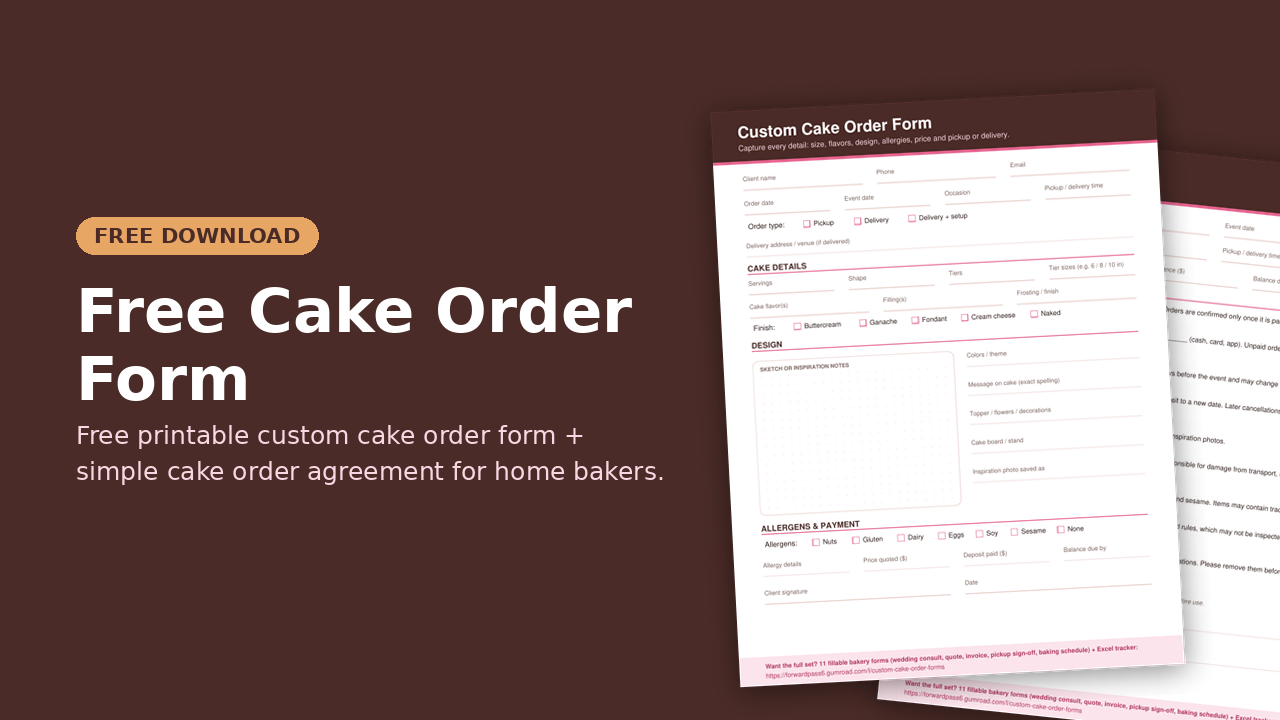
Free Cake Order Form
A free printable custom cake order form with a design sketch box, servings, tiers, flavors, allergens, deposit and balance fields, plus a simple cake order agreement with 9 initialed terms.
Download free →1. Customer, event and timing
Start with the basics, and get them exactly right:
- Customer details: name, phone, email and the best way to reach them on the day
- Event: occasion (birthday, wedding, baby shower, office party), the name and age of the guest of honor if it goes on the cake, and the event date
- Pickup or delivery: the date and a time window for pickup, or the delivery address, venue contact, setup time and any venue rules
- Order date and order number, so you can find it later in your tracker
Ask for the event date and the pickup date separately. A cake for a Sunday party is often picked up on Saturday, and mixing the two up is one of the most common order mistakes.
2. Size and servings, not just inches
Customers think in guests, so ask "how many people are you serving?" first, then choose the size. Many bakers use two serving sizes: a party serving of about 1.5 x 2 x 4 inches and a smaller wedding serving of about 1 x 2 x 4 inches. As a rough guide for a standard 4-inch-tall round cake, a 6-inch round serves about 12, an 8-inch about 20 to 24, a 10-inch about 28 to 38 and a 12-inch about 40 to 56, depending on which serving size you cut. Write on the form which serving size you use, the shape (round, square, sheet, number or shaped cake), the number of tiers and the size of each tier, and whether you add extra height or a kitchen cake for big events.
3. Flavors, fillings and frosting by tier
For each tier or layer, record the cake flavor, the filling, and the frosting. Include the finish: smooth buttercream, semi-naked, textured, ganache or fondant, since fondant and sharp-edged finishes take longer and usually cost more. Note any dietary versions the customer asked for, such as eggless, dairy-free or gluten-friendly, and say clearly whether your kitchen can actually guarantee them. A short flavor menu printed on the form (or attached) speeds up ordering and stops requests for flavors you do not make.
4. Design, colors and the exact message
The design section is where most disputes come from, so make it specific:
- Theme and colors, with color names, not just "blue" (navy, baby blue and teal are all "blue")
- Inspiration photos: note how many the customer sent and which parts of each photo they want copied
- A sketch box for a quick drawing of the layout, tiers and decorations
- The exact message, written letter by letter, with spelling, capital letters and the age or date checked back with the customer
- Toppers, figures, fresh flowers, candles or sparklers, and who supplies them
Add a line saying that handmade cakes will vary slightly from inspiration photos. It sets expectations before the cake is baked, not after.
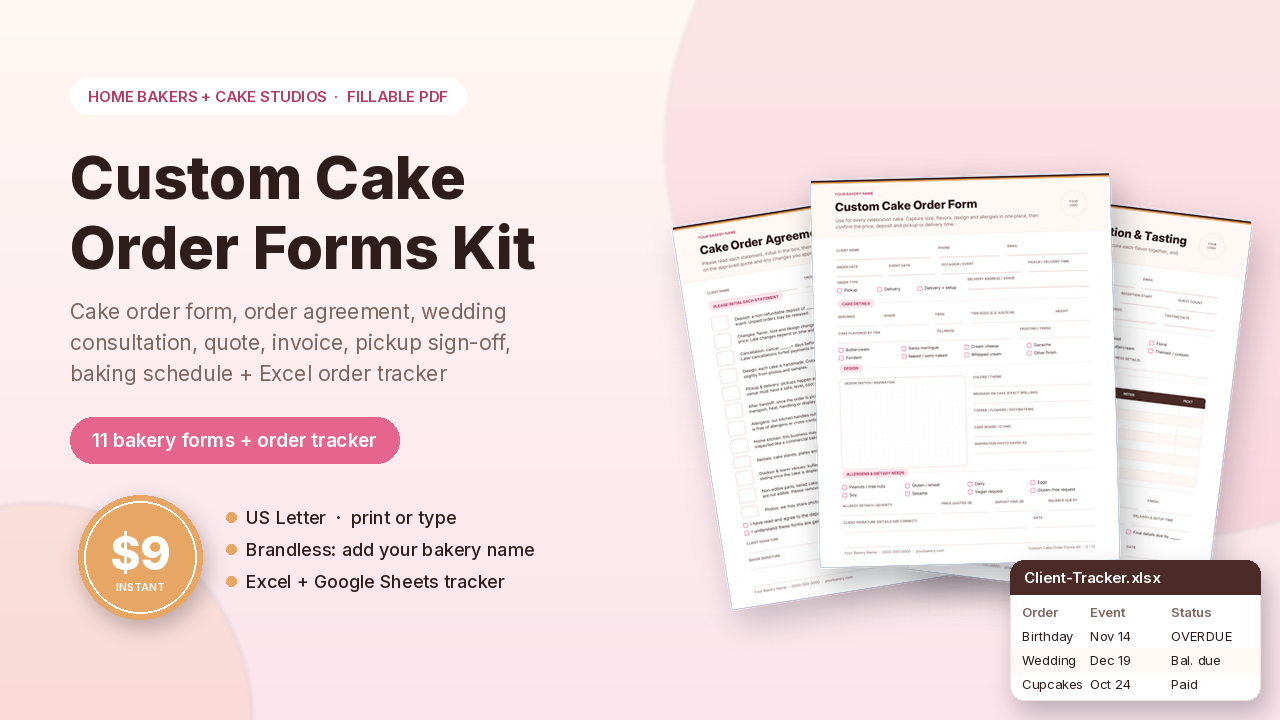
Custom Cake Order Forms Kit for Home Bakers
A fillable PDF with 11 bakery forms (custom cake order form with sketch box, cupcake, cookie and dessert table order, wedding cake consultation and tasting, quote and price sheet by servings, order agreement and policies, delivery and setup checklist, pickup sign-off, allergy sheet, invoice, weekly baking schedule and client feedback) plus an Excel order tracker with deposit, balance and overdue flags.
Get it →5. Allergens and dietary notes
Always ask about allergies, and write the answer down even when it is "none". In the United States, the major food allergens named in federal law are milk, eggs, fish, crustacean shellfish, tree nuts, peanuts, wheat, soybeans and sesame. On your order form, list which of these are in the cake, the filling, the frosting and the decorations, and ask the customer to confirm any guest allergies. If you bake in a home kitchen that also handles nuts, wheat or dairy, say so plainly: most home bakers cannot promise an allergen-free cake, and the form should not imply that you can. Keep a separate allergy sheet for orders with serious allergies so the details travel with the cake.
6. How to price cakes by the serving
Pricing by the serving is the easiest way to quote consistently, and customers understand it. Work it out from your own costs, not a competitor's price list:
- Cost your ingredients for a standard cake (flour, butter, sugar, eggs, filling, frosting) and divide by the number of servings.
- Add packaging and supplies: cake board, box, dowels, liners and any toppers you buy.
- Add your time: baking, cooling, filling, frosting, decorating, shopping, messaging the customer and cleaning up, multiplied by an hourly rate you are happy with.
- Add overhead such as electricity, equipment wear, card fees and any permit or insurance costs.
- Set a base price per serving for a simple buttercream cake, then add per-serving or flat charges for fondant, sculpted designs, sugar flowers, extra tiers, rush orders and delivery.
For example, if a simple 20-serving buttercream cake costs you $18 in ingredients and supplies and takes 3 hours at $20 an hour, your cost is about $78, or roughly $3.90 a serving before profit. This is only an example. Prices vary a lot by area and skill, so set a minimum order price, test your rates and track your real hours. For holiday cookie boxes and pre-orders, the Home Bakery Order Forms Kit adds a cost-per-dozen pricing worksheet and a pre-order form with pickup slots.
7. Deposit, payment and cancellation policy
Write your money rules on the form so they are agreed before you buy ingredients:
- Deposit: how much reserves the date (many bakers ask for 25% to 50%, or a flat amount), and that the date is not held until it is paid
- Balance: when the rest is due, for example 7 days before the event or at pickup, and the payment methods you accept
- Order deadline: how far ahead you need orders, and any rush fee for short-notice orders
- Changes: the last date for design or size changes, and that changes may change the price
- Cancellations: whether the deposit is refundable, and what happens if the customer cancels close to the date
Keep the wording short and clear, have the customer initial each term or sign the agreement, and give them a copy.
8. Pickup, delivery and handoff
Once a cake leaves your kitchen, you no longer control the car, the weather or the venue. Your form should say who is responsible after pickup, how to transport the cake (flat surface, air conditioning on, never on a lap or a seat), how long it can sit at room temperature and how to store leftovers. For delivery, note the delivery fee, the setup time, who signs for the cake and that you will take a photo at handoff. A short pickup sign-off, where the customer confirms the cake was received in good condition, ends most "it was damaged" arguments before they start. Return any rented stands or plates on a deadline, with a deposit if you lend them.
A note on cottage food and local rules
This checklist is educational, not legal advice. Whether you can sell cakes from a home kitchen, what you must put on labels, where and how you may sell, whether you need a permit or registration, sales limits and sales tax all depend on your state, county and city, and the rules change. Check your state cottage food program or local health department before you take orders, and have a professional review your order agreement and policies.
FAQ
What should be on a cake order form?
The customer and event details, pickup or delivery date and time, number of servings, shape, tiers and sizes, flavors, fillings and frosting by tier, the design, colors and exact message, toppers, allergens and dietary needs, the price, deposit and balance due, your deposit, change and cancellation policy, and a signature line.
How much deposit should I take for a custom cake?
Many home bakers take a non-refundable deposit of 25% to 50% of the order, or a flat amount, to reserve the date, with the balance due a few days before the event or at pickup. Choose what suits your costs and local market, and write it clearly on the order form.
How do I price a cake by the serving?
Add up your ingredient and packaging costs, your time at an hourly rate and your overhead for a standard cake, then divide by the number of servings to get a base price per serving. Add extra charges for fondant, detailed designs, extra tiers, rush orders and delivery, and set a minimum order price.
How many servings is an 8 inch round cake?
A standard 8-inch round cake about 4 inches tall serves roughly 20 party servings (about 1.5 x 2 x 4 inches) or about 24 wedding servings (about 1 x 2 x 4 inches). Write the serving size you use on your order form so the customer knows what to expect.
How far in advance should customers order a custom cake?
Many bakers ask for 1 to 2 weeks for simple custom cakes and several weeks or months for wedding cakes and the holiday season, when dates book up quickly. Put your order deadline and any rush fee on the order form.
Do home bakers need to list allergens?
Allergen rules depend on where you sell, but it is good practice to tell customers which major allergens are in each cake and whether your home kitchen also handles nuts, wheat, dairy or other allergens. Cottage food labeling rules vary by state, so check your state rules.
This page is general guidance, not legal advice. Cottage food, labeling, allergen, permit, sales tax and contract rules vary by state and city and change over time, so check yours before you take orders.
Related templates
Free Cake Order Form
A free printable custom cake order form with a design sketch box, servings, tiers, flavors, allergens, deposit and balance fields, plus a simple cake order agreement with 9 initialed terms.
Download free →Custom Cake Order Forms Kit for Home Bakers
Fillable cake order form, quote and price sheet by servings, order agreement, allergy sheet, pickup sign-off and invoice plus an Excel order tracker.
Get it →