Holiday Caregiver Pricing: How Independent Caregivers, Home Care Aides and Senior Companions Price Holiday Shifts, Family Coverage Requests, Backup Care, Overnights and January Scheduling (Plus Free Caregiver Forms)
How private caregivers, home care aides and senior companions can handle late November through New Year’s Day: holiday rate premiums, families asking for extra hours while they travel, shift swaps and backup caregivers, cancellations, travel and overnight rates, care notes and emergency contacts, and clear limits on medical tasks, with a worked example and free caregiver forms.
Why caregivers need a holiday plan in writing
For independent caregivers, the holidays bring two kinds of pressure at once. Families who live far away arrive, leave, or travel, and suddenly ask for extra hours, overnights or a full week of coverage. At the same time, you have your own family, your own travel and possibly other clients asking for the same dates. Without a written plan, the result is weeks without a day off, unpaid extra time, last-minute cancellations and confusion about who covers a shift if you get sick.
The person you care for is the one who suffers most from that confusion. A short holiday sheet, shared with each family by early November, protects your income, your rest and your client’s safety.
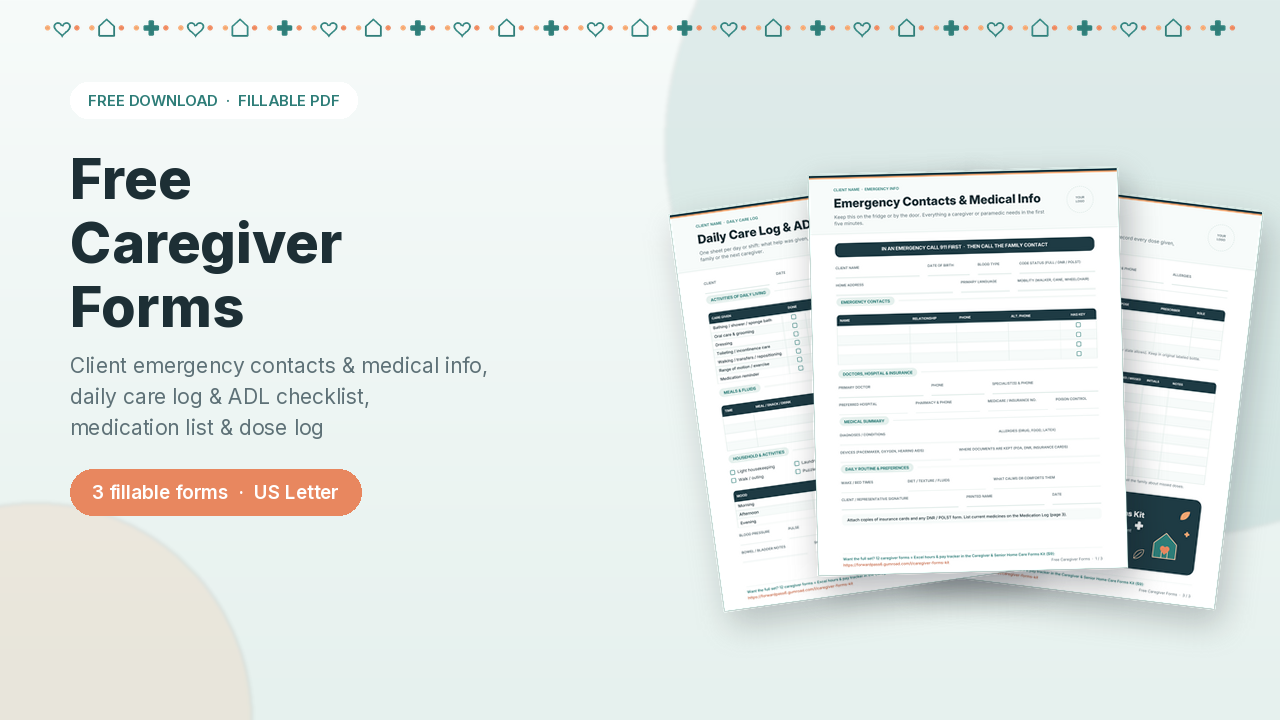
Free Caregiver Forms
A fillable emergency contacts and medical info sheet, a daily care log with ADL checklist, and a medication list and dose log.
Download free →1. Start from your regular rate sheet
Your holiday sheet sits on top of your normal rates; it does not replace them. If your hourly rate by care level, minimum shift, overnight and live-in rates and mileage are not written down yet, start with our caregiver rates guide; our caregiver agreement template covers the terms every family should sign.
The holiday sheet only adds what changes this season: which dates count as holidays, what those dates cost, how families request extra coverage, what happens if you cannot work a shift, and how bookings and cancellations work. A stated seasonal policy beats a surprise on the invoice.
2. Holiday rate premiums and your peak window
Name the dates and the premium before anyone asks:
- List the holidays. For example Thanksgiving Day, Christmas Eve, Christmas Day, New Year’s Eve and New Year’s Day, plus any religious or cultural holidays you and your clients observe.
- Choose the premium. Many private caregivers charge time and a half on major holidays. Others use a flat add-on per shift.
- Define the hours. Say whether the premium applies to the whole calendar day, or from a set time (for example, from 6 p.m. on Christmas Eve).
- Name the peak window. Beyond the holidays themselves, the busiest stretch is often the week of Thanksgiving and December 20 through January 2. Ask families to confirm their schedule for that window by a set date.
If you are hired directly by a family, they may be treated as your employer, and overtime and holiday pay rules can apply regardless of what you agree. Check the rules where you work, and have the family check theirs.
3. Family coverage requests
“We’re flying out on the 22nd—can you stay with Mom until the 28th?” is the classic holiday message. Turn the request into a written plan:
- Set a request deadline. For example, extra holiday coverage requested by December 1 is confirmed in order of request; later requests depend on availability.
- Price extended coverage honestly. A week of 12-hour days or round-the-clock care is not the same job as your usual four-hour visits. Quote it as extended or live-in coverage with its own rate, required rest breaks and sleep time, not as your regular hourly rate multiplied out.
- Agree on who is in charge. Write down who the family’s point person is while they travel, how to reach them across time zones, and who can make decisions if they cannot be reached.
- Protect your own days off. Say which days you are not available at any rate.
4. Shift swaps and backup caregivers
Illness, weather and travel delays peak in December, and families need to know what happens if you cannot make a shift. Decide this in advance:
- Who finds the backup. Either the family keeps their own backup (a relative, neighbor or agency) or you arrange a trusted colleague. If you arrange one, say whether the family pays them directly and at what rate, and that the family approves them in advance.
- Notice for swaps. For example, any swap is agreed in writing at least 48 hours ahead, except in emergencies.
- A backup handover. Keep an up-to-date care plan, routine, medication list and emergency sheet in the home so a backup can step in safely on short notice.
- What if nobody is available. Families should have a fallback plan, such as a relative on call or a local agency’s respite service.
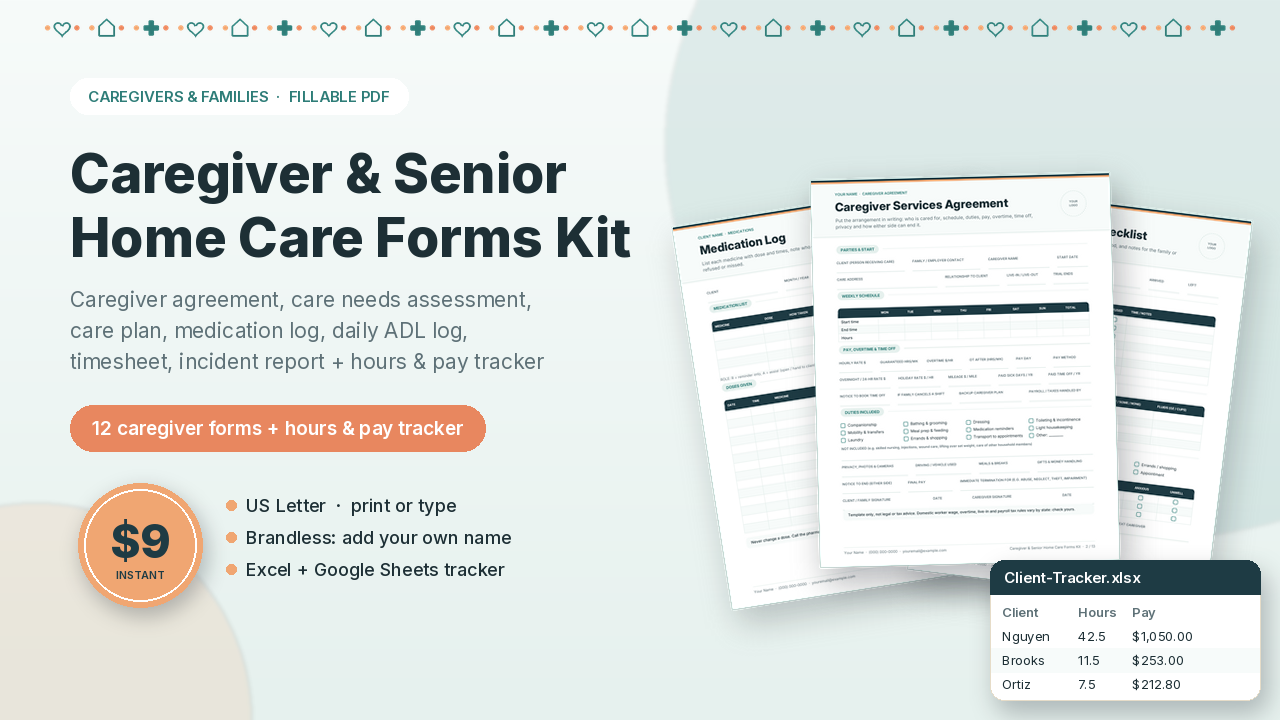
Caregiver & Senior Home Care Forms Kit
12 fillable forms (caregiver services agreement, rate sheet, client intake and care needs assessment, care plan, medication log, daily care log and ADL checklist, timesheet, incident report and more) plus an Excel tracker for hours, overtime and pay.
Get it →5. Deposits, booking and cancellations
Many caregivers do not take deposits for regular weekly shifts. Holiday bookings are different: you may turn down other work to hold those dates. Common approaches:
- a deposit or advance payment for extended holiday coverage and live-in weeks, applied to the final invoice,
- a longer cancellation window for holiday dates (for example, 7 days for extended coverage and 48 hours for individual holiday shifts),
- a rule that cancelled holiday shifts inside the window are paid at a stated percentage,
- clear payment timing: weekly, or before the family leaves for longer trips.
Say how you handle cancellations caused by a hospital stay or death, so the family does not have to ask at a difficult time.
6. Travel, mileage and overnight rates
Holiday care often involves more driving and more nights:
- Mileage and errands. State your mileage rate and whether driving time counts as paid time.
- Traveling with the client. If a family asks you to accompany their relative to a holiday gathering out of town, price it as a separate trip: hours (including travel time), overnight rate, your travel costs, meals and where you sleep.
- Overnights. Separate “sleeping” overnights, where you can sleep most of the night, from “awake” overnights, where you are up and working, and charge more for awake nights. Holiday overnights can carry the holiday premium too.
- Bad weather. Say what happens if roads are unsafe: whether you stay over (and at what rate) or the family arranges cover.
7. Care notes and emergency contacts
Holiday schedules mean more people coming and going: backup caregivers, visiting relatives, new household routines. Good documentation keeps your client safe and protects you:
- An emergency sheet in the home. Family contacts (including travel numbers), doctors, pharmacy, allergies, conditions, insurance details and any advance-directive or do-not-resuscitate instructions the family has provided.
- Daily care notes. Meals, fluids, mobility, mood, sleep, toileting and anything unusual, written each shift so the next person and the family can see what happened.
- A medication list and reminder log. Record what the client took and when, according to the plan the family and their healthcare providers set.
- An incident record. Falls, injuries or near-misses, written the same day and shared with the family.
8. Clear boundaries on medical tasks
Families under holiday stress sometimes ask non-medical caregivers to do more: change a wound dressing, give an injection, adjust medication doses or manage a feeding tube. Put your boundaries in writing. Many independent caregivers and companions provide companionship, personal care, meals, light housekeeping, transportation and medication reminders, and do not perform tasks that require a nurse’s license or specific training. What you are allowed to do depends on your training, certification and local regulations, so check them and list what you will and will not do. If needs have increased, suggest the family ask the client’s doctor or a home health agency about skilled care.
9. January planning
January brings changes: holiday hours drop, and some clients need more help after a tiring season or a winter illness. Before the holidays end, schedule a short check-in with each family to review the care plan, confirm the regular schedule for the new year, update emergency contacts and medication lists, and agree on any rate change for the year ahead with notice. If extra holiday hours showed the client needs more support, now is the time to put it in writing rather than letting it drift.
Worked example (example numbers only)
Here is how one independent caregiver might lay out a holiday sheet. All numbers are an example only; use your own rates, local market and local rules.
- Regular rate: $30/hour, 4-hour minimum shift.
- Holidays: Thanksgiving, Christmas Eve from 6 p.m., Christmas Day, New Year’s Eve from 6 p.m., New Year’s Day; time and a half ($45/hour).
- Peak window: Nov 24–30 and Dec 20–Jan 2; extra coverage requests confirmed in order received until Dec 1.
- Extended coverage while family travels: quoted per day, with an 8-hour sleep period and a 1-hour break; 25% advance payment, applied to the invoice.
- Sleeping overnight: $200 flat; awake overnight: hourly rate; holiday overnights at the holiday rate.
- Cancellation: 7 days for extended coverage, 48 hours for single holiday shifts; inside the window, 50% of the booked hours are paid.
- Mileage: $0.60 per mile for errands and appointments.
- Backup: a named colleague approved by the family, paid by the family at the same rate; care plan and emergency sheet kept in the home.
- Not provided: injections, wound care, medication dosing changes.
- January: care-plan review in the first week of January; new-year rates with 30 days’ notice.
Put it all in writing
Share the holiday sheet with every family by early November and get written confirmation of their holiday schedule. Keep a signed caregiver agreement and rate sheet, an intake and care needs assessment, a care plan, a medication list, daily care logs, a timesheet and an incident report form for each client.
FAQ
Should caregivers charge more on holidays?
Many private caregivers charge time and a half on major holidays, and some charge double on Christmas Day or New Year’s Eve overnight. List the holidays and the premium in writing before the season, and check local overtime and holiday pay rules.
How should I price a week of care while the family travels?
Quote it as extended or live-in coverage with its own daily rate, required sleep and break time, a deposit or advance payment and a cancellation window, rather than multiplying your usual hourly rate.
What happens if a caregiver is sick on a holiday?
Agree in advance who arranges backup: the family, an agency or a colleague you recommend and the family approves. Keep a care plan, medication list and emergency sheet in the home so a backup can step in safely.
Can caregivers ask for a deposit for holiday shifts?
Many do for extended holiday coverage, because they turn down other work to hold those dates. State the amount, apply it to the final invoice and set a clear cancellation window.
Should a sleeping overnight cost less than an awake overnight?
Usually yes. Many caregivers charge a flat rate for a sleeping overnight and their hourly rate for an awake overnight, since the caregiver is working all night. Check local employment rules for overnight pay.
Can a non-medical caregiver give injections or change dressings?
It depends on your training, certification and local regulations. Many companions and private caregivers only give medication reminders and do not perform skilled nursing tasks. Write your boundaries down and refer families to the client’s doctor or a home health agency for skilled care.
This page is general guidance, not legal, tax, employment or medical advice. Overtime, holiday pay, household employment, licensing and scope-of-practice rules vary by location. Refer medical questions to the client’s healthcare providers, and have a professional review your agreement and policies.
Related templates
Free Caregiver Forms
A fillable emergency contacts and medical info sheet, a daily care log with ADL checklist, and a medication list and dose log.
Download free →Caregiver & Senior Home Care Forms Kit
Fillable caregiver agreement, rate sheet, intake, care plan, medication and daily care logs, timesheet plus an Excel hours and pay tracker.
Get it →