Caregiver Daily Log: What to Record Each Shift (+ Free Template)
A practical guide for private caregivers, home care aides and families: what to note during each visit, how to write entries that are factual and useful, and how to hand over clearly to the next caregiver or family member.
Why a caregiver daily log matters
When one person cares for someone at home, a lot of important information exists only in that person’s memory: what was eaten, whether a dose was taken, how the morning walk went, what the client said about their knee. When care is shared between a family member, a private caregiver and perhaps a second caregiver on weekends, that memory is split across several people who rarely see each other. Questions start to repeat. Small changes go unnoticed because nobody sees the whole week.
A daily care log fixes that by putting each shift on paper (or in a shared document) in the same order every time. The next caregiver can read it before starting. The family can see how the week went without calling for a full update. If the client’s doctor or nurse asks how things have been, there is something concrete to look at instead of a general impression.
A log also protects the caregiver. A clear record of what was done, when and what was observed is far better than trying to remember a Tuesday three weeks ago if a question comes up later.
This guide covers what to record, how to write entries that are useful, and how to keep the log manageable. It is aimed at private caregivers, home care aides and families who organize care themselves. It is not about the terms of the arrangement; hours, pay, duties and notice belong in a caregiver agreement. For pricing, see caregiver rates and holiday caregiver pricing.
Free Caregiver Forms
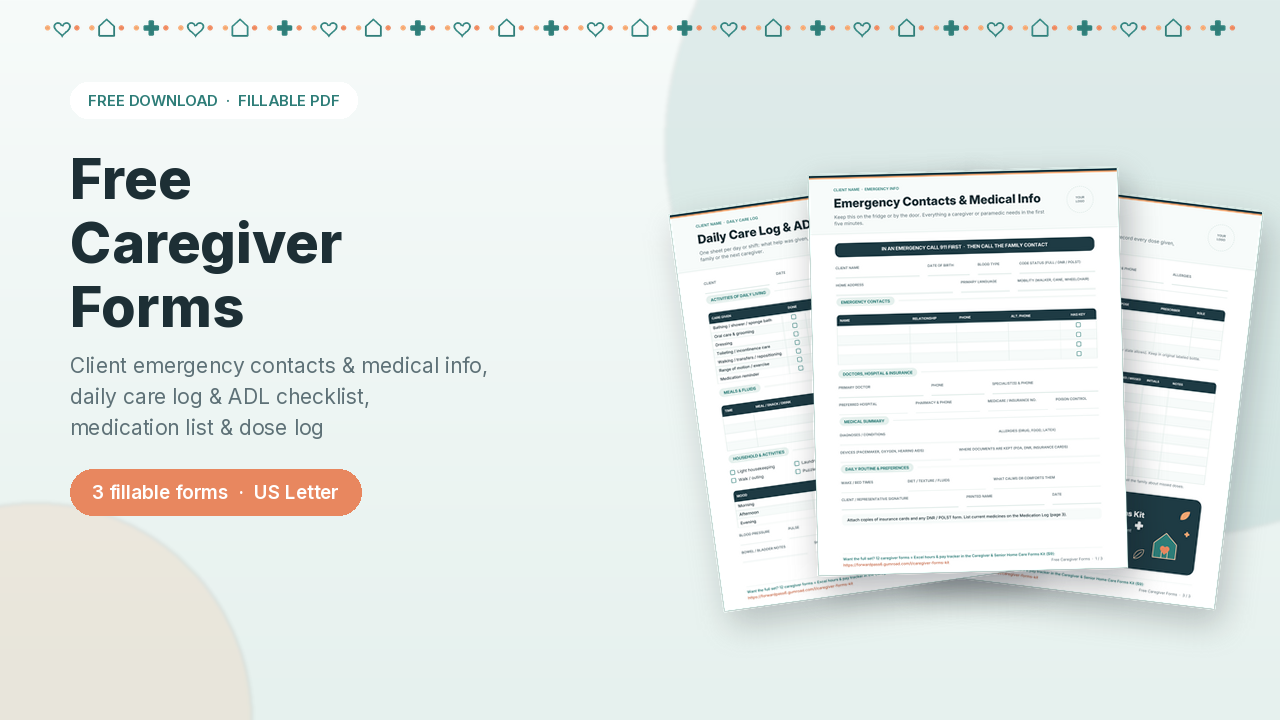
A fillable client emergency contacts & medical info sheet, a daily care log with an ADL checklist, and a medication list & dose log.
Download free →1. The basics at the top of each page
Each log page or entry should start with the same few details, so nobody has to guess which day or which caregiver it refers to.
- Client name
- Date
- Caregiver name
- Shift start and end time (actual, not scheduled)
- Who the caregiver took over from, and who they handed over to
- A short note if anything about the shift was unusual, such as a visit from family, a different start time or a missed shift covered by someone else
Keep the time records consistent with whatever timesheet you use for pay. If the log says the shift ended at 6:30 and the timesheet says 6:00, someone will eventually ask why. Many caregivers use the log times as the source for their timesheet.
If more than one caregiver writes in the same log, ask everyone to sign or initial their entries. That makes it easy to see who noticed what, and who to ask if an entry is unclear.
2. Personal care and daily activities (ADLs)
Most daily logs include a checklist of activities of daily living, often shortened to ADLs. These are the everyday personal tasks the client may need help with. Which ones you include depends on the care plan; there is no need to list tasks the client does fully on their own.
- Bathing or washing
- Dressing and grooming (hair, shaving, oral care)
- Toileting and continence care
- Moving around the home, transfers (for example bed to chair) and walking
- Eating (see Part 3 for meals and fluids)
Many families also track everyday household support, sometimes called instrumental activities: light housekeeping, laundry, meal preparation, shopping, errands, transport to appointments and help with phone calls or mail. Include the ones that are part of the caregiver’s duties.
A simple way to record this is a row for each activity with a column for “done independently”, “needed some help”, “needed full help” or “declined / not done”, plus a short note. Over a few weeks, that pattern can be more useful than any single entry. If the client usually showers with a little help and now needs full help, or declines it several days running, that is worth mentioning to the family.
Use plain, respectful language. The log is about the person’s care, and they or their family may read it.
3. Meals, fluids and appetite
Note what was offered and roughly how much was eaten, not a nutritional analysis. Plain descriptions work well: “Breakfast: oatmeal and half a banana, ate most of it. Lunch: soup and sandwich, ate the soup, left half the sandwich.”
- Meals and snacks offered, and roughly how much was eaten
- Drinks, if the care plan or the client’s doctor has asked for fluids to be tracked
- Any special diet or texture the care plan specifies, and whether it was followed
- Difficulty chewing or swallowing, coughing while eating, or a change in appetite
- Groceries running low, so the next caregiver or the family can plan
If the client’s doctor or dietitian has given specific instructions, such as a fluid limit or a particular diet, follow them and write them into the care plan so every caregiver sees the same instruction. The log records what happened; it is not the place to decide on a new diet.
| Vague entry | More useful entry |
|---|---|
| “Ate OK” | “Lunch 12:30: chicken soup (all), half a cheese sandwich. Said she wasn’t very hungry. Cup of tea at 3.” |
| “Good day” | “Walked to the mailbox and back with the walker, no stops. Watched a film with his daughter in the afternoon. Chatty and in good spirits.” |
| “Didn’t want a shower” | “Declined shower at 9 and again at 11. Washed at the sink with help instead. Third day this week; mentioned to her son at handover.” |
| “Seemed off” | “More confused than usual after lunch: asked twice what day it was and called me by his brother’s name. Called his daughter at 2:15 as agreed in the care plan.” |
Example entries only, made up for illustration. Write what you actually saw and did, and follow the care plan for when to contact the family or a health professional.
4. Medications: what the log records
Medication is the area where a clear record matters most and where caregivers should be most careful about staying within their role. What a private caregiver is allowed to do with medication (reminding, handing over a pre-filled organizer, or giving medication) depends on the rules where you live, the client’s situation and, for agency workers, the agency’s policies. Check what applies to you before taking on any medication task, and agree it in writing in the caregiver agreement.
Within that role, the record itself is straightforward. Many caregivers keep a separate medication log (one line per dose) rather than mixing doses into the daily notes, because it is easier to check at a glance. Whichever you use, record:
- The medication name and dose, written exactly as the label or the prescriber’s instructions say
- The scheduled time and the actual time
- What happened: taken, reminded and taken, declined, missed, or not available
- Your initials
- A short note for anything unusual, such as the client saying a tablet looked different or the supply running low
Keep an up-to-date medication list separate from the log, with the prescribing doctor and pharmacy contact details. If a dose is missed, declined or doubled, or if you are unsure whether a dose was taken, do not guess. Record exactly what happened and follow the instructions in the care plan, which usually means contacting the family and, where appropriate, the pharmacist or prescriber for advice.
5. Mood, behavior and observations
This is the part of the log that helps families and health professionals notice change over time. Caregivers are not expected to diagnose anything. The job is to describe what was seen and heard, in plain words, and to pass on anything that seems different from usual.
- General mood and energy: cheerful, quiet, tired, restless, anxious
- Sleep: naps during the day, and what the client said about the night
- Toileting changes the client mentions or the caregiver notices
- Skin: redness, bruises, sores or dry patches noticed during personal care
- Mobility: steadiness, use of walker or cane, any near-falls
- Pain or discomfort the client mentions, in their own words where possible
- Memory or confusion compared with their usual
- What went well: a good conversation, a phone call they enjoyed, an activity they liked
Write facts rather than conclusions. “Said her hip hurt when standing up, winced twice on the stairs” is more useful than “hip is getting worse”. If something looks like it needs attention, follow the care plan for who to tell. In an emergency, call your local emergency number first and the family second, then write it up when it is safe to do so.
Falls, injuries and other incidents usually deserve their own incident report as well as a line in the daily log. The log entry can simply point to it: “Fall in the bathroom at 10:40, see incident report.”
Caregiver & Senior Home Care Forms Kit
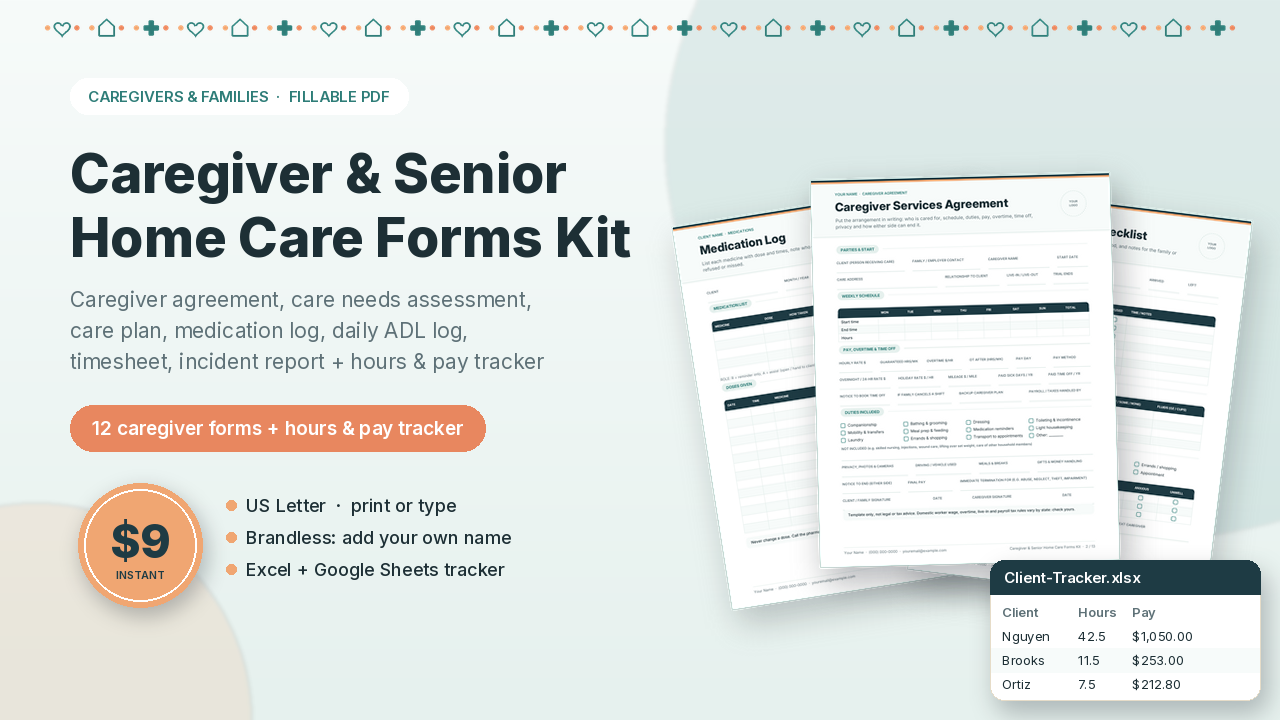
12 fillable forms (caregiver services agreement, rate sheet, client intake and care needs assessment, emergency and medical info, care plan, medication log, daily care log and ADL checklist, timesheet, visitor and appointment log, family communication sheet, incident report and notice of termination) plus an Excel tracker for hours, overtime and pay.
Get it →6. Appointments, visitors and outings
A short section for the outside world keeps everyone in step.
- Appointments attended, who went, and any written instructions brought home (attach or file them rather than rewriting them)
- Upcoming appointments and who is taking the client
- Visitors: family, friends, nurses, therapists, repair people
- Outings: walks, shopping, day programs, religious services
- Phone calls the client asked the caregiver to help with, and any messages for the family
For appointments, the log should record what happened, not interpret it. “Saw Dr. Lee at 11. New written instructions in the blue folder. Daughter has the prescription.” Medical advice should come from the professional and be passed on as given, ideally in writing.
7. The handover note
The end-of-shift summary is the part the next person will actually read first, so it is worth doing well. Three or four lines is usually enough:
- How the shift went overall, in one sentence
- Anything the next caregiver needs to do or watch for
- Anything the family needs to know or decide
- Supplies running low (food, incontinence products, medication refills)
| Situation | What the handover note might say |
|---|---|
| Routine shift | “Quiet day, ate well, walked twice. Evening dose due at 8. Milk and bread low.” |
| Something to watch | “Coughing a bit more after drinks this afternoon. Please keep an eye on it at dinner. Told his son at 5.” |
| Change for the family | “She asked again about going to her sister’s on Sunday. Can someone let her know the plan?” |
| Incident | “Fall in the bathroom at 10:40, no visible injury, family called at 10:45. Incident report on the clipboard.” |
Example notes only. What counts as urgent, and who to tell, should be set out in the care plan and agreed with the family.
When care alternates between family members and a paid caregiver, ask family members to write a short handover note too. A log that only the paid caregiver fills in leaves gaps on the days they are not there.
8. Paper, shared document or app?
Any format works if it is used consistently. The right choice depends on who needs to read it.
- Paper log in a binder at the home. Simple, works without internet, easy for an older client to read. The family only sees it when they visit, unless photos are sent.
- Shared document or spreadsheet. Family members who live elsewhere can read it the same day. Needs a phone or tablet at the home and agreement about who can see and edit it.
- Care coordination app. Some families and agencies use dedicated apps. If you choose one, check how it stores data and who has access.
Whichever you use, keep blank pages or a printed backup in the home for days when a device is flat or missing. And keep the medication list, emergency contacts and care plan in a fixed place where any caregiver can find them quickly.
9. Privacy and respect
A daily log contains personal and health information about someone who may be vulnerable. Treat it carefully.
- Agree with the client (where they are able) and the family who can read the log
- Keep the binder in a private place, not on a table where every visitor can read it
- Do not post photos of the log, or anything about the client, on social media
- Write about the person as you would want to be written about: factual, kind, no jokes or labels
- Agree what happens to old logs when the arrangement ends
Privacy and record-keeping rules for health information vary by location and by setting. Agencies usually have their own policies, and some situations have specific legal requirements. If you are unsure what applies to you, check before you start.
10. Keep it quick enough to keep doing
A log that takes forty minutes at the end of every shift will quietly stop being filled in. A few habits keep it manageable:
- Use a checklist for routine tasks and free text only for what is different
- Write entries during the shift, when you can remember times accurately, rather than all at the end
- Use the same order every time, so readers know where to look
- Agree common abbreviations in advance, or avoid them
- Review the format with the family after the first couple of weeks and drop anything nobody reads
Common mistakes
- Writing opinions instead of observations. “Being difficult” tells the reader nothing. Describe what happened.
- Only writing when something goes wrong. Routine entries show what normal looks like, which is how change gets noticed.
- Recording medication from memory at the end of the day. Note each dose when it happens.
- Mixing up the log and the care plan. The care plan says what should happen; the log records what did happen. Instructions belong in the care plan.
- Leaving out the times. “Fell earlier” is much less useful than “fell at 10:40”.
- No handover from family days. Gaps make patterns hard to see.
- Leaving the log where anyone can read it. It is private information.
One-page checklist
- Client name, date, caregiver name, actual start and end time
- Personal care and daily activities, with how much help was needed
- Meals, snacks and drinks, roughly how much, and appetite
- Medication record (separate log if possible): name, dose, scheduled and actual time, outcome, initials
- Mood, sleep, skin, mobility, pain and memory compared with usual
- Falls or incidents, with a separate incident report
- Appointments, visitors, outings and messages
- Handover note: how it went, what to watch, what the family needs to know, supplies low
- Signature or initials on every entry
- Log kept in a private, agreed place
FAQ
What is the difference between a care plan and a daily care log?
The care plan sets out what care the person needs and how it should be given, usually agreed with the family and sometimes with health professionals. The daily log records what actually happened on each shift. The plan changes occasionally; the log is written every day.
Does a family caregiver need to keep a daily log?
There is no single rule for families caring for a relative, but many find a simple log helpful, especially when several people share the care or when the doctor asks how things have been. It also makes handing over to a paid caregiver or respite care much easier.
Should medication be in the daily log or a separate log?
Either can work, but a separate medication log with one line per dose is easier to check at a glance and less likely to be missed. The daily notes can then refer to it for anything unusual. What a caregiver may do with medication depends on local rules and the arrangement, so check that first.
How detailed should daily log entries be?
Detailed enough that someone who was not there understands what happened: times, what was done, how much help was needed and anything different from usual. Routine items can be ticked on a checklist; changes and concerns deserve a sentence or two in plain words.
Who should be allowed to read the log?
Agree this with the client, where they are able, and the family. Usually the caregivers and the family members coordinating care can read it, and it can be shown to the client’s doctor or nurse if helpful. Keep it private from casual visitors.
How long should we keep old daily logs?
It depends on your situation and, for agencies, on their policies and any legal requirements where you work. Families often keep logs for as long as care continues and for a while afterwards. Agree what happens to them, and who keeps them, when the arrangement ends.
This page is general information for caregivers and families, not legal, medical, nursing or employment advice. Rules on what caregivers may do with medication, health and personal care, record keeping and privacy of health information vary by location and by setting. Follow the client’s care plan and the instructions of their doctor, nurse or pharmacist, check the requirements that apply where you live and work, and in an emergency contact your local emergency services.
Related templates
Free Caregiver Forms
A fillable client emergency contacts & medical info sheet, a daily care log with an ADL checklist, and a medication list & dose log.
Download free →Caregiver & Senior Home Care Forms Kit
Care plan, medication log, daily care log and ADL checklist, visitor and appointment log, family communication sheet, incident report, timesheet and more, plus an Excel hours and pay tracker.
Get it →