Christmas Light Removal Pricing: How to Price January Takedown, Storage and Removal-Only Jobs (Plus Free Forms)
How Christmas light installers can price January takedown and storage: decide whether removal is bundled with install or sold separately, choose per-foot or hourly removal pricing, set storage fees, schedule the takedown season, take deposits, and write the contract clauses that keep January profitable, with a worked example and free installer forms.
Why takedown deserves its own line on the quote
Most new installers put all their effort into pricing the install and treat January as an afterthought. Then the new year arrives and they discover that removal is real work: the same ladders, the same rooflines, often colder and icier weather, plus the time it takes to coil, label, inspect and store every strand. If takedown was never priced properly, it quietly eats the profit from the install.

Free Christmas Light Installation Forms
A printable client intake & measurement sheet plus a simple holiday lighting agreement for Christmas light installers.
Download free →1. Bundle removal with the install, or sell it separately?
There are two common ways to package takedown, and each suits a different kind of business:
- Bundled (install + removal + storage in one price). The client pays once and never thinks about January. It is simple to sell and sets you up for renewals. The risk is that you must price the removal into the install up front, so do not discount it away.
- Separate removal line or add-on. The install is quoted on its own, and takedown is an optional line (or a separate booking). It suits clients who own their lights and store them themselves. The risk is that some clients skip it and then call in late January expecting a same-week visit.
Many installers offer the bundle as the default and show removal-only as a separate, slightly higher price per foot, so the bundle is clearly the better deal. Whatever you choose, write it on the quote in plain words: “Price includes removal in January and storage until next season” or “Removal is not included; see optional takedown line.”
2. Per-foot or per-hour removal pricing
Use the same unit you used for the install so the numbers are easy to compare.
- Per linear foot. If you measured the roofline for the install, you already have the footage. Removal is usually faster than install, so many installers charge a fraction of their install rate per foot for takedown. The exact fraction is your decision; time a few of your own jobs and see how long removal really takes compared with install.
- Per hour, with a minimum. Hourly pricing suits removal-only jobs where someone else did the install, the lights are tangled or damaged, or the layout is unusual. Set a minimum charge (for example one or two hours) so a small job still covers travel and setup.
Add separate lines for anything that takes extra time: trees and bushes wrapped by hand, second-story or steep rooflines, ground stakes that are frozen in, and wreaths or garland that need careful packing.
3. Storage fees
Storage is where many installers either earn a steady extra margin or give away space for free. Decide which kind of lights you are storing:
- Leased lights (you own them). Storage is simply part of your cost of doing business and should already be built into the lease price.
- Client-owned lights. If you keep them for the client between seasons, charge for it. Common approaches are a flat yearly fee per client, a fee per labelled bin or tote, or storage included free only when the client signs up for next season.
State what storage covers (labelled bins, an inventory), what it does not (bulbs that fail in storage), and what happens if the client does not renew. A takedown and storage inventory sheet, signed or emailed to the client, avoids arguments about what was put away.
4. Schedule the takedown season
Removal work bunches up just like install work. Most clients want lights down in the first two or three weeks of January, and weather can wipe out days at a time. Publish a takedown window in your agreement, for example “removal is scheduled between Jan 2 and Jan 31, weather permitting,” and give clients a way to request an earlier or later date. Route the work by neighbourhood and keep a buffer for icy days. If a client wants the lights down on a specific date, such as the day after New Year's, treat it as a priority booking with an extra fee.
Christmas Light Installation Client Forms Kit
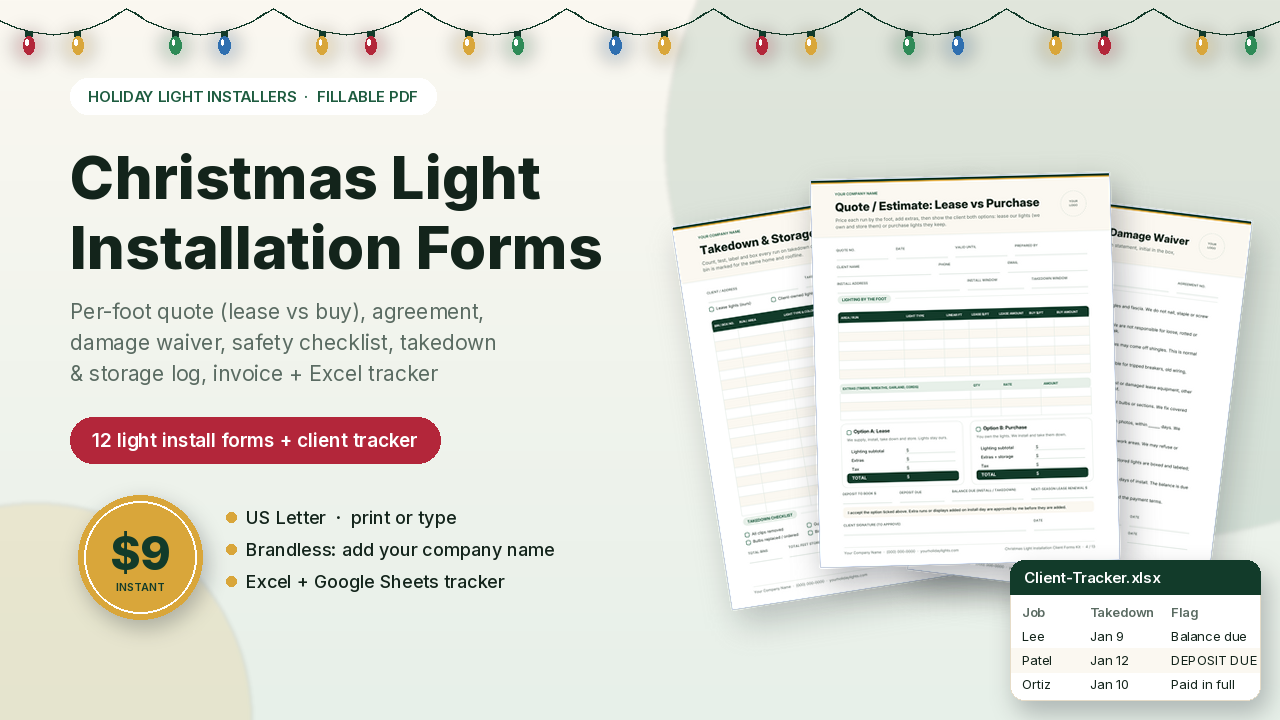
12 fillable forms (intake & roofline info, measurement & design worksheet, per-foot quote with lease vs purchase, service agreement, liability & property damage waiver, ladder / roof safety checklist, takedown & storage inventory, invoice, renewal form and more) plus an Excel client tracker.
Get it →5. Deposits and payment terms
For bundled jobs, the deposit you take at install time covers removal too. A common setup is a deposit to book the install, the balance due when the lights are up, and nothing more owed in January. For removal-only jobs, ask for payment on completion or a small booking deposit to hold a date during the busy weeks. State clearly that removal is included only if the invoice is paid in full, and that unpaid accounts may have lights held until payment.
A worked example (example numbers)
These numbers are made up to show the math, not market rates. Say you install 150 feet of roofline at $8 per foot and price removal at $3 per foot. You also store client-owned lights for $40 a season.
- Install: 150 ft x $8 = $1,200
- Removal: 150 ft x $3 = $450
- Storage: $40
- Bundled total shown to the client: $1,690, with a 50% deposit ($845) to book and the balance due after install
- Removal-only price for a new client, at $4 per foot with a $200 minimum: 150 ft x $4 = $600
Run your own numbers with your real install and removal times before you quote, and keep both versions on the quote so the client can see why the bundle is the better deal.
6. Contract clauses for takedown and storage
Add a short takedown section to your service agreement. Useful clauses include:
- What is included: removal of all lights and decorations you installed, clips, and timers, and whether ground stakes and extension cords are included.
- Removal window: the dates removal will happen and how weather delays are handled.
- Access: roof, yard and outlets reachable on the scheduled day.
- Late requests: requests after the removal window, or lights left up past a set date, may carry an extra fee.
- Damage and condition: how you handle strands that are already broken, bulbs that fail, and normal wear to gutters or shingles from clips.
- Storage terms: what is stored, for how long, the fee, and what happens if the client does not renew or collect.
- Renewal: an option to book next season at the same or a stated price, with a deadline.
Use removal day to sell next season
The takedown visit is the easiest renewal conversation you will have all year. You are already on site, the client just enjoyed the display, and you have the measurements on file. Leave a renewal form or send one the same day, offering an early booking price or a guaranteed install date if they sign by a set deadline.
FAQ
Should Christmas light removal be included in the install price?
It can be either. Many installers bundle install, January removal and storage into one price because it is simpler to sell and leads to renewals, and offer removal-only as a separate, slightly higher price. Whatever you choose, state it plainly on the quote.
How do installers price Christmas light takedown?
Most use the same unit as the install: a price per linear foot, often lower than the install rate because removal is faster, or an hourly rate with a minimum for removal-only and unusual jobs. Time your own jobs to set the number.
Should I charge for storing client lights?
For client-owned lights, many installers charge a yearly fee per client or per bin, or include it only when the client renews. Leased lights are usually stored as part of the lease price.
When should Christmas lights be taken down?
Most clients want removal in the first few weeks of January. Put a removal window in your agreement, such as early to late January, weather permitting, and charge extra for requests outside it.
What should a takedown clause in a lighting contract cover?
What is removed, the removal window, access, weather delays, late request fees, how damage and broken strands are handled, storage terms, and the renewal option for next season.
This page is general guidance, not legal, tax or safety advice. Licensing, insurance and consumer rules vary by state and city, and roof work carries real risk, so check your local rules and have your agreement reviewed by an attorney or insurer.
Related templates
Free Christmas Light Installation Forms
A printable client intake & measurement sheet plus a simple holiday lighting agreement for Christmas light installers.
Download free →Christmas Light Installation Client Forms Kit
Takedown & storage inventory, renewal form, service agreement and an Excel tracker with takedown dates.
Get it →