Christmas Light Installation Invoice: What to Include, How to Bill Deposits and Takedown (+ Free Forms)
A practical billing guide for holiday lighting installers: what to put on the invoice, how to itemize a display, how to handle deposits, change orders, service calls and takedown, with two worked examples.
Why the invoice matters more than you think in lighting season
Christmas light installation is a short, intense season. Most of the money arrives in a few weeks, crews are on roofs every day, and the same client is often billed two or three times: a deposit to hold the install date, a balance when the lights go up, and sometimes a separate charge for takedown and storage in January. When the paperwork is rushed, the problems show up later: a client who thought removal was included, a commercial account that never received a proper invoice for its accounts-payable team, or a balance nobody followed up on until the lights were already back in your storage unit.
A clear Christmas light installation invoice solves most of that. It shows exactly what was installed, whether the lights are leased or purchased, what was already paid, what is still due and when, and what happens at takedown. This guide walks through what to put on the invoice, how to itemize a lighting job, how to bill deposits and balances, and two complete worked examples you can copy.
This page is about billing the job after you have priced and sold it. For what to charge per foot, see Christmas light installation pricing. For the agreement the client signs before install day, see the Christmas light installation contract guide. For pricing takedown and storage, see Christmas light removal pricing, and for getting accurate footage before you quote, see how to measure for Christmas lights.

Free Christmas Light Installation Forms
A printable client intake & measurement sheet plus a simple holiday lighting agreement for Christmas light installers.
Download free →1. What every Christmas light installation invoice should include
An invoice is not just a total and a thank-you. For a lighting job it is also the record of what was installed on the property, which matters when the client calls about a dark section in December or asks what is coming down in January. These are the fields worth having on every invoice.
| Field | What to write | Why it matters |
|---|---|---|
| Your business details | Business name, phone, email, and any license or registration number your area requires | Clients and commercial accounts need to know who to pay and how to reach you |
| Invoice number and date | A unique number (for example CL-2026-014) and the date issued | Makes payments easy to match and stops duplicate billing |
| Client and service address | Billing name and address, plus the property address if different | Property managers and businesses often pay from a different address |
| Reference to the agreement | Agreement or quote number and the date it was signed | Ties the invoice to the terms the client already accepted |
| Install date | The date the display was installed (and crew lead, if useful) | Starts the clock for service calls and payment terms |
| Itemized line items | Each area or product with quantity, unit, rate and amount | Shows the client what they paid for and supports the total |
| Lease or purchase | A clear line stating whether the lights belong to you or the client | The single most common source of takedown disputes |
| Takedown and storage | Included, billed separately, or not included, with the planned window | Prevents the "I thought removal was included" call in January |
| Deposit and payments received | Amount and date of each payment already made | The client sees the balance is fair and up to date |
| Tax | Any sales tax that applies, shown on its own line | Tax rules for lighting services and lights vary by state |
| Balance due and due date | Amount still owed and the exact date it is due | Vague terms like "due soon" get paid last |
| How to pay | Accepted payment methods and what to write in the memo | Removes friction at the moment the client is ready to pay |
| Service call policy | How outages are handled and what is included | Sets expectations for the rest of the season |
2. How to itemize a lighting job
A single line that says "Holiday lighting – $1,200" invites questions. Itemizing by area and product makes the total easy to understand and makes next year's renewal quote almost automatic, because you already have the footage and counts on file. Group the lines in the same order the client sees the house: roofline first, then windows and doors, then landscape, then extras.
| Line item | Unit | Example description |
|---|---|---|
| Roofline / gutter line | Per linear foot | Front roofline and garage, C9 warm white, 140 ft |
| Peaks and ridges | Per linear foot | Two front peaks, 36 ft total |
| Windows and door frames | Per frame | Front windows outlined, 4 frames |
| Trees (trunk wrap or canopy) | Per tree or per foot of height | Maple in front yard, trunk and main branches wrapped |
| Bushes and hedges | Per bush or per foot of hedge | Net lights on 3 front bushes |
| Wreaths and garland | Per item | 36-inch lit wreath over garage |
| Pathway or stake lights | Per foot or per stake | Walkway lights, 24 ft |
| Timers, extension cords, power | Per item | 2 outdoor timers set to client schedule |
| Service calls | Per visit beyond what is included | Second service call, Dec 12 |
| Takedown and storage | Flat fee, per foot or per season | Removal and labeled storage until next season |
Use the same units on the invoice that you used on the quote. If the quote said 140 feet at a per-foot rate, the invoice should say 140 feet at the same rate, plus any approved changes on their own lines. Mixing a per-foot quote with a flat-rate invoice is how clients end up comparing numbers line by line and calling you.
3. Lease vs purchase: say it on the invoice
Most residential installers either lease the lights (you own them, install them, take them down and store them) or sell them (the client owns them after install). Many offer both. The invoice should state which model applies, because it controls what happens at takedown and who keeps the lights.
| Lease (installer owns the lights) | Purchase (client owns the lights) | |
|---|---|---|
| What the invoice says | "Lights provided on a seasonal lease. Lights remain the property of [Business]." | "Lights sold to client. Ownership transfers when paid in full." |
| Takedown | Usually included in the price | Often a separate takedown fee or optional |
| Storage | You store the lights; nothing for the client to track | Client stores them, or pays you a storage fee |
| Next season | Renewal uses your stored, pre-measured strands | Renewal may be a labor-only install with their own lights |
| Typical line wording | "Roofline, 140 ft, lease incl. install, service and removal" | "Roofline lights (sold), 220 ft" plus "Install labor" |
| Tax note | Leases and labor may be treated differently from sales | Sale of lights may be taxed differently from labor; check your state |
If you offer both, put the choice the client made in the agreement and repeat it on every invoice for that job. It takes one line and avoids the most common January dispute in this business.
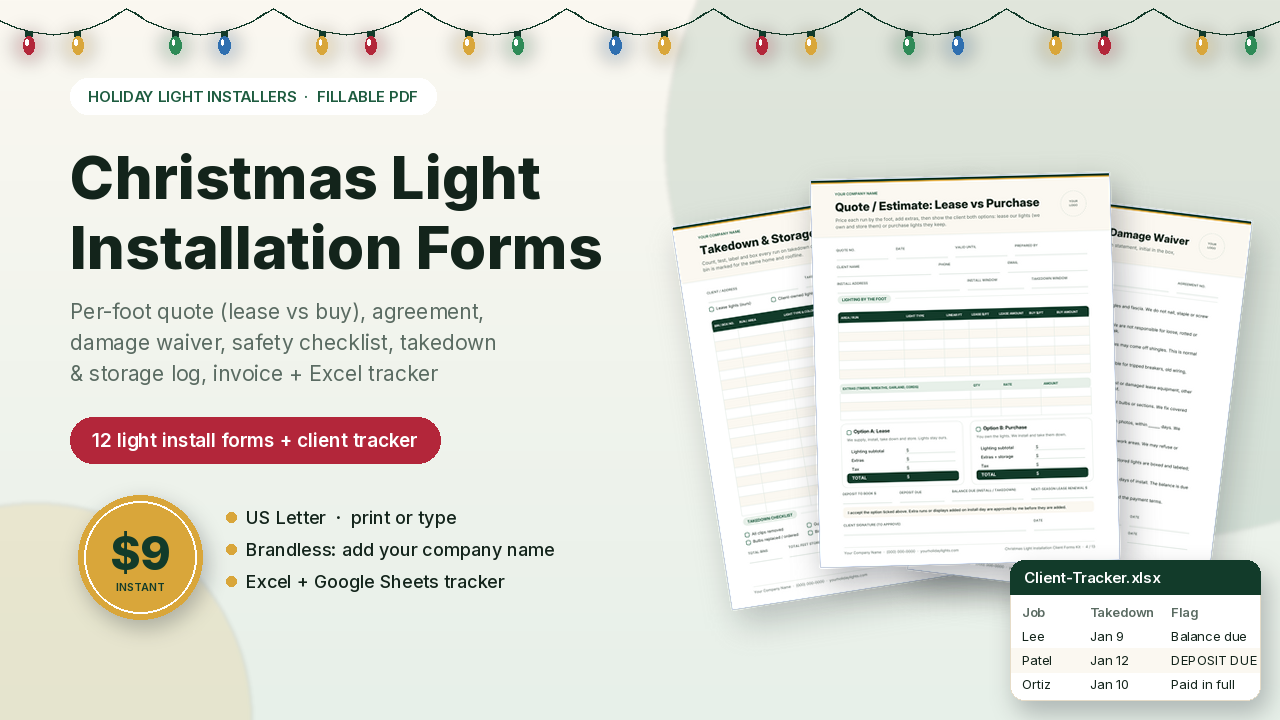
Christmas Light Installation Client Forms Kit
12 fillable forms (intake & roofline info, measurement & design worksheet, per-foot quote with lease vs purchase, service agreement, liability & property damage waiver, ladder / roof safety checklist, takedown & storage inventory, invoice, renewal form and more) plus an Excel client tracker.
Get it →4. Deposit, final and takedown invoices: the billing sequence
Lighting jobs are usually billed in stages. Decide your sequence once, put it in your agreement, and use it for every client so nothing slips during the busy weeks.
| Stage | When | What it covers | Common terms |
|---|---|---|---|
| Deposit invoice | When the agreement is signed | Holds the install date and covers materials | A set percentage or flat amount, due on signing |
| Final (install) invoice | On or right after install day | Balance of the install price plus any approved changes | Due on receipt for residential; a set number of days for commercial |
| Change invoice or line | When the client adds areas or products | Extra footage, trees, wreaths or timers | Billed on the final invoice or as a separate invoice |
| Service call invoice | Only if a call is not included | Extra visits, damage not caused by you | Due on receipt |
| Takedown / storage invoice | Before or at the takedown visit | Removal and storage if not included in the install price | Due before lights are removed, or on receipt |
| Renewal deposit | After takedown or early in the new year | Next season's install date | Often paired with an early-booking offer |
Two rules keep this simple. First, every invoice after the deposit should show the deposit as a payment received, so the client never wonders whether it was credited. Second, takedown should never happen on an account with an unpaid install balance unless you have decided in advance how to handle that. Many installers write in the agreement that removal is scheduled once the account is paid in full, and repeat that on the final invoice.
5. Worked example: a residential lease job
Here is a complete residential invoice. The client signed a lease agreement in early November, paid a 50% deposit, and the display was installed on Friday, November 20, 2026. Removal and storage are included in the lease price. The rates below are placeholders, not a pricing recommendation; see the pricing guide for how to set your own.
| Line | Qty | Rate | Amount |
|---|---|---|---|
| Roofline and garage, C9 warm white (lease) | 140 ft | $4.00 / ft | $560.00 |
| Front trees, trunk and branch wrap (lease) | 2 trees | $75.00 each | $150.00 |
| Lit wreath over garage (lease) | 1 | $45.00 | $45.00 |
| Net lights on front bushes (lease) | 3 bushes | $35.00 each | $105.00 |
| Removal and labeled storage | 1 | Included in lease | $0.00 |
| Subtotal | $860.00 | ||
| Sales tax | Per state and local rules | Not shown | |
| Deposit received Nov 6, 2026 (50%) | −$430.00 | ||
| Balance due on receipt | $430.00 |
The math: 140 × $4.00 = $560, plus 2 × $75 = $150, plus $45, plus 3 × $35 = $105, for a subtotal of $860. Half of that, $430, was paid as a deposit, so $430 is due. The invoice also says: "Lights remain the property of [Business]. One service call is included through December 31. Removal scheduled the week of January 11, 2027, once the account is paid in full."
Because every line has a quantity, next November's renewal quote is already written: same footage, same counts, adjusted for any rate change you announce.
Example only. Client names, footage, rates and dates are made up to show the method. Use your own prices, your own agreement and the tax rules that apply where you work.
6. Worked example: a commercial purchase job with a change order
Commercial accounts (shops, offices, property managers) usually need a formal invoice with a number, a due date and sometimes a purchase order (PO) number before their accounts-payable team will pay. In this example a storefront bought its lights outright, paid a deposit on the original quote, and added 30 feet of roofline on install day.
| Line | Qty | Rate | Amount |
|---|---|---|---|
| Roofline lights sold and installed (original quote) | 220 ft | $6.50 / ft | $1,430.00 |
| Window frames outlined | 4 frames | $60.00 each | $240.00 |
| Outdoor timers | 2 | $25.00 each | $50.00 |
| Change order #1: added side roofline (approved on site) | 30 ft | $6.50 / ft | $195.00 |
| Install subtotal | $1,915.00 | ||
| Sales tax | Per state and local rules | Not shown | |
| Deposit received (50% of original quote of $1,720) | −$860.00 | ||
| Balance due (invoice dated Fri Dec 4, 2026; Net 14, due Fri Dec 18, 2026) | $1,055.00 |
The math: the original quote was 220 × $6.50 = $1,430 plus 4 × $60 = $240 plus 2 × $25 = $50, which is $1,720. The deposit was half of that, $860. On install day the client approved 30 more feet at the same rate, 30 × $6.50 = $195, so the install subtotal is $1,720 + $195 = $1,915. Subtracting the $860 deposit leaves $1,055 due.
Because the lights were sold, takedown and storage are a separate service in this example, billed on their own invoice in January:
| Line | Qty | Rate | Amount |
|---|---|---|---|
| Removal of client-owned lights | 250 ft | $1.25 / ft | $312.50 |
| Labeled storage until next season | 1 season | $75.00 | $75.00 |
| Takedown invoice total (dated Mon Jan 11, 2027; due Mon Jan 25, 2027) | $387.50 |
The removal footage is the 220 original feet plus the 30 added feet, which is 250 feet, and 250 × $1.25 = $312.50. Adding $75 for storage gives $387.50. Notice that the change order carried through to takedown automatically, because it was written on the install invoice as its own line.
Example only. Client names, footage, rates and dates are made up to show the method. Use your own prices, your own agreement and the tax rules that apply where you work.
7. A note on sales tax
Sales tax on holiday lighting is one of the areas where installers most often guess, and it is also one where the answer genuinely depends on where you work. Depending on the state and sometimes the city, the sale of lights, a seasonal lease, installation labor, and takedown or storage may each be treated differently. Some places tax the lights but not the labor, some tax both, and some treat a lease differently from a sale.
On the invoice, the practical steps are the same everywhere: show tax on its own line rather than burying it in your rates, keep products and labor on separate lines so tax can be applied correctly, and keep the resale or exemption certificates that commercial or nonprofit clients give you with that client's file. Before your first invoice of the season, check your state revenue department's guidance or ask an accountant how your specific services are treated. The examples on this page deliberately leave tax out because it varies.
8. Payment terms, due dates and takedown holds
Lighting season is short, so slow payments hurt. The terms you print on the invoice should match the agreement, be specific, and be easy to act on.
| Term | Common wording | When it fits |
|---|---|---|
| Due on receipt | "Balance due on receipt." | Residential clients billed on install day |
| Net 7 / Net 14 / Net 30 | "Due within 14 days of invoice date: [date]." | Commercial accounts with an accounts-payable process |
| Exact due date | "Due by Friday, December 18, 2026." | Always better than terms alone; print the date |
| Late fee | "A late fee of [amount] applies after [date], as set out in the agreement." | Only if your agreement includes it and local rules allow it |
| Takedown hold | "Removal is scheduled once the account is paid in full." | Leased displays, where you need your lights back |
| Payment methods | "Pay by [methods]. Please include invoice number CL-2026-014." | Every invoice |
For residential jobs, sending the final invoice the same day the lights go up, while the client is looking at the finished house, tends to get it paid quickly. For commercial accounts, ask before install day whether they need a PO number, a W-9 or a specific invoice format, so the invoice is not sent back in the middle of December. For gentle follow-up wording when an invoice is late, the late payment email template guide has reminders you can adapt.
9. Service calls, changes and credits
Outages happen: a strand fails, a storm pulls down a section, a pet chews a cord, or a client unplugs the timer. Decide in advance which of these you fix at no charge and which you bill, write it in the agreement, and summarize it on the invoice.
| Situation | Common approach | How it shows on the invoice |
|---|---|---|
| Bulb or strand failure on leased lights | Fixed at no charge during the season | Note: "Service calls for leased lights included through [date]." |
| Storm or wind damage | Often one call included, then billed per visit | Separate service call line with date and reason |
| Damage by others (pets, contractors, vehicles) | Billed per visit plus replacement parts | Line for labor and a line for parts |
| Client adds areas mid-season | Change order at the quoted rate | Change order line with approval date |
| Area removed or not installed | Credit at the quoted rate | A negative line: "Credit: 12 ft not installed" |
| Late install by you | Goodwill credit if you choose | A clearly labeled credit line, not a silent price cut |
Credits and changes should always appear as their own lines. If you quietly change a rate instead, next year's renewal starts from a number nobody remembers agreeing to.
10. Number your invoices and keep a simple log
In a busy season you might send dozens of invoices in a few weeks. A consistent numbering format and one log keep you from losing track of who has paid. A simple format is a prefix, the season year and a running number: CL-2026-001, CL-2026-002 and so on. Deposit, final and takedown invoices for the same client can share a job number with a suffix (for example CL-2026-014-D, -F and -T) if that helps you match them. For more numbering options, see invoice number format.
| Invoice # | Client | Type | Amount | Sent | Due | Paid | Notes |
|---|---|---|---|---|---|---|---|
| CL-2026-014-D | [Client A] | Deposit | $430.00 | Nov 6 | On signing | Nov 6 | Lease, 140 ft |
| CL-2026-014-F | [Client A] | Final | $430.00 | Nov 20 | On receipt | [date] | Removal wk of Jan 11 |
| CL-2026-021-F | [Store B] | Final | $1,055.00 | Dec 4 | Dec 18 | [date] | PO on file; CO #1 +30 ft |
| CL-2026-021-T | [Store B] | Takedown | $387.50 | Jan 11 | Jan 25 | [date] | Purchase; storage 1 season |
Check the log twice a week during the season. Anything past due gets a polite reminder, and any leased display with an open balance gets flagged before takedown scheduling starts. The log also becomes your renewal list: every client in it is someone to contact before next season.
Example only. Client names, footage, rates and dates are made up to show the method. Use your own prices, your own agreement and the tax rules that apply where you work.
11. Use the last invoice to book next season
In holiday lighting, the most valuable invoice is often the one that books next year. The client has just seen their house lit up, and you already have every measurement on file. A short renewal section on the final or takedown invoice can do a lot of the selling for you.
Example wording you can adapt: "Thank you for choosing [Business] this season. Your display measurements are saved. Reserve the same display for [next season] by [date] and lock in this year's rates. Reply to this invoice or call [phone] to hold your install date." Keep any offer simple and put the deadline in writing. A renewal form, signed with a small deposit, turns that wording into an actual booking.
Common invoicing mistakes in lighting season
- One-line invoices. "Holiday lights – $1,200" gives the client nothing to check and you nothing to renew from.
- Not stating lease or purchase. It decides who keeps the lights and whether removal is included.
- Forgetting to credit the deposit. Always show it as a payment received with its date.
- Verbal change orders. Added footage agreed on the driveway should be written down and shown as its own line.
- Terms without a date. Print the actual due date, not just "Net 14".
- Guessing sales tax. Check how your state treats lights, leases and labor before the season starts.
- Taking lights down on unpaid accounts. Decide your takedown-hold rule in advance and print it on the invoice.
- No invoice log. In a compressed season, unpaid balances are easy to forget until January.
One-page invoice checklist
- Business details, invoice number and invoice date
- Client billing details and service address
- Agreement or quote number and install date
- Itemized lines with quantity, unit, rate and amount (same units as the quote)
- Lease or purchase stated clearly
- Takedown and storage: included, billed separately or not included, with the window
- Change orders and credits on their own lines
- Tax on its own line, per your state's rules
- Deposit and other payments shown with dates
- Balance due with an exact due date
- Payment methods and memo instructions
- Service call policy and renewal note
- Entry added to the invoice log
FAQ
What should a Christmas light installation invoice include?
Your business details, an invoice number and date, the client and service address, the agreement reference and install date, itemized lines with quantity and rate, whether the lights are leased or purchased, takedown and storage terms, any tax, payments already received, the balance due with an exact due date, and how to pay.
When should I send the invoice for a Christmas light install?
Most installers invoice a deposit when the agreement is signed and send the final invoice on or right after install day. If takedown and storage are not included in the price, they are usually billed on a separate invoice before or at the takedown visit.
Should removal be on the invoice if it is included?
Yes. Add a line such as "Removal and labeled storage: included" with the planned takedown window. Showing it at $0 prevents disputes later about whether removal was part of the price.
How do I invoice leased lights vs lights the client buys?
State the model on the invoice. For a lease, note that the lights remain your property and that removal is included or scheduled. For a purchase, note that ownership transfers when paid in full and list takedown and storage as separate optional services.
Do I charge sales tax on Christmas light installation?
It depends on your state and sometimes your city. The sale of lights, a seasonal lease, installation labor and storage can each be treated differently. Keep products and labor on separate lines and check your state revenue department or an accountant before the season.
What if a client has not paid when it is time to take the lights down?
Decide this in your agreement before the season. Many installers schedule removal of leased displays only once the account is paid in full, and print that rule on the final invoice so it is not a surprise.
This page is general information for holiday lighting businesses, not tax, legal or accounting advice. Sales tax treatment, late fee rules, licensing and contract requirements vary by state and locality; check with your state revenue department, a qualified accountant or an attorney. All names, rates, footage, dates and amounts shown are examples only.
Related templates
Free Christmas Light Installation Forms
A printable client intake & measurement sheet plus a simple holiday lighting agreement for Christmas light installers.
Download free →Christmas Light Installation Client Forms Kit
Fillable intake, measurement worksheet, per-foot quote, agreement, takedown inventory, invoice and renewal form plus an Excel client tracker.
Get it →