Catering Client Questionnaire: What to Ask Before You Quote an Event
A practical guide for small caterers: the questions to ask on a new event inquiry before you give a price or hold the date, how each answer changes the quote, and what to confirm before the contract.
Why you need a questionnaire before you quote
"How much do you charge per person?" is the first message most caterers get, especially in the weeks before the holiday party season. The honest answer is "it depends." A drop-off lunch of sandwiches and salads for an office of twenty is a very different job from a plated dinner for eighty at a rented hall with no kitchen, a bar, servers, rentals, three guests with severe allergies and a finish time of midnight. Both clients may describe their event as "a small party."
A short pre-quote questionnaire closes that gap. It is the set of questions you ask on a new inquiry before you give a price or hold a date, so you can decide whether the event fits your kitchen, your team and your calendar, which pricing approach makes sense, and what needs to be written into the agreement. It also shows the client that you plan carefully, which matters when they are trusting you with their guests.
This guide covers what to ask and why. For the pricing method itself, see how much to charge for catering. For the signed terms that come after the quote, see the catering contract template. Once an event is booked, the holiday party catering checklist covers the planning timeline from booking to follow-up. If you mainly cook for households on a recurring basis, the personal chef client questionnaire is a better fit. The questionnaire here sits in front of the quote for one-off events.
You can send it as a form link, go through it on a phone call, or fill it in yourself during a consultation. Many caterers do a mix: a few key questions by email or form to decide whether the event is worth a call, then the rest on the call or at a tasting.
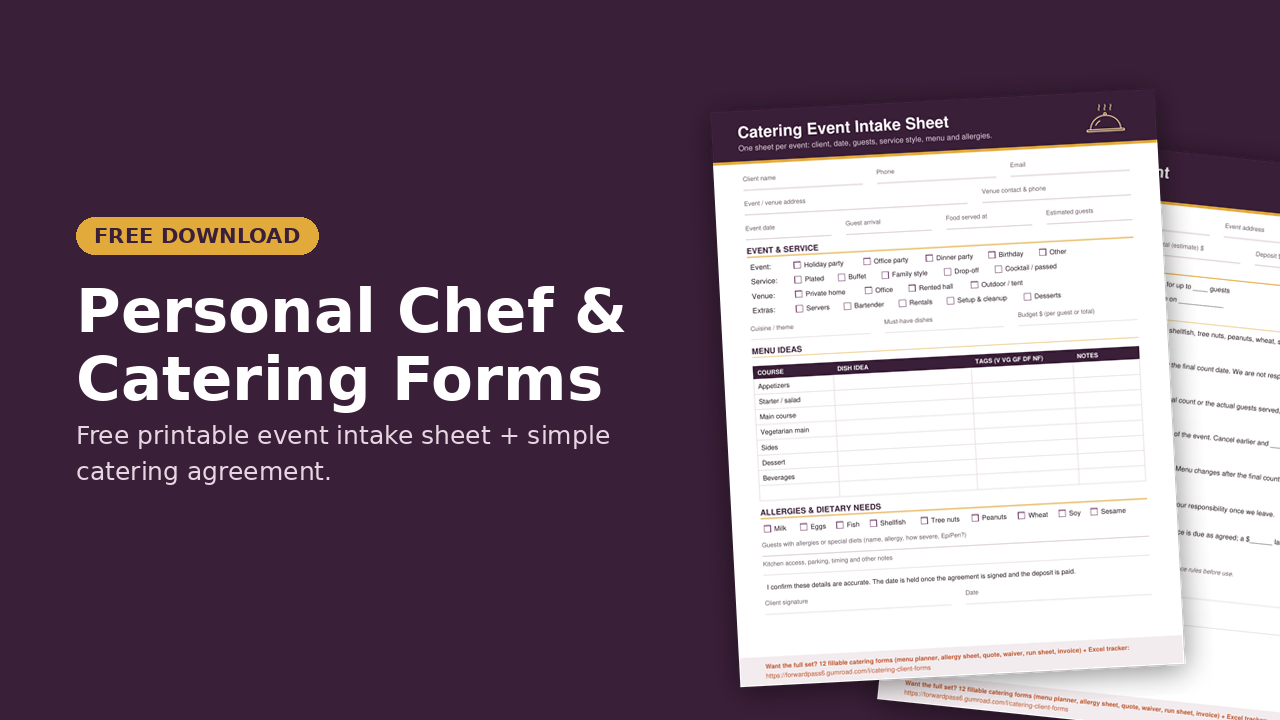
Free Personal Chef & Catering Forms
A printable catering event intake sheet plus a simple catering agreement for personal chefs and small caterers.
Download free →Section 1: Contact details and the event basics
Start with the facts that tell you whether you can take the event at all. If the date is already booked or the venue is outside your service area, you can say so quickly and save everyone time.
- Client name, phone number, email and preferred contact method
- Is the client the host, an assistant, an office manager or an event planner? Who approves the menu, signs the agreement and pays?
- Is there a day-of contact who is not the host (the host is usually busy with guests)?
- Event date, start and end time, and whether the date is fixed or flexible
- Type of event: office party, family holiday dinner, open house, birthday, wedding-related event, fundraiser, corporate meeting
- Venue name and address, or "private home"
- Is the event indoors, outdoors, or both? Is there a weather backup?
- How did they hear about you, and have they worked with a caterer before? What did they like or dislike?
Ask early whether the event is a surprise or private, so you know whether you can contact the venue directly and whether you can post photos afterwards.
Section 2: Guest count and service style
Guest count and service style drive almost every number in a catering quote: food quantity, staff, equipment, rentals and time on site. Ask for both before you talk about price.
- Estimated guest count now, and how confident they are in it (a firm list or a guess?)
- Adults and children, and whether children eat from the same menu
- When can they give you a final count? (Your contract will set the deadline, but ask now so the client is not surprised.)
- Style of service: drop-off, buffet, family style, food stations, passed appetizers, plated meal, or a mix
- Is this a full meal or appetizers only? Is there dessert?
- Will guests arrive at once, or come and go over several hours, as at an open house?
| Service style | What it usually changes in the quote (example only) |
|---|---|
| Drop-off | Packaging and delivery; disposable or returnable serveware; [setup or no setup]; no staff on site |
| Buffet | Chafing dishes and fuel; buffet tables; [number of staff to replenish and clear] |
| Family style | Platters per table; more serveware; staff to carry and clear |
| Food stations | Equipment per station; possibly a chef at a station; more space needed |
| Passed appetizers | More servers; number of pieces per guest per hour; [trays and napkins] |
| Plated meal | Most staff and plating time; china and glassware; timing with speeches or programs |
Write the style down in the client's words, then confirm it in yours. "Buffet" means different things to different people; some expect staff serving at the line, others expect a self-serve table.
Section 3: Menu direction, allergies and dietary needs
You do not need a final menu at the inquiry stage, but you need a direction. A rough sense of cuisine and formality tells you which sample menus to send and which price range to start from.
- Cuisine or theme: classic holiday, regional, comfort food, a specific cuisine, or "surprise us"
- Formality: casual, business casual, dressy
- Must-have dishes, family recipes or anything the host has promised guests
- Dishes or ingredients they do not want
- Do they want a tasting before they book? Is a tasting free, credited to the booking, or charged separately?
Then ask about allergies and diets as a separate question, not as part of "preferences."
- Are there guests with food allergies? Which allergens, and how severe?
- Vegetarian, vegan, gluten-free, dairy-free, halal, kosher-style or other diets, and roughly how many guests
- Do they want allergen labels or dietary tags on buffet items?
- Will the host collect dietary needs from guests, or should you provide a form?
Be clear about what your kitchen can and cannot do. If you cannot prepare food in an allergen-free environment, say so in writing rather than promising "safe" meals. The details of how you handle allergies belong in your agreement and any allergy waiver you use; the questionnaire's job is to surface them before you quote.
Section 4: Venue, kitchen and logistics
Many catering problems start at the venue: no oven, no water, a loading dock that closes at five, or a third-floor walk-up. Ask about the space before you price, because it changes your equipment list and your time on site.
- Is there a kitchen at the venue? What equipment: oven, stove, refrigerator space, sinks, outlets?
- Will you cook on site, finish on site, or bring everything ready to serve?
- Load-in: parking, loading area, stairs or elevators, distance from vehicle to kitchen
- Earliest access time and the time you must be fully out, including cleanup
- Does the venue have its own rules for caterers, such as an approved vendor list, proof of insurance, a kitchen fee or a cleanup checklist?
- Tables, chairs and linens: does the venue provide them, or does someone need to rent them?
- Trash, recycling and food waste: who removes it?
- For private homes: kitchen size, pets, where staff can set up and park
If you have not worked at the venue before, ask for photos of the kitchen or a short walkthrough. Confirm anything that affects food safety, like refrigeration and hot-holding, before you commit to a menu.
Section 5: Staffing, rentals and bar
Staff, rentals and the bar are often where a catering quote is under-priced, because the client assumes they are "included." Ask about each one so you can price it as its own line.
- Do they want staff on site? Servers, a chef on site, bartenders, a captain or event lead?
- Do they expect staff to set up tables, clear plates, cut a cake, or help with cleanup beyond the food?
- Rentals: plates, glassware, flatware, linens, chafing dishes, tables, tents, heaters. Do they want you to arrange them, or will they rent directly?
- Disposable or real serveware? Some clients have strong preferences for one or the other.
- Bar: is there alcohol? Who supplies it? Do they want a bartender, and does the venue or your location require a licensed or insured bartending service?
- Non-alcoholic drinks, coffee and water service
If you do not handle alcohol, say so early and point the client to a separate bartending service. If you do, the mobile bartender client questionnaire covers the bar-specific questions.
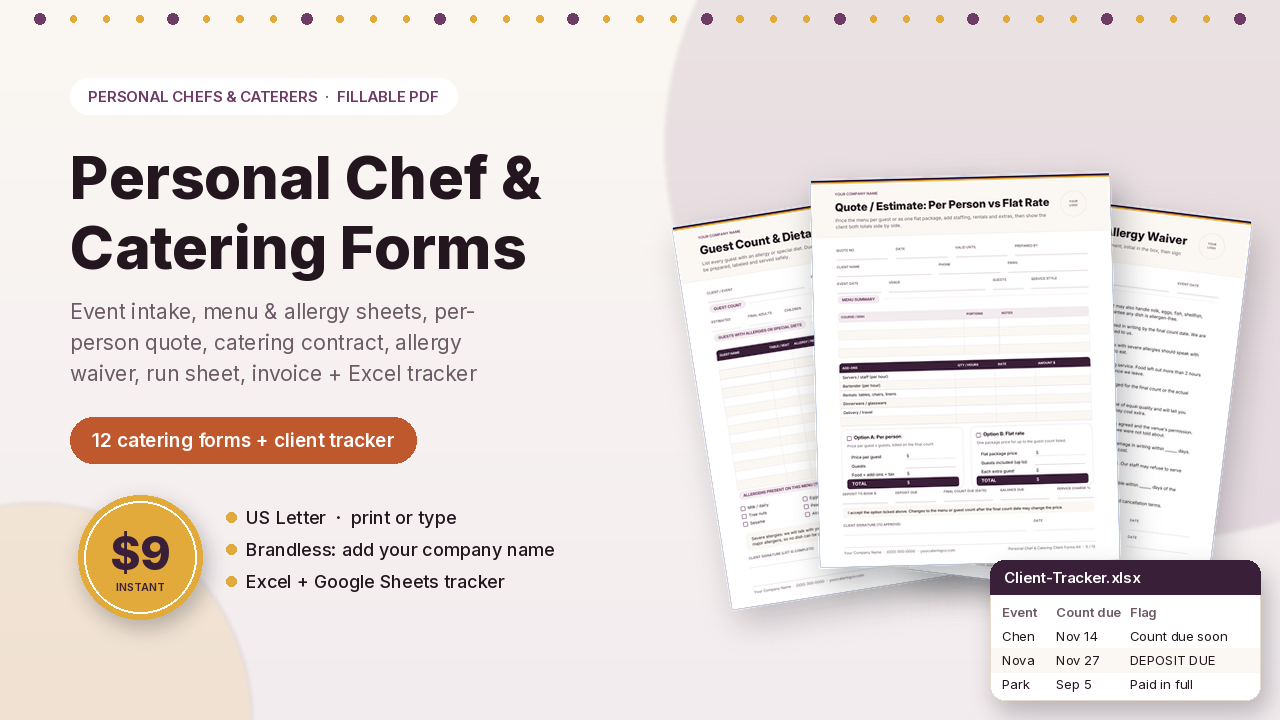
Personal Chef & Catering Client Forms Kit
12 fillable forms (event intake, menu planning & tasting worksheet, guest count & allergy sheet, per-person vs flat-rate quote, catering service agreement, food allergy waiver, run sheet, grocery & prep list, invoice and more) plus an Excel client tracker.
Get it →Section 6: Timeline on the day
An event timeline tells you how long your team is on site, which is a large part of staff cost. Ask for the shape of the day even if the details change later.
- Guest arrival time and when food should be ready
- Is there a program, speeches, a toast, a gift exchange or a performance that the food has to work around?
- When is the main meal, and when is dessert?
- How long should food stay out? (This matters for food safety as well as for staffing.)
- When does the event end, and when must cleanup be finished?
- Are there other vendors arriving (rentals, a DJ, a photographer, a florist) whose timing affects yours?
You will build the full event-day run sheet after booking. The holiday party catering checklist shows one way to do that. At the inquiry stage, you only need enough to estimate hours on site.
Section 7: Budget and terms preview
Ask about budget directly. Many clients will give a number or a range if you ask politely, and it saves you from building a menu they cannot afford. Then preview your main terms so there are no surprises in the contract.
| Question | How you might phrase it (placeholders only) |
|---|---|
| Budget | "Do you have a budget range in mind for food and service? [range] helps me suggest the right menu." |
| Pricing basis | "I usually quote [per person / flat rate / per person plus staff and rentals]." |
| Deposit | "A [deposit amount or percentage] deposit holds the date; the balance is due [date or terms]." |
| Final count | "The final guest count is due [number] days before the event." |
| Changes and cancellations | "Changes after [date] may affect the price; cancellation terms are in the agreement." |
| Service charges and gratuity | "[Service charge / gratuity policy] and [applicable tax] are shown separately on the quote." |
Use your own amounts and policies. The point of the preview is that the client hears about the deposit, final count deadline and cancellation terms before they see the contract, so the contract confirms what you already discussed.
Turning the answers into a quote
Once you have the answers, the quote mostly writes itself. Each section of the questionnaire maps to one or more lines on the estimate. The pricing method is covered in catering pricing; the table below shows how the answers feed into it.
| Questionnaire answer | How it shows up in the quote (example only) |
|---|---|
| Guest count and adults vs children | Number of servings; [per-person rate] x [guests]; child pricing if you offer it |
| Service style | Food quantity, serveware, equipment and staff needed |
| Menu direction and dietary needs | Menu choice; separate dishes for dietary needs; [labeling] |
| Venue and kitchen | On-site cooking vs ready to serve; equipment you bring; [kitchen or venue fees] |
| Staffing | [Number of staff] x [hours] at [staff rate], shown as its own line |
| Rentals and bar | Rental items at cost or with your handling fee; bar service if you offer it |
| Timeline | Hours on site for staff; setup and cleanup time |
| Distance and access | Travel or delivery fee; extra time for difficult load-in |
Send the quote with a short summary of the key answers ("80 guests, buffet, 3 servers, venue kitchen with oven, you are renting tables and linens directly"). If something in the summary is wrong, the client will tell you before they sign, not on the day.
Common mistakes
- Quoting per person before you know the service style. A per-person price for drop-off and the same price for a plated dinner with servers cannot both be right.
- Treating allergies as a preference. Ask about allergies as their own question and record severity. Do not promise what your kitchen cannot guarantee.
- Skipping the venue questions. No oven, no refrigeration or a strict load-in window changes the menu and the staffing.
- Assuming staff, rentals or cleanup are understood. Ask, then list them as separate lines.
- Holding a date without a deposit. A questionnaire is not a booking. Hold the date only with a signed agreement and the deposit your terms require.
- Not asking who pays. On office and family events, the person who inquires is not always the person who signs.
- Leaving the final count open. Mention the final count deadline at the inquiry stage so it is not a surprise in the contract.
One-page catering questionnaire checklist
- Contact name, phone, email, decision-maker and payer
- Day-of contact
- Event type, date, start and end time
- Venue address, indoor or outdoor, weather backup
- Estimated guest count, adults and children, final count timing
- Service style (drop-off, buffet, family style, stations, passed, plated)
- Meal type and dessert
- Cuisine, formality, must-haves and dislikes
- Tasting wanted? Terms?
- Allergies (with severity) and dietary needs, labeling
- Venue kitchen equipment, cooking on site or ready to serve
- Load-in, access times, venue rules for caterers
- Tables, chairs, linens, serveware and rentals
- Staff needed and duties
- Bar and drinks
- Timeline on the day, program and other vendors
- Budget range
- Terms preview: deposit, balance, final count, changes, cancellation, service charge
Keep the form short enough that a client will finish it. You can always ask follow-up questions on the call.
FAQ
What should a catering client questionnaire include?
Event basics (date, time, venue, type of event), guest count and service style, menu direction, allergies and dietary needs, venue kitchen and logistics, staffing, rentals and bar, the timeline on the day, budget, and a preview of your deposit, final count and cancellation terms.
When should I send the questionnaire?
As soon as a new inquiry comes in, before you give a price or hold the date. A few key questions (date, guest count, venue, service style) tell you whether the event fits; the rest can be covered on a call or at a tasting.
Is a catering questionnaire the same as a catering contract?
No. The questionnaire collects information so you can quote. The contract sets the agreed menu, price, deposit, final count deadline, cancellation terms and other conditions, and both sides sign it. The questionnaire answers feed into the contract.
How is this different from a personal chef questionnaire?
A personal chef questionnaire focuses on recurring household service: weekly meal prep, preferences, groceries and kitchen access. A catering questionnaire focuses on a single event: guest count, service style, venue, staff, rentals and the event timeline.
Should I ask the client for a budget?
Yes. Asking for a range is normal and helps you suggest a menu and service style that fits. If the client does not want to share a number, offer two or three sample menus at different levels.
How should I ask about food allergies?
Ask about allergies as a separate question from food preferences, record which allergens and how severe, and ask whether the host will collect guest needs. Be clear in writing about what your kitchen can and cannot guarantee.
This page is general information for caterers and food businesses, not legal, insurance, food safety or licensing advice. Rules on catering licenses, food handling, allergen labeling, alcohol service, contracts, deposits and cancellations vary by location. Check the current requirements that apply to you and have your own forms and agreements reviewed.
Related templates
Free Personal Chef & Catering Forms
A printable catering event intake sheet plus a simple catering agreement for personal chefs and small caterers.
Download free →Personal Chef & Catering Client Forms Kit
Fillable catering and personal chef forms plus an Excel client tracker with deposits, final counts and balances due.
Get it →