How Much Food Per Person: A Caterer's Portion Planning Worksheet for Holiday Parties (+ Free Forms)
A practical method for caterers, personal chefs and hosts: turn guest count, service style and menu into clear per-person portions and a shopping list, with worked examples you can copy and adjust for holiday parties, office lunches and New Year's events.
Why portions deserve their own worksheet
Every holiday inquiry ends with the same worry: “Will there be enough food?” Make too little and the buffet is empty before the last guests arrive. Make too much and you have paid for food nobody eats, or you priced the job so high that you lost it to a competitor.
A short written portion plan fixes both problems. It turns a guest count and a menu into numbers your kitchen can shop and prep from, it shows the client how you got there, and it gives you a record to improve after every event. This guide walks through the method step by step, then puts it together in a worked holiday party example you can copy.
This page is about quantities. To collect the event details first, see the catering client questionnaire guide. For what to charge, see catering pricing; for terms such as the final guest count deadline, see the catering contract template guide; and for the full timeline, see the holiday party catering checklist.
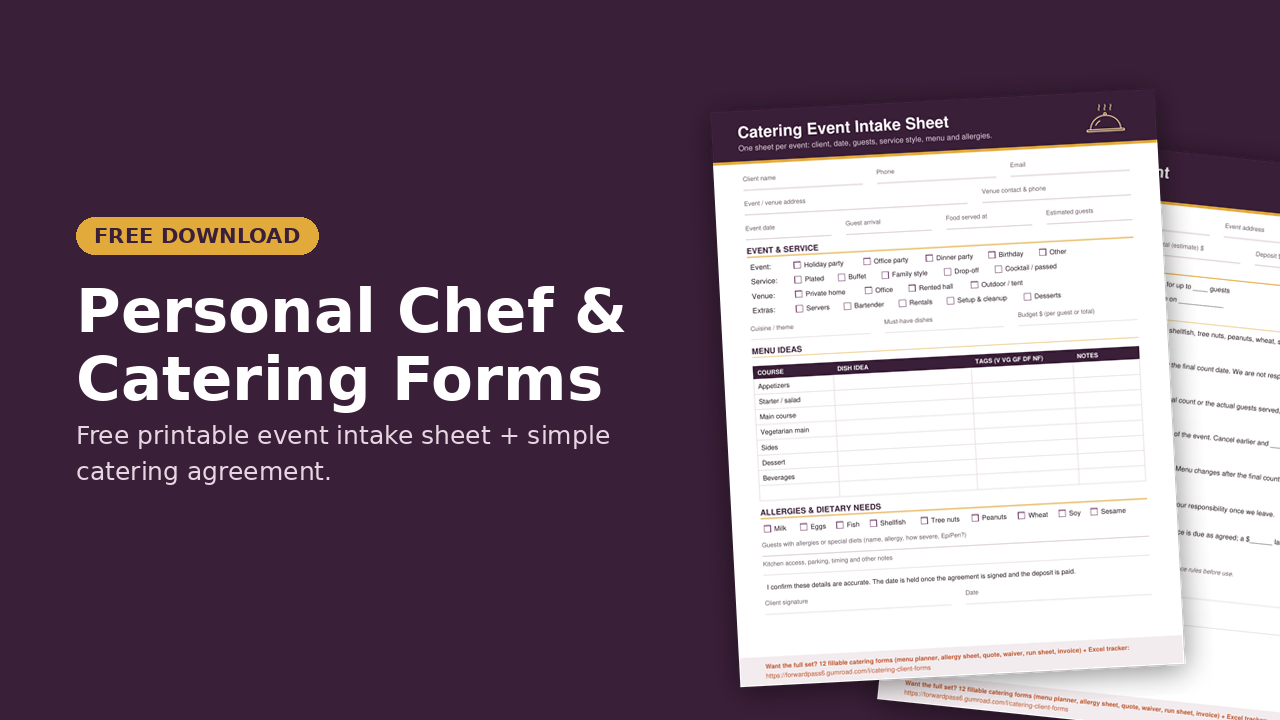
Free Catering Forms
A printable catering event intake sheet plus a simple catering service agreement for personal chefs and small caterers.
Download free →What you need to know before you calculate
Portion math is simple. The inputs are where most mistakes happen. Get these in writing before you build the list:
| Input | Why it matters | Where it comes from |
|---|---|---|
| Guest count (adults and children) | The base for every quantity; children usually eat smaller portions | Intake form, then a confirmed final count |
| Meal or not | A full dinner, a heavy appetizer party and a dessert reception need very different amounts | Conversation with the client |
| Time of day and length | A party over a mealtime needs more food than one in the mid-afternoon; a long event needs more appetizers | Intake form and run sheet |
| Service style | Buffet, family style, plated and passed appetizers each change how much people take | Quote and agreement |
| Menu and number of choices | More dishes means smaller portions of each, but a larger total | Menu planning worksheet |
| Dietary needs and allergies | Vegetarian, vegan, gluten-free or allergy meals need their own counts | Guest count and dietary sheet |
| Other food at the event | Desserts from a bakery, a grazing table or a bar menu change what you need to make | Client and other vendors |
If the client cannot confirm the guest count yet, plan a low and a high number, quote both, and set a final count date in the agreement.
Step 1: Decide what kind of meal it is
The single biggest factor is whether guests expect a meal. Write the answer at the top of the worksheet, because it changes every number below it.
| Event type (example) | What guests expect | How to plan |
|---|---|---|
| Seated holiday dinner | A full meal | Full portions of protein and sides, plus a few appetizers and dessert |
| Buffet over a mealtime | A full meal, served by themselves | Full portions, slightly higher for popular dishes, with a buffer |
| Cocktail party in place of dinner | Enough to count as dinner | Heavy appetizers: more pieces, more variety, some substantial items |
| Cocktail hour before dinner | A light start | A few appetizer pieces per guest, then the meal |
| Afternoon open house | Snacks and sweets | Lighter appetizers, a grazing board and desserts |
| Dessert reception | Sweets and coffee | Dessert servings only, with a few savory bites if the client wants |
Example only. Adjust for your menu, your recipes, your guests and your own yield tests.
Step 2: Start from per-person portions
Many caterers and cookbooks use similar starting portions for a meal. Treat them as a first draft, not a rule: your guests, your recipes and the number of dishes on the menu all change the real amount. The portions below are cooked, ready-to-serve amounts for an adult at a full meal with one main protein.
| Item | Starting portion per adult (example) | Notes |
|---|---|---|
| Main protein, boneless (chicken, beef, fish, pork) | About 6 to 8 oz cooked | Reduce each protein when you serve two or more |
| Bone-in protein (ribs, bone-in chicken, ham on the bone) | More than boneless, since bones add weight | Plan by pieces or by yield tests from your own recipe |
| Starchy side (potatoes, rice, pasta, stuffing) | About 4 to 5 oz, or roughly 1/2 to 3/4 cup | Less when there are several sides |
| Vegetable side | About 3 to 4 oz, or roughly 1/2 cup | Roasted vegetables shrink; plan raw weight higher |
| Green salad | About 1 to 1 1/2 cups of greens | Plus dressing and toppings |
| Bread or rolls | About 1 to 2 rolls | Plus butter |
| Gravy or sauce | A few tablespoons to about 1/4 cup | Holiday dinners often need more than you expect |
| Dessert | About 1 serving, or 2 to 3 mini desserts | More if dessert is the main event |
Example only. Adjust for your menu, your recipes, your guests and your own yield tests.
Some planners use roughly a pound of food per adult for a full meal as a quick sanity check, but build your list item by item rather than from a single total, so nothing gets missed.
Step 3: Adjust for several dishes and service style
When guests can choose from several proteins or sides, most people take a little of each. The total goes up a bit, but each individual dish needs less than a full portion.
| Situation | How to adjust (example) |
|---|---|
| One main protein | Full starting portion per guest |
| Two proteins | Plan each at a bit more than half a portion, since guests often take some of both |
| Three or more proteins | Plan each at a smaller share, and make extra of the one you expect to be most popular |
| Two sides | Close to a full portion of each |
| Four or more sides | Smaller portion of each; the total still grows |
| Plated service | The most predictable: you control the portion, so plan close to the count plus a few spare plates |
| Buffet service | Guests serve themselves and early guests often take more; add a buffer, especially on proteins |
| Family style | Platters per table; plan by table size and refill from the kitchen |
Example only. Adjust for your menu, your recipes, your guests and your own yield tests.
Write the adjustment beside each dish on the worksheet, for example “salmon 0.6 portion, chicken 0.6 portion”. It makes the shopping list easier to check and easier to explain to the client.
Step 4: Plan appetizers by pieces per hour
Appetizers are easiest to plan by the number of pieces per guest. A common starting assumption is a few pieces per guest per hour, with more in the first hour and more when appetizers replace dinner.
| Appetizer situation | Starting estimate per guest (example) | Variety (example) |
|---|---|---|
| Short cocktail hour before a full dinner | About 4 to 6 pieces in total | 3 to 5 kinds |
| Two to three hour party, dinner served later or elsewhere | About 6 to 10 pieces in total | 5 to 7 kinds |
| Heavy appetizers in place of dinner | About 12 to 15 pieces or more in total | 7 or more kinds, including some substantial items |
| Grazing or charcuterie board | Plan by weight of cheese, meat, crackers, fruit and dips, from your own recipe | Several items per category |
Example only. Adjust for your menu, your recipes, your guests and your own yield tests.
To turn this into kinds and trays, divide the total pieces by the number of appetizer kinds, then round up to full trays or batches. Mix light items (crudités, crostini) with filling ones (sliders, skewers, meatballs) when the appetizers are the meal.
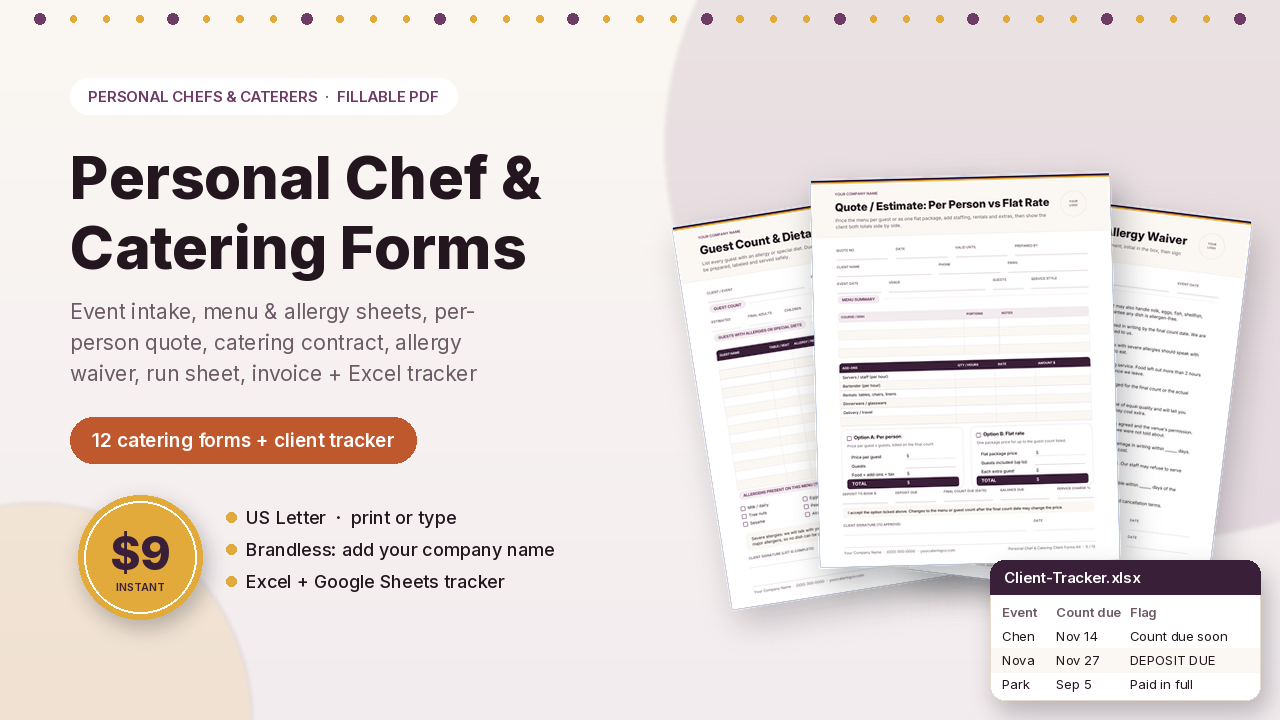
Personal Chef & Catering Client Forms Kit
Fillable event intake, menu planning and tasting worksheet with portions, guest count and dietary / allergy sheet, per-person vs flat-rate quote, catering service agreement, allergy waiver, run sheet, grocery and prep list with food cost per guest, and more, plus an Excel client tracker.
Get it →Step 5: Convert cooked portions into raw amounts
The portions above are cooked. Raw meat, poultry and vegetables lose weight when cooked, and trimming, bones and skin reduce the usable amount further. Use your own yield tests whenever you can: weigh the raw product, cook it the way you will on the day, weigh what you can actually serve and write down the percentage.
The formula is:
Raw amount to buy = guests × cooked portion ÷ your yield percentage
| Item (example) | Cooked portion | Your yield (from your test) | Raw amount per guest |
|---|---|---|---|
| Boneless roast | 6 oz | [your yield %] | 6 oz ÷ yield |
| Bone-in ham | 6 oz served | [your yield %] | 6 oz ÷ yield |
| Roasted vegetables | 4 oz | [your yield %] | 4 oz ÷ yield |
| Rice or pasta (dry) | 1/2 to 3/4 cup cooked | Check the package for cooked volume | Per package directions |
Example only. Adjust for your menu, your recipes, your guests and your own yield tests.
If you have not run a yield test yet, follow your recipe or the supplier's guidance, round up, and record the result after the event so next time the number is your own.
Worked example: 40-guest office holiday buffet
A client books a buffet dinner for 40 adults from 6 to 9 pm, with a short appetizer hour, two proteins, three sides, salad, rolls and dessert. Here is how the worksheet comes together.
| Item | Calculation (example) | Plan |
|---|---|---|
| Appetizers (3 kinds) | 40 guests × about 5 pieces | About 200 pieces, about 70 of each kind |
| Roast turkey breast | 40 × about 4 oz cooked (two proteins) | About 10 lb cooked, then convert to raw with your yield |
| Glazed ham | 40 × about 4 oz cooked | About 10 lb cooked, then convert to raw with your yield |
| Mashed potatoes | 40 × about 4 oz | About 10 lb |
| Roasted vegetables | 40 × about 3 oz | About 7.5 lb cooked; buy more raw |
| Stuffing | 40 × about 3 oz | About 7.5 lb |
| Green salad | 40 × about 1 cup | About 40 cups of greens, plus dressing |
| Rolls | 40 × about 1.5 | 60 rolls |
| Gravy | 40 × about 3 tablespoons | About 7.5 cups; round up to about 2 quarts |
| Dessert | 40 × 1 slice or 2 minis | 40 slices or 80 minis |
Example only. Adjust for your menu, your recipes, your guests and your own yield tests.
Add a small buffer on the proteins and the most popular side, note it on the worksheet, and share the summary with the client before you shop.
Kids, dietary meals and allergies
Count children separately. Young children usually eat much less than adults, while teenagers may eat as much or more, so ask the client for ages rather than just a number. Many caterers count small children at around half an adult portion, but agree how you will count them in the quote.
Vegetarian, vegan, gluten-free and allergy meals need their own lines on the worksheet. Plan a full portion of the alternative for each guest who needs it, plus a few extra, because other guests often take some. For allergies, record each guest, the allergen and how severe it is, keep those meals labeled and separate, and follow your own food safety and allergen procedures.
| Guest group (example) | How to count | What to record |
|---|---|---|
| Adults | Full portions | Final count |
| Young children | A reduced portion, as agreed with the client | Number and ages |
| Teenagers | Often full adult portions | Number |
| Vegetarian or vegan | A full alternative main plus a few extra | Names or table numbers if plated |
| Allergy meals | Individually prepared and labeled | Guest, allergen, severity, substitute meal |
Example only. Adjust for your menu, your recipes, your guests and your own yield tests.
Holiday and New Year's adjustments
| Situation | Adjustment (example) |
|---|---|
| Traditional holiday dinner | Guests expect the classics; make extra of favorites such as stuffing, potatoes and gravy |
| Open house with guests coming and going | Plan by peak attendance, not total invitations, and refill in waves |
| Office party right after work | Guests may arrive hungry; front-load substantial appetizers |
| New Year's Eve party running late | Add a late-night snack round (sliders, flatbreads, sweets) instead of more of everything |
| Holiday cookie or dessert table | Plan several small sweets per guest instead of one large dessert |
| Weather or travel risk | Agree in writing what happens to food costs if attendance drops |
Example only. Adjust for your menu, your recipes, your guests and your own yield tests.
Buffers, leftovers and food safety
A buffer protects the event; too much buffer protects nobody. Decide on your buffer, write it on the worksheet and include it in the quote, so the client understands why the list is slightly above the guest count.
Agree in advance what happens to leftovers. Some clients want them packed; some venues or local rules do not allow it. Put the answer in your agreement. For safety, follow your local food safety rules and current USDA guidance: keep hot food hot (140°F or above) and cold food cold (40°F or below), and do not leave perishable food at room temperature for more than 2 hours (1 hour when it is above 90°F). Replace buffet trays with fresh ones rather than topping up old trays.
Common portion planning mistakes
- Using the invitation count instead of the confirmed final count.
- Giving every protein a full portion when there are two or three.
- Forgetting that appetizers replace dinner at a cocktail party.
- Buying cooked weights instead of raw weights.
- Not counting children, vegetarian or allergy meals separately.
- Running short on gravy, sauces, bread and butter.
- Not recording what was left over, so the same mistake repeats next event.
One-page portion planning checklist
- Confirm guest count, children, dietary and allergy meals.
- Write meal type, time and service style at the top.
- List every dish with its per-person portion and adjustment.
- Plan appetizer pieces per guest and kinds.
- Convert cooked portions to raw amounts using your yield.
- Add a written buffer on proteins and favorites.
- Build the grocery and prep list from the totals.
- Share the summary with the client and set the final count date.
- After the event, record leftovers and adjust your numbers.
FAQ
How much food do I need per person for a party?
For a full meal, many caterers start with about 6 to 8 oz of cooked boneless protein, a few side portions, salad, bread and a dessert per adult. Reduce each dish when there are several choices, and plan by appetizer pieces when there is no meal. Treat these as starting points and adjust for your guests.
How many appetizers per person do I need?
A common starting point is about 4 to 6 pieces per guest before a full dinner, and about 12 to 15 pieces or more when appetizers replace dinner. Longer events and hungry crowds need more, so adjust for the time of day and the crowd.
How much meat per person for a buffet with two proteins?
Guests often take some of both, so each protein needs a bit more than half a full portion. Plan each protein at a reduced share, add a little buffer on the more popular one, and convert cooked amounts to raw with your own yield.
Should I plan for more food at a buffet than a plated dinner?
Usually yes. At a buffet guests serve themselves and early guests may take more, so many caterers add a buffer. Plated service is easier to predict because you control the portion.
How do I count children when planning food?
Ask for ages. Young children usually eat less, while teenagers may eat adult portions. Agree in the quote how children are counted and priced.
What should I do with leftover catering food?
Agree on it in writing before the event. Some clients want leftovers packed and some venues or local rules do not allow it. Follow food safety guidance on time and temperature, and record what was left over to improve your next plan.
This page is general information for caterers, personal chefs and hosts, not food safety, legal or health advice. Food safety rules, licensing and allergen requirements vary by location, so check the rules that apply to you or talk to a professional if you are unsure. Portions, adjustments, recipes and example entries shown are examples only.
Related templates
Free Catering Forms
A printable catering event intake sheet plus a simple catering service agreement for personal chefs and small caterers.
Download free →Personal Chef & Catering Client Forms Kit
Event intake, menu and portion planner, guest count and allergy sheet, quote, agreement, grocery and prep list and more, plus an Excel tracker.
Get it →