Pressure Washing Client Questionnaire: What to Ask Before You Quote
A practical guide for pressure washing and soft washing businesses: the questions to ask a prospective client before you give a price, how each answer changes the quote, and what to have ready once they book.
Why you need a questionnaire before you quote pressure washing
"How much to pressure wash my house?" is a message every exterior cleaning business gets, usually with nothing more than a zip code. The honest answer is "it depends." A single-story vinyl house with light green algae on the north side and a two-story stucco home with rust stains, a steep driveway, no outside spigot and a koi pond under the eaves are completely different jobs, even if the square footage on the listing is similar.
A short pre-quote questionnaire fixes that. Sent by text, email or a simple online form as soon as someone asks for a price, it collects the details that actually drive your time, chemicals and risk: which surfaces they want cleaned, how big they are, what they are made of, how dirty they are, how you will get water and equipment to them, and their budget. It is not the same as the documents you use later. Your pressure washing estimate is the written quote you send back, with line items and totals; your pressure washing contract records the terms and the property waiver once they book; and pressure washing pricing explains how to set per-square-foot, flat and minimum-job rates. The questionnaire has one narrower job: give you enough information to write an accurate estimate quickly, often without a separate site visit. Below are the sections to include, the questions in each, and how to turn the answers into a price.
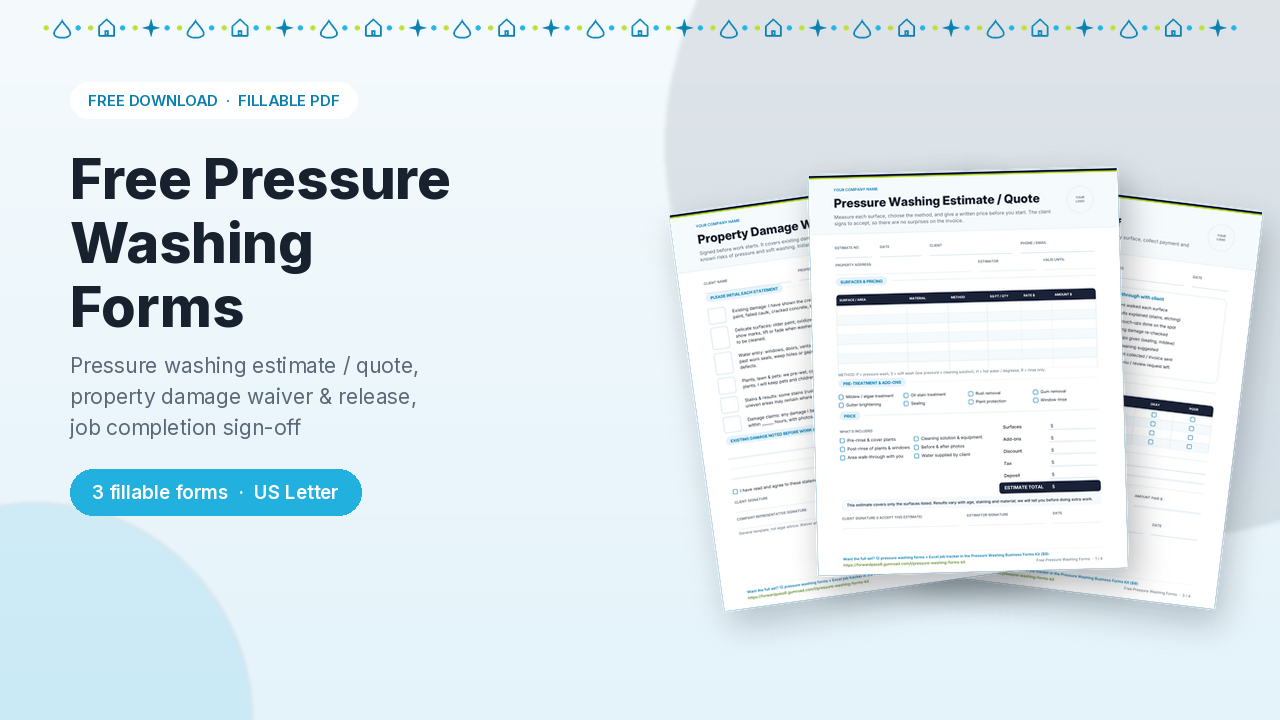
Free Pressure Washing Forms
A printable estimate form plus a simple service agreement for pressure washing and soft washing jobs.
Download free →Section 1: Contact details and the property
- Client name, phone number, email and preferred contact method
- How they heard about you, and whether a neighbor is also interested (a second job on the same street saves a trip)
- Service address, and whether it is a house, townhome, condo, rental, storefront or other commercial property
- Do they own the property, or rent it? If renting, has the landlord or property manager approved the work, and who pays?
- Is there an HOA or condo association that controls exterior work, approved contractors, work hours or where trucks can park?
- Number of stories, and roughly how old the home is
- Is the house being sold, painted, or prepared for an event? Is there a deadline?
The address lets you check travel time and look at the property with an online street or satellite view, which is often enough to confirm the number of stories, the driveway shape and whether there is a fence or pool. Treat those images as a starting point, since they can be out of date. Asking about the owner, the HOA and the reason for the cleaning early prevents two common problems: a renter booking work the landlord never approved, and a client who expects a pre-sale or pre-paint level of cleaning without saying so.
Section 2: Surfaces to clean and how big they are
Ask the client to list every surface they want cleaned, then get a rough size for each. People often say "the house" when they also mean the driveway, the fence and the back patio.
- House siding: all sides, or only the sides with visible growth?
- Roof (soft wash only), gutters (outside faces, or also cleaning out the debris inside?), soffits and fascia
- Driveway, walkways, front steps, curb or sidewalk strip
- Patio, pool deck, pavers, retaining walls
- Wood or composite deck, railings and stairs
- Fence: material, approximate length and height, one side or both sides?
- Other items: outdoor furniture, playsets, garage door, dumpster pad, storefront, signs
- Approximate sizes, if they know them: driveway length and width, deck size, fence length
| Surface | What usually drives the quote (example only) |
|---|---|
| House siding | Stories, total wall area, material and growth; [price per sq ft or per house size] |
| Driveway and walkways | Square footage, surface type and stains; [price per sq ft] |
| Patio, pool deck or pavers | Area, joints, sand or sealer, nearby plants; [price per sq ft] |
| Wood deck and railings | Area, rails and stairs, wood condition, low pressure needed; [deck price] |
| Fence | Length, height, material, one or both sides; [price per linear ft] |
| Roof (soft wash) | Pitch, height, material and access; [roof price], if offered |
| Gutter faces | Linear feet and stories; [price per linear ft] |
Many operators set a minimum job charge so small requests still cover travel and setup. A list of surfaces with rough sizes, plus photos, lets you build the estimate surface by surface instead of guessing one round number.
Section 3: Condition, stains and photos
Condition decides your method, your chemicals and how long each surface takes. Ask neutral questions and request daylight photos of each surface, close up and from a distance:
- What do they see: green or black growth, black streaks, dirt, pollen, spider webs?
- Any oil, grease, tire marks, rust, fertilizer, irrigation or hard-water stains, paint, gum or graffiti?
- When was each surface last cleaned, and how (by a company, a rented machine, by hand)?
- Has the deck, fence or concrete been sealed or stained, and when?
- Is any paint chalking, peeling or flaking? Any loose siding, cracked stucco or soft wood?
- Are they hoping every stain will disappear, or mainly want an overall clean look?
Organic growth usually responds well to a soft wash approach, while some stains, such as rust, oil and irrigation marks, need specific treatments and may only lighten rather than disappear. Saying this before you quote, and writing it on the estimate, is the easiest way to avoid an unhappy client. Peeling paint, damaged siding and soft wood are worth flagging in writing as well, because washing can loosen material that was already failing. Explain that the quote assumes the property matches the answers and photos, and that you will do a quick walkthrough before you start.
Section 4: Materials and sensitive surfaces
The material of each surface tells you how much pressure and which cleaning method are appropriate, and where the risk of damage sits. Ask:
- Siding material: vinyl, wood, fiber cement, aluminum, brick, stone, stucco or a mix?
- Roof material, if they want the roof cleaned, and whether the roof is under a manufacturer warranty
- Deck material: pressure-treated wood, cedar, hardwood or composite?
- Concrete age, and whether there are pavers, stamped or colored concrete, or exposed aggregate
- Are there windows with failing seals, older wood windows, screens, or doors that leak in heavy rain?
- Any delicate items nearby: plants, vegetable gardens, ponds, cars, outdoor electrical outlets, lights, cameras, A/C units?
- Is the home older, with original painted surfaces that might contain lead?
High pressure can etch soft wood, scar some concrete finishes, force water behind siding and damage window seals, so many operators use low-pressure soft washing for siding and roofs and save higher pressure for hard flat surfaces. For roofs and composite decking, check the manufacturer's cleaning guidance, because the wrong method can affect a warranty. For homes built before 1978, painted surfaces may contain lead, and federal and local rules can apply to work that disturbs paint; this is factual background, not legal advice, so check what applies where you work. Knowing about plants and ponds in advance lets you plan pre-wetting, covering and rinsing, and price that time in.
Section 5: Water, power, access and runoff
- Is there a working outside water spigot? Where is it, and is the water on (not shut off for winter)?
- Is the home on a well, or is water pressure or supply limited? Will you need to bring your own water?
- Is there an outside outlet you may use, or will you run your own power?
- Where can your truck or trailer park, and how far is it to the furthest surface? Any steep driveway, narrow side yard or locked gate?
- Are there pets in the yard, and can they be kept inside during the job?
- Will vehicles, grills, furniture, planters and toys be moved before you arrive, or do they want you to move them?
- Where will rinse water drain: lawn, garden beds, street, storm drain, pool or pond?
Water access is easy to overlook and can stop a job on arrival, especially in cold months when spigots are often shut off. Hose and equipment distance affects setup time, and a locked gate or loose dog can turn a scheduled job into a wasted trip. Runoff matters too. Some cities and HOAs restrict what can go into storm drains, and cleaning solutions and loosened oil can harm plants and water features. Rules vary by location, so check local stormwater requirements and follow product labels. Knowing where water will go lets you plan diversion or recovery, and price it.
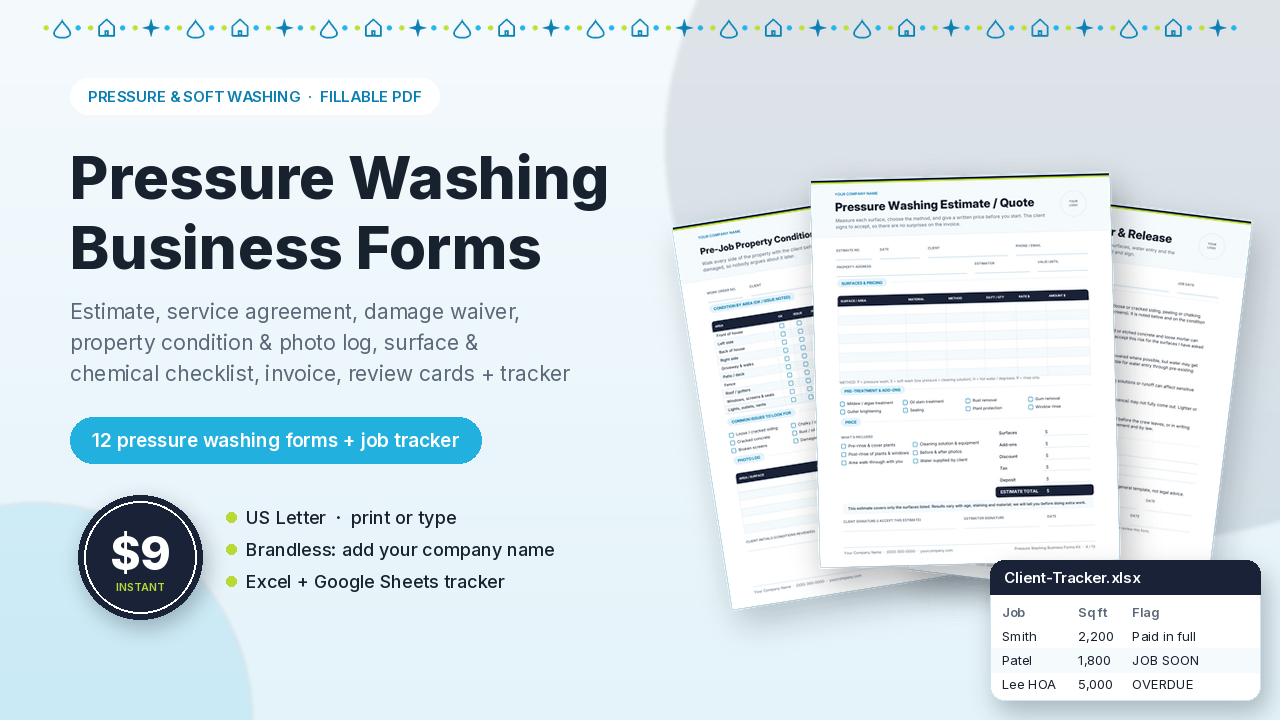
Pressure Washing Business Forms Kit
Fillable pressure washing business forms (client intake, estimate, service agreement, property waiver, pre-job walkthrough, job checklist, invoice and more) plus an Excel client and job tracker.
Get it →Section 6: Scheduling, weather and who will be home
- Preferred dates and any deadline: a listing photo shoot, an open house, a painter's start date, a party or holiday guests
- Will someone be home during the job, or should you work with them away? How will you get gate codes and access?
- Any days or hours to avoid because of HOA rules, noise, children napping or home offices?
- Do they know that some jobs depend on the weather, and that you may reschedule for rain, wind or freezing temperatures?
- Do they want a one-time clean, or a recurring service such as an annual house wash or seasonal driveway cleaning?
Wind can carry spray and cleaning solution onto cars, neighbors and plants, and freezing temperatures can turn rinse water into ice on driveways and steps, so many operators do not wash in those conditions. Agreeing on a weather policy now avoids arguments later. A client preparing for a painter usually wants the job done a set number of days before painting so surfaces can dry; ask the painter's requirement and schedule around it. A recurring client is worth noting for your follow-up reminders.
Section 7: Budget and policies preview
Ask for a rough budget or the price range they expect. It helps you suggest the right package, such as a house wash only this year with the driveway next spring, or a full exterior bundle at a combined price. Then preview your main policies so the contract holds no surprises. The table below uses bracketed placeholders only; it is not recommended wording.
| Policy | What to show (placeholders) |
|---|---|
| Pricing basis | Jobs are priced by [square foot / linear foot / surface / flat package], with a minimum of [amount]. |
| Stain results | Some stains such as [rust, oil, irrigation marks] may lighten but not fully come out; treatments are [included / extra]. |
| Pre-existing damage | Existing damage such as [peeling paint, loose siding, failing window seals] is noted before work and [policy]. |
| Water and access | Client provides [working spigot, gate access, moved vehicles and furniture]; if not, [trip fee policy]. |
| Weather | Jobs affected by [rain, wind, freezing temperatures] are rescheduled to [next available date]. |
| Deposit and cancellation | A deposit of [amount or %] holds the date; cancellations within [notice period] [policy]. |
| Payment | Balance is due [on completion / within X days], by [methods]. |
The policies themselves, including any property waiver, belong in your signed pressure washing contract. The questionnaire only previews them so the client knows how you work before you send a number.
Turning the answers into a quote
With a completed questionnaire, a few photos and a quick look at an online map, you can choose the right method for each surface, estimate your time and chemicals, and send a clear estimate, often without a separate site visit. The example below is for illustration only. The prices are placeholders; set your own based on your costs, market and experience.
| Questionnaire answer | How it affects the quote (example only) |
|---|---|
| Two-story vinyl house, green growth on two sides | Soft wash house price for that size of $[amount] |
| Driveway with oil stains under the cars | Base flat-surface price plus stain treatment of $[amount], results not guaranteed |
| Wood deck, never sealed, some soft boards | Low-pressure deck clean of $[amount]; soft boards noted in writing |
| Spigot is shut off for winter | Bring water on the truck, or reschedule; add $[amount] if hauling water |
| Koi pond and vegetable garden beside the house | Extra pre-wetting, covering and rinsing; add [minutes] or $[amount] |
| Wants house, driveway and fence together | Bundle price of $[amount] instead of three separate prices |
| Painter starts next week | Schedule [X] days before painting; deadline noted on the estimate |
Send the estimate with a line for each surface, the method you plan to use, any stain treatments shown separately, exclusions, and a note that the price assumes the property matches the answers and photos provided. The pressure washing estimate template guide shows how to lay those line items out. Before you start, walk the property with the client if possible, note existing damage with photos, and confirm any change in price before any water goes on a surface.
Common mistakes to avoid
- Quoting "the house" without a surface list. Ask for every surface, then price each one.
- Skipping the material question. Vinyl, stucco, soft wood and composite all need different methods and carry different risks.
- Promising every stain will come out. Rust, oil and irrigation stains may only lighten; say so in writing.
- Not asking about water. A shut-off spigot or a well with limited supply can stop the job on arrival.
- Ignoring runoff and plants. Ask where water drains and what is planted near each surface.
- Not recording existing damage. Note peeling paint, loose siding and failing seals before you start.
- No weather policy. Agree in advance how rain, wind and freezing temperatures affect the date.
- Letting a renter book without approval. Confirm who owns the property and who pays.
One-page pressure washing client questionnaire checklist
- Contact details, preferred contact method and how they found you
- Service address, property type, owner or renter, HOA rules, stories and home age
- Reason for cleaning and any deadline (sale, painting, event)
- Surfaces: siding, roof, gutters, driveway, walkways, patio, deck, fence, other items
- Approximate size of each surface
- Condition: growth, stains, last cleaned, sealer, peeling paint, damage, and photos
- Materials: siding, roof, deck and concrete type, windows, warranties, older painted surfaces
- Sensitive items nearby: plants, ponds, cars, outlets, lights, A/C units
- Water spigot and supply, power, parking, hose distance, gates, pets
- Who moves furniture and vehicles, and where rinse water will drain
- Preferred dates, who will be home, weather expectations, one-time or recurring
- Budget range and policies previewed: pricing basis, stain results, existing damage, access, weather, deposit, payment
Send the questionnaire as soon as someone asks for a price, review the answers and photos before you quote, and once they book, move them onto your contract, pre-job walkthrough and client record.
FAQ
What should a pressure washing business ask before giving a quote?
Ask for the service address, every surface they want cleaned with rough sizes, the material of each surface, the type of dirt or stains, when it was last cleaned, water and power access, parking and gates, pets, nearby plants and ponds, where rinse water will drain, their timing, and a rough budget. Daylight photos of each surface help a lot.
Can you quote pressure washing without visiting the property?
Often, yes, for common jobs such as house washes and driveways, using the questionnaire, photos and an online map, as long as the estimate states that it assumes the property matches the information provided. Roofs, heavy staining, older painted surfaces and large commercial jobs are often better confirmed with a walkthrough.
How is a client questionnaire different from a pressure washing estimate?
The questionnaire collects information from the client before you price the job. The estimate is the written quote you send back, with a line for each surface, totals and terms, based on those answers.
Why ask what the siding and deck are made of?
Because different materials need different methods. High pressure can damage soft wood, some siding and window seals, so many operators soft wash siding and roofs and use more pressure only on hard flat surfaces. Knowing the material lets you choose the method and price the time correctly.
Should I guarantee that stains will come out?
It is safer not to. Organic growth often cleans up well, but rust, oil, irrigation and some fertilizer stains may only lighten. Ask about stains up front, explain likely results, and note on the estimate that full removal is not guaranteed.
Do I need to worry about where the rinse water goes?
Yes. Some cities and HOAs restrict what can enter storm drains, and cleaning solutions can harm plants, ponds and lawns. Requirements vary by location, so check local stormwater rules, follow product labels, and ask the client where water will drain before you quote.
This page is general information for pressure washing and soft washing businesses, not legal, insurance, environmental or safety advice. Rules on business licenses, insurance, contracts and deposits, stormwater and wastewater discharge, cleaning chemicals, and work on older painted surfaces vary by location. Check the current requirements that apply to you, follow product labels, manufacturer guidance and safe equipment practices, and have your own forms and contract reviewed.
Related templates
Free Pressure Washing Forms
A printable estimate form plus a simple service agreement for pressure washing and soft washing jobs.
Download free →Pressure Washing Business Forms Kit
Fillable pressure washing forms plus an Excel client and job tracker.
Get it →