Pressure Washing Contract Template: What to Include (Free Template + Example)
A plain-English walkthrough of the clauses pressure, power and soft washing businesses put in their client agreements: surfaces and square footage, cleaning method, existing damage and photos, property damage waiver, water, access and runoff, weather rescheduling, price, deposit and payment terms, cancellation and job completion sign-off, with a worked example and free pressure washing forms.
Why pressure washing jobs need a written contract
Pressure washing looks simple from the curb, but it is one of the easier home services to argue about afterward. High pressure can etch soft wood, lift loose paint, push water behind siding or reveal cracks that were already in the concrete. Cleaning solutions can mark plants if they are not rinsed. Old oil stains may fade instead of vanishing. Without a written agreement, every one of those outcomes can turn into a refund request.
A short pressure washing contract sets expectations before the machine starts: exactly which surfaces you will clean, which method you will use on each one, what results are realistic, what was already damaged, and how and when you get paid. It also makes a small exterior cleaning business look established, which helps homeowners and property managers say yes. This guide walks through each section, gives sample wording ideas and finishes with a worked example.
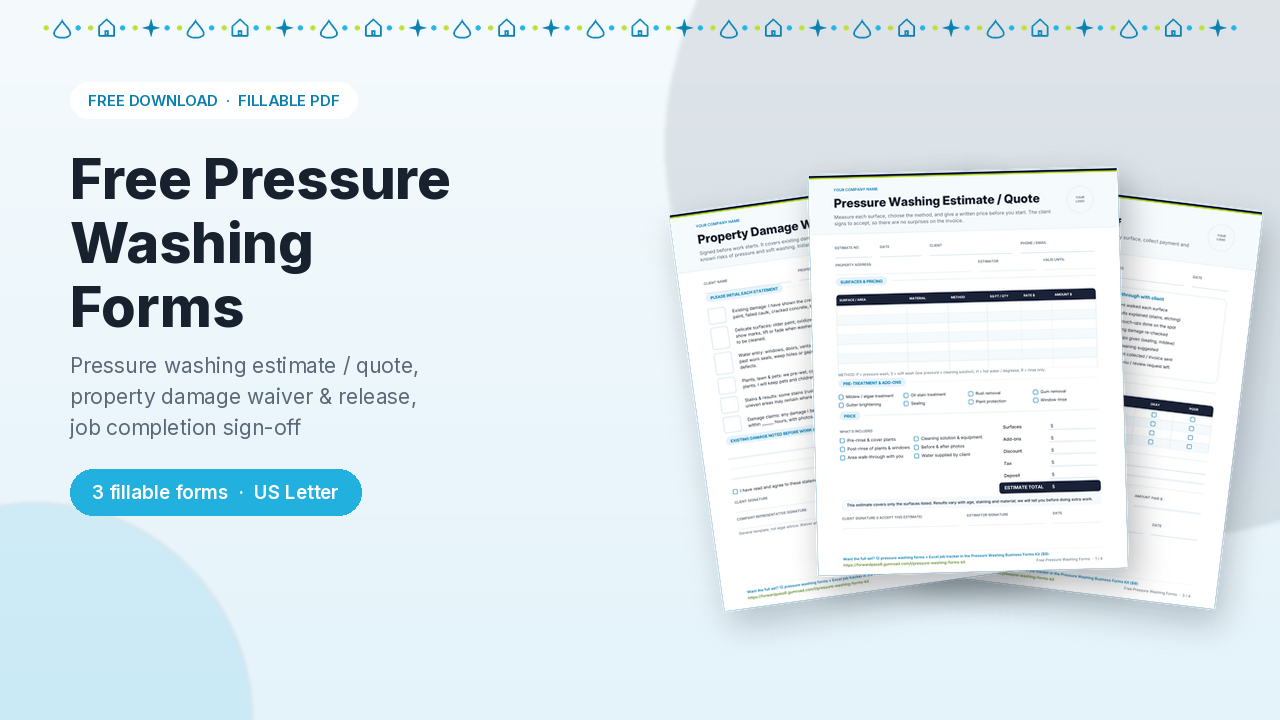
Free Pressure Washing Forms
A free fillable pressure washing estimate / quote sheet with per-sq-ft pricing rows, a property damage waiver & release and a job completion sign-off for pressure, power and soft washing jobs.
Download free →1. Parties, property and job details
Start with the basics: your business name and contact details, the client's name, phone and email, and the service address. If the client is a tenant or a property manager, note who owns the property and confirm the person signing has permission to authorize the work. Add the scheduled date, an arrival window and a reference to the attached estimate, so the contract and the quote clearly describe the same job. For commercial sites, add the on-site contact and any access hours, such as before opening or after closing.
2. Scope of work: surfaces, sizes and method
This is the most important section. List every surface you will clean with an approximate size and the method for each one, for example:
- Driveway, about 800 sq ft: surface cleaner plus pre-treatment
- House siding, vinyl, two stories: soft wash (low pressure with cleaning solution)
- Back deck, about 300 sq ft, wood: low pressure wash; sealing not included
- Front walkway and steps: pressure wash
Naming the method matters. Many homeowners assume everything gets blasted at full pressure; writing “soft wash” for siding and roofs explains why you will not, and protects you if they later ask why the surface looks different from a neighbor's job. Note any add-ons such as gutter brightening, rust or oil stain treatment, or post-wash sealing, each with its own price.
3. Exclusions and realistic results
Say what is not included: window interiors, roof washing unless listed, moving heavy furniture or vehicles, repairing loose boards or paint, and sealing or staining. Then set honest expectations about results. Deep oil, rust, tire marks, paint, efflorescence and some organic stains may lighten but not disappear completely. A sentence such as “Stain removal is not guaranteed; we will use reasonable methods to improve the appearance of listed stains” prevents the most common complaint in this trade.
4. Existing conditions and photos
Walk the property with the client or alone before you start and record existing damage: cracked or spalling concrete, loose or oxidized siding, failing paint, rotted wood, loose mortar, damaged screens and leaking outdoor fixtures. Take dated photos and attach a short condition checklist to the contract. Washing often makes old damage more visible, and a pre-job photo log is the simplest way to show it was there before you arrived.
5. Property damage waiver and liability
Most pressure washing agreements include a property damage waiver or release covering issues that come from pre-existing conditions: paint that was already failing, loose siding, old caulk, windows or doors that do not seal, and surfaces that are weakened by age. The client acknowledges these risks and agrees you are not responsible for damage caused by existing defects. At the same time, the contract can say you will take reasonable care and that you carry business insurance. Keep the waiver in plain language, keep it separate or clearly headed, and have the client initial it. How far a waiver protects you depends on local law, so treat it as a way to set expectations rather than a guarantee.
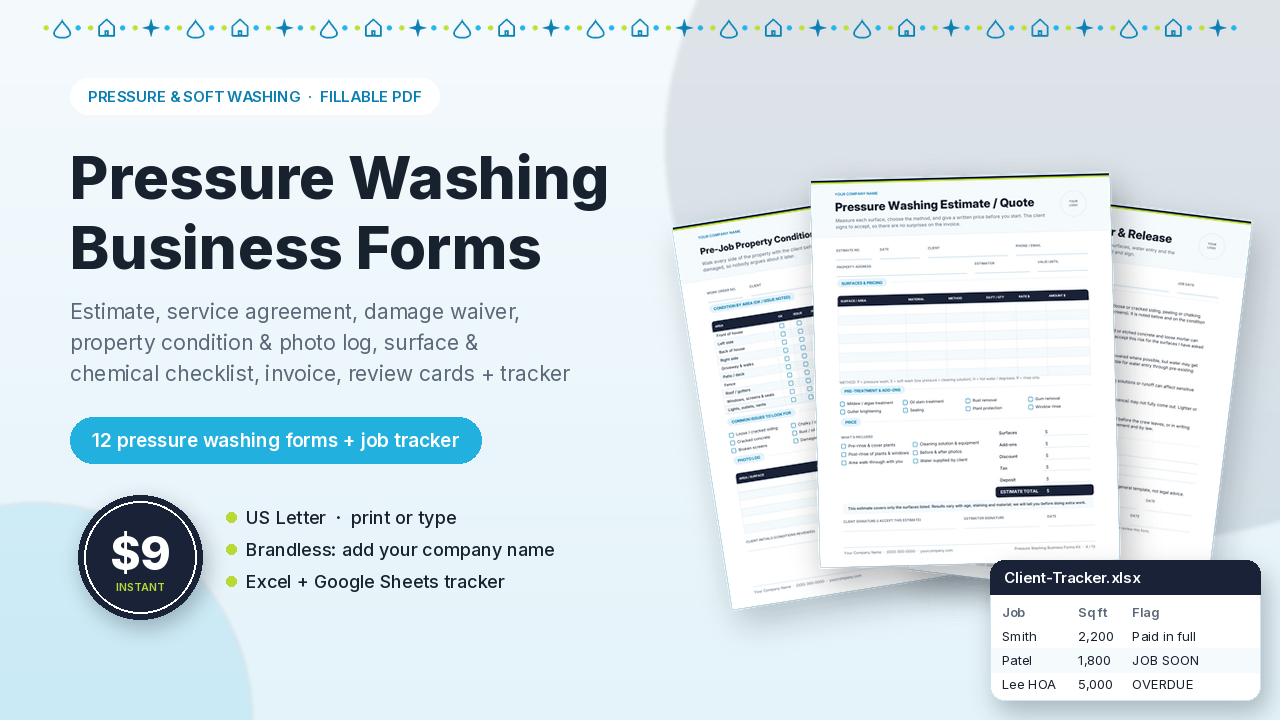
Pressure Washing Business Forms Kit
12 fillable forms (client intake and property walk-through, per-square-foot price sheet, estimate / quote, service agreement, property damage waiver, pre-job condition checklist and photo log, surface and chemical checklist, job schedule and work order, completion sign-off, invoice, seasonal flyer and review cards) plus an Excel job tracker that prices by the square foot and shows costs and profit.
Get it →6. Client responsibilities: water, access, pets and plants
List what the client must provide or do before the job. Typical items include access to an outdoor water spigot with good flow, an outdoor electrical outlet if you need one, vehicles moved off the driveway, furniture, toys, grills and planters cleared from the work area, windows and doors closed, pets kept inside and gates unlocked. Add a note that you will pre-wet and rinse nearby plants, but that the client should point out any sensitive landscaping. If the client fails to prepare and you cannot work, the contract can allow a trip fee.
7. Runoff, chemicals and local rules
Include a short clause that you will use cleaning products according to label directions and follow local rules on wash water. Some cities and counties restrict what can flow into storm drains, especially from commercial properties or from degreasing work. The exact rules vary, so check yours and do not promise anything in the contract you cannot back up. Listing the main products you use, or offering the safety data sheet on request, reassures careful clients.
8. Price, deposit and payment terms
State the total price, or the price per surface, and whether it is a fixed quote or an estimate that may change if sizes differ. For larger or commercial jobs, many contractors take a deposit to hold the date; small residential jobs are often paid in full on completion. Spell out the accepted payment methods, the due date (for example, due on completion, or within 7 days for commercial accounts) and any late fee. If you offer recurring cleaning, such as an annual house wash or a quarterly storefront clean, list the frequency, the price per visit and how either side can stop the service.
Many operators also set a minimum job charge, for example $150 in the example market, so a quick walkway clean still covers travel, setup and cleanup time. If you charge a trip fee for locked gates or no water access, list it here too, so it never looks like a surprise on the invoice.
9. Weather, scheduling and rescheduling
Exterior work depends on the weather. Say that you may reschedule for rain, high wind, freezing temperatures or other unsafe conditions without penalty to either side, and that you will contact the client as early as possible. Freezing temperatures matter more than many people expect: water left on concrete, decks and steps can turn into ice. Note that the new date will be the next available opening in your schedule.
10. Cancellation and changes
Give the client a clear cancellation window, for example free cancellation up to 48 hours before the appointment, a trip fee for late cancellations or locked gates, and a refund rule for any deposit. Add a change clause: if the client asks for more surfaces on the day, you will confirm the extra price in writing (a text or signed change note is fine) before you do the work. That one sentence prevents most invoice disputes.
11. Completion walkthrough and sign-off
When you finish, walk the property with the client if they are home, or send photos if they are not. A completion sign-off form confirms the listed surfaces were cleaned and gives the client a short window, such as 48 hours, to report any concern. After that window the job is treated as accepted. This step also gives you a natural moment to ask for a review and to book the next cleaning.
12. Common mistakes in pressure washing contracts
- Writing “clean house exterior” instead of listing surfaces, sizes and methods
- Promising that every stain will come out
- Skipping the pre-job photos and condition checklist
- Burying the damage waiver in small print with no initials
- No weather or freezing temperature clause
- Doing extra surfaces on request without confirming the price
- Leaving out water and access requirements, then arriving to a locked gate
Worked example: a residential house wash and driveway
Example numbers only; set your own prices for your market. A homeowner books a soft wash of a two-story vinyl house (about 2,200 sq ft of siding) and a surface clean of an 800 sq ft driveway. The example quote is $350 for the house wash and $160 for the driveway, plus $40 for oil stain pre-treatment, for a total of $550. The contract lists each surface, size and method, notes that the oil stain may lighten but not disappear, records two existing cracks in the driveway and one section of loose siding with photos, and includes the initialed damage waiver. The client agrees to provide water, move two cars and keep the dog inside. Payment is due on completion, cancellation is free up to 48 hours before, and rain days are rescheduled at no charge. After the job, the client signs the completion form and books an annual house wash for next spring.
How to send and store your contract
Send the agreement with the estimate, and confirm the date once it is signed (and the deposit is paid, if you take one). A fillable PDF the client can sign electronically saves time on site. Keep the signed agreement, the condition photos, any change notes and the completion sign-off together in one job file. If a question comes up months later, you will have the whole story in one place.
FAQ
Do I need a contract for a small pressure washing job?
Yes, even a one-page agreement helps. It lists the surfaces, methods, price and payment terms and records existing damage, which prevents most disagreements on small residential jobs.
What is the difference between a pressure washing contract and a damage waiver?
The contract covers the whole job: scope, price, schedule, payment and cancellation. The damage waiver is a specific section or separate form in which the client acknowledges risks from pre-existing conditions such as failing paint or loose siding.
Should I take a deposit for pressure washing?
Many operators take payment on completion for small residential jobs and ask for a deposit on large, commercial or multi-day jobs. Whatever you choose, write it in the contract with the refund rule.
How do I handle rain days in a pressure washing contract?
Add a weather clause that lets you reschedule for rain, wind or freezing temperatures without penalty, explains how you will notify the client and states that the new date is the next available opening.
Can I guarantee stain removal?
It is safer not to. Oil, rust, paint and some organic stains may only lighten. Promise reasonable effort on listed stains and describe realistic results in writing.
Do I need a different contract for commercial clients?
The same sections apply, but commercial agreements usually add recurring schedules, invoicing terms such as payment within a set number of days, proof of insurance, site access rules and any local wash water requirements.
This page is general guidance, not legal advice. Contractor licensing, insurance, waiver enforceability, wash water and runoff rules, and consumer contract rules vary by location. Have a qualified professional review your pressure washing contract before you use it.
Related templates
Free Pressure Washing Forms
A free fillable pressure washing estimate / quote sheet with per-sq-ft pricing rows, a property damage waiver & release and a job completion sign-off for pressure, power and soft washing jobs.
Download free →Pressure Washing Business Forms Kit
Fillable intake, per-sq-ft price sheet, estimate, service agreement, damage waiver, condition photo log and invoice plus an Excel job tracker.
Get it →