Nanny Holiday Bonus: How Much to Give, How to Pay It and What to Put in Writing (+ Free Forms)
A practical guide for families who employ a nanny (and for nannies who want to know what to expect): how much to give at the holidays, how to pay it through payroll, how to handle holiday weeks, and what to put in writing.
Why the holiday bonus deserves a plan
For many families, the nanny is the most important person on the payroll they never think of as a payroll. Then December arrives and the questions start: How much is normal? Is it cash or a gift? Does it go through payroll? What if she only started in the summer? What about the week we are away for Christmas?
A nanny holiday bonus (also called a year-end or Christmas bonus) is a thank-you for the year, and it is usually the single biggest one-off payment a family makes to their nanny. Handled well, it builds loyalty for the year ahead. Handled badly (late, vague, or with a surprise tax deduction), it can do the opposite. This guide walks through how families decide the amount, how to pay it, how to handle holiday weeks, and what to put in writing so both sides know what to expect.
This page is about the year-end bonus and holiday-week pay. For setting a nanny's regular hourly or weekly pay, see nanny rates. For the full written agreement (guaranteed hours, overtime, paid time off), see the nanny contract template guide. For what sitters charge on Christmas Eve, New Year's Eve and winter break, see holiday babysitting rates, and for the sheet you leave with any sitter, see the babysitter information sheet.
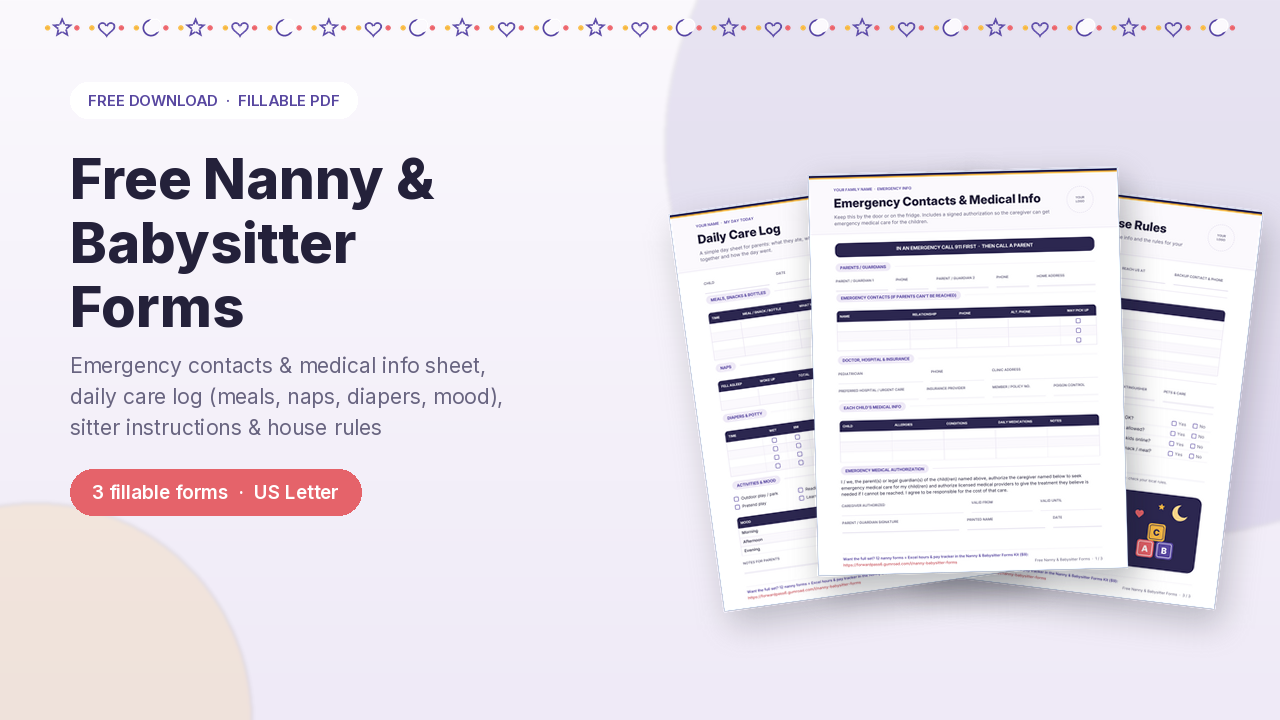
Free Nanny & Babysitter Forms
A fillable emergency contacts & medical info sheet, a daily care log and a sitter instructions & house rules page.
Download free →1. How much to give: common rules of thumb
There is no legal requirement to give a nanny a holiday bonus, and there is no official amount. What families do have is a handful of common rules of thumb. The most widely used is about one week's pay for a nanny who has worked with the family for the whole year. Start there, then adjust for your situation and your budget.
| Situation | Common approach | Notes |
|---|---|---|
| Full-time nanny, worked the whole year | About one week of usual pay | Use the normal weekly pay, including regular overtime if she always works it |
| Started part-way through the year | Prorate one week of pay by months worked | Example: worked 6 of 12 months = about half a week of pay |
| Part-time nanny | One week of her usual part-time pay | Base it on her own normal week, not a full-time week |
| Long-term nanny (several years) | One week of pay plus something extra, if you choose | Extra time off, a larger amount or a raise in January |
| Occasional babysitter | One typical evening or session of pay, or a gift | Many families give a gift card or a thoughtful gift instead |
| Shared nanny (two families) | Each family gives a share, agreed together | Agree the total and the split so the nanny is not left guessing |
Some families give more, and some give less in a tight year. A smaller bonus with a sincere written note and a clear explanation is usually received far better than silence. If money is tight, extra paid days off can be worth as much to a nanny as cash.
2. Bonus, gift, raise or time off?
A holiday bonus is not the only way to say thank you. Each option works differently, both for the nanny and for your paperwork.
| Option | What it is | Things to know |
|---|---|---|
| Cash bonus | A one-off payment, usually in the last paycheck before the holidays | Counts as wages; goes through payroll like regular pay |
| Gift card | A card for a store or a general-purpose card | Treated like cash for tax purposes, so it is also wages |
| Personal gift | Something chosen for her: a meal out, a framed photo, a gift from the kids | A nice addition to a bonus, but rarely a replacement for one |
| Extra paid time off | Paid days added for the new year | Write the days and the rules down so they do not get lost |
| January raise | A higher hourly rate from the first pay period of the new year | Raises affect every week going forward; a bonus is one-off |
| Combination | For example, a cash bonus plus a card and something from the children | The most common family choice |
Whatever you choose, include a short handwritten note. The note is often the part a nanny keeps.
3. When to give it
Give the bonus before the holidays, not after. Nannies have holiday expenses too, and a bonus that arrives in January lands after the bills. The most practical timing is the last regular payday before the family's holiday break or the nanny's own time off.
| Timing option | Example date in 2026 | Why families choose it |
|---|---|---|
| Last full week before Christmas | Fri Dec 18, 2026 | Arrives before most holiday shopping and travel |
| Last day before the holiday break | Wed Dec 23, 2026 | Natural moment to hand over a card and say thank you |
| First payday of December | Early December | Most useful for nannies who travel home for the holidays |
| Anniversary of her start date | Any month | Works for families who prefer a work-anniversary bonus instead |
If the bonus goes through payroll, check your payroll service's cutoff for the pay date you want, since many services need the details a few days in advance, and processing can be slower around the holidays.
4. Paying it the right way: payroll and taxes
If your nanny is your household employee (you set her hours and tell her how to do the work, which is the usual nanny arrangement in the US), a cash bonus is wages. That means it goes through payroll the same way as her regular pay. A gift card counts the same way, because the IRS treats it like cash. A small personal gift that is not cash or a gift card is treated differently; ask your tax professional or payroll service how to handle it.
A few points to check (this is general information, not tax advice):
- Social Security and Medicare (FICA). If you pay a household employee more than the yearly cash-wage threshold the IRS sets, you withhold her share of Social Security and Medicare (6.2% + 1.45% = 7.65%) and pay a matching 7.65% as the employer. The bonus is included. The current threshold and rules are in IRS Publication 926 (Household Employer's Tax Guide).
- Income tax withholding. For household employees, federal income tax withholding is generally only done if you and the nanny agree to it. If you already withhold, the bonus is included.
- Year-end forms. The bonus is part of the wages you report on her W-2 for the year it is paid.
- State rules. State income tax, unemployment and other household employer rules vary. Check your state's rules or ask your payroll service.
- Overtime. A truly discretionary holiday bonus is generally not part of the overtime rate calculation, but a bonus that is promised in the contract or tied to performance targets may be. If in doubt, ask.
Want the nanny to receive a round number? Some families "gross up" the bonus so the amount she takes home after withholding is a round figure. If only FICA is withheld, divide the take-home amount you want by 0.9235 (that is, 1 minus 0.0765). The worked example below shows the math.
Paying cash "off the books" may seem simpler, but it can cause problems for both of you later: the nanny loses Social Security credit, and you may owe back taxes. Run it through payroll.
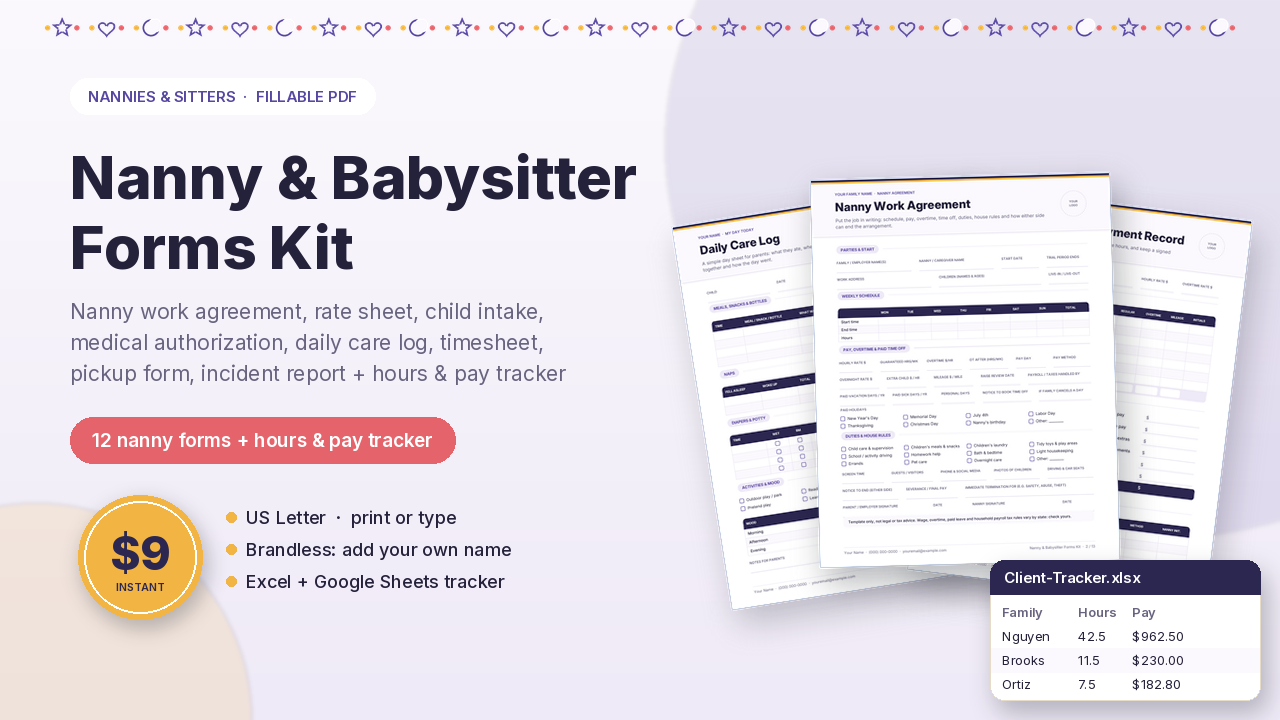
Nanny & Babysitter Forms Kit
12 fillable forms (nanny work agreement, babysitter rate sheet, child information form, emergency contacts and medical authorization, allergy and medication log, daily care log, weekly timesheet, pickup authorization, incident report and more) plus an Excel tracker for hours, overtime and pay.
Get it →5. Worked example: full-time nanny, one week of pay
A family employs a live-out nanny, Maria, for 45 hours a week at $25 an hour. She works 40 regular hours plus 5 overtime hours at time-and-a-half every week, so her usual week includes overtime. She has been with the family all year, and they withhold FICA only.
| Step | Calculation | Amount |
|---|---|---|
| Regular pay | 40 h × $25 | $1,000.00 |
| Overtime pay | 5 h × $37.50 ($25 × 1.5) | $187.50 |
| One week of usual pay (bonus amount) | $1,000.00 + $187.50 | $1,187.50 |
| Nanny's FICA withheld from bonus | $1,187.50 × 7.65% | $90.84 |
| Bonus take-home (before any income tax withholding) | $1,187.50 − $90.84 | $1,096.66 |
| Employer's matching FICA | $1,187.50 × 7.65% | $90.84 |
| Total cost of the bonus to the family | $1,187.50 + $90.84 | $1,278.34 |
Grossing up instead. Suppose the family would rather Maria take home exactly $1,000. Gross bonus = $1,000 ÷ 0.9235 = $1,082.84 (rounded to the cent). Check: $1,082.84 × 7.65% = $82.84 withheld, and $1,082.84 − $82.84 = $1,000.00 take-home. If income tax is also withheld, the gross-up needs to be larger, so ask your payroll service to calculate it.
Example only. Names, rates, hours and bonus amounts are made up to show the method. Use your own numbers, your own agreement and the tax and labor rules that apply where you live.
6. Worked example: part-time nanny who started mid-year
A second family hired a part-time nanny, Jess, on June 1, 2026. She works 25 hours a week at $22 an hour. They also have a regular Saturday-night sitter, Ana, who works about 4 hours at $20 an hour.
| Step | Calculation | Amount |
|---|---|---|
| Jess's usual week | 25 h × $22 | $550.00 |
| Months worked by December | June through December | 7 of 12 months |
| Prorated one week of pay | $550.00 × 7 ÷ 12 | $320.83 |
| Family's chosen bonus (rounded up) | Round $320.83 to a tidy figure | $325.00 |
| Ana's typical evening | 4 h × $20 | $80.00 |
| Ana's thank-you (one evening's pay, as a gift card) | Equal to one typical evening | $80.00 |
Jess's $325 bonus goes through payroll like her regular pay. For an occasional sitter like Ana, whether you are an employer at all depends on how much you pay her in the year and how the work is arranged; check IRS Publication 926 or ask a tax professional. Either way, a card from the kids with the gift goes a long way.
Example only. Names, rates, hours and bonus amounts are made up to show the method. Use your own numbers, your own agreement and the tax and labor rules that apply where you live.
7. Holiday-week pay: the questions that come up every December
The bonus is only half of the holiday money conversation. The other half is what happens to regular pay during holiday weeks. These answers belong in your nanny agreement; if they are not there yet, decide them now and write them down. In 2026, Christmas Eve and New Year's Eve fall on a Thursday and Christmas Day and New Year's Day fall on a Friday.
| Question | Common approach | Where it belongs |
|---|---|---|
| The family travels for a week and does not need care | Guaranteed hours are still paid, because the nanny kept the week free | Guaranteed hours clause |
| Christmas Day and New Year's Day | Paid holidays, if listed by name in the agreement | Paid holidays list |
| Christmas Eve and New Year's Eve | Normal day, early finish with full pay, or a paid day off: the family's choice | Paid holidays list or a written note |
| The nanny is asked to work a paid holiday | Holiday pay at a higher rate or a day off in lieu, as agreed | Holiday work clause |
| The nanny wants extra days off | Uses her paid time off, or unpaid days by agreement | Paid time off clause |
| Evening babysitting at holiday parties | Extra hours at the agreed rate; check overtime if she is already near 40 hours | Overtime clause |
The most common December dispute is a family deciding not to pay for a week they chose to travel. If your agreement includes guaranteed hours, that week is normally paid. If you are not sure what your agreement says, read it before you book the trip.
8. What to put in writing
A holiday bonus is usually discretionary: the family decides each year whether to give one and how much. Say that clearly so it never becomes a surprise in either direction. Here is a simple clause you can adapt for your nanny agreement (fill in the brackets):
Holiday bonus. The Family may, at its discretion, give the Nanny a year-end bonus. Any bonus will be paid through payroll by [date, e.g. the last payday before the holiday break] and is subject to the usual tax withholding. A bonus in one year does not create an obligation to give a bonus in later years. Holidays. The following are paid holidays: [list each holiday by name]. If the Family asks the Nanny to work on a paid holiday, the Nanny will be paid [rate] or given [another day off]. Family travel. Guaranteed hours of [number] per week are paid when the Family travels or does not need care, unless the Nanny chooses to take unpaid time off. |
Notice the bonus clause does not promise a fixed amount. If you want to promise one, write the exact amount or formula, and treat it as part of pay.
9. A short note to go with the bonus
Keep it specific and personal. A fill-in example:
Dear [Nanny's name], Thank you for everything you have done for our family this year. [One specific memory, e.g. "Watching [child] learn to ride a bike with you cheering her on" or "The way you got us all through the flu in February"]. We could not do what we do without you. Please accept this holiday bonus as a small thank-you. It is included in your [date] paycheck. We are looking forward to [something specific in the new year]. With love and thanks, |
If you are also giving extra time off or a January raise, mention it in the note with the dates or the new rate so there is no confusion later.
Common mistakes
- Giving the bonus after the holidays. It arrives after the expenses it was meant to help with.
- Paying a bonus in cash outside payroll. It still counts as wages, and leaving it off the W-2 can cause tax problems for both of you.
- A surprise withholding. If you announce "$500" and the nanny receives less after taxes, explain why, or gross it up.
- Not paying guaranteed hours during family travel. If the agreement guarantees the hours, a trip you chose does not cancel them.
- Vague holiday lists. "A few holidays" causes arguments; name each paid holiday.
- Forgetting shared-nanny coordination. Two families giving very different amounts creates awkwardness; agree on it together.
- No note. Money without a word of thanks feels like a transaction.
One-page holiday bonus checklist
- Bonus amount decided (one week of pay, prorated, or your own figure).
- Form decided: cash through payroll, gift card, extra paid time off, raise, or a combination.
- Pay date chosen before the holiday break, and payroll cutoff checked.
- Withholding confirmed; gross-up calculated if you want a round take-home amount.
- Paid holidays for Dec 24-25 and Dec 31-Jan 1 confirmed in writing.
- Guaranteed hours for family travel weeks confirmed.
- Holiday work rate or day-in-lieu rule agreed.
- Bonus clause in the agreement says it is discretionary (or states the exact formula).
- Shared-nanny families agreed on the total and the split.
- Handwritten note and something from the children ready.
- Bonus included in the year's W-2 wages.
FAQ
How much should I give my nanny for a holiday bonus?
A widely used rule of thumb is about one week of her usual pay for a nanny who has worked with you all year. Prorate it for a nanny who started part-way through the year, and adjust for your budget and how long she has been with you. There is no legal requirement or official amount.
Is a nanny holiday bonus taxable?
If your nanny is your household employee, a cash bonus or gift card counts as wages. It goes through payroll like regular pay, including Social Security and Medicare withholding if you pay above the IRS threshold, and it is reported on her W-2. See IRS Publication 926 or ask a tax professional.
When should I give my nanny her bonus?
Before the holidays, usually on the last payday before your holiday break or hers, so it arrives before holiday expenses. Check your payroll service's cutoff for that pay date.
Should I give a nanny who started recently a holiday bonus?
Many families give a prorated bonus, for example one week of pay multiplied by the months worked and divided by 12. A nanny who started a few weeks ago might receive a thoughtful gift and a note instead.
Do I have to pay my nanny when we go away for Christmas?
If your agreement includes guaranteed hours, those hours are normally paid when the family chooses to travel or does not need care. Check your agreement and put the rule in writing before you book the trip.
Can I give extra time off instead of a cash bonus?
Yes. Extra paid days off, a January raise or a combination can all work. Write down the dates or the new rate so there is no confusion later, and add a personal note.
This page is general information for families who employ a nanny or sitter, and for nannies, not tax, legal or payroll advice. Household employer tax rules, thresholds, state requirements and labor laws vary and change; check IRS Publication 926, your state's rules and a qualified tax professional or payroll service before you pay a bonus. All names, rates, hours and amounts shown are examples only.
Related templates
Free Nanny & Babysitter Forms
A fillable emergency contacts & medical info sheet, a daily care log and a sitter instructions & house rules page.
Download free →Nanny & Babysitter Forms Kit
Fillable nanny agreement, babysitter rate sheet, logs and timesheet plus an Excel hours and pay tracker.
Get it →