Lawn Care Client Questionnaire: What to Ask Before You Quote
A practical guide for mowing and lawn care businesses: the questions to ask a prospective client before you give a price, how each answer changes the quote, and what to have ready once they sign up.
Why you need a questionnaire before you quote lawn care
"How much to cut my grass?" is the message every lawn care business gets, often with nothing but an address. The honest answer is "it depends," because a flat, open quarter-acre with a wide gate and a sloped yard full of flower beds, trees, a trampoline and a locked side gate are completely different jobs, even if both sit on the same size lot.
A short pre-quote questionnaire fixes that. Sent by text, email or a simple online form as soon as someone asks for a price, it collects the details that actually drive your time on site: the property, the lawn's current condition, access and obstacles, pets, the services they want, how often, and their budget. It is not the same as the documents you use later. Your lawn care estimate is the written quote you send back, with line items and totals; your lawn care service agreement records the terms once they sign up; and lawn care pricing explains how to set per-cut, hourly and seasonal rates. The questionnaire has one narrower job: give you enough information to write an accurate estimate quickly, often before you drive out. Below are the sections to include, the questions in each, and how to turn the answers into a price.
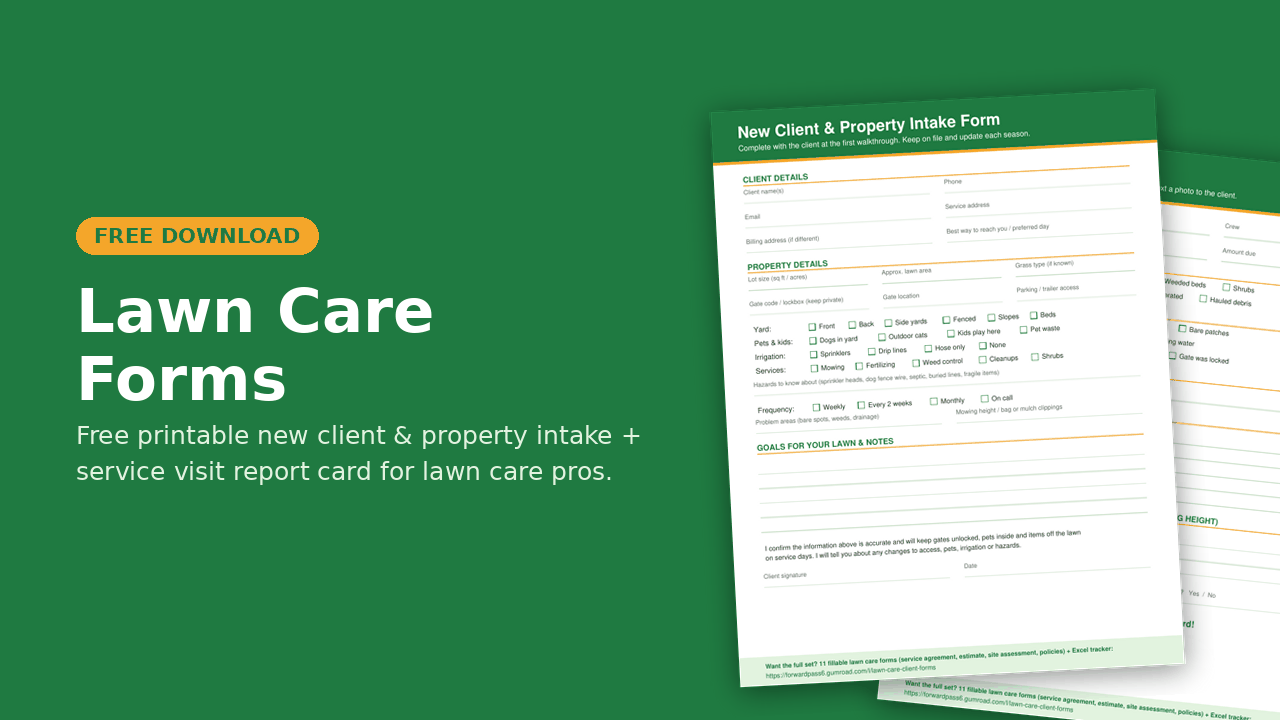
Free Lawn Care Forms
A printable new client and property intake form plus a service visit report card.
Download free →Section 1: Contact details and the property
- Client name, phone number, email and preferred contact method
- How they heard about you, and whether a neighbor already uses your service
- Service address, and whether it is a house, townhome, rental, commercial site or vacant lot
- Do they own the property, or rent it? If renting, has the landlord or property manager approved the service, and who pays?
- Is there an HOA with rules about mowing height, service days, hours or equipment noise?
- Which areas are included: front yard, back yard, side strips, the strip between sidewalk and street, ditches?
- Approximate lawn size, if they know it, or permission for you to measure from the street or with an online map tool
- Is there more than one property, or a neighbor who might want service on the same day?
The address alone lets you check travel time and whether the property fits your route, which matters a lot in a business where drive time eats into every visit. Many lawn care operators measure the turf area with an online satellite map before quoting, but trees, shade and recent changes can make those images misleading, so treat the measurement as a starting point. Ask specifically which areas they expect you to cover. A client who assumes the back yard and the ditch are included and an operator who quoted the front only is the most common source of first-visit disputes.
Section 2: Lawn condition and photos
Condition tells you whether the first visit is a normal cut or a cleanup. Ask neutral questions and request photos:
- When was the lawn last mowed, and by whom?
- Roughly how tall is the grass right now?
- Any overgrown areas, tall weeds, brush or saplings?
- Any bare patches, thin areas, moss, heavy weeds or areas that stay wet?
- Any sticks, leaves, toys, dog waste, rocks or other debris on the lawn?
- Grass type, if they know it, and whether there is an irrigation system
- Would they send photos of each lawn area, the gates and any slopes, taken in daylight?
Grass that has been left for several weeks can take far longer than a regular cut, may need more than one pass and produces much more clippings to deal with. Many operators quote a one-time first-cut or cleanup price, then a lower recurring price once the lawn is under control. Photos of each area and the gate let you spot problems a satellite view misses. Explain that the quote assumes the property matches the answers and photos, and that you will confirm on the first visit or a quick walkthrough before starting.
Section 3: Access, gates, slopes and obstacles
- How do you get to the back yard: gate width, steps, narrow side passage, or through the garage?
- Is the gate locked? Who provides the code or key, and will someone be home?
- Any steep slopes, banks, retaining walls or ditches that need a trimmer or a smaller mower?
- Obstacles in the lawn: trees, flower beds, play sets, trampolines, sheds, sculptures, garden hoses
- Anything in the turf you might hit: sprinkler heads, low valve boxes, buried cables, invisible pet fence wires, landscape lighting
- Fences, beds, driveways and walks that need edging or trimming
- Where can you park the truck and trailer? Any street parking limits?
- Areas to avoid: new seed, vegetable gardens, wildflower patches
Access decides which mower fits. A gate narrower than your main mower means a smaller machine and more time, and a steep bank may need string trimming or a different approach for safety. Obstacles add trimming time around each one. Ask about sprinkler heads, lighting and invisible fence wires before your first visit so they can be flagged, and agree in writing how damage to hidden or unmarked items is handled. Your agreement should cover that; the questionnaire just makes sure you know what is there.
Section 4: Pets, children and safety
- Any dogs or other pets that use the yard? Will they be inside during service?
- Is dog waste picked up before visits, or do they want waste pickup as an add-on?
- Do children play in the yard, and are toys usually left out?
- Any known hazards: wasp nests, holes, broken glass, loose boards, overhead lines near trees?
- Anyone in the household with allergies or sensitivities to grass clippings, dust or lawn products?
- Do they want advance notice before any fertilizer or weed control treatment?
Pets and toys slow you down and create safety risks. Many operators require pets to be inside and the yard cleared before mowing, and will skip or reschedule if a dog is loose. Ask about allergies and sensitivities so you can note them on the client record. If you offer fertilizer, weed control or pest treatments, notification and posting rules for treated lawns vary by state and locality, and some products may only be applied by a licensed applicator. Check the rules that apply where you work and follow the product label.
Section 5: Services they want
Ask what they want and why. A homeowner listing the house for sale, a busy family that wants the lawn handled all season and a landlord between tenants all need different packages:
- Mowing only, or mowing, trimming, edging and blowing off hard surfaces?
- Clippings: mulched back into the lawn, or bagged and removed?
- Spring or fall cleanup, leaf removal, or bed cleanup?
- Hedge and shrub trimming? Approximate number and height of shrubs
- Aeration, overseeding, dethatching or topdressing?
- Fertilizer and weed control program, if you offer it and are licensed where required
- Mulch, weeding beds, gutter cleaning or other add-ons you offer
- Anything they do not want touched, such as a specific bed or a natural area
| Service | What it usually means for the quote (example only) |
|---|---|
| Recurring mow, trim, edge and blow | Base visit price set by lawn size and obstacles; [per-visit price] |
| First cut on an overgrown lawn | One-time cleanup or first-cut charge; [cleanup price or hourly rate] |
| Bagging and removing clippings | Extra time and disposal; [bagging add-on] |
| Spring or fall cleanup | Priced per job by size and volume; [cleanup price] |
| Leaf removal | Priced by volume, visits and haul-away; [leaf removal price] |
| Aeration or overseeding | Priced per job by lawn area; [service price] |
| Hedge and shrub trimming | Priced per job or hourly; [trimming price] |
| Fertilizer or weed control | Per application or program; [program price], where licensed |
Write down exactly which tasks belong to a standard visit, so "lawn mowing" means the same thing to you and the client. Leaf work is its own category; see leaf removal pricing for per-bag, per-hour and per-job methods.
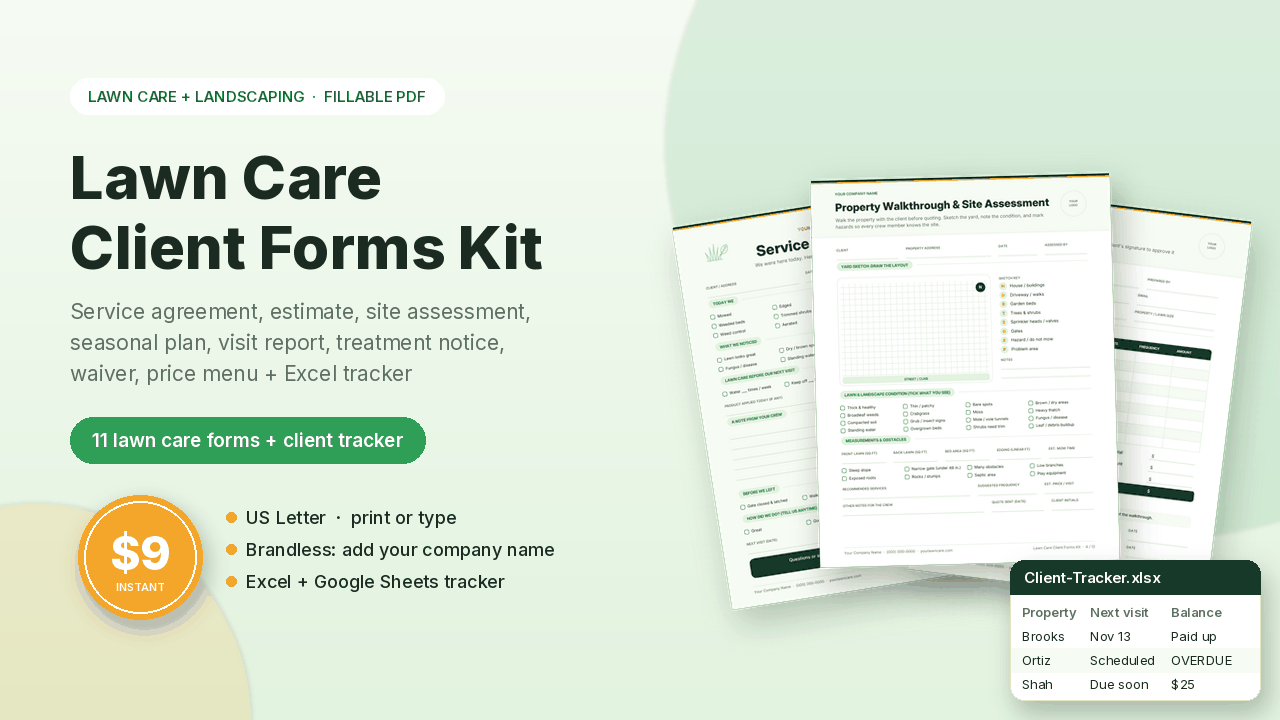
Lawn Care Client Forms Kit
11 fillable lawn care forms (service agreement, estimate, site assessment, visit report, treatment notice) plus an Excel client tracker.
Get it →Section 6: Frequency, season and scheduling
- How often do they want service: weekly, every two weeks, or on request?
- When should service start and end for the season, and do they want a final cut or fall cleanup?
- Preferred mowing day, and any days or hours to avoid because of HOA rules, work-from-home calls or sleeping shift workers
- Preferred mowing height, if they have one
- Irrigation schedule, so you are not mowing right after the sprinklers run
- Any deadline: a party, an open house, a home inspection or a move-in date?
- Do they want to pay per visit, monthly, or for a full season?
Frequency changes the price per visit because grass cut every two weeks is usually taller and slower to cut than grass cut weekly, so many operators charge more per visit for biweekly service. Ask about the season up front: a client who expects service until the last leaf falls and an operator who plans to stop at a set date will clash in autumn. Agree how rain delays work. Most lawn care businesses move a rained-out visit to the next workable day rather than skip it, and the client should know that before the first storm.
Section 7: Budget and policies preview
Ask for a rough budget or the price range they expect. It helps you suggest a package that fits, such as biweekly mowing with occasional trimming, or a one-time cleanup followed by a lighter recurring plan. Then preview your main policies so the service agreement holds no surprises. The table below uses bracketed placeholders only; it is not recommended wording.
| Policy | What to show (placeholders) |
|---|---|
| Pricing basis | Visits are priced by [lawn size / time / package], with add-ons listed separately. |
| First cut or cleanup | Overgrown lawns are charged [first-cut fee or hourly rate] on the first visit. |
| Weather | Rained-out visits move to [next workable day / policy]. |
| Access and pets | Gates must be [unlocked / code provided] and pets inside; if not, [skip or trip fee policy]. |
| Hidden items | Unmarked items in the lawn such as [sprinkler heads, wires, lighting] are handled as [policy]. |
| Cancellation and season | Service can be paused or cancelled with [notice period]; the season runs [dates]. |
| Payment | Payment is due [per visit / monthly / in advance], by [methods]. |
The policies themselves belong in your signed lawn care service agreement. The questionnaire only previews them so the client knows how you work before you send a number.
Turning the answers into a quote
With a completed questionnaire, a few photos and a quick measurement, you can choose the right package, estimate your time and send a clear estimate, often without a site visit. The example below is for illustration only. The prices are placeholders; set your own based on your costs, market and experience.
| Questionnaire answer | How it affects the quote (example only) |
|---|---|
| Front and back yard, mostly flat, measured with an online map | Base per-visit price for that size of $[amount] |
| Last mowed about a month ago, grass well above ankle height | One-time first-cut charge of $[amount] or [hourly rate] |
| Back gate narrower than your main mower | Smaller mower for the back yard; add [minutes] per visit |
| Many beds, trees and a play set | Extra trimming time; add $[amount] per visit |
| Dog uses the yard, waste not always picked up | Require pickup before visits, or add waste pickup at $[price] |
| Wants clippings bagged | Bagging add-on of $[price] per visit |
| Biweekly service, season start to first frost | Biweekly rate of $[amount] per visit; season dates on the agreement |
Send the estimate with the base visit price, what a standard visit includes, any first-cut or cleanup charge shown separately, add-ons, frequency, exclusions, and a note that the price assumes the property matches the answers and photos provided. The lawn care estimate template guide shows how to lay those line items out. On the first visit, walk the property, flag sprinkler heads and hazards, and confirm any change in price before you start.
Common mistakes to avoid
- Quoting from the lot size alone. Turf area, obstacles, slopes and gates decide your time, not the lot line.
- Not asking which areas are included. Front, back, side strips and ditches need to be written down.
- Pricing an overgrown lawn like a regular cut. Quote a separate first cut or cleanup.
- Skipping the gate question. A narrow or locked gate can turn a quick visit into a wasted trip.
- Forgetting hidden items. Ask about sprinkler heads, lighting and invisible fence wires before you mow.
- Leaving pets and weather vague. Agree what happens if a dog is loose or it rains on service day.
- Offering treatments without checking the rules. Licensing, labeling and notification rules for lawn products vary by location.
- No season dates. Write down when service starts and stops so autumn does not become a dispute.
One-page lawn care client questionnaire checklist
- Contact details, preferred contact method and how they found you
- Service address, property type, owner or renter, HOA rules
- Areas included and approximate lawn size or permission to measure
- Last mow, grass height, weeds, bare patches, debris and photos
- Gate width and lock, slopes, obstacles, parking and areas to avoid
- Sprinkler heads, lighting, invisible fence wires and other hidden items
- Pets, children, hazards, allergies and treatment notice preferences
- Services: mowing, trimming, edging, blowing, bagging, cleanups, leaves, aeration, shrubs, treatments
- Frequency, season start and end, preferred day, mowing height, irrigation schedule
- Deadlines such as an open house or event
- Budget range and policies previewed: first cut, weather, access, hidden items, cancellation, payment
Send the questionnaire as soon as someone asks for a price, review the answers and photos before you quote, and once they sign up, move them onto your service agreement and client record.
FAQ
What should a lawn care business ask before giving a quote?
Ask for the service address, which areas are included, the approximate lawn size, current condition and when it was last mowed, gate access, slopes and obstacles, pets, the services and frequency they want, the season, and a rough budget. Photos of each lawn area and the gate help a lot.
Can you quote lawn care without visiting the property?
Often, yes, for routine mowing, using the questionnaire, photos and an online map measurement, as long as the estimate states that it assumes the property matches the information provided. Larger cleanups, slopes and treatment programs are often better confirmed with a walkthrough.
How is a client questionnaire different from a lawn care estimate?
The questionnaire collects information from the client before you price the job. The estimate is the written quote you send back, with line items, totals and terms, based on those answers.
Should I charge more for the first cut?
Many operators do when a lawn is overgrown, because it can take much longer and produce far more clippings than a regular visit. Asking when the lawn was last mowed lets you quote a separate first-cut or cleanup charge instead of surprising the client.
Why ask about sprinkler heads and invisible fences?
Because they can be hit by a mower or edger and are not always visible. Knowing about them before the first visit lets the client mark them, and your agreement can state how damage to unmarked items is handled.
Do I need a license to apply fertilizer or weed control?
It depends on where you work and what products you use. Many states regulate commercial pesticide application and some localities have notification or posting rules. Check with your state or local regulator before offering treatments.
This page is general information for lawn care and landscaping businesses, not legal, insurance, licensing or safety advice. Rules on business licenses, insurance, contracts and deposits, and on the application, notification and posting of fertilizers and pesticides vary by location. Check the current requirements that apply to you, follow product labels and safe equipment practices, and have your own forms and agreement reviewed.
Related templates
Free Lawn Care Forms
A printable new client and property intake form plus a service visit report card.
Download free →