Junk Removal Contract Template: What to Include (Free Template + Example)
A plain-English walkthrough of the clauses junk removal businesses put in their service agreements: who can authorize removal, an itemized load description, volume-based pricing and minimums, prohibited and hazardous items, weight and overage surcharges, on-site price approval, access path and property damage, donation and recycling, scheduling and cancellation, payment and completion sign-off, with a worked example and free junk removal forms.
Why junk removal jobs need a written agreement
Junk removal looks simple: show up, load the truck, haul it away. The disputes start after the truck is full. The customer expected a quarter load and it filled half the truck. A mattress was hidden behind the boxes. The old fridge still had refrigerant in it. A tenant asked you to clear a garage that the landlord had not approved. Or a doorframe got scraped on the way out with a sofa.
A short junk removal contract, often called a junk removal service agreement or work order, settles these questions before anything goes on the truck. It names who is authorizing the removal, describes what is being hauled, explains how the price is calculated and when it is final, lists items you will not take, and covers damage, disposal, cancellation and payment.
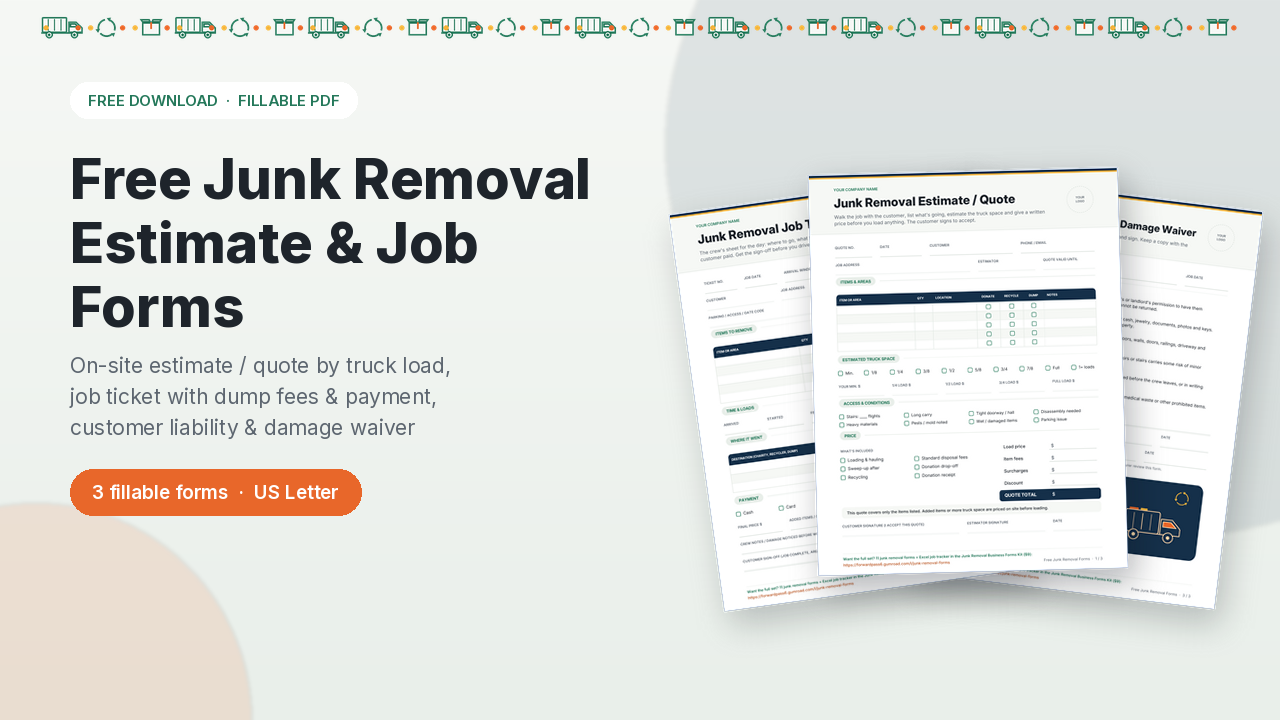
Free Junk Removal Estimate & Job Forms
A fillable junk removal estimate form priced by truck-load fraction, a job ticket and a customer liability waiver.
Download free →1. Parties, property access and owner permission
Start with your business name, phone, email and any license or registration number your area requires. Add the customer's name, contact details and the pickup address, including the exact location of the items: garage, basement, backyard shed, curbside or a specific unit in a storage facility.
Then confirm authority. The person signing should own the items and have the right to let you onto the property. This matters most for estate cleanouts, rentals, foreclosures, storage units and commercial jobs. A simple line works: “Customer confirms they own the listed items or are authorized by the owner to dispose of them, and that they have permission to grant access to the property.” For estates or landlord jobs, write down who gave permission (executor, property manager or owner) and keep any written approval with the job file.
2. Itemized load description
Vague descriptions cause most junk removal arguments. Instead of “garage cleanout,” list the main items and the areas being cleared, for example:
- Garage: one sectional sofa, two mattresses with box springs, about 20 boxes of household items
- Backyard: broken trampoline frame, pile of yard debris roughly 4 ft x 6 ft
- Basement: treadmill (needs partial disassembly), old desk, carpet roll
Add a line that anything not listed or not shown during the estimate is not included and will be priced separately. Take dated photos of the pile before loading. Photos protect both sides if the customer later says something was not there or that you missed an item.
3. Volume-based pricing and minimum charge
Most junk removal companies price by how much of the truck the job fills, such as a minimum load, 1/8, 1/4, 1/2, 3/4 or a full truck. Others price single items (one couch, one hot tub) at a flat rate. Whichever you use, write it into the contract with the truck size so the customer understands what a “full load” means.
Example price sheet only; set your own prices for your market: minimum charge $95, 1/4 truck $195, 1/2 truck $345, 3/4 truck $475, full truck $595, based on a 15-cubic-yard truck. State what the price includes, such as labor for up to two crew members, loading from the listed areas, sweeping the cleared space, and standard dump and recycling fees. If heavy disassembly, demolition, stairs beyond a certain number of flights or long carries are extra, list those charges here.
4. Prohibited and hazardous items
Every junk removal agreement should include a prohibited items list. Many disposal sites will not accept, or charge extra for, items like wet paint, solvents, pool and garden chemicals, motor oil, gasoline and propane tanks, car batteries, asbestos and medical waste. Other items are usually accepted only with a separate fee or special handling, such as tires, mattresses, appliances with refrigerant (refrigerators, freezers, AC units and dehumidifiers) and electronics like TVs and computer monitors.
The rules and fees for these items vary a lot by city, county and disposal facility, so check your local rules and the sites you use, and keep your list up to date. In the contract, say that the customer must tell you about hazardous items before the job, that you may refuse any item you cannot legally or safely haul, and that surcharges for special items are added to the load price.
5. Weight, overage and surcharges
Volume pricing assumes average household junk. Dense loads like concrete, brick, dirt, roofing shingles, tile or wet carpet can hit a truck's weight limit long before it looks full, and landfills often charge by weight. Add a weight clause: heavy materials may be priced by weight or limited to a set portion of the truck, with an overage charge if the dump ticket exceeds an agreed amount.
List other surcharges clearly, for example per-item fees for mattresses, tires or refrigerant appliances, a stairs or long-carry fee, a disassembly fee for hot tubs and playsets, and an after-hours or same-day rush fee.
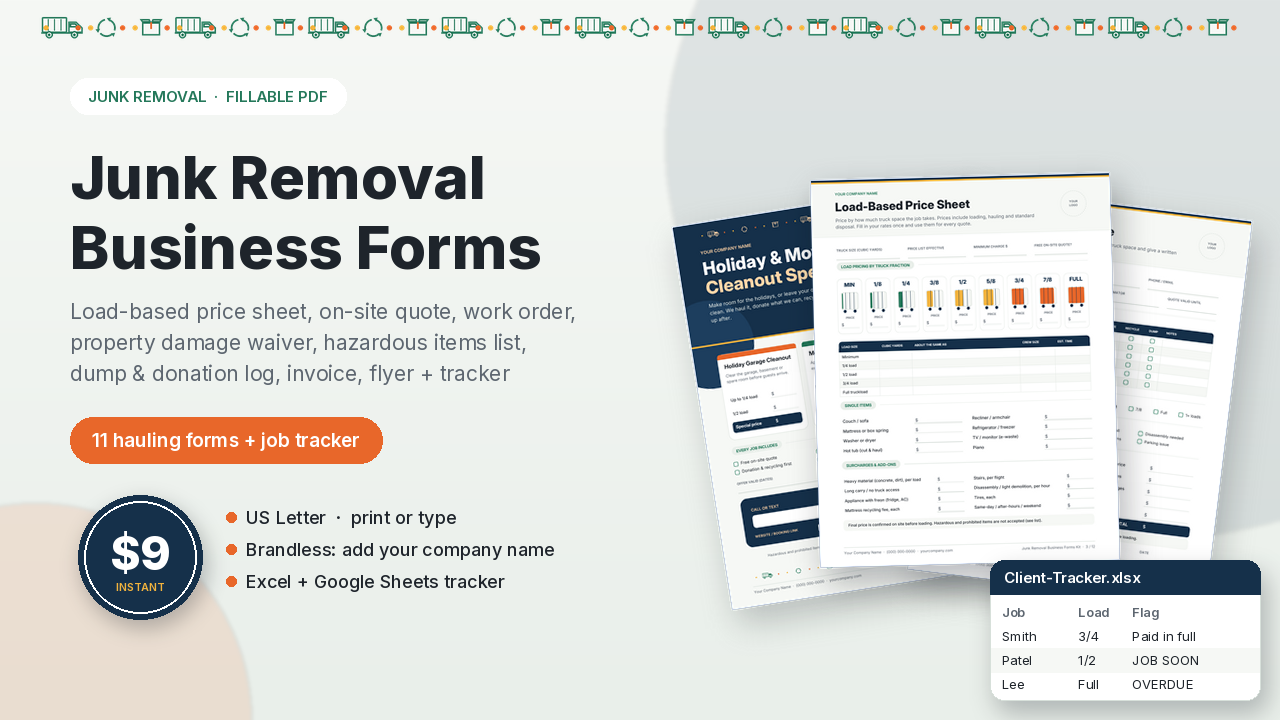
Junk Removal Business Forms Kit
11 fillable forms (booking form, load-based price sheet, estimate / quote, work order, liability & property damage waiver, prohibited items list, before / after checklist, dump & donation log, invoice, cleanout specials flyer, review cards) plus an Excel job tracker with profit per job.
Get it →6. On-site quote versus final price approval
Phone and photo estimates are useful, but the real price is set when you see the pile. Write a clause that any estimate given by phone, text or photo is a range, and that the final price is confirmed on site before loading begins. Ask the customer to approve the final price by signature, initials on the work order or a reply text. If the job grows while you are loading because the customer adds items, stop and confirm the new load size and price before continuing.
7. Property damage, liability and the access path
Hauling bulky items through tight hallways and down stairs carries risk. Agree on the access path before loading: which doors, stairs, driveway area and gate you will use, and where the truck will park. Note existing damage such as scuffed walls, cracked driveways or loose railings, and take photos. Ask the customer to move vehicles, secure pets and clear the path.
State whether you carry general liability insurance, and add a fair liability clause: you take reasonable care, report any damage you cause right away, and are not responsible for pre-existing conditions or for driveway wear from a normally loaded truck when the customer chose the parking spot. How far a liability limit can go depends on local law.
8. Donation, recycling and disposal statement
Customers increasingly ask where their things go. Add a disposal statement: items will be donated, recycled or taken to a licensed disposal facility at your discretion, and donation is not guaranteed because charities can refuse items. Once items are loaded, ownership passes to your company, and you are not responsible for valuables, cash or documents left in drawers, boxes or pockets. Ask the customer to check everything first.
9. Schedule, arrival window, cancellation and trip fee
Give an arrival window rather than an exact time, for example a two-hour window, and say you will call or text when the crew is on the way. Add a cancellation policy, such as free rescheduling or cancellation up to 24 hours before the appointment, and a trip fee if the crew arrives and cannot do the job because no one is there, the gate is locked, the items are not ready or the customer declines after the on-site quote. Example only: a $50 trip fee.
10. Payment terms
Most residential junk removal is paid in full on completion. List accepted payment methods, whether you charge a card fee where allowed, and when payment is due. For large estate or commercial cleanouts that span several days or loads, consider a deposit and payment per load or per day.
11. Completion sign-off
Before the truck leaves, walk the cleared areas with the customer. Confirm the listed items are gone, the area has been swept, and nothing was missed or taken by mistake. Have the customer sign or initial the work order with the final load size and total. Give a short window to report concerns, after which the job is treated as accepted.
Common mistakes in junk removal agreements
- Writing “garage cleanout” instead of listing items and areas
- Not confirming the signer owns the items or can authorize access
- No truck size, so “half load” means nothing
- No prohibited items list or special-item surcharges
- Treating a phone estimate as the final price
- No weight clause for concrete, dirt or shingles
- Skipping before and after photos and the sign-off
Worked example: a garage and basement cleanout
Example numbers only; set your own prices for your market. A homeowner books a garage and basement cleanout from photos. The phone estimate is a range of $345–$475 (half to three-quarters of a truck). On site, the crew lists the items: a sectional, two mattresses, a treadmill, an old refrigerator and about 25 boxes. The pile fills about half the truck, so the base price is $345. Surcharges from the price sheet are added: $25 per mattress ($50) and $40 for the refrigerator because it contains refrigerant. The customer initials the work order approving $435 before loading. During loading, the customer adds a broken grill; the crew confirms it still fits within the half load and adds no charge, noting it on the work order. Items are photographed before and after, two boxes of usable housewares go to donation, and the customer signs off on a final invoice of $435, paid by card on completion.
How to send and store your agreement
Send the agreement with your booking confirmation so customers see the price sheet, prohibited items and cancellation terms in advance, then confirm the final price on site. Keep the signed agreement, before and after photos, dump tickets and donation receipts together in one job file. Review your template once a year, or whenever disposal fees or local rules change, so the terms still match how you actually work.
FAQ
Do I need a contract for small junk removal jobs?
A one-page work order is enough for most single-item pickups. It records the items, price, prohibited items and the customer's approval, so a quick haul does not turn into a dispute.
How do junk removal companies usually price jobs?
Most price by volume, as a fraction of the truck with a minimum charge, and add surcharges for special items like mattresses, tires or refrigerant appliances. Heavy materials may be priced by weight.
Can the final price be different from the estimate?
Yes, if the contract says so. Phone and photo estimates are ranges; the final price is confirmed on site before loading and approved by the customer in writing.
What items should a junk removal contract exclude?
Typical exclusions are hazardous materials such as paint, chemicals, fuel, asbestos and medical waste. Rules vary locally, so check your local disposal rules and list what you refuse and what carries a fee.
Who is responsible if something valuable is hauled away?
The contract should ask the customer to check drawers, boxes and pockets first and state that ownership passes to the hauler once items are loaded.
Should I take photos on junk removal jobs?
Yes. Dated before and after photos of the items and the access path help settle disputes about load size, missed items and property damage.
This page is general guidance, not legal advice. Disposal rules, hazardous waste regulations, special-item fees, hauling licenses, liability limits and consumer contract rules vary by location. Have a qualified professional review your junk removal contract before you use it.
Related templates
Free Junk Removal Estimate & Job Forms
A fillable junk removal estimate form priced by truck-load fraction, a job ticket and a customer liability waiver.
Download free →Junk Removal Business Forms Kit
Fillable junk removal forms plus an Excel job tracker with load pricing, dump fees, crew labor and profit per job.
Get it →