Junk Removal Estimate Template: How to Quote Holiday, Move-Out and Year-End Cleanouts (Plus Free Estimate Forms)
A practical junk removal estimate template for haulers: what to ask before you drive out, how to estimate truck space, list items by donate, recycle or dump, price surcharges, write the quote and get it signed, with tips for busy holiday and year-end cleanouts and free printable estimate forms.
Why a written estimate matters in cleanout season
November through January is a busy stretch for many junk removal and hauling businesses. People clear garages and basements before guests arrive, empty spare rooms for family, deal with estate cleanouts, move at the end of the year, and throw out old furniture and appliances after new ones arrive for the holidays. More jobs means more quotes, and quick verbal quotes are where haulers lose money: the "half a truck" that turns into a full one, the piano nobody mentioned, the three flights of stairs, the dump fees that went up. A written estimate template makes every quote consistent, fast and easy to defend. This guide walks through what to include, section by section.
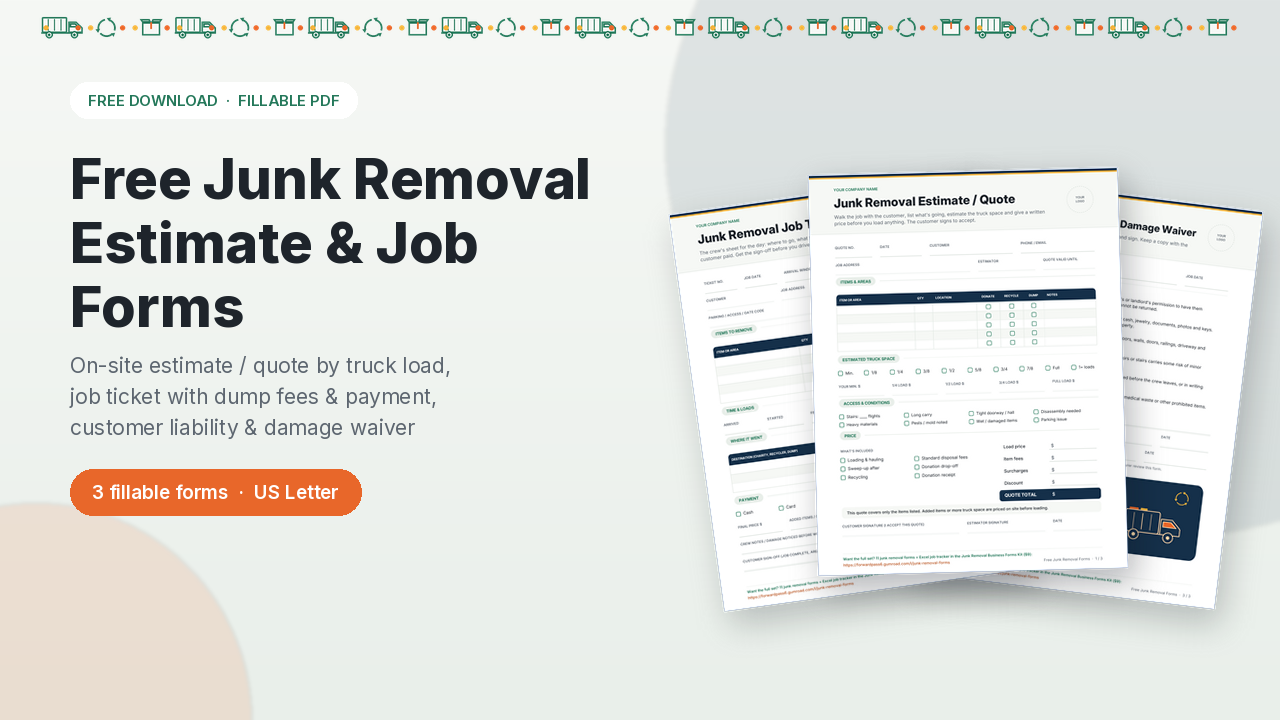
Free Junk Removal Estimate and Job Forms
Printable junk removal estimate and job forms: items, truck space, fees, quote total and customer sign-off.
Download free →1. Ask the right questions before you drive out
A good estimate starts with the booking call or message. Capture the customer name, phone, email and address, the type of job (single item, garage, basement, attic, move-out, estate, yard waste, light construction debris), a rough list of what is going, and what can be donated. Ask about access: stairs, an elevator, a long carry from the back yard, items that must be taken apart, and where the truck can park. Ask for photos or a short video. For small, simple jobs, photos may be enough for a firm price range; for large cleanouts, book an on-site estimate. Note the date the customer needs the space cleared, because holiday deadlines are real and often tight.
2. Estimate truck space, not just items
Most junk removal businesses price by the share of the truck a job fills, often from a minimum load up through eighths or quarters to a full truckload, with single-item prices for things like a couch, mattress or fridge. On the estimate, list the items and areas, then record the estimated truck space and the matching load price from your price sheet. It helps to know the cubic yards your truck holds and to keep a few reference examples, such as what a quarter load or a typical one-car garage looks like for your truck. Write the estimate as a range when you cannot see everything, for example "1/2 to 5/8 load", and explain that the final price is based on the space the items actually take once loaded.
3. Sort items into donate, recycle and dump
A column for each item showing donate, recycle or dump does two jobs. It helps you plan the route and the disposal cost, and it shows the customer that their usable furniture and appliances will not all go to the landfill, which many customers care about. Donation centers and recyclers have their own rules about what they accept, so check before you promise. After the job, log where each load went, the weight and the fee or receipt number, so you know your real disposal cost for future quotes.
4. List surcharges and special items clearly
Surcharges are where most disputes start, so put them on the estimate before work begins. Common ones include heavy material such as concrete, dirt, roofing or tile, stairs or long carries, disassembly of sheds, hot tubs, playsets or furniture, appliances with refrigerant, tires, mattresses where your local disposal site charges extra, and same-day or after-hours service. Add a section for hazardous and prohibited items: many haulers cannot take paint, chemicals, fuel, propane tanks, asbestos or medical waste, and local rules decide where these go. Mark anything you will not take, so there is no argument on the day.
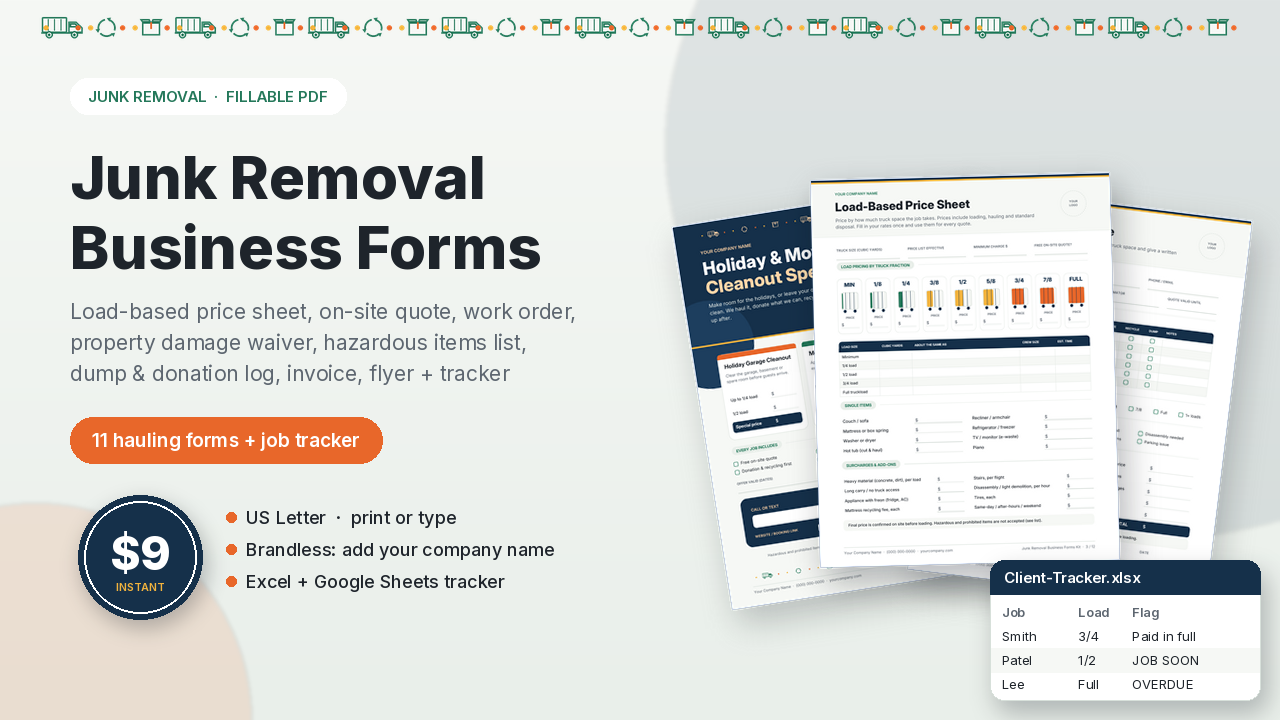
Junk Removal Business Forms Kit
11 fillable forms (booking form, load-based price sheet, on-site estimate and quote, work order, property damage waiver, hazardous items list, before and after checklist, dump and donation log, invoice, holiday and move-out cleanout flyer and review cards) plus an Excel job tracker with dump fees, truck costs, labor and profit per job.
Get it →5. Write the quote total and get a signature
The bottom of the estimate should show the load price, item fees, surcharges, any discount, tax where it applies, and the quote total or range. State what is included (loading, sweeping the area, hauling, disposal fees), how long the quote is valid, and how the final price is set if the volume changes. Then ask the customer to sign or initial before you start loading. A short property damage waiver is worth adding for tight spaces and heavy items: the customer confirms they own the items, points out anything they are keeping, notes existing damage, and accepts that driveways and lawns can be marked by a loaded truck. A signed estimate and waiver protect both sides.
6. Holiday and year-end cleanout tips
Busy season rewards organization. Offer clear packages, such as a holiday garage cleanout, a move-out cleanout and a single-item pickup, each with a starting price, so customers can book quickly. Give realistic arrival windows and confirm the day before. For estate cleanouts, ask who is authorized to approve the job and which items must be kept for the family, and get that list in writing. For move-outs, confirm the deadline, whether a landlord or property manager needs access, and whether sweeping is expected. After the holidays, many customers want boxes, old furniture and replaced appliances gone; a short flyer or message to past customers in late December can fill January.
7. Compare estimates with actual results
An estimate is only as good as what you learn from it. After each job, record the actual truck space used, crew hours, dump fees and fuel, next to the quoted price. Over a few weeks, you will see which jobs you consistently underestimate, such as basements, estate cleanouts or anything with stairs, and adjust your price sheet. Tracking profit per job is also how you know whether a minimum charge or a surcharge needs to go up.
Example estimate (example numbers)
These are example numbers to show the format, not recommended prices. A customer wants a two-car garage cleared before the holidays: an old couch, a treadmill, boxes, a broken grill, a fridge and a pile of scrap wood. On site you estimate a 1/2 to 5/8 load. If your price sheet says a half load is $300 and a 5/8 load is $360, the load price range is $300 to $360. Add a $40 refrigerant appliance fee for the fridge and a $25 disassembly fee for the treadmill. The couch and a dresser go in the donate column. The quote reads $365 to $425 plus any tax, valid for 14 days, final price based on the space used once loaded. The customer signs the estimate and the waiver, and the crew notes that the dresser was donated and the scrap wood was dumped, with the receipt number.
Use the same template for every job
When every quote follows the same template, your crew estimates the same way, customers see the same clear breakdown, and you can compare jobs over time. Pair the estimate with a load-based price sheet, a work order for the crew, a waiver and a simple invoice, and the whole job from first call to payment is on paper.
FAQ
What should a junk removal estimate include?
Customer and address, job type, a list of items and areas, access notes, estimated truck space and load price, item fees and surcharges, a donate, recycle or dump note for each item, the quote total or range, what is included, how long the quote is valid and the customer's signature.
Can I give junk removal estimates from photos?
For small and simple jobs, photos or a video are often enough for a price range. For large cleanouts, basements or estate jobs, an on-site estimate is usually more accurate.
How do I handle jobs that turn out bigger than quoted?
Write the estimate as a range and state that the final price is based on the truck space used once loaded. If the job grows beyond the range, show the customer and get approval before loading more.
Should junk removal quotes include dump fees?
Many haulers include standard disposal in the load price and charge separately for items with extra disposal fees, such as mattresses, tires or appliances with refrigerant. Whatever you choose, say so on the estimate.
Do I need a waiver for junk removal jobs?
Many haulers use a short property damage waiver for tight spaces and heavy items, confirming ownership of items, items to keep and existing damage. Have your wording reviewed by an attorney or insurer.
How can I get more junk removal jobs in winter?
Offer simple holiday, move-out and post-holiday cleanout packages with starting prices, follow up with past customers in late December, and respond to quote requests quickly with a clear written estimate.
This page is general guidance, not legal, tax or environmental advice. Disposal, recycling, hazardous waste, licensing and waiver rules vary by state and city, so check your local rules and have your forms reviewed by an attorney or insurer.
Related templates
Free Junk Removal Estimate and Job Forms
Printable junk removal estimate and job forms: items, truck space, fees, quote total and customer sign-off.
Download free →Junk Removal Business Forms Kit
Load-based price sheet, on-site estimate, work order, damage waiver and an Excel job tracker with profit per job.
Get it →